
Sauna Room Australia: The Complete 2026 Guide | Psycle
Sauna Room Australia: The Complete Guide to Building or Buying Right

Key Takeaways
- A dedicated sauna room in Australia costs AU$8,000–$35,000 for a custom build-out, versus AU$6,000–$18,000 for a high-quality pre-built cabin like the Genesis — installed and warranted.
- Japanese Cedar is the benchmark timber for sauna lining: low resin, zero off-gassing, dimensionally stable in sustained 80–100°C heat, and antimicrobial without treatment.
- Heater sizing matters: the HUUM DROP 6kW suits rooms up to 8m³; the 9kW handles up to 13m³ — undersizing is the single most common sauna room mistake in Australia.
- Most Australian states treat a pre-built sauna cabin as a Class 10a structure — requiring building approval in some councils but exempt in others under 10m².
- A landmark 20-year Finnish study found sauna use 4–7 times per week reduced fatal cardiovascular disease risk by 50% — but only at authentic Finnish temperatures of 80–100°C.
- Running cost for a Genesis session is approximately AU$0.50–$1.00 per 45-minute session — less than a single cup of coffee at most Australian cafés.
- Active mechanical ventilation at 88–120 m³/hr is non-negotiable for a healthy sauna room — stale, recirculated air undermines both the experience and the health outcome.
By Psycle Wellness · Last updated: May 2026 · 16 min read
A sauna room in Australia is a fixed, thermally insulated space — either custom-built within your home or installed as a pre-built cabin — designed to reach and hold 80–100°C with controlled humidity via water poured over heated stones. It is not an infrared panel setup, not a steam room, and not a trend. It is a functional recovery and health tool with five decades of peer-reviewed evidence behind it.
Why Most Sauna Rooms in Australia Miss the Mark
The Australian sauna market is full of shortcuts. Flat-pack units built with MDF panels and particle board. Glued timber joints that off-gas formaldehyde at temperature. Undersized heaters that plateau at 65°C and never deliver real löyly. Infrared rooms sold as saunas when the two are categorically different products with different mechanisms and different evidence bases.
The problem is not that Australians don't want a real sauna room. The market has spent a decade selling them the wrong version of one — and most buyers only discover the compromise after the first session.
A landmark 20-year cohort study of 2,315 Finnish men by Laukkanen et al., published in JAMA Internal Medicine (2015), found that sauna use 4–7 times per week reduced the risk of fatal cardiovascular disease by 50% compared to once-weekly bathing. That research was conducted in authentic Finnish saunas operating at 80–100°C with genuine steam. Not infrared. Not 65°C panels. Temperature and steam generation are not optional variables — they are the intervention.
If your sauna room cannot hold 80°C and cannot generate proper löyly, you are not accessing the same physiological response the research documents. You are paying for the idea of a sauna, not the function of one.
For a broader overview of what a genuine home sauna should deliver, our home sauna Australia buyer's guide covers the full category — this article focuses specifically on the dedicated sauna room: how to design it, build it, specify it, and get it right the first time.
What Is a Sauna Room — and How Does It Differ from a Pre-Built Cabin?
A sauna room is a fixed, purpose-built space within or adjacent to a home — framed, lined, insulated, and fitted with a heater, bench, ventilation, and lighting. It is structurally integrated. A pre-built sauna cabin is a freestanding unit manufactured off-site, delivered complete, and placed in position without structural integration into the building envelope.
Both approaches can deliver identical heat performance. The difference is in construction complexity, lead time, cost flexibility, and permanence. A custom-built room is not inherently superior to a precision-engineered cabin — and in many cases, the pre-built path delivers a more consistent result because the manufacturing environment is controlled.
| Factor | Custom Build-Out | Pre-Built Cabin (e.g. Genesis) |
|---|---|---|
| Cost range (AUD) | $8,000–$35,000+ | $6,000–$18,000 installed |
| Lead time | 6–16 weeks (trades-dependent) | ~120 days from order |
| Timber quality control | Builder-dependent | Factory-controlled; 38mm Japanese Cedar |
| Structural integration | Full — part of building fabric | Freestanding — placed on-site |
| Relocation | Not possible without rebuild | Possible with crane and logistics |
| Off-gassing risk | High if builder uses standard MDF | Zero-glue, non-VOC oil (Genesis spec) |
| Council approval | Almost always required | Often exempt under 10m² threshold |
| Warranty | Builder warranty (varies) | 5-year cabin, 3-year heater (Psycle) |
For most Australian homeowners comparing these two paths, the pre-built cabin delivers a more predictable, better-specified outcome — with less trades coordination and no risk that your builder substitutes a cheaper timber or skips the vapour barrier. Our detailed home sauna cost Australia guide breaks down both paths with current 2026 pricing.

The Genesis: A Sauna Room That Comes Pre-Engineered
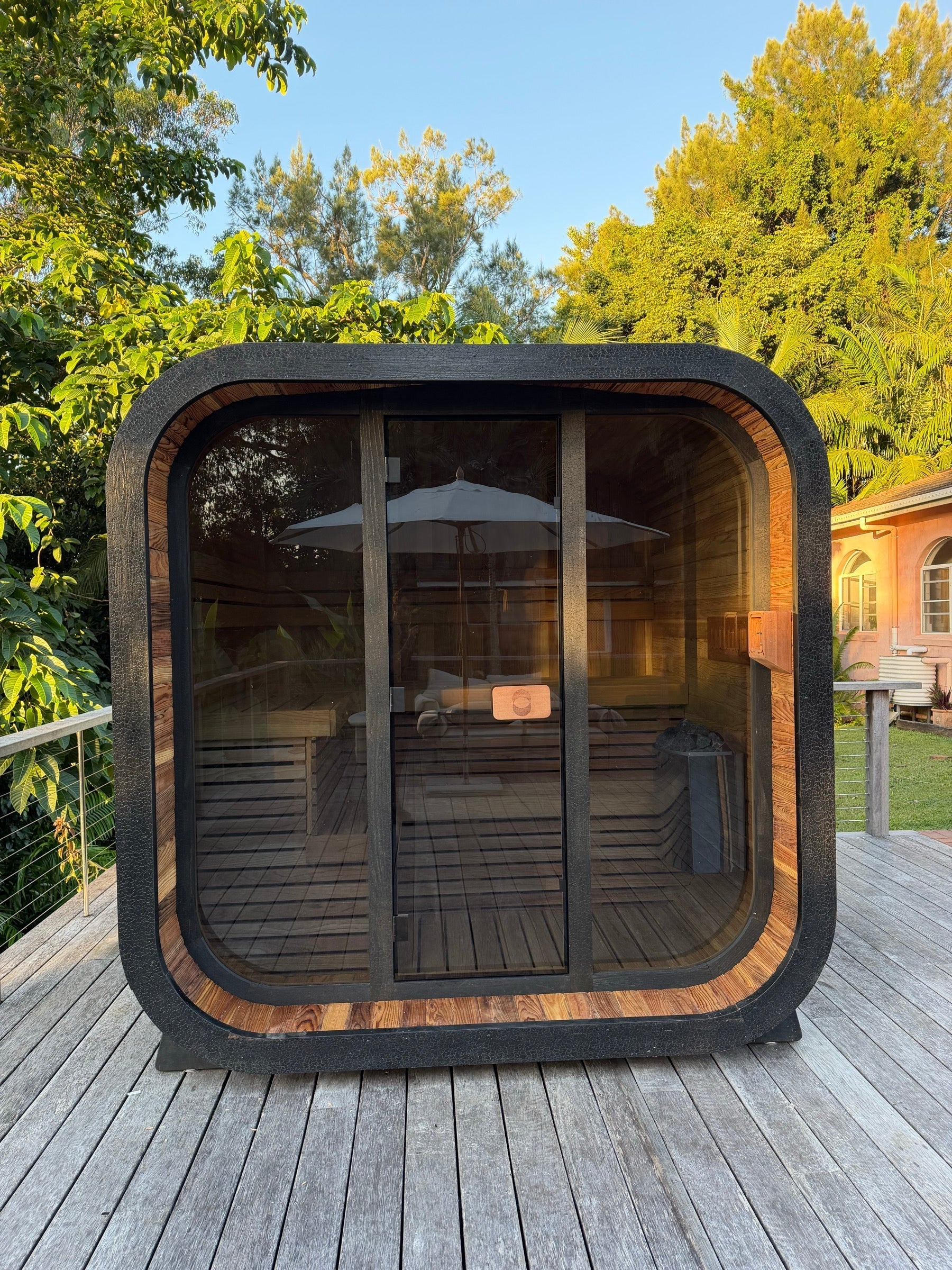
The Genesis is Psycle's flagship sauna — a 3–5 person traditional Finnish-style unit built to a specification that most custom sauna room builders in Australia cannot match at any price. Every material choice is deliberate. Every joint is mechanical. Nothing is glued.
38mm Japanese Cedar walls. Two finish options: Natural cedar or Charcoal (Shou Sugi Ban). 8mm safety laminated tempered glass — 4+4mm dual-layer, grey tint — across a full panoramic facade. Zero-glue construction throughout. Non-VOC oil finish. No MDF. No particle board. No formaldehyde.
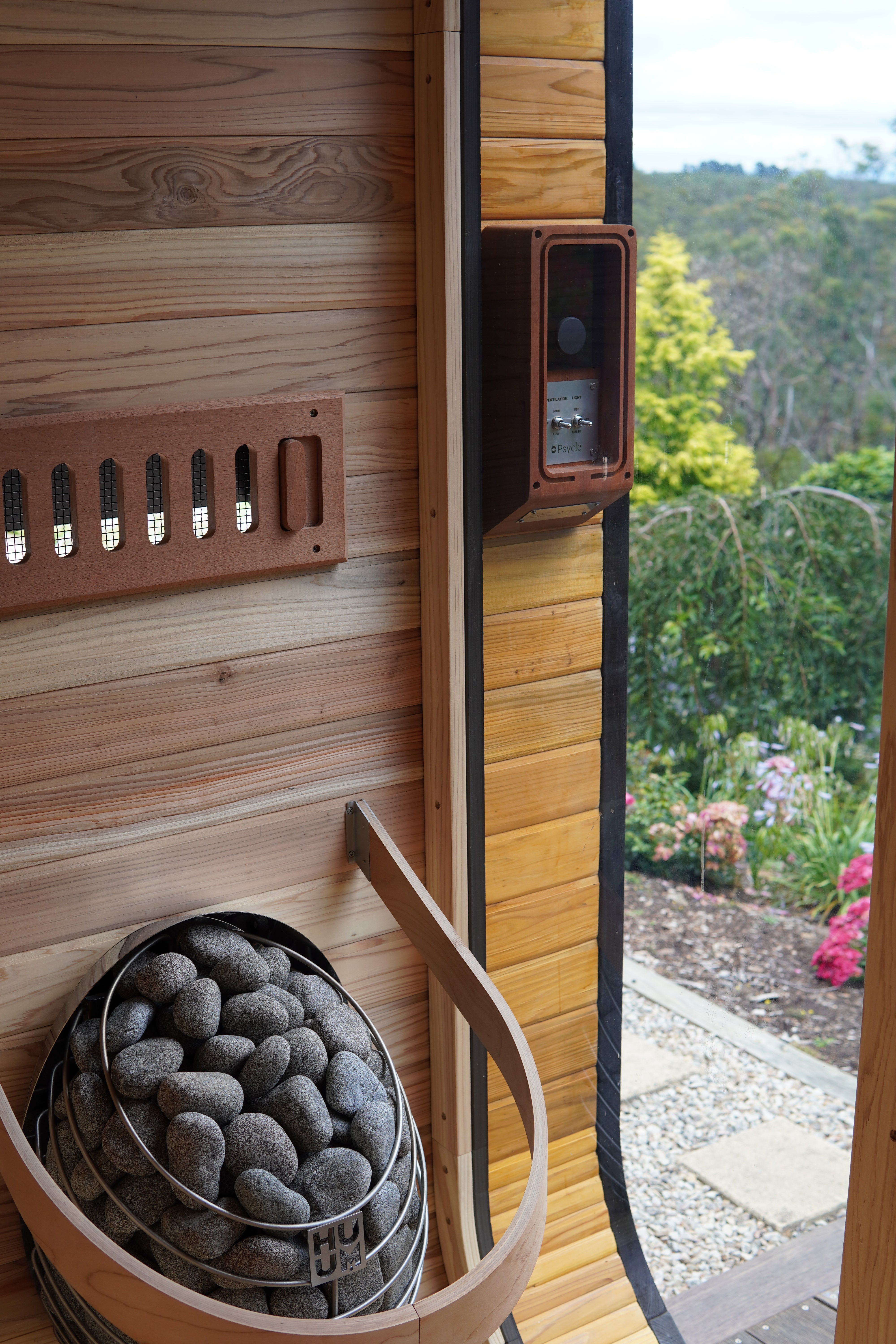
Heater choice: HUUM DROP 9kW with 60kg of Olivine diabase stones and WiFi UKU app control, or Harvia Vega 9kW with 20kg of Olivine diabase stones and mechanical controls. Blue-light-free IP67-rated LED lighting at 585–590nm amber or 630–635nm red. Active mechanical ventilation at 88–120 m³/hr. External dimensions: 2289H × 2288W × 1945D mm. 50A dedicated circuit required.
The Genesis Mini delivers the identical zero-toxin specification in a 1–3 person footprint: 2267H × 1571W × 1950D mm, 32A circuit, HUUM DROP 6kW or Harvia Vega 6kW heater, 60kg stone volume on the HUUM option. For smaller homes, terraces, and apartments with courtyard access, the Mini reduces session capacity and footprint only — material quality is unchanged.
Zero-Toxin Finnish Heat, Built for Australian Homes
Japanese Cedar. Zero-glue construction. HUUM DROP 9kW heater. 3-year cabin warranty. Australia-wide delivery — ~120-day build.
SEE THE GENESIS →Indoor Sauna Room Design: What Australian Homes Actually Need
Designing an indoor sauna room in Australia is not the same as fitting a bathroom or laundry. The thermal and moisture loads are categorically different — and most standard Australian builders are not equipped to handle them correctly without specialist guidance.
Insulation
A sauna room requires a continuous thermal envelope: walls, ceiling, and floor all insulated to prevent heat bleed into adjacent rooms and to reach operating temperature efficiently. Standard R2.5 wall batts are adequate for mild climates, but R4.0 or above in ceilings is recommended to counteract heat rise. The vapour barrier sits on the hot side of the insulation — placing it on the cold side is the single most common error in DIY sauna room builds, and it causes moisture damage within two to three years.
Timber Lining
Timber choice for sauna room lining is a material decision, not an aesthetic one. The wrong timber off-gasses at temperature, splinters, or conducts heat to the touch. The right timber stays cool on exposed surfaces, absorbs and releases humidity gradually, and improves with age.
Japanese Cedar — the species used throughout the Genesis — is the benchmark. It is low in resin, dimensionally stable under sustained heat cycling, naturally antimicrobial without treatment, and produces a scent that deepens with use rather than fading. Western Red Cedar is the common alternative; it is adequate but resin-rich and more prone to surface checking. Thermo-treated Aspen is popular in Scandinavian prefab units and performs well but lacks Cedar's thermal comfort on contact.
Avoid pine, MDF, plywood, or any glued engineered timber product. At 90°C, formaldehyde off-gassing from urea-formaldehyde adhesives is measurable and harmful — the opposite of what a wellness room should deliver.
Ventilation
Sauna ventilation is not air conditioning. The goal is a controlled exchange: fresh air enters near the floor, rises through the heat, and exits near the ceiling. This creates a convection loop that keeps the air fresh without stripping heat from the room or disrupting humidity stratification.
The Finnish standard for a room operating at 80–100°C is a minimum of 6–8 air changes per hour. Anything below this produces stale, CO²-rich air that makes sessions feel oppressive rather than restorative — a condition frequently mistaken for heat intolerance when poor air quality is the real cause. The Genesis runs active mechanical ventilation at 88 m³/hr on low and 120 m³/hr on high, purpose-engineered for this exchange rate. For a deeper look at why ventilation defines session quality, read our guide to sauna ventilation in Australia.
Humidity and Löyly
Löyly — the Finnish term for the steam generated when water meets heated stones — is not a feature. It is the mechanism. A sauna room that cannot generate proper löyly is a hot room, not a sauna. The stones must be voluminous enough to absorb the water without crashing the temperature, and the heater must be powerful enough to recover within 60–90 seconds of a pour.
The HUUM DROP 9kW holds 60kg of Olivine diabase stones. That stone mass absorbs a ladle of water, produces a clean bloom of vapour, and holds the temperature. A heater with 10–15kg of stone will spike and crash. Stone volume is a specification, not a footnote. For the full science on what makes löyly authentic and why it matters, see our löyly sauna guide.
Floor and Drainage
A sauna room floor in Australia should be non-slip, thermally comfortable underfoot, and drainable. Concrete with a floor waste is the cleanest solution for a custom build. Tile is common but thermally cold — a timber duck-board over tile solves both problems. For pre-built cabins placed on a deck or slab, a slight grade toward an adjacent drain is sufficient. Never seal a sauna floor airtight — moisture needs an exit path at the base of the room or mould will develop in the sub-structure within a season.

HUUM Heater Sizing Guide for Australian Sauna Rooms
Heater sizing is determined by room volume, not room area. Height matters because hot air rises and a taller room takes more energy to heat. The Finnish rule of thumb is 1kW per 1m³ of room volume for a well-insulated space; add 20–25% for poorly insulated rooms, concrete or tile walls, or rooms with glass panels.
| Heater | Power | Ideal Room Volume | Stone Mass | Control |
|---|---|---|---|---|
| HUUM DROP 6kW | 6kW | Up to 8m³ | 60kg Olivine diabase | WiFi UKU app |
| Harvia Vega 6kW | 6kW | Up to 8m³ | 20kg Olivine diabase | Mechanical controls |
| HUUM DROP 9kW | 9kW | Up to 13m³ | 60kg Olivine diabase | WiFi UKU app |
| Harvia Vega 9kW | 9kW | Up to 13m³ | 20kg Olivine diabase | Mechanical controls |
The Genesis Mini pairs with the 6kW option — matched to its internal volume. The Genesis pairs with the 9kW — matched to its 3–5 person capacity. Both HUUM variants carry 60kg of Olivine diabase stone regardless of which heater you choose. The Harvia Vega variants carry 20kg. That difference in stone mass is the difference in löyly quality and temperature recovery after a pour.
For custom sauna room builds outside these standard volumes, apply the 1kW/m³ rule and round up to the next available heater size. Undersizing a heater is a permanent problem — you cannot add more power without rewiring. Oversizing by one tier is always the safer specification.
Why Japanese Cedar Is the Right Timber for a Sauna Room
Japanese Cedar — Cryptomeria japonica — is the benchmark sauna lining timber for reasons that have nothing to do with aesthetics. It is low in resin, which means it does not bleed sap or pitch at sustained heat. It is dimensionally stable through repeated heat-and-cool cycles. Its cell structure absorbs and releases moisture gradually, which moderates humidity spikes rather than amplifying them. And it does not require chemical treatment to resist microbial growth.
In a sauna room, the timber you choose is the air you breathe. Every session at 90°C heats the lining and everything in it. If that lining is glued with urea-formaldehyde adhesive — standard in MDF, particle board, and most engineered wood products — the heat drives off-gassing that you inhale directly. That is not a theoretical risk. It is a documented chemical process.
The Genesis uses zero-glue mechanical joinery throughout. The non-VOC oil finish is applied to all exposed surfaces. The result is a sauna room interior that off-gasses nothing — at any temperature, for the life of the unit. That is the zero-toxin standard. It is a material specification, not a marketing claim.
The Genesis offers two surface finishes. Natural cedar develops a warm honey patina with use. The Charcoal finish — Shou Sugi Ban, Japanese charred timber — is architecturally bold: deep smoke-grey exterior, warm cedar interior. Both age well. Neither requires retreatment within the 5-year warranty period under normal use.
Finnish Sauna Traditions and Why Authentic Heat Design Matters
Finnish sauna culture is not a wellness trend — it is a 2,000-year-old practice with a physiological rationale that modern research has now quantified with precision. The design principles that emerged from that tradition are not arbitrary. They are the result of generations of empirical refinement.
The key variables are temperature (80–100°C at bench level), humidity (10–20% relative humidity at rest, spiking briefly to 40–60% during löyly), session duration (10–20 minutes per round), and cooling between rounds (cold shower, plunge, or outdoor air). Each variable is interdependent. Remove one and the physiological response changes fundamentally.
The KIHD cohort study by Laukkanen et al. (2015, JAMA Internal Medicine), following 2,315 men over 20 years in Finland, found that men who used the sauna 4–7 times per week had a 40% lower risk of all-cause mortality compared to once-weekly users. The research was conducted in traditional Finnish saunas. The protocol matters as much as the frequency.
Infrared rooms operate at 50–70°C and do not generate steam. They are a categorically different product with a different mechanism and a thinner evidence base. Psycle does not manufacture infrared saunas. Our traditional sauna vs infrared guide covers the science in detail. For the full evidence base on what traditional sauna heat does to the body, see our traditional sauna benefits Australia guide.
Sauna Room Cost in Australia: What You Actually Pay
Sauna room cost in Australia depends on three things: the path you choose (custom build vs pre-built), the specification you hold to, and the trades you engage. The range is wide — and the cheapest option is reliably the most expensive long-term.
Custom Build-Out Costs
A custom sauna room framed into an existing Australian home typically costs AU$8,000–$35,000+ depending on size, timber choice, heater specification, and finishing. That range assumes a competent builder, a correct vapour barrier, and a properly sized heater. Add a further $2,000–$5,000 for electrical work (dedicated circuit, isolation switch) and $1,500–$3,000 for a floor drain and waterproofing if not already present.
The risk in the custom path is specification drift. A builder unfamiliar with sauna construction will often substitute cheaper materials, and the buyer does not know until heat reveals it — typically within the first season. Our home sauna installation Australia guide covers what to specify in writing before works begin.
Pre-Built Cabin Costs
A pre-built sauna cabin of the Genesis standard delivers a controlled specification at a fixed delivered price. The Genesis requires a 50A dedicated circuit (electrician cost approximately $300–$600) and a level concrete slab or composite deck for placement. No other trades are required. Placement is a two-person job; the Genesis ships at approximately 600kg and requires a crane or machinery for second-floor or elevated deck installations.
The $1,000 refundable deposit locks in your build slot. Lead time is approximately 120 days. Australia-wide delivery is included. The full cost breakdown by state, site type, and installation scenario is detailed in our home sauna cost Australia 2026 guide.
Running Costs
The Genesis 9kW heater draws approximately 9kWh at full load during the 45–60 minute warm-up phase, then cycles to maintain temperature. At AU$0.30–$0.35/kWh (current Australian residential average), a 45-minute session costs approximately AU$0.50–$1.00. That is less than a single espresso at most Australian cafés and significantly less than a drop-in session at a commercial sauna facility — which typically runs AU$30–$60 per visit in Sydney and Melbourne.
Compared to an annual gym membership at AU$1,200–$2,400/year, or weekly physiotherapy at AU$100–$160/session, the Genesis pays back quickly. Over a 10-year service life, the daily cost of ownership becomes negligible against the stack of commercial alternatives it replaces.
Planning and Council Approval: NSW, QLD, VIC, and WA
Planning requirements for a sauna room in Australia vary by state and by the nature of the installation. The pre-built cabin path is generally simpler than a custom build-out, which is treated as a structural alteration to the home and typically requires a Development Application or building permit regardless of state.
| State | Pre-Built Cabin (under 10m²) | Custom Build-Out | Electrical |
|---|---|---|---|
| NSW | Often exempt as Class 10a; confirm with local council | DA or CDC required | Licensed electrician; 50A or 32A dedicated circuit |
| QLD | Exempt under 10m² in most LGAs; setback rules apply | Building approval required | Licensed electrician; QBCC-registered |
| VIC | Exempt under 10m² under Schedule 3 of Building Regulations 2018; setback and height rules apply | Building permit required | Licensed electrician; permit required |
| WA | Exempt under 10m² and 2.4m height as Class 10a; front setback rules apply | Building permit required | Licensed electrician; WA-registered |
The Genesis footprint (2288W × 1945D mm externally) sits at approximately 4.45m² — well within the 10m² exemption threshold in most states. The Genesis Mini (1571W × 1950D mm) sits at approximately 3.06m². Always confirm with your local council before installation. Planning rules change, and local heritage overlays or bushfire zones can apply additional requirements.
Our complete installation guide for Australian home saunas includes a state-by-state planning checklist and what to ask your council before you order.
Sauna Room Ideas for Australian Homes: Coastal, Bush, and Urban
The sauna room that works in a Queenslander in Noosa is not the same conversation as one on a Sydney terrace rooftop or a Melbourne urban backyard. Australian homes are diverse — and a well-specified sauna room should respond to the site, not fight it.
Coastal Queensland: Outdoor Deck Integration
In coastal QLD, the most natural placement for a sauna room is an extended deck or covered outdoor area. The humidity and heat of the Queensland climate aids sauna warm-up in the cooler months — and the proximity to a pool or outdoor shower makes contrast therapy straightforward. The Genesis Charcoal finish (Shou Sugi Ban) reads well against tropical timber decking and withstands coastal UV without fading. See how the Genesis sits in a coastal Queensland context: genesis coastal QLD portrait.
Byron Bay and Northern NSW Bush Setting
Bush settings suit the Natural Cedar finish — the warm honey tone reads against eucalypt foliage and raw timber architecture. Place the sauna room on a north-facing deck to capture winter morning sun for pre-session warmth and post-session light. A cold plunge immediately adjacent completes the setup. The Contrast Kit — Genesis plus Origin cold plunge — was designed for exactly this configuration. For bush and garden placement inspiration, see the genesis foliage deck front staging and the genesis foliage deck golden hour context shots.
Sydney and Melbourne Urban Terrace
Urban terraces and inner-city homes are the Genesis Mini's natural environment. A 3.06m² footprint fits a standard terrace courtyard without dominating it. The panoramic glass facade keeps visual connection to the garden — the room does not feel enclosed. For urban buyers comparing a 1–2 person unit against the Mini, our 2 person sauna Australia guide covers the size decision in detail. The interior timber vault look in a compact format is shown in the genesis interior cedar barrel vault staging.
The Contrast Kit: Sauna Room Plus Cold Plunge
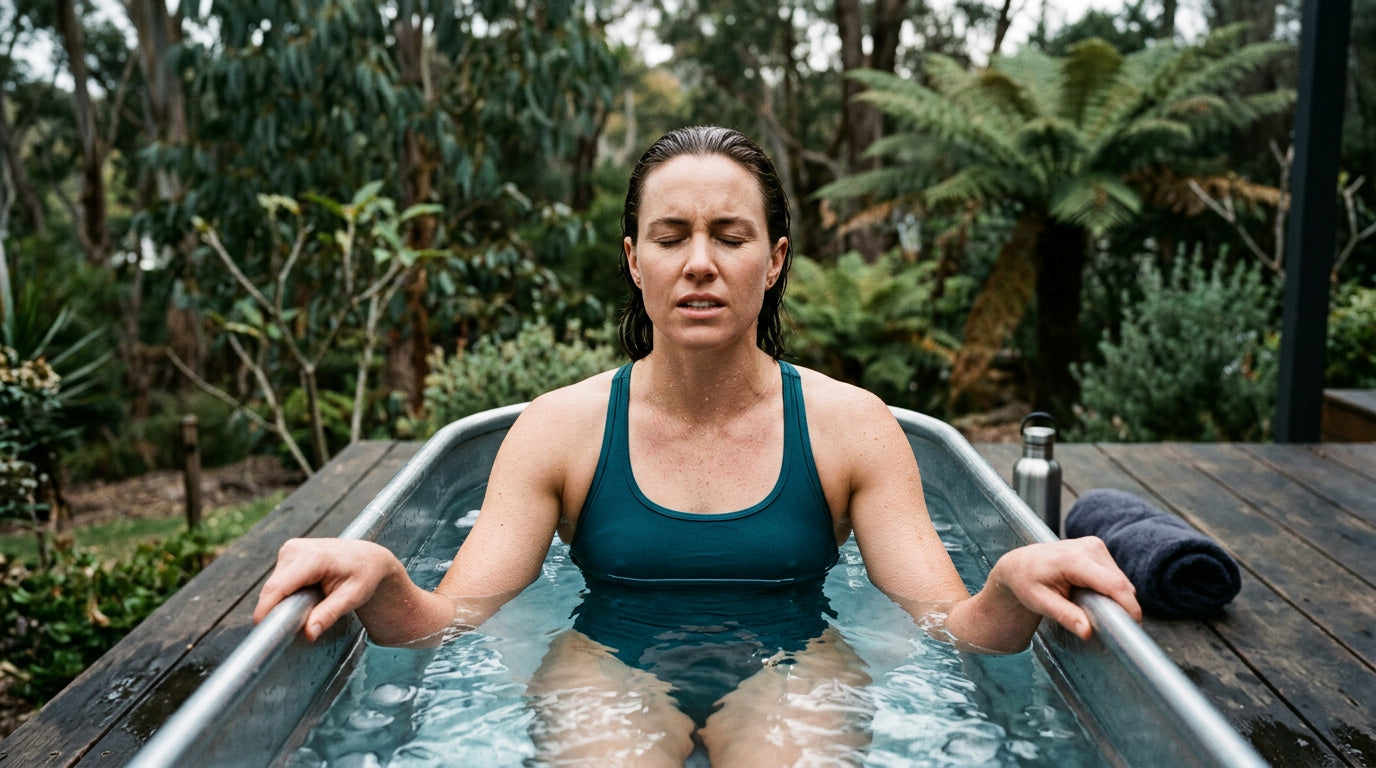
A sauna room paired with a cold plunge is not a luxury configuration. It is the protocol. Heat and cold in alternation drive a physiological response that neither produces alone: vasodilation followed by vasoconstriction, a noradrenaline spike following the heat-induced dopamine load, and parasympathetic recovery accelerated by the cold. A 2018 meta-analysis by Dupuy et al. in Frontiers in Physiology, covering 99 studies and over 1,000 athletes, found cold-water immersion and contrast water therapy to be among the most effective recovery modalities for reducing muscle soreness and perceived fatigue.
The Contrast Kit bundles the Genesis with the Origin cold plunge — purpose-matched for the alternating protocol. Heat recovers you. Cold hardens you. Together, they do both. For the full contrast therapy evidence base, read our contrast therapy Australia science guide and our overview of the sauna and cold plunge Australia protocol.
The Sauna Room That Does Not Compromise
Active mechanical ventilation. Blue-light-free IP67 lighting. Zero-glue Japanese Cedar. Every detail engineered for high-frequency use by people who take recovery seriously.
EXPLORE THE GENESIS →What Owners of Australian Sauna Rooms Actually Notice
The buyers who take the most convincing tend to become the most consistent users. That pattern repeats across the Genesis install base. The shift from weekly commercial sauna to daily home session is driven by heat quality, the absence of other people's schedules, and the ability to run a proper contrast protocol without a 40-minute drive.
“I have run this protocol daily for 90 days. My recovery markers don't lie — HRV up, resting heart rate down, sleep quality measurably different. The difference between the Genesis and what I was using at the gym is not incremental. It is categorical.”
The detail that surprises most owners is the air quality. Active mechanical ventilation at 120 m³/hr on high pulls fresh air through the session continuously — there is no staleness at the 20-minute mark that signals it's time to leave. Sessions that were capped at 15 minutes in a commercial room extend naturally to 20–25 minutes at home. Not because the heat is lower. Because the air is cleaner.
The sauna cardiovascular health Australia science guide and our sauna longevity Australia guide both draw on the same Finnish cohort data — and both point to the same conclusion: frequency and temperature determine outcome. Both are easier to control when the sauna room is yours.
The evidence on sauna and mental health in Australia and sauna for sleep in Australia extends the case beyond cardiovascular outcomes into neurological and hormonal regulation — areas where daily home access makes a measurable difference.
Traditional Sauna Room vs Infrared Room: The Honest Comparison
Infrared saunas and traditional Finnish saunas are not two versions of the same thing. They are different products with different mechanisms, different operating temperatures, and different evidence bases. The comparison matters because the Australian market blurs this distinction aggressively.
| Variable | Traditional Finnish Sauna | Infrared Room |
|---|---|---|
| Operating temperature | 80–100°C | 50–70°C |
| Heat mechanism | Convective air heat + steam | Radiant infrared panels |
| Löyly (steam generation) | Yes — core to the protocol | No |
| Evidence base (cardiovascular) | 20+ years, 2,315-person Finnish cohort (Laukkanen et al.) | Limited; smaller, shorter studies |
| Warm-up time | 30–45 minutes | 15–20 minutes |
| Timber requirements | Heat-rated, low-resin (Cedar, Aspen, Alder) | Lower heat tolerances; more species viable |
| Social/ritual dimension | Multi-person; 2,000-year cultural practice | Typically solo; no shared steam ritual |
Psycle builds traditional Finnish saunas. Our infrared sauna Australia real science guide sets out the evidence without bias. The conclusion is not that infrared is worthless — it is that the two products are not interchangeable, and the research that makes sauna a serious longevity and cardiovascular tool was built on traditional Finnish heat.
How to Choose the Right Sauna Room Size for Your Home
Sauna room size is determined by three things: how many people will use it simultaneously, how much floor space you have, and whether you want the option to scale use over time. Most Australian buyers underestimate the first variable and overestimate the second.
A 1–2 person room feels right for a solo buyer — until a partner starts using it daily, a teenage child adds themselves to the roster, or a post-training session with a training partner becomes part of the routine. The Genesis Mini (1–3 persons) is the right call for a single household where 2 people will use it regularly. The Genesis (3–5 persons) suits households with 3 or more regular users, or buyers who want guests to use it without scheduling conflicts.
For households torn between the two: the Genesis Mini is correct for tight spaces and couples. The Genesis is correct if you have the space — it grows with your household and holds its value as a built asset. Our 4 person sauna Australia buyer guide covers the family-size configuration in detail, and our best home sauna Australia complete buyer's guide helps you narrow the decision across the full category.
If you are weighing an indoor sauna room against an outdoor installation, the considerations differ: drainage, weatherproofing, electrical routing, and aesthetic integration with the yard. Our outdoor sauna Australia complete 2026 guide covers that path in full.
What to Look for When Comparing Sauna Rooms in Australia
Most sauna room buyers in Australia compare price first and specification second. That order of operations is how you end up with a glued MDF room that off-gasses at temperature and a 6kW heater that never reaches 85°C. Reverse the order. Start with the specification. Then price becomes a function of what you're actually comparing.
The six non-negotiable specifications for a genuine sauna room:
Zero-glue or low-VOC joinery
Any adhesive in the construction will off-gas at temperature. Mechanical joinery or zero-glue specification is the only acceptable standard.
Correct timber species
Japanese Cedar, Western Red Cedar, Thermo Aspen, or Alder. Not pine, not MDF, not plywood. Low resin and dimensional stability under heat are the criteria.
Properly sized heater with adequate stone mass
1kW per 1m³ of room volume. Stone mass minimum 20kg; 60kg for genuine löyly quality and temperature recovery after a pour.
Active mechanical ventilation
Passive vents are insufficient for sustained high-heat sessions. Active ventilation at 88–120 m³/hr is the minimum for genuine air quality at temperature.
Blue-light-free lighting
Amber (585–590nm) or red (630–635nm) LEDs. Standard white or blue-spectrum LEDs suppress melatonin during evening sessions — defeating one of the primary recovery mechanisms of sauna use.
Warranty that reflects engineering confidence
A 1–2 year warranty on a sauna room is a signal, not a reassurance. The Genesis carries a 3-year cabin warranty and a 3-year heater warranty — the longest in the Australian market.
For how these specifications translate into session quality, duration recommendations, and frequency protocols, read our guides on how long to stay in a sauna by goal and how often you should sauna for results.
Frequently Asked Questions: Sauna Room Australia
How much does a sauna room cost in Australia?
A sauna room in Australia costs AU$8,000–$35,000+ for a custom build-out, or AU$6,000–$18,000 for a high-specification pre-built cabin like the Genesis, inclusive of delivery. The custom path adds electrical work ($300–$600), plumbing for drainage ($1,500–$3,000 if required), and trades mark-up on materials. The pre-built path requires only a licensed electrician to install the dedicated circuit. Running costs are approximately AU$0.50–$1.00 per 45-minute session at current Australian electricity rates.
Do I need council approval for a sauna room in Australia?
It depends on the state and the installation type. In NSW, QLD, VIC, and WA, pre-built sauna cabins under 10m² are typically exempt from planning approval as Class 10a structures, subject to setback and height rules. Custom build-outs within the home envelope almost always require a Development Application or building permit. Always confirm with your local council before works begin — heritage overlays and bushfire zones can apply additional requirements.
What is the best timber for lining a sauna room in Australia?
Japanese Cedar (Cryptomeria japonica) is the benchmark: low resin, dimensionally stable under heat cycling, naturally antimicrobial, and zero off-gassing without chemical treatment. Western Red Cedar is a viable alternative but more resin-rich. Thermo Aspen performs well in Scandinavian-specification units. Avoid pine, MDF, plywood, or any engineered timber product with adhesive — at 90°C, formaldehyde off-gassing from urea-formaldehyde adhesives is measurable and directly inhaled during sessions.
What heater size do I need for my sauna room?
Size your heater at 1kW per 1m³ of room volume for a well-insulated space. A room 1.5m × 2.0m × 2.2m high (6.6m³) needs a minimum 7kW heater — the HUUM DROP 9kW covers rooms up to approximately 13m³ and is the correct choice for the Genesis. Add 20–25% to the base calculation for rooms with concrete or tile walls, large glass panels, or inadequate insulation. Never undersize — a heater that cannot reach 80°C is a permanent problem that cannot be fixed without rewiring and replacement.
What is the difference between a sauna room and an infrared sauna?
A traditional Finnish sauna room operates at 80–100°C using a stone heater and generates steam (löyly) when water is poured on heated stones. An infrared sauna uses radiant panels to heat the body directly at 50–70°C and does not generate steam. The two are categorically different products with different mechanisms and different evidence bases. The landmark Finnish cardiovascular research (Laukkanen et al., JAMA Internal Medicine, 2015) was conducted in traditional saunas — that evidence does not transfer automatically to infrared rooms.
Can I add a cold plunge to my home sauna room setup?
Yes — and the research strongly supports doing so. A 2018 meta-analysis by Dupuy et al. in Frontiers in Physiology found contrast water therapy to be among the most effective recovery modalities for reducing muscle soreness and perceived fatigue across 99 studies and over 1,000 athletes. The Contrast Kit bundles the Genesis sauna with the Origin cold plunge for buyers setting up a dedicated recovery space. Placing the cold plunge adjacent to the sauna room — on a shared deck or in a covered outdoor area — makes the alternating heat-cold protocol easy to run in practice. See our best sauna cold plunge combo Australia 2026 guide for setup options.
How long does it take to install a home sauna room in Australia?
A pre-built sauna cabin like the Genesis has a lead time of approximately 120 days from order to delivery, with installation on delivery day taking 2–4 hours for placement and electrical connection (by a licensed electrician). A custom build-out depends entirely on trades availability and project complexity — typically 6–16 weeks from approval to completion. The pre-built path is more predictable. For the full installation process, read our home sauna installation Australia complete guide.
What electrical requirements does a home sauna room need in Australia?
A 9kW sauna heater requires a 50A dedicated circuit — single or three phase — with an isolation switch within reach of the heater. A 6kW heater requires a 32A dedicated circuit. Both must be installed by a licensed electrician and must comply with AS/NZS 3000 wiring rules. Do not run a sauna heater on a shared circuit or an extension lead. The electrical installation is typically a half-day job for an experienced electrician and costs approximately AU$300–$600 depending on the distance from the switchboard.
Ready to Build This Into Your Routine?
Free Australia-wide delivery. 3-year cabin warranty. 3-year heater warranty. $1,000 refundable deposit locks your build slot — ~120-day lead time.
SHOP THE GENESIS →