
4 Person Sauna Australia: Complete Buyer Guide | Psycle
4 Person Sauna Australia: The Complete Buyer's Guide

Key Takeaways
- A 4-person sauna is the most practical size for Australian families and households — large enough for a shared ritual, compact enough for most backyards and covered decks.
- The Psycle Genesis fits 3–5 people and is built with 38mm Japanese Cedar walls, zero-glue mechanical joints, and a 9kW HUUM DROP heater with 60kg of Olivine diabase stone — the standard serious buyers benchmark against.
- For genuine Finnish heat (80–100°C), a 9kW heater is the minimum for a 4-person cabin — infrared units running at 50–70°C do not deliver the same physiological response.
- Most flat-pack saunas on the Australian market use glued MDF or particle board construction. At 90°C, those materials off-gas formaldehyde. Zero-glue, non-VOC construction is non-negotiable.
- Running cost for the Genesis is approximately AU$0.50–$1.00 per 45-minute session — less than a single cup of coffee at your local cafe.
- The Genesis requires a 50A dedicated circuit and ships Australia-wide with a 120-day build lead time. The $1,000 deposit is fully refundable.
- A landmark 20-year study published in JAMA Internal Medicine found that sauna use 4–7 times per week reduced fatal cardiovascular disease risk by 50% compared to once-weekly bathing.
By Psycle Wellness · Last updated: May 2026 · 14 min read
A 4 person sauna in Australia sits in the sweet spot of the market: large enough for a family session or post-training ritual with friends, compact enough to fit on a standard suburban deck. The best options run at 80–100°C with a high-mass stone heater, are built from untreated structural timber with zero-glue construction, and are engineered to handle Australian outdoor conditions year-round.
If you have already decided on a 2-person unit, our 2-person sauna Australia guide covers that decision in full. This article is for buyers who have made the step-up decision — who want real heat for a household, not a solo box in the corner of the garage.
Why Most 4-Person Saunas Sold in Australia Are Built Wrong
Walk through the category and you will find the same pattern: flat-pack saunas with glued MDF panels, particle board floors, and heaters sized for a broom cupboard. The price looks reasonable. The specifications sheet looks credible. Then you read the fine print and find that the timber is kiln-dried spruce bonded with urea-formaldehyde resin.
Heat that to 90°C and you are not sweating out toxins. You are breathing them in. Formaldehyde is a Group 1 carcinogen classified by the International Agency for Research on Cancer. The off-gassing from low-grade construction materials gets worse with temperature — meaning a hotter session produces a worse exposure environment. That is not a small compromise. That is the opposite of what you are trying to achieve.
The second problem is heater sizing. Most budget 4-person saunas are sold with 6kW heaters carrying 10–15kg of stone. A properly sized 4-person Finnish sauna needs a minimum 9kW heater with high stone mass to achieve thermal stability. Low stone mass means the temperature drops the moment you pour löyly — the steam ritual that is the centrepiece of a genuine Finnish session. If you want to understand why löyly matters physiologically and culturally, our löyly guide covers the science and technique in full.
The third problem is ventilation. Australian outdoor conditions — coastal humidity, summer heat loads, subtropical rainfall — demand active mechanical ventilation, not passive vents designed for a Scandinavian winter. Without forced airflow, heat goes stale, humidity builds unevenly, and timber degrades faster than the warranty covers.
These are not edge cases. They are the standard offering in the Australian 4-person sauna market. The category sells you a product, not an outcome.
The 4-Person Home Sauna Australia Buyers Actually Want
A genuine 4-person home sauna in Australia holds 80–100°C with thermal stability across a full session, uses structural timber with no glue or VOC finish, and is built to live outdoors in Australian conditions without deteriorating. That is the standard. Almost nothing at the entry tier meets it.
A landmark 20-year cohort study of 2,315 Finnish men by Laukkanen et al., published in JAMA Internal Medicine (2015), found that sauna use 4–7 times per week reduced the risk of fatal cardiovascular disease by 50% compared to once-weekly bathing. Those outcomes were achieved in saunas running at 79–100°C — traditional Finnish heat, not infrared. If the product you are buying cannot maintain that temperature range, you are not replicating the research protocol. You are buying a warm box.
The KIHD cohort study by Laukkanen et al. (2015, JAMA Internal Medicine), following 2,315 men over 20 years in Finland, found that men who used the sauna 4–7 times per week had a 40% lower risk of all-cause mortality compared to once-weekly users. Frequency and temperature are both variables. A sauna you actually want to use daily — because it performs, because it is beautiful, because it is in your backyard — is not a luxury. It is the whole point. For a deeper look at the evidence, our sauna longevity Australia guide covers the full research base.

The Genesis: Built to the Standard
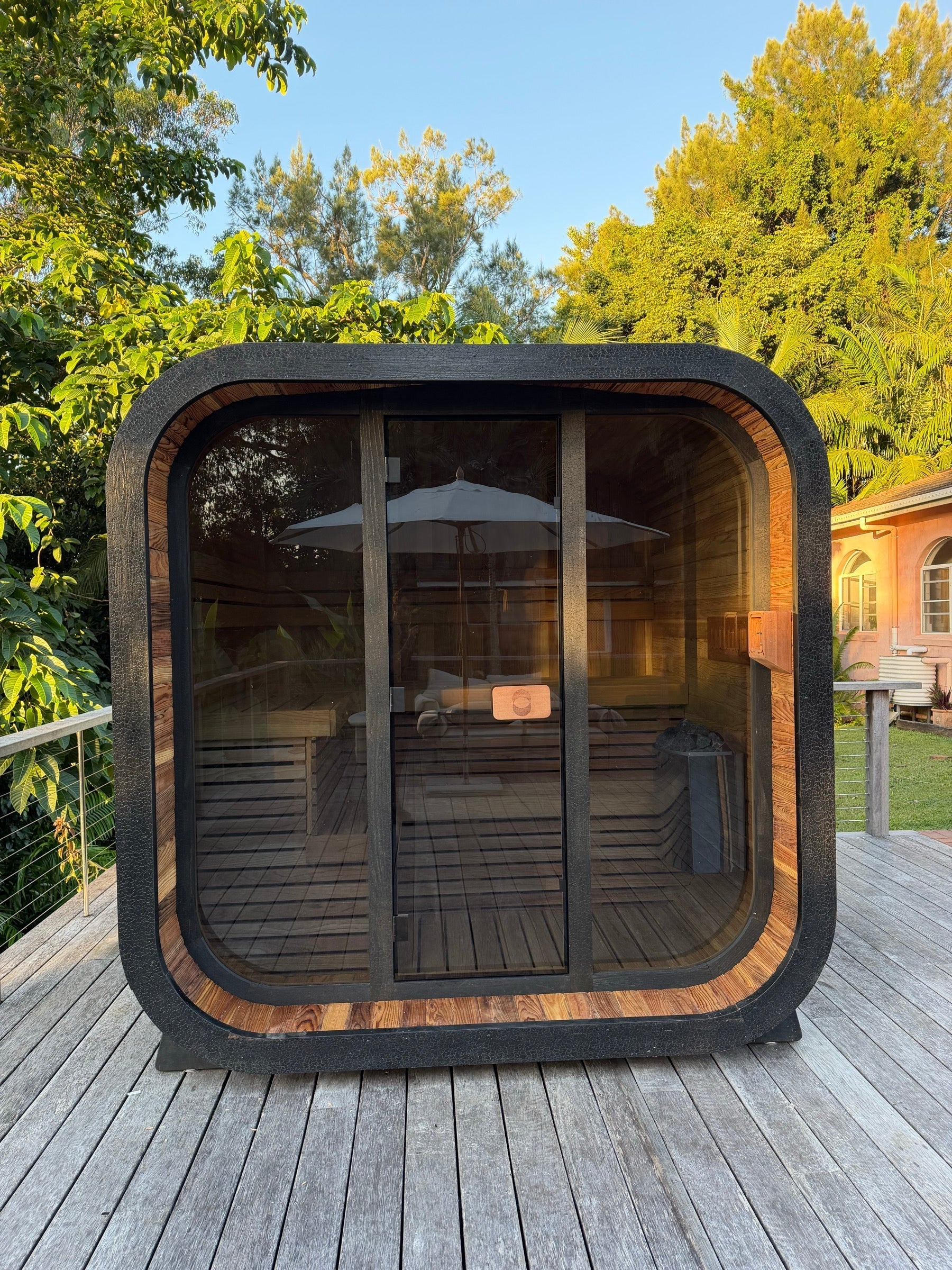
The Psycle Genesis is a 3–5 person traditional Finnish sauna built from 38mm Japanese Cedar with zero-glue mechanical joints and a non-VOC oil finish throughout. There is no MDF. No particle board. No urea-formaldehyde resin. At 90°C, the only thing off-gassing is the natural aromatic oils in the cedar — which is why the smell of a real sauna is nothing like the chemical warmth of a flat-pack unit.
The cabin measures 2289mm high × 2288mm wide × 1945mm deep externally — a footprint that fits a standard suburban deck or outdoor area with room to move. The 8mm safety laminated tempered glass (4+4mm dual-layer, grey tint) runs the full width of the front facade. It is architectural, not decorative. The glass wall turns the session into an experience — ambient lighting, sightlines to the garden, the contrast between fire and open air.
Two finishes are available: Natural cedar (warm honey tones that deepen with age) or Charcoal (Shou Sugi Ban Japanese charred timber, smoke-tinted, architectural). Both are structural, not cosmetic. The charred finish on the Charcoal edition is carbonised to resist moisture, insects, and UV degradation — which matters in coastal Queensland and Northern NSW climates where untreated timber struggles within five years.
For buyers comparing all the options in the Australian market, our complete best home sauna Australia guide covers every tier, material, and heater type side by side.
Zero-Toxin, Built for Australian Conditions
38mm Japanese Cedar. Zero-glue mechanical joints. HUUM DROP 9kW heater with 60kg Olivine diabase stones. Built to live outdoors in Australian weather, year-round.
SEE THE GENESIS →What kW Heater Does a 4-Person Sauna Need?
A 4-person traditional sauna requires a minimum 9kW heater with high stone mass to maintain thermal stability across a full session. This is thermodynamics, not marketing. The cabin volume, bench surface area, and timber mass all draw heat. Underpowering the heater means the cabin climbs slowly, recovers poorly after a door opening, and drops temperature the moment you pour water on the stones.
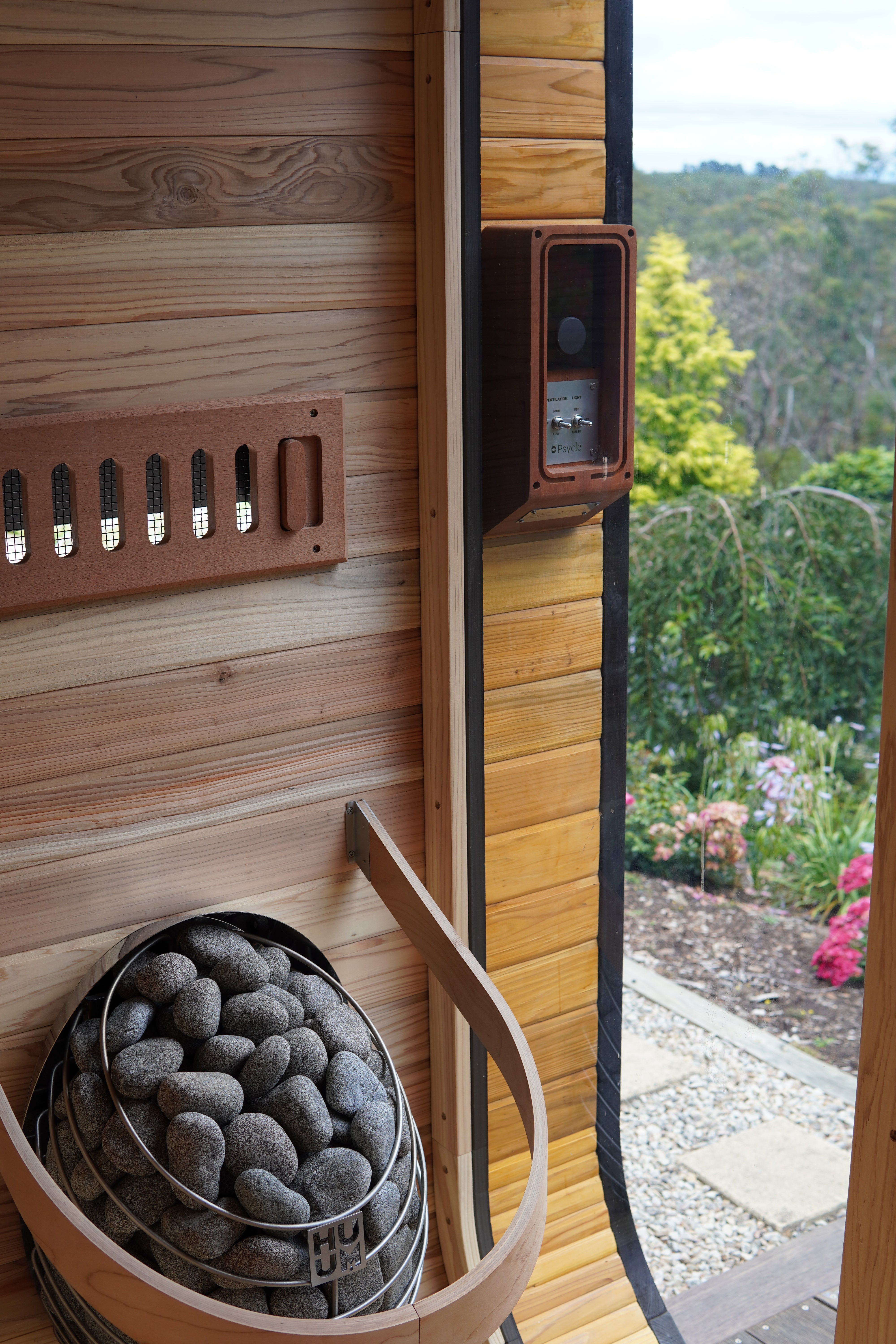
The Genesis ships with a choice of two 9kW heaters. The HUUM DROP 9kW carries 60kg of Olivine diabase stone — a volcanic rock with exceptional thermal mass and heat retention. That stone volume is three times what most competitor heaters carry at the same wattage. When you pour water on 60kg of 200°C stone, the steam response is immediate and sustained. The temperature does not crash. The löyly holds.
The alternative is the Harvia Vega 9kW, which carries 20kg of Olivine diabase stone and uses mechanical controls rather than WiFi. Same wattage, more tactile operation, lower stone mass. The Harvia suits buyers who want simplicity and do not need app control. The HUUM suits buyers who want to preheat the cabin from bed, monitor temperature remotely, or dial in precise conditions before a training session.

Heater Sizing Logic for Multi-Person Saunas
The general rule for Finnish sauna heater sizing is 1kW per cubic metre of cabin volume, plus 1kW per square metre of glass surface area. The Genesis cabin volume sits at approximately 8.5m³ with a full-width glass facade — which puts the theoretical minimum at around 9kW before accounting for outdoor heat loss in winter climates. The Genesis is built to spec. Most flat-pack alternatives are not.
Stone mass matters as much as wattage. A 9kW heater with 20kg of stone heats faster but holds less thermal energy — fine for short solo sessions, marginal for 90-minute group sessions where the door is opening and closing and the bench is radiating heat in four directions. The HUUM DROP at 60kg stone volume is engineered for exactly this use case: multiple users, extended sessions, repeated löyly cycles. If you want to understand how to run this correctly, our guide to sauna temperature covers the science of optimal heat settings.
Large Home Sauna Australia: Size, Space Planning, and Installation
Planning a large home sauna in Australia means working from your actual outdoor or indoor space — not just the cabin dimensions, but the door swing, ventilation clearance, electrical access, and structural load for a unit shipping at approximately 600kg.
The Genesis external dimensions are 2289mm high × 2288mm wide × 1945mm deep. That is a 2.3m × 2.0m footprint — roughly the size of a single-car garage parking space. Most Australians underestimate how much of their deck or outdoor area this occupies once you account for the door swing (minimum 600mm clearance in front) and side access for ventilation maintenance.
A 50A dedicated electrical circuit is required — single or three phase. This is not a standard circuit. Most Australian homes will need a licensed electrician to run a sub-board feed, particularly for outdoor installations where the run from the main switchboard is more than 10 metres. Factor this into your total cost and timeline. For a full breakdown of what installation involves state by state, our home sauna installation Australia guide covers electrical, planning, and siting requirements across QLD, NSW, VIC, and WA.
Outdoor Installation in Australian Climates
Outdoor sauna installation in Australia presents three distinct climate challenges: coastal humidity (QLD, NSW, WA), summer heat load (SA, VIC, NT), and alpine cold (ACT, alpine VIC and NSW). Each puts different demands on the cabin structure and heater.
Coastal humidity is the most aggressive environment for timber saunas. The combination of salt air, high moisture, and UV exposure degrades untreated softwood within a few years. The Genesis Charcoal finish — Shou Sugi Ban charred timber — resists this environment far better than untreated cedar or pine. The IP67-rated lighting and active mechanical ventilation (88–120 m³/hr) are specified to handle high-humidity conditions without creating a closed, damp interior.
For fully exposed outdoor placement, the optional Colorbond roof kit replaces the standard cedar roof panel and removes any concern about direct rainfall. This is the recommended configuration for coastal QLD and Northern NSW decks with no overhead cover. For a full outdoor installation guide specific to Australian conditions, our outdoor sauna Australia guide covers every siting scenario.
Ventilation for Multi-Person Use
Active ventilation is not optional for a 4-person sauna. It is the difference between a clean, breathable session and a stale, oxygen-depleted one. The Genesis runs a mechanical ventilation system at 88 m³/hr (low) and 120 m³/hr (high). This forces fresh air through the cabin, exhausts humidity, and maintains the oxygen-CO2 balance across multi-person extended sessions.
Most flat-pack saunas use passive venting — a hole in the wall covered by an adjustable vent. In an outdoor Australian climate with variable wind pressure, passive venting is unreliable. It works in the conditions it was designed for (a sealed European bathroom installation). It does not work on a Byron Bay or Mornington Peninsula deck in summer. Our sauna ventilation guide explains exactly why active airflow changes the quality of every session.
Traditional Sauna vs Infrared for a Family or Group Setting
Traditional Finnish saunas and infrared saunas are fundamentally different products. Traditional saunas heat the air to 80–100°C using a stone heater, which in turn heats your body through convection and radiant heat from the cabin surfaces. Infrared saunas operate at 50–70°C and use electromagnetic radiation to heat body tissue directly, with less air temperature elevation. For a group of 4 people who want to share the same thermal environment, talk, pour water on stones, and run a proper contrast protocol, traditional heat is the right choice — and the only format that Psycle Wellness builds.
The practical difference for group use comes down to three things: evenness of heat distribution, the löyly ritual, and physiological intensity. In a traditional sauna, the heat is ambient — everyone in the cabin experiences the same temperature regardless of where they sit. In an infrared sauna, proximity to the panels matters significantly, which creates uneven heating across a 4-person bench. The person at the end of the bench is not having the same session as the person in the centre.
Löyly — the act of pouring water on hot stones to generate steam — is only possible in a traditional sauna. It is also the mechanism through which the user controls the perceived intensity of the session: high-humidity steam at 90°C feels significantly hotter than dry air at the same temperature, even though the thermometer reads the same. This is the feature that turns a sauna session from a passive heat exposure into an active ritual. The traditional vs infrared sauna comparison covers the full evidence base for buyers still weighing both options.
For families with children, traditional heat also has the advantage of immediately legible safety signals. Children can feel the heat, respond to it naturally, and leave on their own terms. Lower-temperature infrared can seem deceptively mild until thermal load builds — which is a less intuitive environment for younger users. For a full guide to sauna safety including mixed-age groups, our sauna health risks and safety guide covers every scenario.
What the Genesis Delivers in Daily Use
“The recovery outcomes from regular sauna use are not subtle — they are measurable. We see it in HRV data, in sleep quality, and in the training volume athletes can sustain week over week. The mechanism is cardiovascular: the hyperthermic response drives cardiac output and peripheral vasodilation at levels comparable to moderate aerobic exercise,” says Dr Jari Laukkanen, Professor of Medicine at the University of Eastern Finland, whose 20-year KIHD cohort study remains the most cited longitudinal research on sauna and human health.
That cardiovascular load — heat stress driving your heart rate to 100–150 BPM — is not produced by mild infrared warmth. It requires a cabin running at genuine Finnish temperatures. The Genesis is calibrated to deliver exactly that. The 9kW heater reaches operating temperature in approximately 30–45 minutes. The 38mm cedar walls retain heat across a session. The mechanical ventilation keeps the air clean through repeated löyly cycles. For a deeper look at the cardiovascular science behind regular sauna use, our sauna cardiovascular health guide breaks down the evidence.
The lighting system deserves its own mention. Blue-spectrum light (400–500nm) suppresses melatonin and elevates cortisol — which is the last thing you want in an evening recovery session. The Genesis uses amber (585–590nm) and red (630–635nm) LEDs exclusively, specified to sit outside the melatonin-suppressing range. IP67-rated, meaning they withstand full immersion. Rated to 200°C, meaning they will outlive the warranty. This is not a brochure feature. It is a deliberate engineering decision that changes what a late-session sauna does to your sleep. For the science on how this plays out in practice, our sauna for sleep Australia guide covers the full relationship between heat therapy and sleep architecture.
Real Results from Australian Buyers
The buyers who choose the Genesis are not making an impulse purchase. They have typically spent three to six months researching the market, visited competitors, priced European imports, and concluded that the Genesis is the only product in the Australian market that meets their standard without requiring a custom build.
A builder in Byron Bay who installed the Genesis Charcoal edition on a north-facing deck: “I have built custom saunas for clients for 12 years. The joinery on the Genesis is the same standard I hold my own work to. The zero-glue mechanical joints are not a marketing claim — you can see the construction method when you open the cabin. I have not seen this in a prefabricated Australian product before.”
A performance coach in Melbourne with a Genesis + Origin contrast kit: “My athletes run 20 minutes heat, 3 minutes cold, repeat three cycles, three mornings a week. HRV up 12 points on average across the cohort over 90 days. Resting heart rate down 6 BPM. I have the data. The equipment made the protocol possible — nothing else we tried got consistent daily compliance.”
If contrast therapy is part of your protocol, our best sauna cold plunge combo Australia guide covers how to pair the Genesis with the Origin for maximum physiological return. The Contrast Kit bundles both at a combined price with Australia-wide delivery.
The Sauna That Performs the Way You Expect
Active ventilation. Blue-light-free IP67 lighting. 60kg volcanic stone thermal mass. Every detail engineered for daily use — not weekend showpieces.
EXPLORE THE GENESIS →Running Costs and Value: What a Family Sauna Australia Actually Costs to Own
The Genesis 9kW heater running for a 45-minute session at Australian residential electricity rates of AU$0.30–$0.35 per kWh costs approximately AU$0.50–$1.00 per session. For daily use, that is AU$180–$365 per year in electricity — less than a single month of gym membership at most mid-tier Australian facilities.
Compare that to the alternatives. A gym or commercial sauna membership in Australia runs AU$1,200–$2,400 per year — for access you share with strangers, at times that suit the gym timetable, in a facility you have no control over. Weekly remedial massage or physio at AU$100–$160 per session adds up to AU$5,200–$8,320 annually if you are using it for recovery rather than acute injury. The Genesis is not a luxury. It is a capital purchase that replaces a recurring cost.
Over a 10-year lifespan — conservative given the 3-year cabin warranty and the durability of Japanese Cedar — the Genesis amortises to less than AU$3–$5 per day including electricity. That is the cost of a single cold brew at your local cafe, for a recovery asset that is available at 5am, at midnight, and every moment in between. For a full cost breakdown across every tier of the Australian sauna market, our home sauna cost Australia guide covers purchase price, installation, and running costs across every product category.
The $1,000 deposit to secure a Genesis build is fully refundable. The 120-day build lead time is not a constraint — it is the production window for a cabin that is built to order, not pulled from a warehouse shelf. You have 120 days to finalise your electrical prep, your deck layout, and your installation plan before delivery. The Genesis ships with a full accessories kit: sand timer, thermometer, hygrometer, sauna bucket and ladle, towel hooks, and three Australian wool sauna hats. Nothing is missing when it arrives.
Comparing Your Options: Genesis Mini vs Genesis vs Barrel Sauna
The most common decision point for Australian buyers at the 4-person mark is the choice between the Genesis Mini (1–3 person), the Genesis (3–5 person), and barrel-style alternatives. Here is how they compare across the criteria that matter.
| Feature | Genesis Mini | Genesis | Barrel Sauna (typical) |
|---|---|---|---|
| Capacity | 1–3 people | 3–5 people | 4–6 people (curved bench) |
| Timber | 38mm Japanese Cedar | 38mm Japanese Cedar | Spruce or pine (varies) |
| Construction | Zero-glue mechanical joints | Zero-glue mechanical joints | Barrel stave joinery — often glued |
| Heater options | HUUM DROP 6kW (60kg stone) or Harvia Vega 6kW | HUUM DROP 9kW (60kg stone) or Harvia Vega 9kW | Wood-fired or 6–9kW electric (varies by brand) |
| Glass facade | 8mm safety laminated (4+4mm) | 8mm safety laminated (4+4mm) | None or small window |
| Ventilation | Active mechanical 88–120 m³/hr | Active mechanical 88–120 m³/hr | Passive vents (standard) |
| Lighting | Amber/Red IP67, blue-light-free | Amber/Red IP67, blue-light-free | Standard LED or none |
| Circuit requirement | 32A dedicated | 50A dedicated | 32–50A (varies) |
| Warranty | 5yr cabin, 3yr heater | 5yr cabin, 3yr heater | 1–2yr typically |
| Colorbond roof option | No | Yes — for fully exposed outdoor placement | No |
| Best for | Apartments, courtyards, solo-to-duo use | Families, groups, entertainers, performance households | Buyers prioritising rustic aesthetic or wood-fired heat |
The Genesis Mini is the right choice for tight spaces, apartments, and households of one or two. If you have the outdoor area for the Genesis, stepping up to 3–5 person capacity means the cabin grows with your household — guests, training partners, family members — without requiring a rebuild. It also holds its value better as a lifestyle asset when you eventually sell the property. For a full exploration of barrel sauna options in the Australian market, our barrel sauna Australia guide covers every format, material, and heater configuration available locally.
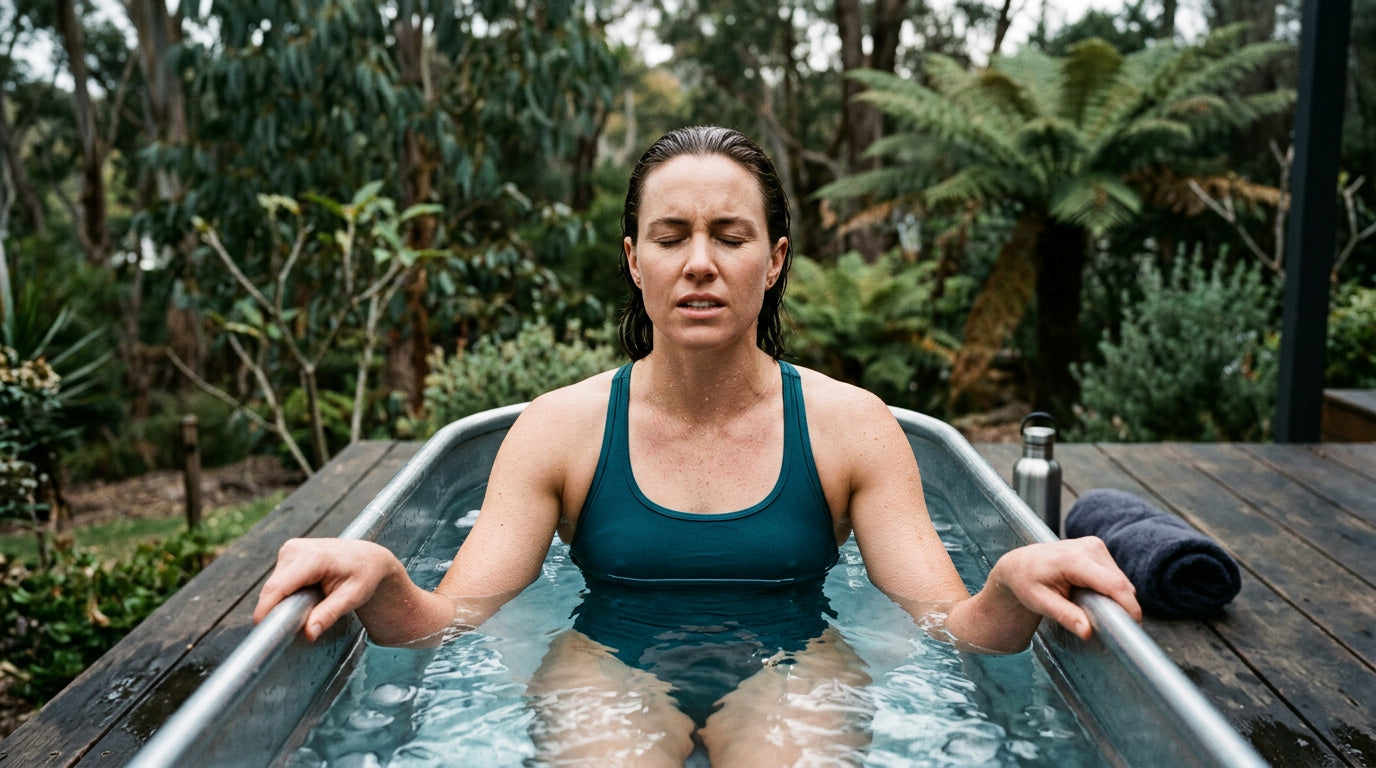
If contrast therapy is your goal, the Contrast Kit (Genesis + Origin cold plunge) and Contrast Kit Mini (Genesis Mini + Origin) bundle both products with Australia-wide delivery. The recovery science behind the combination is straightforward: heat drives vasodilation, cold drives vasoconstriction, and the repeated cycle produces an autonomic nervous system response that neither modality achieves alone. Our contrast therapy Australia guide covers the full protocol and evidence base. You can also explore the complete home sauna Australia buyer's guide if you are still mapping the full category.
If mental performance and stress recovery are your primary drivers, the sauna evidence base extends well beyond cardiovascular health. Our sauna mental health Australia guide covers the research on heat therapy, cortisol, and mood regulation — and why a daily sauna habit changes more than your training recovery. For the full benefits picture across all domains, our traditional sauna benefits Australia guide covers every evidence-backed outcome in one place.
Frequently Asked Questions: 4 Person Sauna Australia
How big should a 4 person sauna be?
A 4-person sauna should have a minimum interior bench length of 2 metres and an interior floor area of approximately 3.5–4.5 m². This allows four adults to sit comfortably on two-level benching without crowding. The Psycle Genesis external dimensions are 2288mm wide × 1945mm deep, providing a generous interior bench layout for 3–5 users. Ceiling height of 2289mm allows upper bench placement at the optimal heat zone — where air temperature is highest — without the ceiling being uncomfortably close. Plan for at least 600mm of clearance in front of the door, plus side clearance for ventilation access.
What kW heater do I need for a 4 person sauna?
A 4-person traditional sauna requires a minimum 9kW heater to maintain Finnish temperatures (80–100°C) with thermal stability. The standard sizing rule is 1kW per cubic metre of cabin volume, plus 1kW per square metre of glass area. A 4-person cabin with a glass facade will typically land at 9–12kW as the correct range. The HUUM DROP 9kW with 60kg of Olivine diabase stone is the Genesis heater specification — engineered to hold temperature across extended multi-person sessions and repeated löyly cycles. A 6kW heater is adequate for a 1–3 person cabin (Genesis Mini) but will underperform in a larger 4–5 person space.
Is a 4 person sauna worth it?
Yes — for households of two or more, a 4-person sauna is almost always the better long-term investment over a 2-person unit. The research supporting regular sauna use is solid: Laukkanen et al. (2015, JAMA Internal Medicine) found that 4–7 sessions per week reduced fatal cardiovascular disease risk by 50%. The key variable is compliance — how often you actually use it. A 4-person cabin that comfortably fits a partner, a training partner, or children creates the social context for daily use. A cramped 2-person box does not. Running costs are approximately AU$0.50–$1.00 per session, making daily use economically irrelevant compared to commercial gym or recovery facility alternatives.
What is the difference between a traditional and infrared sauna for 4 people?
Traditional saunas heat air to 80–100°C via a stone heater; infrared saunas operate at 50–70°C using radiant panels. For group use, traditional heat is superior: the ambient temperature is even across the entire cabin, every user experiences the same session, and the löyly steam ritual is available. Infrared heating is proximity-dependent — users near the panels absorb more radiation than those further away, creating an uneven group experience. The cardiovascular and longevity research cited across this article was conducted on traditional Finnish saunas, not infrared. The infrared sauna Australia guide breaks down the evidence gap between the two modalities in full.
Can children use a 4 person sauna?
Yes, with supervision and appropriate session management. Children should start with shorter sessions (5–10 minutes) at lower bench positions where temperature is 10–15°C cooler than the upper bench. They should be well hydrated before entry and exit the cabin immediately if they feel dizzy, nauseous, or uncomfortable. Traditional heat provides intuitive feedback — children can feel when it is too hot and respond naturally. Never leave children unsupervised in a sauna. The Genesis does not have a locking mechanism, which is the correct safety design for family use. For a thorough safety overview, our sauna health risks guide covers all age-related safety considerations.
How much does a 4 person home sauna cost in Australia?
4-person home saunas in Australia range from approximately AU$4,000–$8,000 for flat-pack budget units, AU$8,000–$20,000 for mid-tier prefabricated options, and AU$20,000–$120,000+ for custom or European-commissioned builds. The Psycle Genesis sits in the premium prefabricated tier — engineered to a custom-build standard with a price that reflects zero-toxin construction, a 9kW HUUM heater, and a 3-year cabin warranty. Installation (electrical circuit, concrete pad or deck reinforcement, delivery) typically adds AU$1,500–$4,000 depending on site conditions and state. Running costs for the 9kW heater are approximately AU$0.50–$1.00 per 45-minute session at current Australian electricity rates. Our complete home sauna cost Australia guide covers every cost variable in detail.
How long does it take to get a 4 person sauna delivered in Australia?
The Psycle Genesis has a 120-day build lead time from deposit. Each unit is built to order — not pulled from warehouse stock. Delivery is Australia-wide, with the Genesis shipping at approximately 600kg. Delivery includes kerbside offload; installation coordination (electrical, siting, and assembly guidance) is covered in the Psycle installation support process. The $1,000 deposit to commence the build is fully refundable. Budget 2–3 weeks for electrical prep and site preparation to coincide with the delivery window.
Ready to Build This Into Your Routine?
Free Australia-wide delivery. 3-year cabin warranty — the longest in the Australian market. $1,000 fully refundable deposit. 120-day build — order now for delivery this season.
SHOP THE GENESIS →