
Outdoor Sauna Australia: The Complete 2026 Guide | Psycle
Outdoor Sauna Australia

Key Takeaways
- Australian outdoor saunas must be built with genuinely weather-resistant timber — Japanese Cedar, Western Red Cedar, or Thermowood — to withstand UV, humidity, and coastal salt air long-term.
- A landmark 20-year Finnish study found sauna use 4–7 times per week reduces fatal cardiovascular disease risk by 50% — frequency is only practical when the sauna is in your own backyard.
- Most states require no council approval for outdoor saunas under 10m², but setback rules from fences and boundaries vary — always check your local council before ordering.
- A 9kW traditional sauna costs approximately AU$0.50–$1.00 per 45-minute session at current Australian electricity rates — cheaper than a single gym recovery session.
- The Genesis uses zero-glue construction and non-VOC oil finish throughout — at 90°C, there is no formaldehyde off-gassing, unlike MDF-based flat-pack saunas.
- Outdoor sauna costs in Australia range from $3,000 for entry-level barrel kits to $25,000+ for premium engineered cabins — with significant differences in material quality, heater performance, and longevity.
- Contrast therapy — pairing a traditional sauna with a cold plunge — is among the most evidence-backed recovery protocols available, supported by a 2018 meta-analysis covering over 1,000 athletes.
By Psycle Wellness · Last updated: May 2026 · 16 min read
An outdoor sauna in Australia is one of the most practical home wellness investments you can make. The climate suits year-round use, outdoor structures typically need no council approval under 10m², and a quality build in Japanese Cedar or Western Red Cedar will last 20–30 years with minimal maintenance. The decision is which build is worth buying.
Why Most Outdoor Saunas Sold in Australia Are Not Worth Buying
The Australian market is flooded with flat-pack saunas built from MDF panels, particle board, and glued timber composites. They photograph well. They price competitively. And when you heat them to 90°C, they off-gas formaldehyde — a Group 1 carcinogen — directly into the air you are breathing.
That is not a fringe concern. It is basic material science. Urea-formaldehyde resin adhesives are the standard bonding agent in composite timber products, and their off-gassing rate increases with heat. Inside a sauna, you are not in a warm room — you are in a sealed, high-temperature enclosure with concentrated vapour exchange at every breath.
The other problem is weatherproofing. Most entry-level outdoor saunas are marketed as outdoor-ready but built to indoor standards. Untreated pine or low-grade spruce will crack, warp, and mould within two Australian summers — particularly in coastal environments where salt air accelerates timber degradation.
If you are investing in an outdoor sauna for long-term health benefit, build quality is not a secondary consideration. It is the whole point. See our guide to the best home sauna Australia options to understand what separates a real investment from a landfill-bound flat-pack.
The Health Case for an Outdoor Sauna in Your Backyard
The evidence base for sauna use is substantial and growing. A 20-year cohort study of 2,315 Finnish men by Laukkanen et al., published in JAMA Internal Medicine (2015), found that sauna use 4–7 times per week reduced the risk of fatal cardiovascular disease by 50% compared to once-weekly bathing. That finding alone reframes the outdoor sauna from lifestyle purchase to long-term health infrastructure.
Frequency is the operative variable. The health outcomes Laukkanen documented — reduced cardiovascular mortality, lower blood pressure, improved arterial compliance — were tied to habitual, high-frequency use. You do not get those outcomes from a monthly visit to a commercial wellness centre. You get them from a sauna in your own backyard that you use before work, after training, or as an evening wind-down.
The research on heat therapy extends well beyond cardiovascular health. Regular sauna use has been shown to reduce systemic inflammation, improve sleep quality, and support mental health through endorphin and norepinephrine release. For a full breakdown of the evidence, read our sauna benefits Australia guide and the dedicated sauna mental health Australia overview.
Why the Australian Climate Makes Outdoor Saunas a Year-Round Investment
The most common objection to an outdoor sauna in Australia is that it will only get used in cooler months. That assumption does not hold up. In every major Australian climate zone — temperate, subtropical, and Mediterranean — outdoor saunas get used consistently across all four seasons, for different reasons at different times of year.
In winter, the draw is obvious: 90°C of radiant heat when the temperature drops. In summer, a 15–20 minute sauna session followed by a cold plunge or outdoor shower is one of the most effective thermal regulation protocols available. The contrast between extreme heat and cold activates the autonomic nervous system in ways that neither heat nor cold alone achieves.
The outdoor lifestyle is also a structural advantage for Australian sauna use. Covered decks, alfresco areas, and established gardens offer natural sauna positioning that creates easy indoor-outdoor flow between sauna, cold plunge, and relaxation space. Byron Bay, the Mornington Peninsula, the Hunter Valley — the Australian outdoor entertaining tradition is already built for contrast therapy. A backyard sauna adds the infrastructure to match the lifestyle.
What the Australian climate does demand is engineering honesty about outdoor exposure. UV radiation in Australia is among the highest in the world. Coastal salt air is corrosive. Summer storms bring humidity spikes. Any outdoor sauna not built for these conditions will show it within three years — in cracking timber, degraded seals, failing joints, and surface mould.
Timber Types for Outdoor Saunas in Australia: What Actually Holds Up
Timber selection is the single most consequential decision in outdoor sauna construction. The right timber resists moisture cycling, UV exposure, and the biological activity that accelerates in warm, humid Australian conditions. The wrong timber looks identical on day one and fails by year three.
Japanese Cedar (Cryptomeria japonica)
Japanese Cedar is the premium choice for outdoor sauna construction in Australia. Its natural oil content makes it highly resistant to moisture and biological decay without chemical treatment. The timber is dimensionally stable under heat cycling — expanding and contracting minimally between cold nights and 90°C sauna interiors — which means joints stay tight and walls stay true over decades of use.
The aesthetic is a genuine differentiator. Japanese Cedar has a warm, tight grain that deepens in colour with age and UV exposure. Applied as Shou Sugi Ban — the Japanese charring technique used in the Genesis Charcoal finish — it produces one of the most architecturally considered sauna exteriors available at any price point.
Every Genesis and Genesis Mini is built from 38mm Japanese Cedar walls. No composite fill, no structural MDF, no formaldehyde adhesives — Japanese Cedar throughout, finished with non-VOC oil that does not off-gas under heat.
Western Red Cedar
Western Red Cedar is the traditional Scandinavian sauna timber and a genuine outdoor performer. High in thujaplicin — a natural fungicide — it resists rot and insect attack without treatment. Its low density means it stays comfortable to touch even at high interior temperatures.
Its weakness in the Australian market is supply consistency and cost. Quality Western Red Cedar commands a premium, and a high proportion of stock available locally is lower grade and does not perform to the timber's reputation. Sourcing matters more than the species name on the label.
Thermowood
Thermowood is pine or spruce heat-treated to 212°C in a steam process, which breaks down the sugars bacteria feed on and significantly improves dimensional stability. It is a legitimate outdoor option — used widely in Scandinavia — but requires surface oiling every 2–3 years in Australian UV conditions to prevent surface checking.
Timbers to Avoid for Australian Outdoor Saunas
Pine and spruce in untreated form are not suitable for Australian outdoor sauna use. Both absorb moisture readily, support fungal growth in humid conditions, and crack under the UV load in Queensland, NSW, and WA coastal environments. If a sauna is priced at the entry level and ships with pine or spruce as the exterior timber, the price is the explanation.
| Timber | Moisture Resistance | UV Performance | Coastal Salt Suitability | Maintenance Requirement |
|---|---|---|---|---|
| Japanese Cedar | Excellent — natural oils | Excellent — stable grain | Excellent | Low — re-oil every 3–5 years |
| Western Red Cedar | Very good — thujaplicin | Good — grades vary | Good | Moderate — re-oil every 2–3 years |
| Thermowood | Good — heat-modified | Moderate — surface checks | Moderate | Moderate — re-oil every 2–3 years |
| Pine / Spruce (untreated) | Poor — high absorption | Poor — cracks readily | Poor | High — or replace |
| MDF / Composite | Very poor — swells and delaminates | Very poor | Not suitable | Replace — not repaired |
The Genesis: Zero-Toxin Outdoor Sauna Built for Australian Conditions
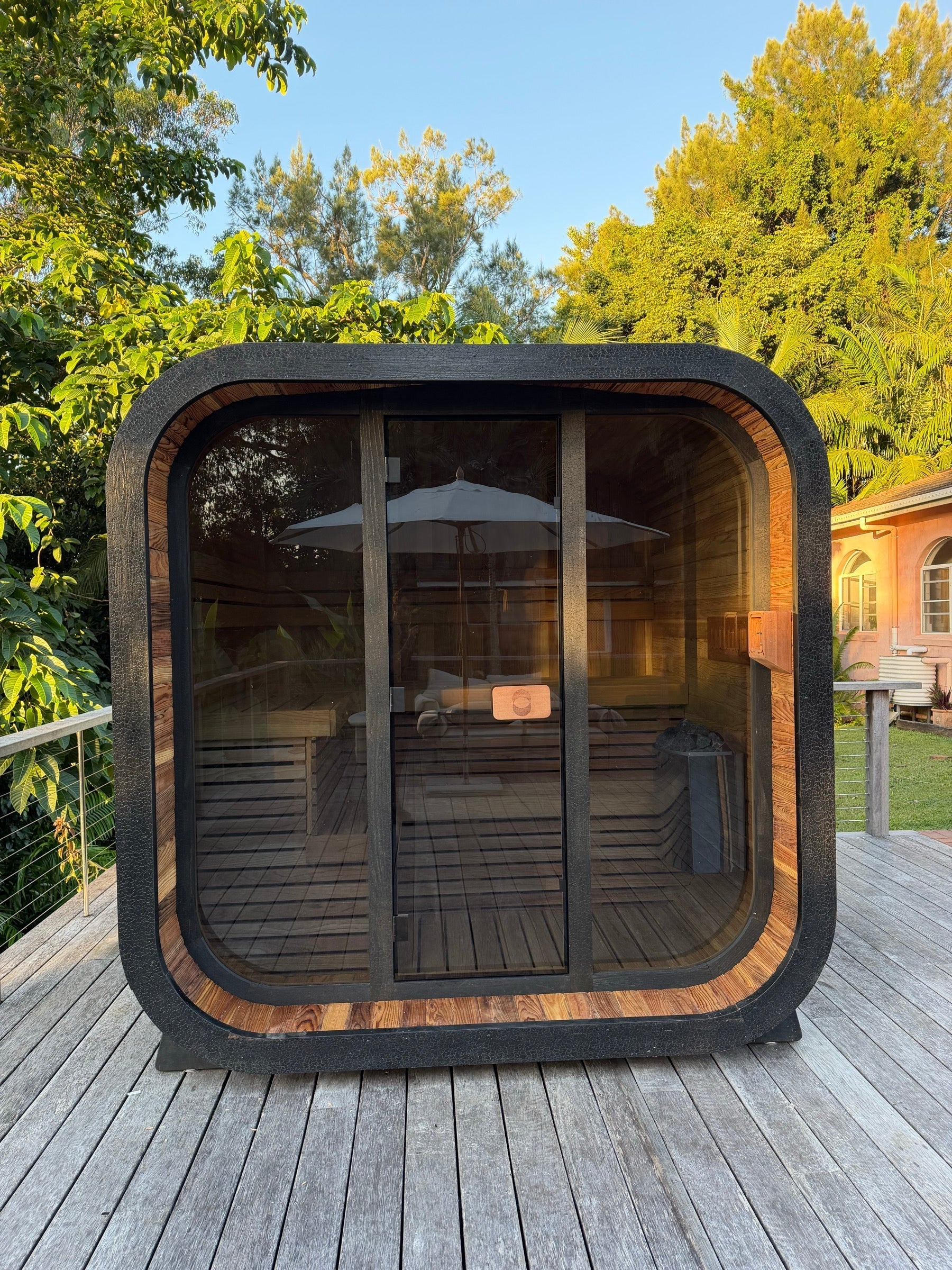
The Genesis is the flagship sauna from Psycle Wellness — a 3–5 person traditional Finnish sauna built from 38mm Japanese Cedar with zero-glue mechanical joints and a non-VOC oil finish throughout. It is available in two exterior finishes: Natural cedar, or Charcoal, which uses the Shou Sugi Ban charring technique to create a smoke-darkened exterior that is architecturally striking and additionally resistant to surface weathering.
The facade is 8mm safety laminated tempered glass in a dual-layer 4+4mm configuration with a grey tint — full-height, floor to ceiling, with a direct sightline from the interior to the garden beyond. On a coastal deck, that glass wall is the reason the Genesis photographs the way it does. In practice, it transforms the sauna session from a closed, sensory-deprived experience into a deliberate, landscape-engaged ritual.

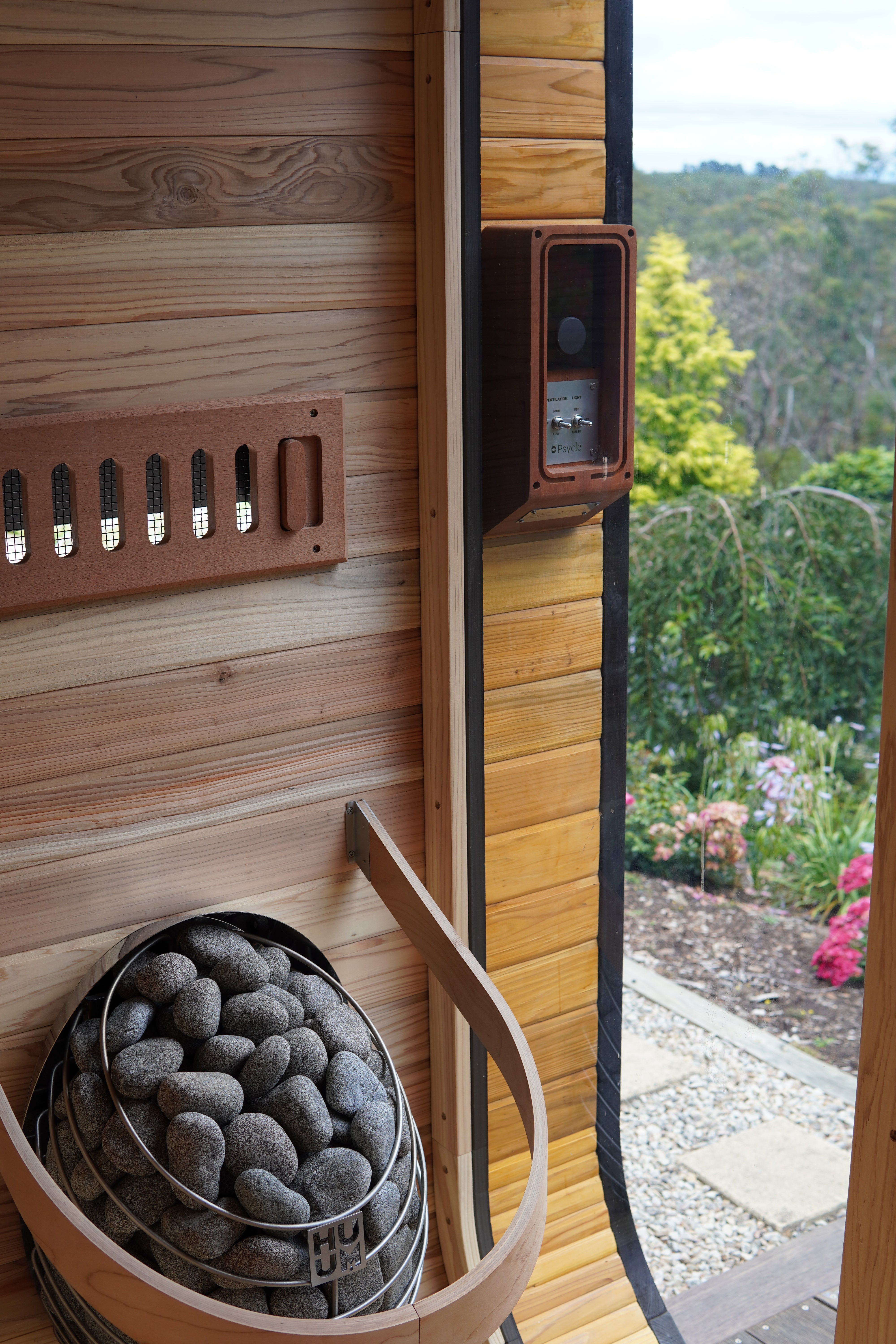
For outdoor placement in exposed environments — coastal properties, elevated decks, open-sky backyards — the optional Colorbond roof kit converts the Genesis into a fully weatherproof standalone structure. The lighting system is IP67 rated and designed to withstand 200°C internal temperatures. The active ventilation system runs at 88 m³/hr on low and 120 m³/hr on high — pulling fresh, oxygenated air through the cabin and expelling stale, humid air at a rate that keeps the heat environment clean and the löyly consistent.
To understand how ventilation affects your experience inside the sauna, read our dedicated sauna ventilation guide. It is a detail most buyers overlook until they have used a poorly ventilated sauna and felt the difference.
Zero-Toxin. Zero-Glue. Built for Decades Outdoors.
Japanese Cedar, 38mm walls, Shou Sugi Ban or Natural finish — engineered for Australian outdoor placement from day one.
SEE THE GENESIS →Inside the Genesis: Heater, Stone Volume, and What It Actually Feels Like
The heater is where a sauna either delivers or disappoints. Low stone mass means fast temperature loss the moment you pour water. Low kilowattage means the sauna cannot recover after the door opens. Both problems are common in entry-level and mid-range outdoor saunas — and both are invisible until you are inside the session.
The Genesis offers two heater options. The HUUM DROP 9kW carries 60kg of Olivine diabase stone — a volcanic rock with exceptional heat retention and a low silica content that produces clean, soft steam when water is poured across the surface. That stone mass holds the heat for the full session; the temperature does not drop when you pour löyly, it rises. Control is via the HUUM UKU app over WiFi, which means you can pre-heat the sauna from your phone before you get home from training.
The alternative is the Harvia Vega 9kW, which carries 20kg of Olivine diabase stones and uses mechanical dial controls — analogue, tactile, no app required. For buyers who prefer simplicity over remote control, it is the right choice. Both heaters run on a dedicated 50A circuit (single or three phase). For a full breakdown of installation requirements, our home sauna installation Australia guide covers electrical, siting, drainage, and what your electrician needs to know.

The lighting in every Genesis is blue-light-free: amber at 585–590nm and red at 630–635nm, IP67 rated and rated to 200°C. Blue light at standard LED wavelengths suppresses melatonin — the exact opposite of what you want from an evening sauna session designed to support sleep. The Psycle lighting system was specified to support cortisol reduction, not interrupt it. For the science on how sauna affects sleep quality, read our sauna for sleep Australia guide.
The Genesis Mini carries the same zero-toxin specification — 38mm Japanese Cedar, zero-glue construction, non-VOC oil finish, IP67 lighting — in a compact 1–3 person form that suits smaller backyards, courtyard spaces, or properties where the larger Genesis footprint is not workable. It runs on a 32A dedicated circuit. Shipping weight is approximately 350kg.
What Australians Who Own a Genesis Actually Say
Buyers who order a Genesis have typically spent three to six months researching. They have used commercial saunas, visited showrooms, compared specifications, and asked hard questions about what they are actually getting for the money. By the time they order, they have made a considered decision — not an impulse buy.
What they consistently report after installation is not satisfaction with the purchase. It is frustration that they waited as long as they did. The specific feedback that surfaces repeatedly: the quality of the heat is different from anything they had used before, the morning and evening ritual that forms around the sauna is more consistent than any gym routine they had maintained, and the contrast therapy setup — sauna followed by cold plunge — changes the recovery baseline in ways that show up in their training data.
“I've run this protocol daily for 90 days. My recovery markers don't lie.” That is the kind of feedback we hear from competitive athletes, business operators, and anyone who treats their body as a performance system rather than something to manage. The sauna is not a luxury item in their lives. It is infrastructure.
The Sauna That Does Not Compromise
Active ventilation, IP67 lighting, 60kg stone volume, zero-glue Japanese Cedar — every specification chosen for performance, not marketing.
EXPLORE THE GENESIS →Outdoor Sauna vs Indoor Sauna: Which Makes More Sense in Australia?
Outdoor and indoor saunas are fundamentally different propositions in the Australian market — not just in placement, but in experience, planning requirements, installation complexity, and long-term flexibility. The difference determines whether the sauna fits naturally into your property and your daily life.
| Factor | Outdoor Sauna | Indoor Sauna |
|---|---|---|
| Planning approval | Usually exempt under 10m² — check local council | May require building permit if structural changes needed |
| Installation complexity | Level pad or deck, electrical connection, delivery access | Room preparation, ventilation extraction, flooring protection |
| Ventilation | Natural airflow assists; active sauna ventilation required | Dedicated extraction to outside required — more complex |
| Experience | Landscape view, outdoor transition to cold plunge | Contained, climate-controlled environment |
| Cold plunge pairing | Natural pairing on deck or in garden | Requires proximity to outdoor space or bathroom |
| Timber weatherproofing | Critical — Japanese Cedar or equivalent essential | Less critical — internal moisture management is the priority |
| Resale value impact | Adds to property appeal as a lifestyle feature | More niche — depends on buyer profile |
| Relocatability | Yes — freestanding units can be moved | No — integrated into building fabric |
For most Australian homeowners with an outdoor entertaining area, the outdoor sauna is the right choice. The planning pathway is simpler, the cold plunge pairing is natural, and the freestanding structure fits the existing outdoor lifestyle rather than displacing internal room space. Our full home sauna Australia guide covers both options in detail if you are still working through which configuration suits your property.
Barrel vs Cabin vs Pod: Which Outdoor Sauna Style Is Right for You?
The Australian outdoor sauna market offers three primary structural styles — barrel saunas, cabin saunas, and pod or studio saunas. Each has legitimate use cases and genuine limitations. Style preference is secondary to build quality — but style does affect experience, capacity, and long-term satisfaction.
Barrel Saunas
Barrel saunas are the most recognisable outdoor sauna form and the most widely sold in the Australian budget-to-mid-range market. Their circular cross-section is structurally self-reinforcing — the curved stave construction means no internal framework is required, which reduces cost and build complexity. Heat rises to the curved ceiling and is redistributed efficiently, reducing the dead air that accumulates in flat-ceiling rectangular cabins at height.
The limitations are real. Seating is fixed to the curve of the wall, which constrains layout flexibility. The benching system is less ergonomic than a purpose-designed cabin bench configuration. Timber quality in the Australian barrel sauna market is highly variable — many are built from untreated Nordic spruce or pine that will not hold up to Australian outdoor conditions without significant maintenance. Our full barrel sauna Australia guide breaks down the category honestly.
Cabin Saunas
Cabin saunas — rectangular or square-footprint structures with conventional wall and roof construction — are the premium standard. They offer greater interior flexibility, higher glass area for views, and a wider range of material finishes. The Genesis is a cabin sauna — and the full-height tempered glass facade is only possible in a cabin form. For 3–5 person capacity at genuine Finnish temperatures, the cabin format delivers an experience the barrel form cannot match.
Pod and Studio Saunas
Pod saunas are architect-specified custom structures — typically used in high-end residential or commercial installations where the sauna is a design statement as much as a functional space. They carry a significant price premium and a long build lead time. For most Australian homeowners, the Genesis cabin delivers an equivalent aesthetic at a fraction of the cost, with a defined specification rather than a custom build process.
| Style | Capacity | Heat Efficiency | Glass / Views | Typical AU Price Range |
|---|---|---|---|---|
| Barrel | 2–6 person | Good — curved ceiling | Limited — small door window | $3,000–$12,000 |
| Cabin (standard) | 2–8 person | Excellent with active ventilation | Good — panel windows standard | $6,000–$18,000 |
| Cabin (premium — Genesis) | 3–5 person | Excellent — 120 m³/hr active ventilation | Full-height 8mm laminated glass | Premium segment |
| Pod / Studio | 2–4 person | Variable — design dependent | Often large glazed sections | $25,000–$120,000+ |
How Much Does an Outdoor Sauna Cost in Australia?
Outdoor sauna cost in Australia spans a significant range — from $3,000 for an entry-level barrel kit to well over $25,000 for a premium engineered cabin. The price variation is not arbitrary. It reflects real differences in timber species, wall thickness, heater kilowattage and stone volume, glazing quality, ventilation engineering, and weatherproofing specification. Our full home sauna cost Australia guide covers the category in detail, including what you are actually paying for at each price tier.
| Tier | Price Range (AUD) | Typical Spec | Expected Lifespan |
|---|---|---|---|
| Entry-level | $3,000–$6,000 | Pine or spruce barrel, low-wattage heater, no active ventilation, glued composite panels | 3–7 years outdoors with maintenance |
| Mid-range | $6,000–$12,000 | Thermowood or Western Red Cedar, 6–8kW heater, basic glazing, passive ventilation | 8–15 years with maintenance |
| Premium | $12,000–$25,000 | Japanese Cedar or premium WRC, 9kW+ heater, large glazing, active ventilation, zero-toxin | 20–30 years with minimal maintenance |
| Custom / Architect | $25,000–$120,000+ | Bespoke design, custom glazing, high-end heater systems, architect-specified materials | Decades — if specified correctly |
The running cost calculation is often overlooked in the purchase decision. A Genesis fitted with a 9kW HUUM DROP heater costs approximately AU$0.50–$1.00 per 45-minute session at current Australian electricity rates of AU$0.30–$0.35/kWh. Over a year of daily use, that is AU$180–$365 in electricity — less than a single month of a commercial wellness membership or three physio sessions at AU$100–$160 per visit.
The correct comparison is not the purchase price against zero. It is the purchase price against what you are currently spending to access the same outcome at a commercial facility — while factoring in the time cost of travelling to use it and the frequency ceiling a commercial facility imposes. At 4–7 sessions per week — the frequency that delivered the cardiovascular outcomes in the Laukkanen et al. study — a home sauna is the only practical delivery mechanism.
Council Approval and Planning Permission for Outdoor Saunas in Australia
In most Australian states and territories, a freestanding outdoor sauna under 10m² is classified as exempt development — meaning no council approval or building permit is required before installation. This is one of the most practically significant advantages of an outdoor sauna over an indoor structural modification, which typically does require approval regardless of size.
Exemption thresholds and setback rules vary by state and local council, and some areas with heritage overlays, flood overlays, or bushfire risk designations impose additional restrictions. The general rules by state are listed below — but always verify with your local council before ordering, as local planning instruments can override state-level guidelines.
| State / Territory | Exempt Threshold (approx.) | Setback Rules (general) | Key Caveat |
|---|---|---|---|
| NSW | Up to 20m² in many zones | 900mm from side/rear boundaries | Must not exceed 3m wall height; check flood and bushfire overlays |
| VIC | Up to 10m² generally exempt | 1m from side/rear boundaries | Heritage and neighbourhood character overlays may apply |
| QLD | Up to 10m² generally exempt | 1.5m from boundaries typical | Flood and bushfire planning areas impose additional requirements |
| WA | Up to 10m² generally exempt | 1m from side boundaries | R-codes apply — check local scheme |
| SA | Up to 15m² in most zones | 900mm from boundaries typical | Character overlay areas may require approval regardless of size |
| TAS | Up to 12m² in most zones | 1m from side/rear boundaries | Coastal and landscape overlays apply in many rural areas |
| ACT | Up to 10m² generally exempt | 1m from side/rear boundaries | Heritage and bush fire abatement zones may restrict |
The electrical connection for a Genesis requires a dedicated 50A circuit — single or three phase — run by a licensed electrician. This is a non-negotiable specification for the HUUM DROP 9kW or Harvia Vega 9kW heater; standard household circuits are not adequate. The Genesis Mini requires a 32A dedicated circuit. Factor in electrician cost — typically AU$500–$2,000 depending on distance from your switchboard and cable routing complexity — when budgeting total installation cost.
Contrast Therapy: Pairing Your Outdoor Sauna with a Cold Plunge
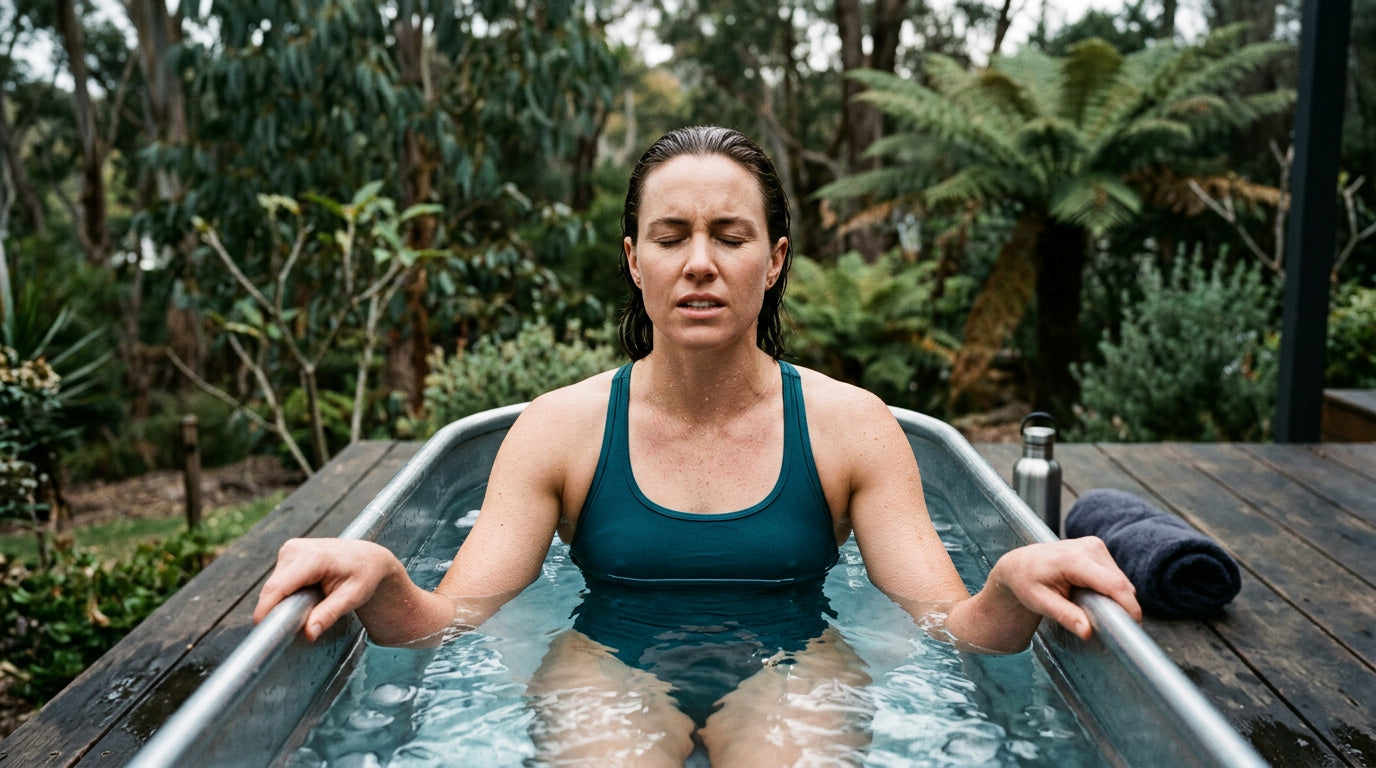
Contrast therapy — alternating between high heat and cold water immersion — is among the most evidence-backed recovery protocols available to high-performing Australians. It is also the natural extension of an outdoor sauna setup, and the reason the Contrast Kit exists as a product bundle.
A 2018 meta-analysis by Dupuy et al. in Frontiers in Physiology, covering 99 studies and over 1,000 athletes, found cold-water immersion and contrast water therapy to be among the most effective recovery modalities for reducing muscle soreness and perceived fatigue. The effect size was clinically meaningful — not marginal — and held across both team sport and endurance athletes.
Research published in the European Journal of Physiology found that cold water immersion produces a sustained 250% increase in dopamine levels — a neurological effect that outlasts the cold exposure itself by several hours. Paired with the endorphin and norepinephrine response from heat exposure, the combined neurochemical effect of contrast therapy is categorically different from either modality alone.
The Psycle Contrast Kit pairs the Genesis sauna with the Origin cold plunge — a premium ice bath engineered to the same zero-compromise standard as the cabin. The Contrast Kit Mini pairs the Genesis Mini with the Origin for smaller outdoor spaces. Both bundles are designed for the outdoor deck format: sauna, cold plunge, and the deliberate transition between them as a structured daily ritual.
Pre-heat the Genesis
Use the HUUM UKU app to pre-heat 30–45 minutes before you intend to use it. Target 80–100°C. Hydrate before entering.
First heat round: 12–20 minutes
Sit on the upper bench. Pour water over the stones for löyly. Exit when you are genuinely ready, not when you have hit a timer.
Cold plunge: 2–5 minutes
Enter the Origin cold plunge immediately after exiting the sauna. 10–15°C is the target range. Control the breath; stay present.
Rest: 5–10 minutes
Allow your body to return toward baseline before the next round. This is where the parasympathetic response develops.
Repeat 2–3 rounds
Two to three rounds of heat and cold is the standard contrast therapy protocol. Total session time: 45–90 minutes.
For the full science behind contrast therapy, read our contrast therapy Australia guide and the dedicated sauna and cold plunge Australia overview. If you are specifically looking at how heat affects post-training recovery, our sauna after workout guide covers timing and protocol in detail.
Heat recovers you. Cold hardens you. Together, they transform you.
Installation Requirements: What You Need Before the Genesis Arrives
The Genesis arrives as a flat-pack prefabricated unit — delivery weight approximately 600kg — and is assembled on-site. Installation is straightforward for an experienced handyperson or trade, but there are four non-negotiable prerequisites that must be in place before delivery.
A level base. The Genesis requires a level concrete slab, timber deck, or compacted gravel pad of sufficient size. The cabin footprint is 2288W x 1945D mm. The base must be level within 5mm across its full surface — uneven bases cause door alignment issues and stress joints over time.
Dedicated electrical circuit. A 50A dedicated circuit for the Genesis (32A for the Genesis Mini), run by a licensed Australian electrician, must be in place before delivery. The HUUM DROP 9kW heater operates on single or three phase — confirm your phase availability with your electrician before ordering.
Delivery access. The Genesis ships on a pallet at approximately 600kg. Delivery vehicle access to within a manageable carry distance of the installation site is required. Discuss site access with the Psycle team at time of order — this is a standard part of the ordering process.
Drainage consideration. Outdoor saunas produce condensate and require periodic cleaning. Siting near an existing outdoor drain or on a gravel base that allows natural drainage prevents moisture pooling under the cabin. Our home sauna installation Australia guide details the drainage, electrical, and siting requirements in full.
The 120-day build lead time means the ordering process is deliberate. A $1,000 refundable deposit secures your place in the build schedule. Production then begins — and you have the time between order and delivery to complete your base preparation and electrical work without pressure.
Frequently Asked Questions: Outdoor Sauna Australia
How much does an outdoor sauna cost in Australia?
Outdoor sauna prices in Australia range from approximately $3,000 for entry-level barrel kits to $25,000 or more for premium engineered cabin saunas. Entry-level options typically use untreated pine or spruce with low-wattage heaters and no active ventilation — adequate for occasional indoor use but not built for sustained Australian outdoor exposure. Mid-range options from $6,000–$12,000 use Thermowood or Western Red Cedar with 6–8kW heaters. Premium cabins like the Genesis use Japanese Cedar with 9kW heaters, full-height laminated glass, and active ventilation at 120 m³/hr. For a full breakdown by tier, read our home sauna cost Australia guide.
Do I need council approval for an outdoor sauna in Australia?
In most Australian states, a freestanding outdoor sauna under 10m² is classified as exempt development and requires no council approval. NSW, QLD, WA, VIC, SA, TAS, and ACT all have exempt thresholds for small outbuildings, but setback rules from boundaries vary by local council. Properties with heritage, flood, bushfire, or coastal overlays may have additional restrictions regardless of structure size. Always verify with your specific local council before ordering — state-level guidelines can be overridden by local planning instruments.
What timber is best for an outdoor sauna in Australia?
Japanese Cedar is the premium choice for Australian outdoor sauna construction. Its natural oil content provides moisture and biological decay resistance without chemical treatment, and it is dimensionally stable under the heat cycling between ambient outdoor temperatures and 90°C sauna interiors. Western Red Cedar is a legitimate alternative, though quality varies significantly by grade in the Australian market. Thermowood is suitable with regular maintenance. Untreated pine, spruce, and any composite or MDF-containing timber are not suitable for sustained Australian outdoor exposure.
What is the difference between a barrel sauna and a cabin sauna?
A barrel sauna uses a circular cross-section stave construction that is self-reinforcing and distributes heat efficiently from the curved ceiling. It is widely available in the Australian budget-to-mid-range market and suits smaller backyards. A cabin sauna uses conventional rectangular construction, allows for larger glazing areas, greater interior layout flexibility, and higher capacity — and is the format used by premium saunas like the Genesis. For a detailed comparison of the barrel category in Australia, see our barrel sauna Australia guide.
How often should you use an outdoor sauna to get health benefits?
The research is clear on frequency. The Laukkanen et al. study published in JAMA Internal Medicine (2015) found that the most significant cardiovascular outcomes — including a 50% reduction in fatal cardiovascular events — occurred at 4–7 sessions per week. Once-weekly use showed benefit but at a significantly reduced magnitude. This is why home ownership matters: commercial sauna facilities impose a practical ceiling on frequency that a backyard sauna removes entirely. Our sauna frequency guide covers recommended protocols by health goal.
Can you use a sauna outdoors in Australian summer?
Yes — and it is one of the most underrated use cases for an outdoor sauna in Australia. In summer, a 15–20 minute sauna session at 80–100°C followed by cold water immersion or a cold plunge activates a powerful thermal contrast response that supports autonomic nervous system regulation and recovery. The sauna-to-cold transition in hot ambient conditions is a different sensory experience from winter use, but the physiological outcomes are equivalent. Summer use is common among Psycle Genesis owners — particularly those with a contrast kit setup on their outdoor deck.
What electrical requirements does an outdoor sauna need in Australia?
The Genesis requires a dedicated 50A circuit — single or three phase — installed by a licensed Australian electrician. The Genesis Mini requires a 32A dedicated circuit. Standard household power outlets and general lighting circuits are not adequate for a 9kW or 6kW sauna heater. Electrical installation cost typically ranges from AU$500–$2,000 depending on distance from the switchboard and cable routing. Factor this into your total installation budget alongside the base preparation cost.
Is a traditional Finnish sauna better than an infrared sauna for outdoor use?
Traditional Finnish saunas operate at 80–100°C with steam from water poured over heated stones — the löyly experience is central to the Finnish sauna tradition and produces a qualitatively different heat to infrared. Infrared saunas operate at 50–70°C using radiant panels rather than convection heat and steam. For outdoor structural use, traditional cabin saunas — with their solid timber construction and high-temperature heaters — are better suited to Australian outdoor conditions than most infrared units, which are typically designed for indoor installation. For a full comparison of the two technologies, read our traditional vs infrared sauna guide.
Ready to Build This Into Your Outdoor Space?
Free Australia-wide delivery. 3-year cabin warranty — the longest in the Australian market. $1,000 refundable deposit. 120-day build — order now for delivery before the season closes.
SHOP THE GENESIS →If you are still in the research phase, the following guides will answer the remaining questions in your decision process. Our home sauna Australia hub covers the full category. For two-person configurations, our 2 person sauna Australia guide compares the Genesis Mini against the category. For the cold plunge side of the setup, our cold plunge tub Australia guide and ice bath Australia overview cover what to look for in a cold water immersion unit built to the same standard as the Genesis. For the long-term case on sauna as a longevity investment, read our sauna longevity Australia science guide.