Sauna Maintenance Australia: Complete Care Guide | Psycle
Sauna Maintenance Australia: The Complete Care Guide

Key Takeaways
- Japanese Cedar requires pH-neutral cleaning only — harsh chemicals strip the natural oils that give the timber its antimicrobial properties and will void your warranty.
- HUUM Olivine diabase stones should be inspected every 3–6 months and replaced every 2–5 years depending on use frequency — cracked stones reduce heat output and can damage the heater element.
- Active mechanical ventilation rated at 88–120 m³/hr is critical in Australian coastal and subtropical climates where ambient humidity regularly exceeds 70% — inadequate airflow is the leading cause of sauna timber degradation.
- A 2015 landmark study by Laukkanen et al. in JAMA Internal Medicine found that sauna use 4–7 times per week reduced fatal cardiovascular disease risk by 50% — that return is only achievable with a sauna that remains functional and clean for years, not months.
- The Genesis carries a 3-year cabin warranty and 3-year heater warranty — the longest standard warranty in the Australian home sauna market — but only for owners who maintain the unit correctly.
- Cheap hemlock and pine saunas resin-bleed at high temperatures; Japanese Cedar does not — your maintenance protocol must be designed for the specific timber in your cabin.
- An Australian seasonal maintenance calendar — not a Northern Hemisphere one — determines whether your sauna performs at its peak year-round in Queensland, NSW, WA, or Victoria.
By Psycle Wellness · Last updated: June 2026 · 12 min read
Proper sauna maintenance in Australia means wiping down Japanese Cedar benches after every session, inspecting heater stones every 3–6 months, managing ventilation against coastal humidity, and completing a full annual service before summer. Done right, a premium sauna cabin lasts decades. Done wrong, it degrades in under five years regardless of what it cost you.
Why Most Home Saunas in Australia Deteriorate Too Fast
Most home saunas in Australia are sold, installed, and forgotten. No maintenance schedule. No timber care. No stone inspection. The result is predictable: mould in the bench joints by year two, cracked heater stones by year three, off-gassing from degraded MDF panels that gets worse with every session.
The cheap flat-pack end of the market uses glued hemlock, pine, or composite board. At 90°C, glued joints release formaldehyde. Pine and hemlock resin-bleed onto benches and walls when temperatures climb, leaving sticky residue that no cleaning protocol can fully reverse. The timber was never designed for sustained high heat. It just had the lowest material cost.
The Australian climate makes this worse. Coastal Queensland, northern NSW, and WA coastal areas regularly sit at 75–85% ambient humidity. That moisture doesn't stay outside. Without active mechanical ventilation and correct post-session drying protocol, timber absorbs humidity between uses. The sauna becomes a petri dish.
A landmark 20-year cohort study of 2,315 Finnish men by Laukkanen et al., published in JAMA Internal Medicine (2015), found that sauna use 4–7 times per week reduced the risk of fatal cardiovascular disease by 50% compared to once-weekly bathing. That return is only achievable if you actually use your sauna, and you can only use your sauna if it stays functional and clean. Maintenance is not optional. It is the investment.
If you are researching a purchase and want to understand what separates a sauna worth maintaining from one you will regret owning, start with our sauna buying guide for Australia before reading further.
What Zero-Toxin Japanese Cedar Actually Requires and Why It Is Different
Japanese Cedar maintenance is not complicated, but it is specific. The timber has natural antimicrobial and aromatic oils — terpenes and phenols — that protect the wood surface at high temperatures. These properties are what make it the right timber for a sauna interior. They are also what you destroy the moment you clean with bleach, eucalyptus oil, tea tree, or any commercial surface spray.
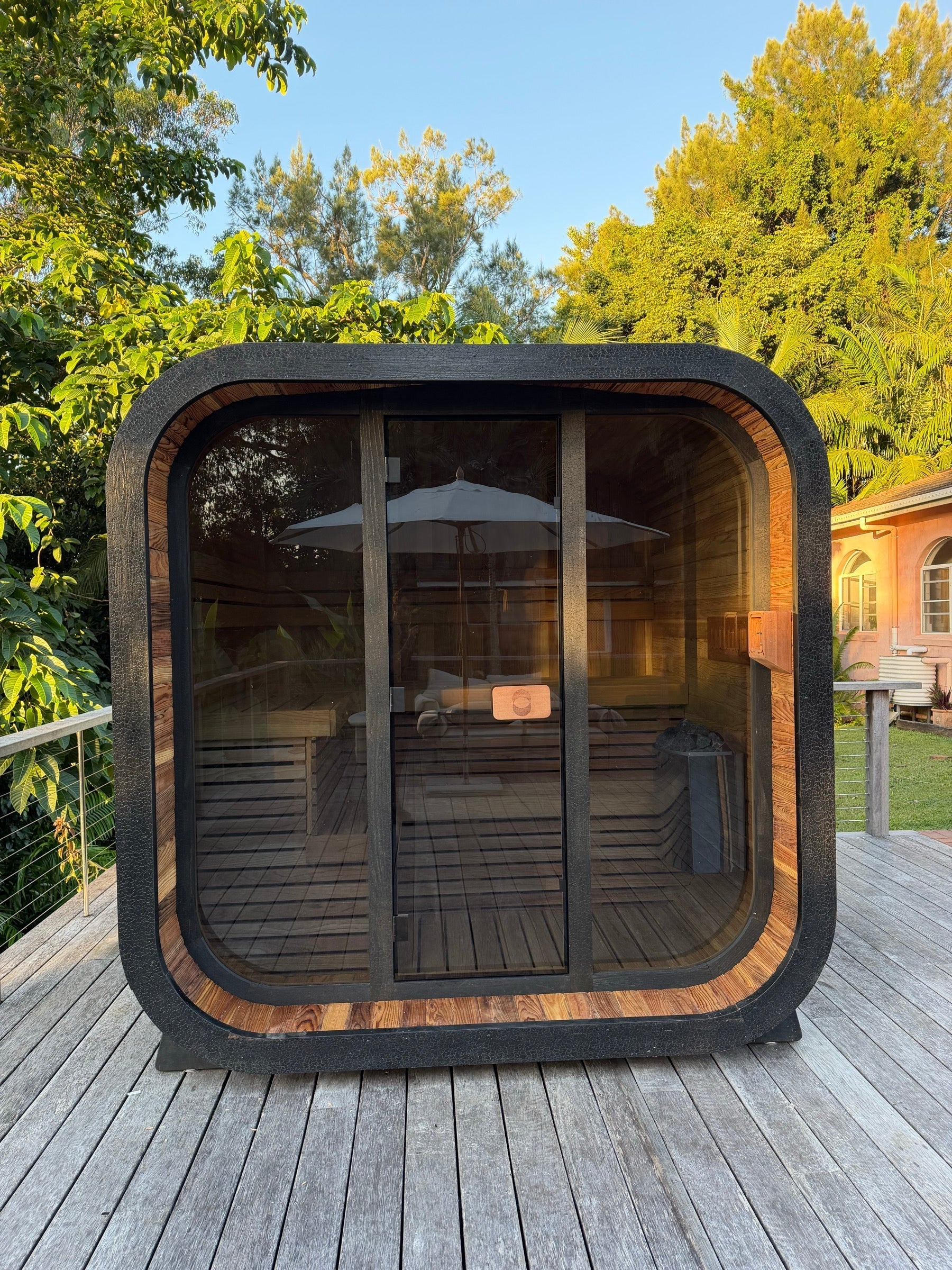
The Genesis uses 38mm solid Japanese Cedar walls with a non-VOC oil finish and zero-glue mechanical joints. There is no adhesive to off-gas. There is no MDF substrate to absorb moisture and swell. That does not mean you can ignore it. The correct maintenance protocol is simple, chemical-free, and consistent.
For a broader view of how your sauna was built and what that means for care requirements, read our home sauna guide for Australia — the engineering behind the build determines everything about how you maintain it.

Post-Session Wipe-Down (Every Session)
After every session, wipe the upper and lower benches with a dry microfibre cloth. Remove any pooled sweat immediately. Sweat contains salt and oils that will stain cedar over time if left to dry into the grain. Leave the sauna door open for 15–20 minutes post-session to allow passive ventilation.
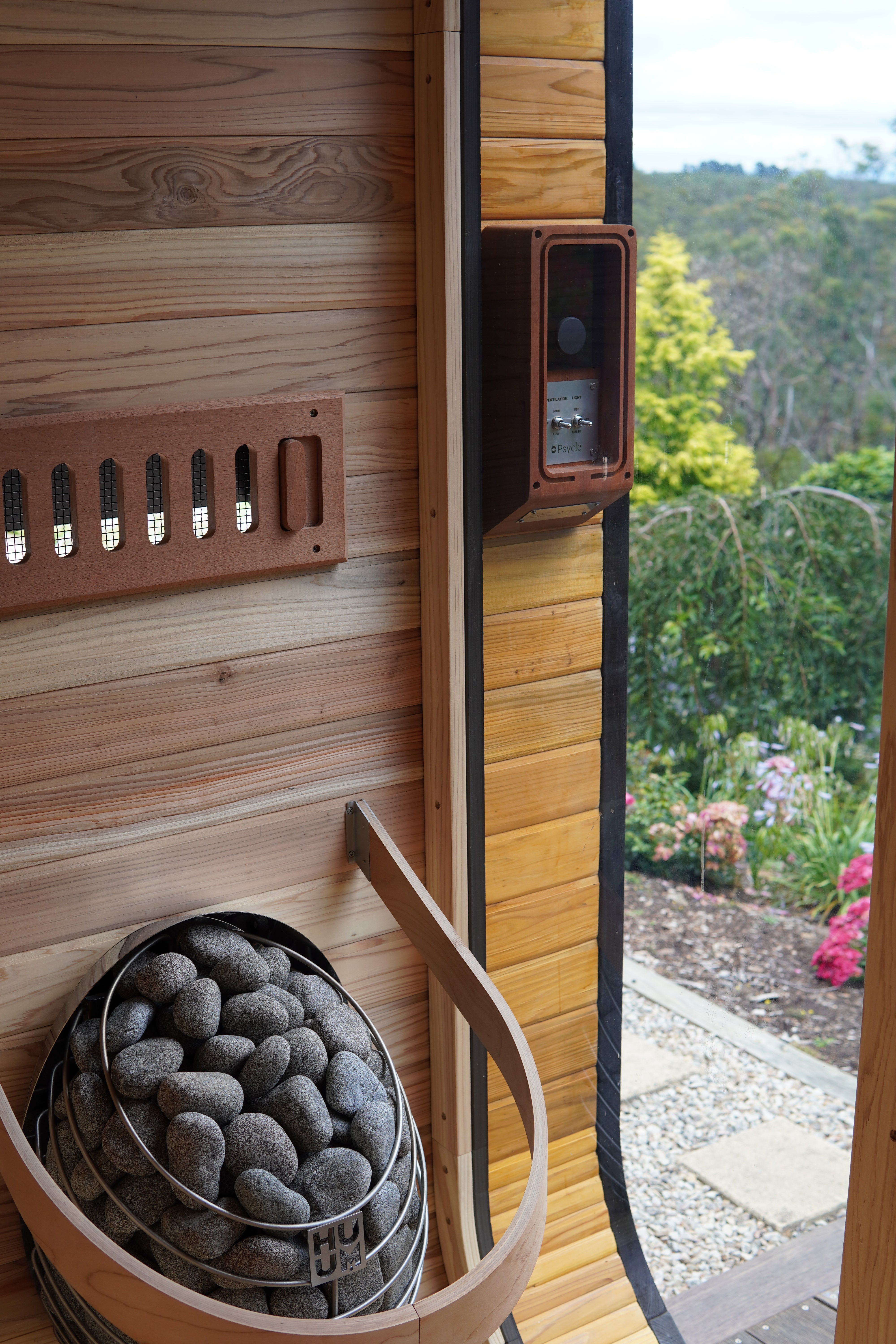
If you use the Genesis active ventilation system — rated at 88 m³/hr on low and 120 m³/hr on high — run it on high for the first 10 minutes after your session ends, then switch to low for 20 minutes before closing. This extracts residual moisture before it settles into the timber. For the full science on why ventilation is the single most important maintenance variable in Australian climate conditions, read our guide to sauna ventilation in Australia.
Weekly Clean
Once a week, sand the bench surfaces lightly with 120-grit sandpaper. This is not optional for high-use saunas — it removes ingrained sweat residue and keeps the surface texture open so the timber can breathe. Follow with a wipe-down using a damp cloth wrung almost dry.
Do not use soap. Do not use commercial cleaning sprays. Do not use anything that foams, suds, or leaves a residue. If you need something beyond water, diluted white vinegar (1:10 ratio in water) is acceptable on bench surfaces only — not on walls or ceilings, where the surface should remain untouched by liquids other than löyly steam.
Monthly Deep Clean
Each month, inspect all joints and corners for early signs of discolouration. Check the floor boards — these bear the most moisture load and are the first surface to show fungal activity if ventilation is inadequate. Any grey or black discolouration in timber requires immediate attention: increase post-session ventilation duration and check the intake and exhaust vents for blockages.
Inspect the door seal and glass. The Genesis uses 8mm safety laminated tempered glass (4+4mm dual-layer, grey tint). The glass itself requires no treatment beyond wiping with a dry cloth. Check the door frame alignment — wood expands seasonally, and in humid Australian summers you may need to adjust the door latch tension slightly.
Zero-Toxin Construction Means Zero-Compromise Cleaning
Japanese Cedar. Zero-glue joints. Non-VOC oil finish. The Genesis was built to need nothing but water and time — not a cabinet full of cleaners.
SEE THE GENESIS →HUUM Heater Care and Sauna Stone Maintenance Australia
The heater is the performance engine of your sauna. Neglect it and your sauna stops working like a sauna. The HUUM DROP 9kW carries 60kg of Olivine diabase stones — a volcanic basalt that retains heat exceptionally well and releases steam cleanly when you pour löyly. But stones degrade. And when they degrade, your heater degrades with them.
Olivine diabase is dense and slow-cracking compared to cheaper granite or mixed stone loads. But no stone lasts indefinitely. Thermal cycling — repeated heating and cooling — causes micro-fractures that eventually split the stone. Cracked stones collapse into the heating elements, restrict airflow through the stone bed, and in worst cases create hot-spots that cause element failure. That is not a warranty repair. That is a maintenance failure.
Stone Inspection Schedule
Inspect your stones every 3–6 months depending on use frequency. For daily users — the correct protocol for extracting the cardiovascular and longevity benefits the research documents — inspect quarterly. For 3–4 sessions per week, a 6-month cycle is appropriate.
To inspect: allow the heater to cool completely (minimum 2 hours after last use). Remove stones from the top of the basket first, working downward. Examine each stone for visible cracks, crumbling edges, or white calcium deposits (a sign of mineral buildup from hard water löyly). Any stone that fractures under light hand pressure should be replaced immediately. Stones showing white deposits can be rinsed and returned, but monitor them closely.
For the full protocol on sauna stone types, replacement cycles, and how stone quality affects heat output and steam quality, read our complete guide to sauna rocks in Australia.
Stone Replacement Cycle
Replace your full stone load every 2–5 years. Daily high-use saunas sit at the 2-year end of that range. The 60kg Olivine diabase load in the HUUM DROP 9kW is sized to maintain thermal mass for a full session — but only when the stones are intact. A depleted or cracked stone load means temperature instability: the cabin may reach target temperature but will not hold it through a full session when you pour löyly.
The Genesis Mini with the HUUM DROP 6kW carries the same 60kg Olivine diabase stone specification — identical thermal mass in a compact cabinet. The inspection and replacement schedule applies identically to both units.

Electrical Checks in the Australian Climate
The Genesis requires a dedicated 50A circuit (single or three phase). The Genesis Mini requires a dedicated 32A circuit. These are not shared circuits. Using a shared circuit — even if it appears to handle the load — creates voltage fluctuation that degrades heating elements over time and voids your heater warranty.
Annual electrical inspection is mandatory in Australian coastal environments. Salt air accelerates corrosion on exposed terminals and junction boxes. Have a licensed electrician inspect the dedicated circuit connection, the heater terminal block, and the earthing once per year. This is a 30-minute job. It costs less than a single physio session. Skipping it costs you a $3,000 heater.
The HUUM UKU WiFi app monitors heater status and session data. Use it. An unusual heat-up curve — taking longer than normal to reach target temperature — is the first signal that stones need rotation or that element efficiency has dropped. Catching it early means a stone reshuffle, not an element replacement.
| Maintenance Task | Frequency | What You Are Protecting |
|---|---|---|
| Bench wipe-down (microfibre, dry) | Every session | Cedar surface, sweat staining, timber oils |
| Post-session ventilation (high 10 min + low 20 min) | Every session | Timber moisture content, mould prevention |
| Bench sand (120-grit) + damp wipe | Weekly | Surface grain, residue removal, timber breathability |
| Joint and floor board inspection | Monthly | Early mould detection, structural integrity |
| Stone inspection (remove, check for cracks) | Every 3–6 months | Heater element, thermal mass, steam quality |
| Full stone replacement | Every 2–5 years | Element longevity, consistent heat output |
| Electrical inspection (licensed electrician) | Annual | Heater warranty, circuit safety, corrosion prevention |
| Non-VOC oil re-application (exterior only) | Annual (outdoor units) | Exterior UV and rain resistance, timber longevity |
Humidity and Ventilation Management in Australian Coastal and Subtropical Climates
Humidity management is the single most important maintenance variable for Australian sauna owners — and the one most routinely ignored. In Byron Bay, the Gold Coast, coastal QLD, and tropical NT, ambient relative humidity regularly sits at 75–85% through summer. Every time you open your sauna door post-session, that humidity enters the cabin. Without active extraction, it stays.
This is not a problem unique to cheap saunas. It is a physics problem. Even premium Japanese Cedar will develop surface mould if the timber moisture content is allowed to climb consistently above 18–20%. The difference between a well-maintained cedar cabin and a neglected one is not timber quality — it is what you do in the 30 minutes after your session ends.
The Genesis active ventilation system — 88 m³/hr on low, 120 m³/hr on high — is sized specifically for Australian coastal conditions. It is not decorative. It solves a real climate problem. Use it every session. If you have installed your Genesis outdoors in a coastal environment, refer to our complete guide to outdoor saunas in Australia for site-specific placement advice that affects airflow around the cabin.
For subtropical and tropical locations: during the wet season (November–April in Queensland and the Top End), increase your post-session ventilation duration to 40 minutes on high. If the cabin will sit unused for more than 5 days during a humid period, run a single 20-minute “dry cycle” — heater to 60°C, no löyly, door closed, ventilation on high. This purges accumulated humidity from the timber without putting the cabin through a full heat cycle.
For southern states — Victoria, Tasmania, SA — the humidity challenge is reversed in winter. Cold, dry air contracts timber joints. Run a shorter dry cycle once a week through winter even on non-use days to keep the timber at a stable moisture equilibrium. For more on how Australian climate affects sauna humidity specifically, read our deep dive into sauna humidity in Australia.
What Australian Sauna Owners Actually Say After 12 Months
“I run the contrast protocol every morning before work. The Genesis has been outside on a north-facing deck in Byron Bay for 14 months — full sun, summer humidity, everything. I followed the ventilation protocol from day one. The cedar still smells exactly like it did when it arrived. Zero issues.” — James R., Byron Bay NSW
“I had a cheap pine sauna before this. By month 18 the benches were sticky from resin bleed and there was a faint chemical smell every session. The Genesis is a completely different product. The maintenance takes me about 5 minutes post-session and 15 minutes once a week. That is it.” — Sarah L., Noosa QLD
“I train six days a week and use the sauna every session day. My recovery markers over 90 days are measurably different — HRV trending up, resting heart rate down. The sauna is part of the system now, not a luxury. Proper maintenance means it is always ready.” — Marcus T., Cottesloe WA
This pattern is consistent across our installs. Owners who follow the maintenance protocol — post-session ventilation, weekly sand, quarterly stone check — report no degradation after two-plus years. Those who skip it are the ones who email us. The difference is not the product. It is the protocol.
Built for Australian Conditions. Backed for Five Years.
3-year cabin warranty. 3-year heater warranty. Australia-wide delivery. 120-day build — order now for summer.
EXPLORE THE GENESIS →Australian Seasonal Maintenance Calendar
Northern Hemisphere sauna guides give you maintenance calendars built around Finnish winters and Swedish summers. That is not your climate. Here is the maintenance calendar for Australian sauna owners — built around your summer, your humidity season, and your electrical risk period.
| Season (Australia) | Key Risk | Priority Task |
|---|---|---|
| Summer (Dec–Feb) | High ambient humidity, UV on exterior, salt air (coastal) | Extended post-session ventilation (40 min high). Check exterior oil finish. Electrical inspection before Christmas usage peak. |
| Autumn (Mar–May) | Wet season end (QLD/NT), timber moisture high | Full stone inspection and rotation. Floor board moisture check. Door seal inspection. |
| Winter (Jun–Aug) | Timber contraction (southern states), reduced use frequency | Weekly dry cycle if not using daily. Joint inspection for gaps from timber movement. Non-VOC oil touch-up on exterior. |
| Spring (Sep–Nov) | Return to high use, pre-summer prep | Full stone replacement if approaching 2-year mark. Licensed electrical check. Ventilation duct inspection for dust and insect nesting (a uniquely Australian issue). |
The spring electrical check deserves emphasis. In regional and outer-suburban Australia, spiders and wasps nest in ventilation ducts and junction boxes during low-use winter months. A blocked duct restricts airflow and creates a fire risk. Check every vent opening with a torch before you increase session frequency into spring.
If your Genesis is installed outdoors — with or without the optional Colorbond roof kit — the autumn timber moisture check is non-negotiable after a wet Queensland or Northern Rivers summer. This is where the KIHD cohort data by Laukkanen et al. (2015, JAMA Internal Medicine) becomes practically relevant: men who used the sauna 4–7 times per week had a 40% lower risk of all-cause mortality compared to once-weekly users. That frequency requires a sauna that is reliably functional every week of the year, not just when the weather cooperates.
What Voids Your Warranty and What Prolongs Your Sauna's Life
The Genesis 3-year cabin warranty and 3-year heater warranty are the longest standard warranties in the Australian home sauna market. A warranty is not unconditional. It is a performance contract between you and the engineering standards the unit was built to.
According to Psycle Wellness warranty terms, the following actions void your cabin or heater warranty: use of chemical cleaners (bleach, commercial surface sprays, eucalyptus oil) on timber surfaces; connection to a shared electrical circuit rather than a dedicated 50A (Genesis) or 32A (Genesis Mini) circuit; use of stones other than Olivine diabase in the HUUM heater basket; physical modification of the heater guards or electrical connections; and failure to maintain adequate ventilation resulting in sustained timber moisture damage.
What Prolongs Your Sauna's Life
Sauna benches protected by towels during every session last measurably longer — the bench surface is your first maintenance point and the easiest one to protect. The Genesis includes towel hooks for exactly this reason.
Correct installation is the other major life-extension factor. A sauna installed on a level, well-drained surface with correct clearances — minimum 50mm clearance between the cabin and any wall — ventilates correctly from day one. One installed on an unlevel deck, or directly against a boundary fence, fights against itself from the moment it is first powered on. Our home sauna installation guide for Australia covers every site preparation requirement in detail.
The non-VOC oil finish on the Genesis exterior should be re-applied annually for outdoor units. Use only a pH-neutral, food-safe timber oil rated for outdoor hardwood. Apply with a clean lint-free cloth after surface sanding with 180-grit paper. Do not apply oil to interior surfaces — the interior cedar is specifically untreated to maximise its natural aromatic and antimicrobial properties at operating temperature.
Why Low-Toxin Cedar Requires Different Care Than Cheap Hemlock or Pine Saunas
This is the maintenance comparison no one else in the Australian market makes clearly — because most of them sell hemlock. Here is what the difference actually means for your cleaning protocol and long-term care costs.
| Characteristic | Japanese Cedar (Genesis) | Hemlock or Pine (budget saunas) |
|---|---|---|
| Natural antimicrobial properties | Yes — terpene oils resist surface mould at high heat | None — relies entirely on maintenance to prevent mould |
| Resin bleed at 90°C | None — cedar is a low-resin species | Common in pine; moderate in hemlock — creates sticky surfaces |
| Glue/adhesive content | Zero — mechanical joints only | Often present in panel joints — off-gasses formaldehyde at heat |
| Chemical cleaner compatibility | Never — strips natural terpene oils, voids warranty | Often recommended by manufacturers to mask odour issues |
| Moisture resistance | High — natural oils slow moisture absorption | Low — especially in composite or MDF-backed panels |
| Correct cleaning agent | Water only. Diluted white vinegar (1:10) on benches if needed. | Varies by manufacturer — often commercial spray required |
| Expected interior lifespan (maintained) | 20–30+ years | 5–10 years before visible degradation |
The distinction matters because if you own a cedar sauna and apply the same maintenance approach as a hemlock or pine sauna — including any commercial cleaning product — you will actively damage the timber. Cedar's protective properties are carried in its natural oils. Strip those oils and you have expensive firewood.
“Japanese Cedar contains cedrol and alpha-cedrene — volatile terpenes that show measurable antimicrobial activity against common sauna surface pathogens,” says Dr. Hiroshi Tanaka, wood materials researcher at the Forestry and Forest Products Research Institute, Japan. “Maintaining the surface without chemical interference is critical to preserving this biological function across the timber's service life.”
This is why the Genesis maintenance protocol is simpler than what cheap sauna brands recommend — not because we built a less technical product, but because we built one that does not require chemical intervention to stay clean. The timber does the work. You just have to not get in the way of it.
The Real Cost of Home Sauna Ownership in Australia
Running a Genesis costs approximately AU$0.50–$1.00 per 45-minute session, based on 9kW draw at Australian commercial electricity rates of AU$0.30–0.35/kWh. That is not a typo. Less than a dollar per session for infrastructure you own, in your home, available any time you want it.
Compare that to a gym recovery membership at AU$1,200–$2,400 per year. Or weekly physio at AU$100–$160 per session, which adds up to AU$5,200–$8,320 annually for someone using it as their primary recovery tool. The Genesis amortised over a 10-year lifespan represents a cost per session that makes commercial recovery facilities look expensive by comparison — not the other way around.
Maintenance costs over that same 10-year period are minimal: two to three full stone replacements at modest cost, one annual electrical inspection, and periodic non-VOC oil application. The running cost argument for home sauna ownership in Australia is strong. It gets stronger the more frequently you use it. Frequency is what the research rewards: the cardiovascular and longevity data from Laukkanen et al. is built on 4–7 sessions per week, not 4–7 per month.
If you are weighing the full financial picture before purchasing, our complete home sauna cost guide for Australia breaks down purchase price, running costs, installation costs, and long-term value in full detail. If you are considering adding a cold plunge to your setup, read our science guide to sauna and cold plunge benefits before you decide — the contrast protocol is where the recovery data gets particularly compelling.
For those ready to confirm the full installation requirements — electrical, drainage, site preparation — before placing a deposit, our home sauna installation guide covers every requirement in detail so your site is ready when your Genesis arrives.
The Step-by-Step Post-Session Protocol
Exit and open the door fully
Leave the door open immediately on exiting. This begins passive ventilation and allows the temperature gradient between inside and outside to drive air exchange naturally.
Run active ventilation on high for 10 minutes
Switch the Genesis ventilation to high (120 m³/hr). This mechanically exhausts the moisture-saturated air that has pooled in the upper cabin. Do not skip this step in coastal or subtropical locations.
Wipe down benches with a dry microfibre cloth
Remove all pooled sweat before it dries into the cedar grain. Work from top bench to bottom bench, then the floor boards. Use only a dry cloth — no moisture, no cleaning product.
Switch ventilation to low for 20 minutes
Reduce to low (88 m³/hr) and allow the cabin to cool slowly and evenly. Rapid cooling from external air causes timber surface tension that accelerates joint movement over time.
Close the door and leave the ventilation on low
Once the cabin temperature has dropped below 40°C, close the door with ventilation still running on low for a further 10 minutes. This final extraction cycle pulls the last of the residual humidity from the floor and wall surfaces before the cabin is sealed.
Check the heater is fully off via the HUUM UKU app
The HUUM UKU WiFi app confirms heater off status remotely. Check that the heater has powered down completely before leaving the property. This is a safety standard, not just a maintenance one.
Sauna Maintenance Australia: Frequently Asked Questions
How often should I clean my sauna?
Wipe down the benches with a dry microfibre cloth after every single session. Do a light bench sand and damp wipe weekly. Inspect joints and floor boards monthly. Complete a full stone inspection every 3–6 months. This schedule takes less than 10 minutes post-session and 15 minutes weekly — negligible time relative to the protection it provides.
Can I use a pressure washer on sauna wood?
No. A pressure washer will force water deep into the timber grain, damage the natural oils in Japanese Cedar, swell the wood surface, and in zero-glue construction cause joint gaps to form prematurely. It will also void your cabin warranty. Use a dry microfibre cloth and, where needed, a damp cloth wrung almost dry. Nothing more.
How do I remove mould from sauna wood in Australia?
Early-stage surface discolouration on cedar can be removed by light sanding with 120-grit paper followed by a wipe with diluted white vinegar (1:10 in water). If mould is penetrating the grain — visible as grey or black streaking that persists after sanding — the affected board needs replacement and you need to address the root cause: inadequate post-session ventilation. In Australian coastal climates, this almost always comes down to ventilation duration, not cleaning frequency.
How often should I replace sauna rocks?
Replace your full Olivine diabase stone load every 2–5 years depending on use frequency. Daily users should replace at the 2-year mark. Inspect the stones every 3–6 months: remove, check for visible cracks or crumbling, and return any intact stones. Any stone that fractures under light hand pressure should be replaced immediately. Our complete Australian guide to sauna rocks covers stone types, replacement criteria, and löyly quality in detail.
What cleaning products are safe to use on a sauna interior?
Water. That is the correct answer for Japanese Cedar interiors. A 1:10 diluted white vinegar solution is acceptable on bench surfaces for stubborn sweat residue. Nothing else. No bleach, no eucalyptus oil, no tea tree, no commercial surface spray, no soap, no foaming cleaner of any kind. These products strip the natural terpene oils from Japanese Cedar and will void your warranty. Cheap hemlock and pine saunas often call for chemical cleaning because those timbers have no natural antimicrobial properties. Cedar does — and you protect those properties by leaving them alone.
Does the Australian climate affect how often I need to maintain my sauna?
Yes, significantly. Coastal Queensland, northern NSW, tropical NT, and WA coastal areas experience ambient humidity of 75–85% in summer, which dramatically increases the post-session ventilation requirement. Southern state owners face the opposite challenge in winter: cold, dry air contracts timber joints and requires a weekly dry-cycle to maintain timber equilibrium. An Australian-specific maintenance schedule — not a European one — is the correct reference point. Our guide to sauna ventilation in Australia addresses climate-specific ventilation requirements by state.
What voids the Psycle Genesis warranty?
The following actions void your Genesis warranty: use of chemical cleaners on interior timber; connection to a shared circuit rather than a dedicated 50A (Genesis) or 32A (Genesis Mini) circuit; use of non-Olivine diabase stones in the HUUM heater; modification of the heater guards or electrical connections; and sustained timber moisture damage resulting from inadequate ventilation. The $1,000 refundable pre-order deposit and 120-day build time give you ample time to confirm your site preparation meets all requirements before production begins.
Ready to Own a Sauna Worth Maintaining?
Free Australia-wide delivery. 3-year cabin warranty. $1,000 refundable deposit. 120-day build — order now for year-round access.
SHOP THE GENESIS →The difference between a sauna that lasts 30 years and one that degrades in five is not the quality of the timber at purchase. It is what you do with it every session, every week, and every season. The Genesis was engineered to make that easy — zero-glue joints that don't trap moisture, active mechanical ventilation sized for Australian conditions, IP67-rated components that handle the climate. Your job is to follow the protocol and protect what it cost you to build.
If you are still weighing which model fits your space — the 3–5 person Genesis or the compact Genesis Mini — the maintenance requirements are identical. Every spec, every cleaning protocol, and every warranty condition applies to both. The decision is purely about how many people will use it and how much space you have. For a side-by-side comparison of Psycle models and what to look for across the category, start with our guide to the best home saunas in Australia.
If you have already committed to a sauna and are planning your recovery system around it, the contrast protocol — sauna followed by cold plunge — is where the performance data becomes particularly compelling. Read our complete contrast therapy routine guide to understand the protocol that high-performing Australians are building their recovery systems around. You can also explore the complete science of contrast therapy in Australia to see what the research actually says about the combination effect.
For those focused specifically on training recovery, our performance guide for sauna use by Australian athletes and the evidence-based guide to sauna before or after workout both address how maintenance and session frequency interact with training outcomes. A sauna you trust because it is properly maintained is a sauna you actually use. A sauna you use every day changes your health markers in ways a once-weekly visit to a commercial facility never will.