
Sauna Ventilation Australia: Why It Makes or Breaks Sessions
Sauna Ventilation: Why It Makes or Breaks Your Session

Key Takeaways
- Passive ventilation causes mould behind sauna timber within approximately 18 months
- CO2 in an unventilated sauna can reach 100 times outdoor concentration (4% vs 0.04%), causing headaches and early session exits
- Oxygen levels in a crowded, unventilated cabin can drop from 21% to as low as 16%, degrading cognitive function
- Heat stratification in a poorly ventilated cabin creates a head-to-floor temperature difference of up to 60°C
- Psycle uses active mechanical ventilation with intake above the heater and exhaust below the bench - targeting CO2 where it actually accumulates
- A 2018 Laukkanen et al. study in Mayo Clinic Proceedings found sauna use 4-7 times per week was associated with a 50% reduced risk of fatal cardiovascular events in men
- Both the Genesis (3-5 person) and Genesis Mini (2-3 person) use active mechanical ventilation as a baseline requirement, not an optional feature
Sauna ventilation is the engineering standard that determines whether your session is genuinely therapeutic or physically intolerable. A properly ventilated sauna maintains consistent oxygen levels, removes CO2-heavy exhaled air, eliminates heat stratification, and prevents moisture buildup - all simultaneously. Without it, you are not recovering. You are enduring.
Most home saunas sold in Australia rely on passive ventilation - a gap under the door and a vent in the wall. That is not a system. It is an afterthought. The result is stagnant air, dizziness, uneven heat, and mould behind the timber within 18 months. Psycle saunas use active mechanical ventilation, engineered from first principles, because passive airflow in an enclosed 90°C box is not good enough.
Zero-Toxin Saunas Built for Breathable Heat
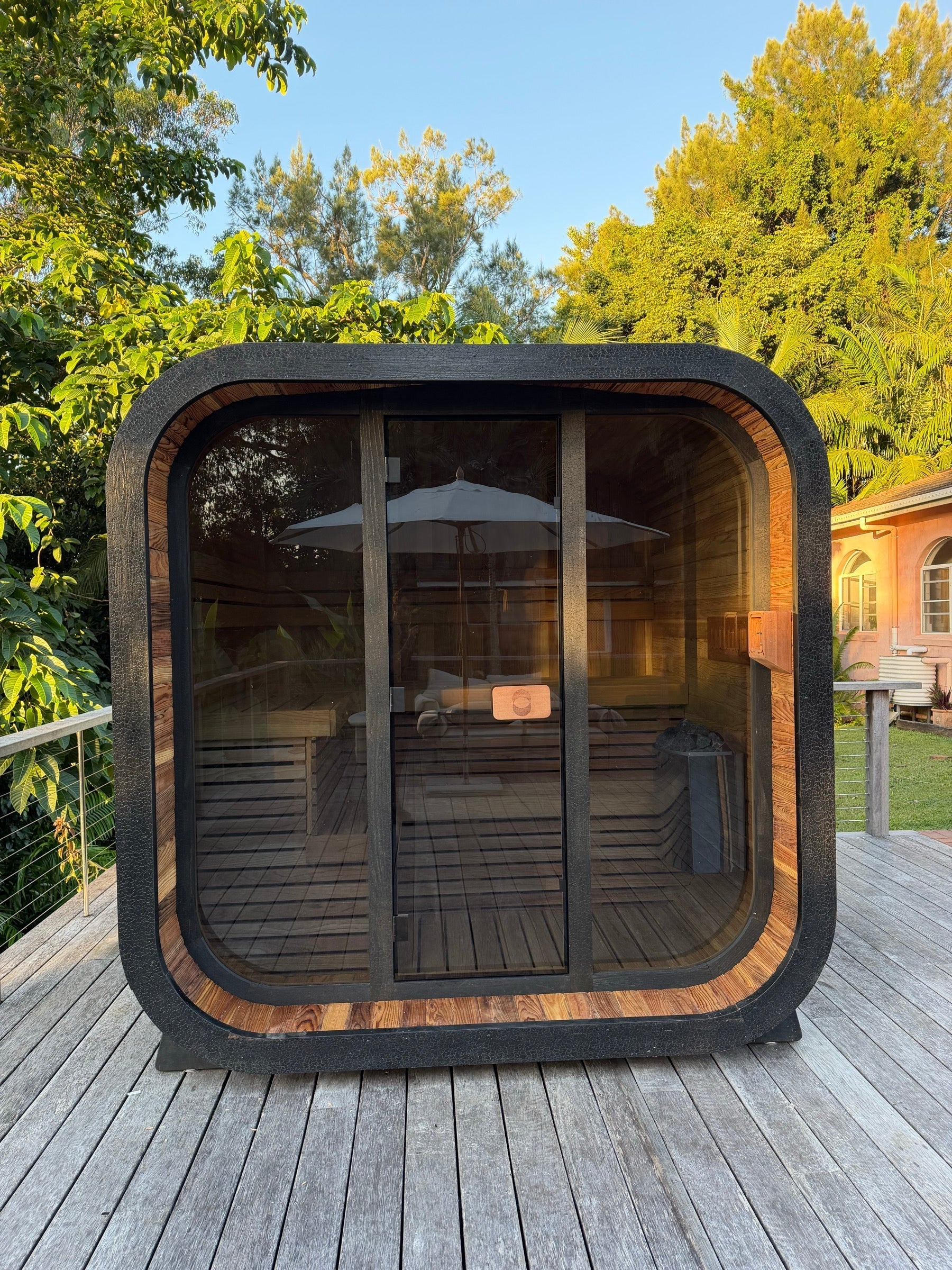
Japanese Cedar exterior. Zero-glue construction. HUUM Drop heater. Active mechanical ventilation engineered for Australian conditions.
SEE THE GENESIS →What Happens Inside a Poorly Ventilated Sauna
The problems are measurable, not theoretical. When you sit in an enclosed sauna without active air exchange, four things happen - and all four degrade your session.
CO2 accumulation. Every exhale releases air containing approximately 4% CO2 - roughly 100 times the concentration of fresh outdoor air (0.04%). Without continuous extraction, CO2 builds rapidly in the lower cabin, causing headaches, dizziness, and the heavy, suffocating feeling that makes people cut sessions short.
Oxygen depletion. In a crowded, unventilated cabin, oxygen levels can drop from 21% to as low as 16%. At that concentration, cognitive function degrades and physical discomfort increases - the opposite of a recovery protocol.
Heat stratification. Hot air rises. Without mechanical circulation, the temperature difference between head height and floor level can reach 60°C in a poorly designed cabin. Your upper body overheats while your legs stay cool. That is not a sauna session - it is a stress response.
Moisture accumulation. Each breath releases approximately 5-6% water vapour. Without extraction, that moisture saturates the timber, creating the conditions for mould, mildew, and structural degradation. A 2019 review published in the International Journal of Environmental Research and Public Health noted that moisture control is among the most critical factors in maintaining hygienic sauna conditions over time.
How Psycle's Active Mechanical Ventilation System Works
Psycle engineered an active mechanical ventilation system that solves all of the above simultaneously. It is not a passive gap - it is a controlled convective loop, designed around the same airflow principles used in traditional Finnish public saunas.
Fresh Air Intake Above the Heater
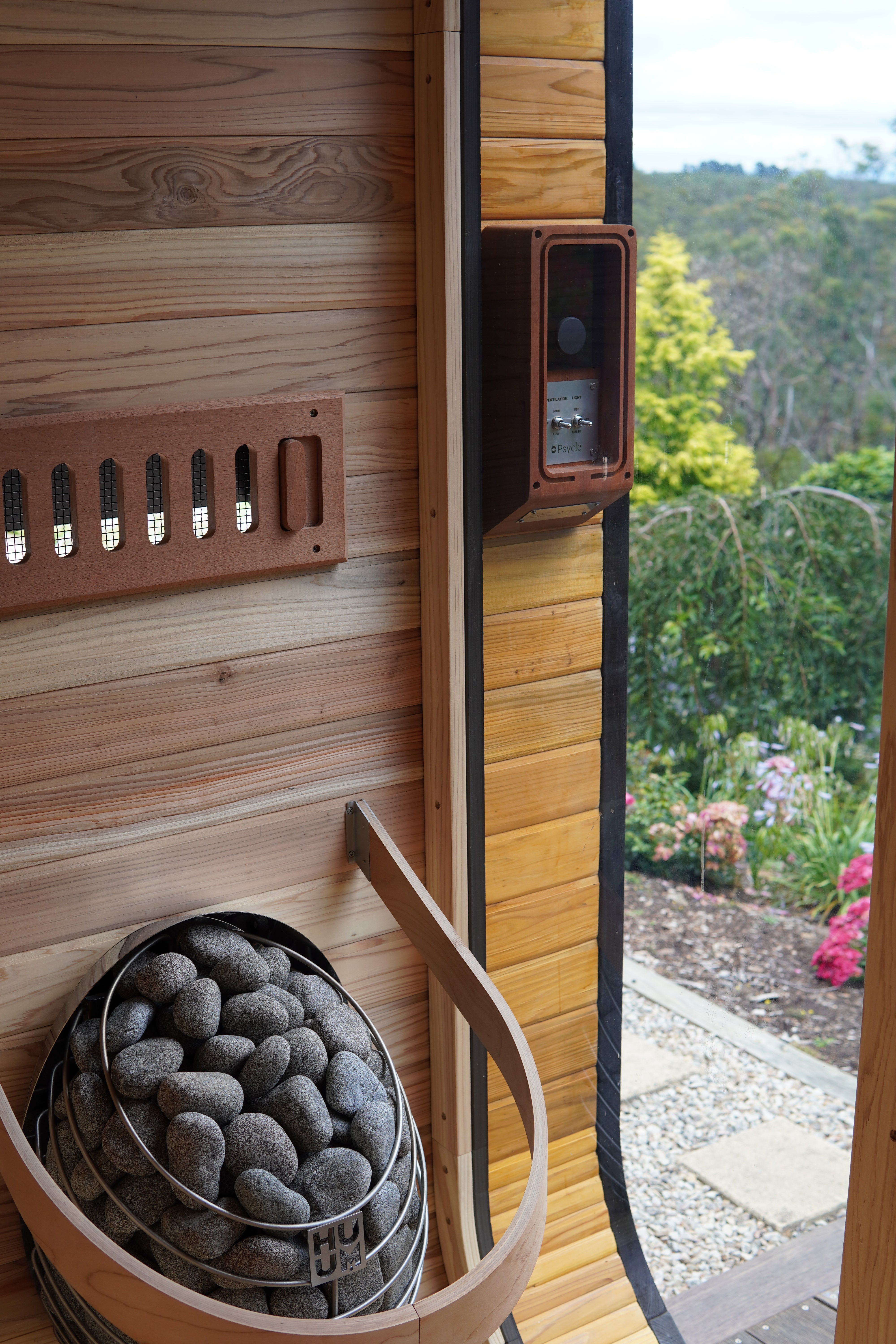
The intake vent is positioned directly above the HUUM Drop heater. Fresh, oxygen-rich air enters and is immediately preheated before reaching the occupants - no cold draughts, no temperature shock. Incoming air is conditioned to sauna temperature before it circulates through the cabin.
CO2 Extraction Below the Bench Line
CO2 is denser than oxygen and settles low. The exhaust vent is placed below the seating area - precisely where stale, CO2-heavy air accumulates. This creates a continuous convective loop: warm fresh air rises, circulates, and pulls the spent air downward and out.
Eliminating Heat Stratification
The convective loop circulates warm air evenly from floor to ceiling. The 60°C head-to-floor differential documented in poorly ventilated saunas is eliminated. What replaces it is consistent, enveloping heat across the entire body - which is what produces the cardiovascular and thermoregulatory responses the research actually documents.
Moisture Control and Structural Integrity
Continuous air exchange removes moisture before it saturates the timber. The Genesis uses zero-glue mechanical joinery throughout - because glued joints fail when timber cycles through repeated heat and humidity stress. Active ventilation protects that investment by keeping moisture levels stable.
A 2018 study by Laukkanen et al. published in Mayo Clinic Proceedings found that regular sauna use was associated with a 50% reduced risk of fatal cardiovascular events in men who used saunas four to seven times per week. That outcome is only achievable in sessions people can actually complete - which requires breathable, even heat. Read more about sauna and cardiovascular health and the research behind it.
Passive vents placed at head height extract the wrong air. The Psycle system extracts the right air - from where CO2 actually builds - and replaces it with preheated, oxygenated intake air before it reaches you.
The Sauna That Doesn't Compromise
Active mechanical ventilation at 88-120 m³/hr. Zero-glue construction. HUUM Drop 9kW heater with 60kg stone volume. Built to run daily for decades.
EXPLORE THE GENESIS →Why Most Home Saunas Get Ventilation Wrong
Most flat-pack and imported saunas are designed to a price point. Ventilation is expensive to engineer correctly - it requires precise vent placement, mechanical components, and rigorous testing across temperature ranges. Cutting it means a lower landed cost and a wider margin. The buyer pays for that decision in every session.
The tell is simple: if a sauna manufacturer does not specify exactly where intake and exhaust vents are positioned, and why, they have not engineered the system. They have included a vent. That is not the same thing.
Psycle saunas were designed by founders who tested poorly ventilated setups firsthand and refused to replicate them. The mechanical ventilation system in the Genesis and Genesis Mini is not a feature - it is a baseline requirement. Without it, you do not have a functional sauna. You have a hot box.
If you are comparing options, our complete home sauna buyer's guide for Australia covers what to scrutinise before committing to any brand.
How the Genesis Ventilation Spec Compares to Standard Home Saunas
| Feature | Standard Flat-Pack Sauna | Psycle Genesis |
|---|---|---|
| Ventilation type | Passive (door gap + wall vent) | Active mechanical, 88-120 m³/hr |
| Intake position | Unspecified or door gap | Above heater - preheats incoming air |
| Exhaust position | High wall vent (extracts warm air, not CO2) | Below bench - extracts CO2 where it accumulates |
| Heat stratification | Up to 60°C head-to-floor differential | Eliminated by convective loop |
| Moisture management | Saturates timber - mould within ~18 months | Continuous extraction - stable humidity |
| Construction | Glued MDF or pine - degrades under humidity | Zero-glue Japanese Cedar, mechanical joints |
| Warranty | Typically 1-2 years | 3-year cabin warranty |
The Ventilation Standard in the Genesis and Genesis Mini
Both the Genesis (3-5 person) and Genesis Mini (2-3 person) use the same active mechanical ventilation specification. The system is integrated into the zero-glue Japanese Cedar construction, positioned precisely relative to the HUUM Drop heater, and engineered to perform consistently at 70-100°C across Australian climate conditions - from coastal humidity to inland heat.
The Genesis runs a HUUM Drop 9kW heater with 60kg of Olivine diabase stone on a 50A dedicated circuit. The Genesis Mini uses a HUUM Drop 6kW heater on a 32A circuit. Both heaters are the anchor point for the intake vent - because the physics of convective airflow requires fresh air to enter where heat is generated, not wherever it is convenient to cut a hole.
The ventilation system operates at 88 m³/hr on low and 120 m³/hr on high. That is a specified, tested figure - not a passive estimate. It is the kind of detail that separates a sauna built on engineering principles from one built on a flatpack template.
Understanding how temperature and airflow interact is central to session quality. Our guide to optimal sauna temperature covers the range that produces real physiological outcomes and how ventilation underpins it.
What Proper Ventilation Delivers in Practice
The outcomes are measurable. When the air in a sauna is fresh, oxygenated, and evenly distributed, sessions run longer, the body responds correctly, and the physiological benefits the research documents are actually accessible.
- Consistent oxygen levels - no cognitive fog, no dizziness, no premature exit
- Even heat distribution - full-body thermal response, not overheated shoulders and cold feet
- Controlled humidity - Löyly that enhances the session, not moisture that degrades the timber
- No CO2 accumulation - every breath is clean and effortless, session after session
- Structural longevity - timber that stays dry stays stable - the cabin performs the same in year ten as it did in year one
Ventilation is also what makes contrast therapy protocols viable. If you cannot complete a full heat session, pairing the sauna with a cold plunge loses most of its value. Our complete guide to contrast therapy in Australia covers the full protocol - and why session quality on the heat side determines the outcome on the cold side.
If session duration is where you want to start, our guide to how long to stay in a sauna by goal and experience level gives you the benchmarks. None of those benchmarks are achievable in a poorly ventilated cabin.
Frequently Asked Questions: Sauna Ventilation
Does a home sauna need ventilation?
Yes. Sauna ventilation is not optional - it is the difference between a functional sauna and a hot, stagnant box. Without active air exchange, CO2 builds to headache-inducing levels, oxygen drops, heat stratifies unevenly, and moisture saturates the timber within 18 months. A sauna without proper ventilation is not a wellness tool. It is a poorly engineered enclosure.
What is the difference between passive and active sauna ventilation?
Passive ventilation relies on a door gap and a wall vent to create natural airflow. It is low-cost to include and largely ineffective - it cannot control where air enters or exits, and it has no capacity to extract CO2 from below the bench where it accumulates. Active mechanical ventilation uses a forced-air system with precisely positioned intake and exhaust vents to create a continuous, controlled convective loop. The Genesis runs 88-120 m³/hr of active airflow. There is no comparison.
Where should sauna ventilation vents be positioned?
The intake vent should be positioned above the heater so fresh air is preheated before reaching occupants. The exhaust vent should be placed below the bench line - below seating level - because CO2 is denser than oxygen and settles low. A high wall exhaust vent extracts warm air, not the stale CO2-heavy air that causes dizziness and discomfort. Vent placement is the engineering decision most manufacturers get wrong.
Can poor sauna ventilation cause health problems?
Yes. In an unventilated sauna, CO2 can reach 4% concentration - 100 times outdoor levels - causing headaches and dizziness. Oxygen levels can fall to 16%, at which point cognitive function degrades. Heat stratification creates extreme temperature differentials that overheat the upper body while the lower body stays cold, generating an uneven stress response. These are not theoretical concerns - they are measurable outcomes in cabins that rely on passive airflow only.
How does sauna ventilation affect timber and long-term construction quality?
Without active moisture extraction, water vapour saturates the timber during every session. This causes mould growth behind panels within approximately 18 months and accelerates the expansion-contraction cycles that destroy glued joints. Psycle uses zero-glue mechanical joinery throughout - and active ventilation to keep humidity stable - because the two engineering decisions work together. Dry timber stays structurally sound. Saturated timber does not.
Ready to Build This Into Your Routine?
Free Australia-wide delivery. 3-year cabin warranty. $1,000 refundable deposit. 120-day build - engineered for the long game.
SHOP THE GENESIS →