
Best Home Sauna Australia: The Complete Buyer's Guide
Best Home Sauna Australia

Key Takeaways
- The best home sauna in Australia is a traditional Finnish-style sauna operating at 80–100°C — not infrared, not steam. Heat, stone, and löyly.
- A landmark 20-year Finnish study found that sauna use 4–7 times per week reduces fatal cardiovascular disease risk by 50% compared to once-weekly bathing.
- Most Australian home saunas are built with glued MDF or particle board — materials that off-gas formaldehyde at high heat. Timber species and construction method are the first things to check.
- The Genesis by Psycle Wellness uses 38mm Japanese Cedar walls, zero-glue mechanical joints, and a non-VOC oil finish throughout — no off-gassing at any temperature.
- Running a Genesis costs approximately AU$0.50–$1.00 per 45-minute session at current Australian electricity rates — less than a single commercial sauna drop-in.
- Active mechanical ventilation (88–120 m³/hr) is non-negotiable for air quality and structural longevity — most flat-pack saunas have neither.
- The Genesis ships Australia-wide with a 120-day build lead time and a 3-year cabin warranty — the longest in the Australian market.
By Psycle Wellness · Last updated: May 2026 · 16 min read
The best home sauna in Australia is a traditional Finnish-style sauna — 38mm timber walls, volcanic stone heater, real löyly, and zero toxic materials. A landmark 20-year study found that sauna use 4–7 times per week cuts fatal cardiovascular disease risk by 50%. The question is not whether to buy one. The question is what you're actually buying.
Why Most Home Saunas Sold in Australia Are Not Worth the Investment
Walk into a large home improvement warehouse or scroll through an Australian e-commerce marketplace and you will find home saunas listed from $1,500 to $8,000. They look the part in photographs. Tongue-and-groove timber. Glass doors. A heater control panel that glows. Then you look closer.
Most of those cabins are built with hemlock or spruce sourced from softwood plantations, framed with MDF or particle board, and assembled with industrial adhesive. Heat that construction to 90°C and you are not creating a wellness environment. You are activating formaldehyde off-gassing — directly into air you are breathing deeply, for 20–40 minutes, multiple times per week.
That is not a small compromise. That is the definition of the opposite of what a sauna is supposed to do.
The flat-pack category also consistently fails on structural basics. Walls that are 16–20mm thick lose heat faster than they hold it. Heaters undersized for the cabin volume never reach proper Finnish sauna temperature. Ventilation is passive at best — a small hole near the floor and another near the ceiling — which means the air inside stagnates, the timber degrades faster, and the session feels nothing like what a real sauna should feel like.
A genuine Finnish sauna operates at 80–100°C with 10–20% relative humidity, climbing briefly to 40–60% after löyly. That thermal environment is what produces the physiological responses documented in peer-reviewed literature. A cabin hitting 60°C with a 1.5kW underpowered heater and no stones produces none of those outcomes — and you still paid several thousand dollars for it.
If you are researching the best home sauna in Australia, you need to understand the full picture — materials, heater engineering, ventilation, and what each of those decisions means for your health, your home, and your investment over 10 to 20 years. Our complete home sauna Australia buyer's guide covers the landscape. This article goes deeper: what separates the genuine article from the category noise, and what zero-toxin engineering actually looks like in practice.
What Makes a Finnish Sauna Actually Finnish
A Finnish sauna is defined by specific conditions: high dry heat (80–100°C), a stone-filled heater capable of producing löyly when water is poured, and a timber cabin engineered to hold that temperature without degrading or off-gassing. Everything else is a variation on a different product category.
Infrared saunas operate at 50–70°C and produce radiant heat through carbon or ceramic panels — no stones, no löyly, no steam response. They are a different product with a different thermal experience. For a direct breakdown of how the two compare physiologically and practically, our guide to traditional vs infrared sauna covers the evidence in full. The short version: if you want the cardiovascular and longevity outcomes documented in Finnish research, you need a traditional sauna at traditional temperatures.
A landmark 20-year cohort study of 2,315 Finnish men by Laukkanen et al., published in JAMA Internal Medicine (2015), found that sauna use 4–7 times per week reduced the risk of fatal cardiovascular disease by 50% compared to once-weekly bathing. That research was conducted in traditional Finnish saunas at 80–100°C. The evidence base does not extend to lower-temperature infrared sessions.
The KIHD cohort study by Laukkanen et al. (2015, JAMA Internal Medicine), following 2,315 men over 20 years in Finland, also found that men who used the sauna 4–7 times per week had a 40% lower risk of all-cause mortality compared to once-weekly users. Frequency and temperature are the two variables that matter. Both require an engineered product built to sustain them.
The Engineering Standard: What a Zero-Toxin Home Sauna Looks Like
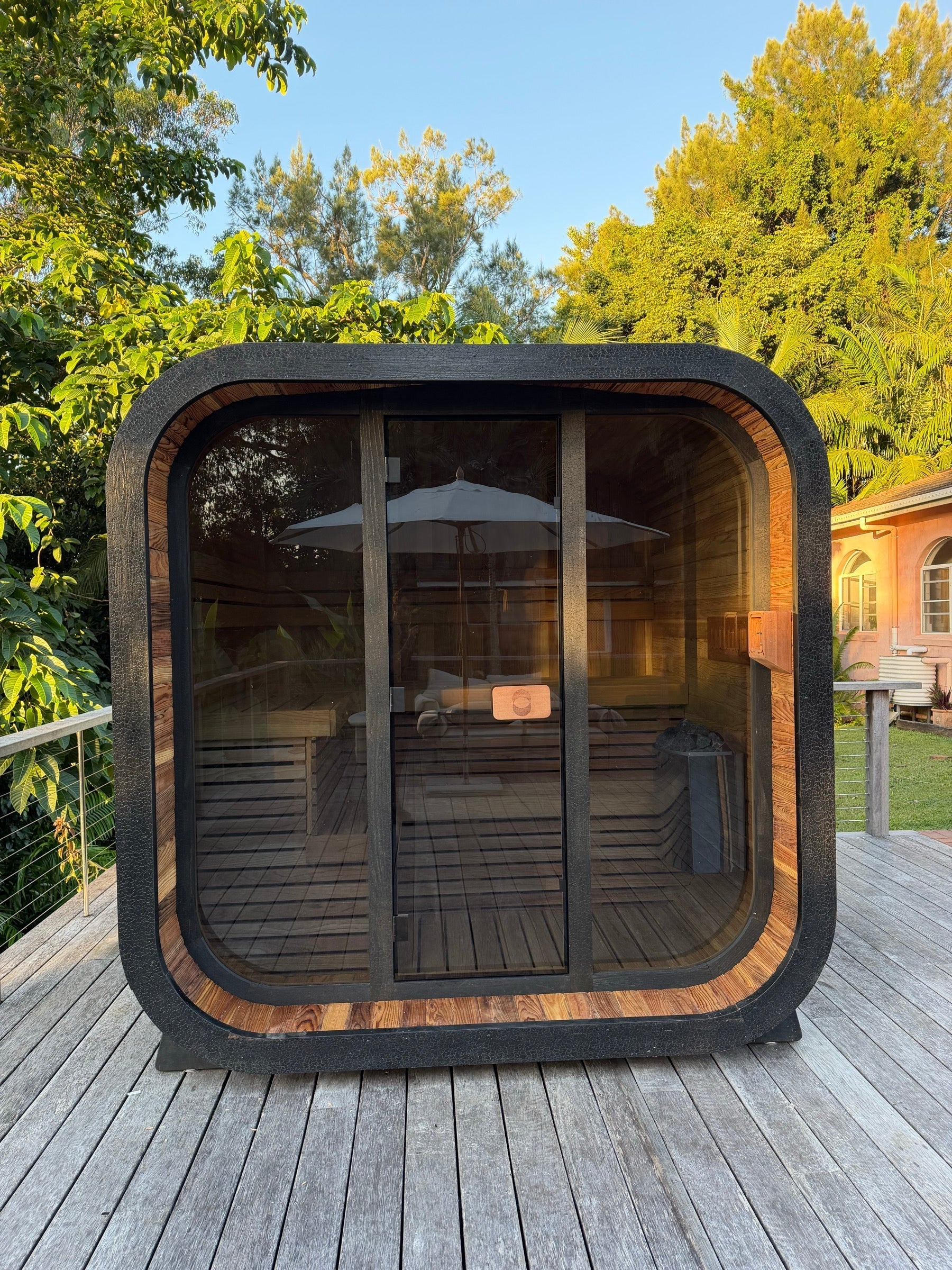
The Genesis is the Psycle Wellness flagship home sauna. It is a 3–5 person traditional Finnish-style cabin built to a specification that eliminates every compromised material decision that defines the flat-pack category.
The construction starts with Japanese Cedar — a naturally aromatic, thermally stable timber with a fine grain structure that expands and contracts predictably under repeated heat cycling. The walls are 38mm thick. That is not decorative. That is the minimum required to hold 90°C ambient heat without the surface temperature spiking on the exterior or the insulation failing over time. Compare that to the 16–20mm panels standard in budget Australian saunas and you are comparing a structural product to a furniture product.
Zero-glue mechanical joints mean there is no adhesive anywhere in the cabin construction. No formaldehyde. No off-gassing compounds that activate at high temperature. The non-VOC oil finish applied throughout eliminates the final source of chemical contamination that persists in glued MDF assemblies — even premium-looking ones. You are breathing clean air at 90°C, not chemical steam.
The glass is 8mm safety laminated tempered glass — a dual-layer 4+4mm construction with a grey tint. That specification handles the thermal cycling without cracking risk and meets Australian safety glazing standards. Budget saunas typically use 4–6mm single-pane glass that clouds and stresses over time.
Heater Options: HUUM DROP vs Harvia Vega
The Genesis offers two heater configurations — both 9kW and both loaded with Olivine diabase stone, which is the volcanic rock type used in traditional Finnish saunas for its density, thermal mass, and heat retention properties.
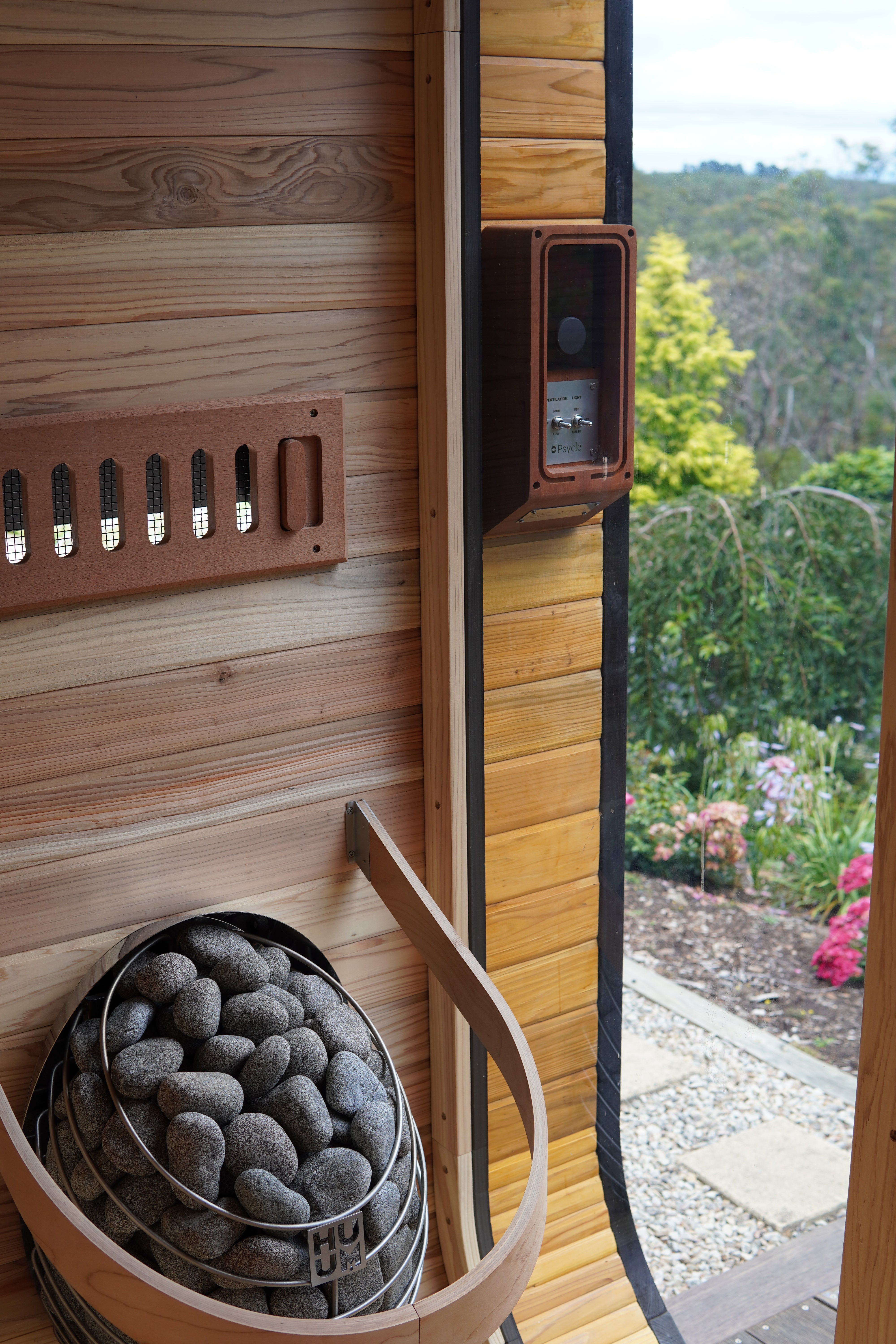
The HUUM DROP 9kW carries 60kg of Olivine diabase stone. That stone mass is what produces genuine löyly — when you pour water over 60kg of volcanic rock heated to temperature, the steam response is immediate, full, and sustained. The temperature does not drop mid-session. The DROP connects to the HUUM UKU WiFi app, so you can preheat remotely and arrive to a cabin already at temperature. For a full breakdown of what löyly actually is and why stone volume matters, our löyly sauna guide covers the detail.
The Harvia Vega 9kW carries 20kg of Olivine diabase stone with fully mechanical controls — no app, no connectivity, no dependency on a WiFi network. For users who want a physically controlled, analogue sauna experience, the Vega delivers it. Both heaters carry a 3-year warranty.
Both options require a 50A dedicated circuit (single or three phase). This is not a plug-in appliance. Before ordering, confirm your electrical panel can support a 50A circuit or budget for the switchboard upgrade as part of your installation planning. Our home sauna installation guide walks through the electrical and site requirements in full.
| Specification | HUUM DROP 9kW | Harvia Vega 9kW |
|---|---|---|
| Power output | 9kW | 9kW |
| Stone volume | 60kg Olivine diabase | 20kg Olivine diabase |
| Controls | WiFi UKU app + manual | Mechanical only |
| Remote preheat | Yes — app-controlled | No |
| Löyly performance | Exceptional — high stone mass | Good — lower stone mass |
| Warranty | 3 years | 3 years |
Lighting, Ventilation, and the Details That Actually Matter
Blue-light exposure suppresses melatonin production and disrupts sleep architecture — the opposite of what you want from a post-training or evening sauna session. Every Genesis cabin uses IP67-rated amber (585–590nm) and red (630–635nm) LED lighting that has no blue-light component. These wavelengths are rated to withstand 200°C. The lighting will not degrade in the heat. Your sleep will not be disrupted by the session that was meant to support it.
Ventilation is where most Australian home saunas fail structurally, not just experientially. Inadequate air exchange creates stale, oxygen-depleted air inside the cabin — which makes sessions uncomfortable and accelerates timber degradation from humidity accumulation. The Genesis runs active mechanical ventilation at 88 m³/hr (low) and 120 m³/hr (high). Fresh air is drawn in, hot stale air is expelled, and the timber environment stays controlled. Our full sauna ventilation guide explains why this is a non-negotiable specification and what to look for in any sauna you consider.
The cabin dimensions are 2289H × 2288W × 1945D mm. It ships at approximately 600kg and requires a level surface — indoor or outdoor — with appropriate drainage consideration. For placement on an outdoor deck, the optional Colorbond roof kit allows fully exposed year-round installation in any Australian climate. For more on outdoor placement requirements and site preparation, our outdoor sauna Australia guide covers everything you need to confirm before ordering.
Zero-Toxin Finnish Sauna, Built in Australia
38mm Japanese Cedar. Zero-glue construction. HUUM DROP 9kW with 60kg of volcanic stone. IP67 blue-light-free lighting. 3-year cabin warranty. Ships Australia-wide.
SEE THE GENESIS →The Science Behind Traditional Sauna Use in Australia
Traditional sauna therapy produces measurable, repeatable physiological outcomes that are well-documented in peer-reviewed literature. Understanding the evidence is important — not because it is a sales argument, but because it determines which product category actually delivers results and which one is theatre.
A 2018 meta-analysis by Dupuy et al. in Frontiers in Physiology, covering 99 studies and over 1,000 athletes, found cold-water immersion and contrast water therapy to be among the most effective recovery modalities for reducing muscle soreness and perceived fatigue. This is the research base behind contrast therapy — the pairing of sauna heat with cold plunge immersion that has become a cornerstone of serious recovery protocols in Australia. Our guide to contrast therapy Australia covers the full protocol and the evidence in detail.
The cardiovascular effects are similarly well-established. Repeated exposure to temperatures of 80–100°C drives peripheral vasodilation, increases cardiac output, and produces haemodynamic adaptations comparable to moderate-intensity aerobic exercise. This is the mechanism behind the Laukkanen et al. findings on cardiovascular mortality — it is not a passive experience. For a full breakdown of what the evidence shows for traditional sauna use, our traditional sauna benefits science-backed guide covers the research in depth.
Beyond cardiovascular outcomes, regular sauna use shows documented effects on sleep latency and sleep architecture, testosterone levels, and skin health. If you are building a daily recovery protocol around a home sauna, understanding the sauna for sleep science, the testosterone evidence, and the skin benefit data will help you dial in the protocol variables that matter — session duration, frequency, and timing relative to training and sleep.
How long you should stay in the sauna, how hot it needs to be, and how often you need to use it to see measurable outcomes are questions with specific, evidence-based answers. Our guides on sauna session duration, optimal sauna temperature, and sauna frequency give you the numbers without the hedging.
Genesis vs Genesis Mini: Choosing the Right Size
Psycle Wellness offers two cabin sizes — the Genesis (3–5 person) and the Genesis Mini (1–3 person). Both are built to identical zero-toxin specification: 38mm Japanese Cedar walls, zero-glue construction, non-VOC oil finish, IP67 blue-light-free lighting, active mechanical ventilation, and 8mm safety laminated tempered glass. The materials do not change between models. The scale does.
| Specification | Genesis | Genesis Mini |
|---|---|---|
| Capacity | 3–5 persons | 1–3 persons |
| External dimensions | 2289H × 2288W × 1945D mm | 2267H × 1571W × 1950D mm |
| Wall thickness | 38mm Japanese Cedar | 38mm Japanese Cedar |
| Heater options | HUUM DROP 9kW or Harvia Vega 9kW | HUUM DROP 6kW or Harvia Vega 6kW |
| HUUM stone volume | 60kg Olivine diabase | 60kg Olivine diabase |
| Circuit requirement | 50A dedicated circuit | 32A dedicated circuit |
| Shipping weight | ~600kg | ~350kg |
| Sauna hats included | 3 Australian wool sauna hats | 2 Australian wool sauna hats |
| Cabin warranty | 5 years | 5 years |
The Genesis Mini is the right choice for apartments with a large balcony, compact outdoor decks, or households with one or two regular users. The 32A circuit requirement is also more likely to be achievable without a switchboard upgrade in older homes. It takes up less footprint without taking any shortcuts on materials.
If you have the space, the Genesis is the obvious choice. The 3–5 person capacity means it functions as a household asset, not a personal device. It holds its value over time — and a sauna used daily by two people for 10 years has already returned its purchase price in commercial sauna visits alone. For a full cost-per-use breakdown across both models, our guide to home sauna cost Australia runs the numbers.
What Australians Who Own a Genesis Actually Say
The buyers who choose a Genesis have typically spent three to six months researching. They have looked at barrel saunas, flat-pack units, and commercial infrared brands. By the time they order, they are not looking for reassurance. They are confirming a decision they have already made on the evidence.
What comes back consistently in post-delivery feedback is not about aesthetics — though the charcoal Shou Sugi Ban finish tends to earn strong comments. It is about the thermal experience. The HUUM DROP at full temperature with 60kg of volcanic stone produces a heat quality that flat-pack saunas simply cannot replicate. When you pour löyly over 60kg of stone, the steam response fills the cabin instantly and the temperature does not recover slowly — it holds.
The other consistent theme is daily use. Australians who install a Genesis use it. Not twice a week, not when they remember — daily. That frequency shift is what produces the physiological outcomes in the research. When the infrastructure is in your home, engineered to the standard you expect, you use it. And when you use it at 4–7 sessions per week, the data starts to show up in your recovery markers.
“I've run this protocol daily for 90 days. My recovery markers don't lie.” That is the kind of outcome that drives word-of-mouth referrals among high performers. Not brand loyalty — measured results.
Built for Daily Use. Engineered to Last.
Over 200 Genesis installations across Australia. 3-year cabin warranty. $1,000 refundable deposit. 120-day build — order now to lock in your lead time.
EXPLORE THE GENESIS →Running Costs and Australian Lifestyle Context
At Australian residential electricity rates of AU$0.30–$0.35 per kWh, a 45-minute Genesis session running a 9kW heater costs approximately AU$0.50–$1.00. That is the ballpark figure for a single session, fully loaded.
Compare that to the alternatives. A commercial sauna or gym recovery suite in Sydney or Melbourne typically charges AU$25–$45 per session. A physio consult runs AU$100–$160 per session. A mid-range gym membership with recovery access costs AU$1,200–$2,400 per year — and you still have to drive there, wait for the sauna to free up, and time your sessions around someone else's facility schedule.
Over a 10-year lifespan at one session per day, a Genesis costs less than AU$0.10 per session in electricity. At two sessions per day for a household of two, the per-person running cost is negligible. The upfront capital is not cheap — it is not meant to be. But the per-session economics are fundamentally different from any other delivery model for this experience.
Australia's climate adds another layer of context. In Queensland, Northern Territory, and Western Australia, ambient temperatures during summer make outdoor sauna use in the middle of the day impractical — but early morning and evening sessions on a timber deck in those climates are exceptional. The Genesis with the optional Colorbond roof kit is rated for fully exposed outdoor placement year-round. The cedar exterior ages beautifully in UV and humidity. It is designed for the Australian outdoor lifestyle, not imported from a Nordic context and hoped to survive it.
In Victoria and New South Wales, the contrast between a 90°C sauna and cold air on a winter morning is something that flat-pack saunas simply cannot produce — because they cannot hold 90°C when the ambient temperature drops. The 38mm walls and active ventilation of the Genesis mean the cabin temperature stays where it is set regardless of what is happening outside. That is structural engineering, not marketing language.
If you are considering pairing your sauna with a cold plunge — which the research strongly supports — our guide to sauna and cold plunge in Australia covers the contrast therapy protocol, the physiological rationale, and what to consider when placing both on the same site. The Contrast Kit (Genesis + Origin cold plunge) is available as a bundle for buyers who want to build the full protocol from day one.
Home Sauna Australia: How to Compare Your Options Before You Buy
Most Australians researching the best home sauna will encounter five or six recurring categories: flat-pack sauna kits, barrel saunas, infrared cabins, prefabricated Finnish-style rooms, and custom installations. Each has a different price point, material standard, and experience profile. Knowing what you are comparing before you spend is the entire job.
| Category | Typical Price (AUD) | Timber Standard | Temperature | Key Weakness |
|---|---|---|---|---|
| Flat-pack / kit sauna | $1,500–$6,000 | Hemlock / spruce, 16–20mm, often glued MDF frame | 50–75°C (practical) | Off-gassing, poor heat retention, inadequate stone mass |
| Barrel sauna | $3,500–$12,000 | Western red cedar or pine, variable construction | 70–90°C | Curved geometry wastes space, limited bench area, aesthetic only |
| Infrared cabin | $2,000–$15,000 | Hemlock or cedar panels, varied construction | 50–70°C | Different product category — no löyly, limited research at this temperature |
| Custom installation | $40,000–$120,000+ | High-grade, site-specific | 80–100°C | Long lead times, major construction, not relocatable |
| Genesis (Psycle Wellness) | See thepsycle.com | 38mm Japanese Cedar, zero-glue, non-VOC finish | 80–100°C | 120-day lead time, 50A circuit required |
The barrel sauna category deserves a direct mention because it is visually popular in Australian outdoor lifestyle content. A barrel sauna is an aesthetically interesting product. It is not an engineered one. The curved geometry reduces usable bench space, creates uneven heat distribution, and limits how the cabin can be positioned on site. For a detailed breakdown of where barrel saunas fit in the category, our barrel sauna Australia guide covers the full comparison.
The custom installation market — European sauna rooms built into homes — is the category that the Genesis competes with on experience and outperforms on economics. A custom cedar sauna room built by a Scandinavian specialist in Sydney or Melbourne starts at AU$40,000 and regularly reaches AU$120,000 or more by the time tiling, plumbing, electrical, and structural work are included. The Genesis delivers that thermal experience in a relocatable, prefabricated format at a fraction of that investment — with a 3-year cabin warranty included.
If you want to understand where your specific situation fits across the full spectrum of cost and capability, our detailed analysis on home sauna costs in Australia includes site preparation, installation, electrical, and ongoing running cost breakdowns across all categories.
The Contrast Protocol: Pairing Your Sauna With Cold Immersion
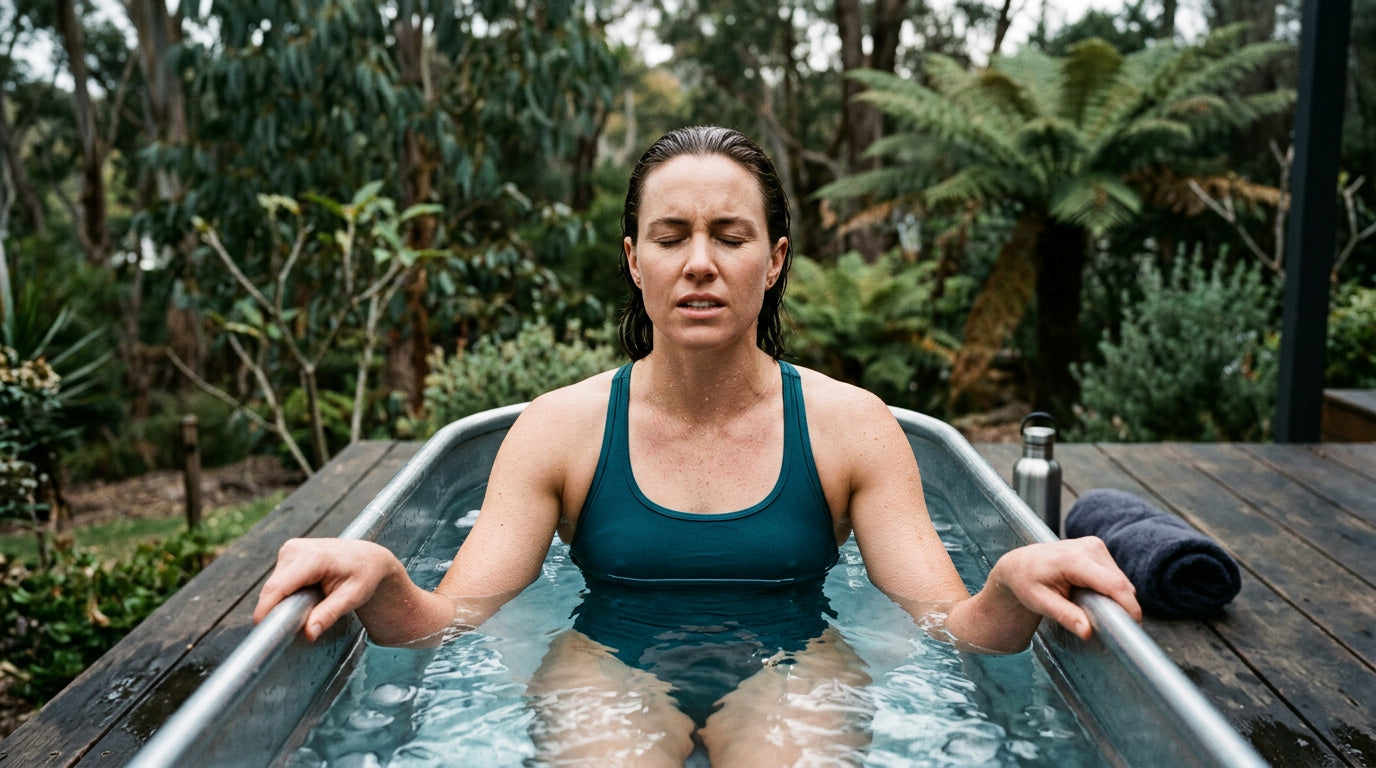
Heat and cold used in sequence produce compounding physiological effects that neither modality produces alone. This is the mechanism behind contrast therapy — and it is the reason Psycle Wellness offers the Genesis as part of the Contrast Kit bundle alongside the Origin cold plunge.
Research published in the European Journal of Physiology found that cold water immersion produces a sustained 250% increase in dopamine levels — a neurological effect that outlasts the cold exposure itself by several hours. Paired with the post-sauna parasympathetic state produced by heat exposure, the contrast protocol creates a recovery and neurological reset that is difficult to replicate through any other single intervention.
The protocol used by performance athletes and high performers in Australia typically follows this structure: 10–20 minutes at 80–100°C in the sauna, followed by 2–5 minutes cold immersion at 10–15°C, repeated for two to three rounds. The final round ends with cold. The entire session runs 45–75 minutes. For a detailed breakdown of the session structure, timing, and physiological rationale, our guide to contrast therapy in Australia covers the protocol in full.
Heat — 10–20 minutes
Enter the sauna at 80–100°C. Pour löyly at the midpoint of each round to spike humidity. Stay until you feel full peripheral vasodilation — that sustained heat flush through the extremities.
Cool-down — 2–5 minutes
Cold immersion at 10–15°C. Full body submersion if possible. The thermal contrast drives the dopamine spike and the acute recovery response.
Repeat 2–3 rounds
Each successive round compounds the cardiovascular and neurological response. Most serious protocols run three rounds for a total session of 45–75 minutes.
End on cold
Always finish the final round in the cold plunge. This locks in the norepinephrine and dopamine response. Do not return to the sauna after the final cold immersion.
For a full breakdown of the cold plunge side of this equation — what to look for in an ice bath, the difference between chiller-based and ice-based systems, and the evidence for cold water immersion outcomes — our guide on cold plunge benefits in Australia covers the research in depth.
Frequently Asked Questions: Best Home Sauna Australia
What is the best home sauna for Australia?
The best home sauna for Australia is a traditional Finnish-style sauna with 38mm solid timber walls, a volcanic stone heater capable of reaching 80–100°C, zero-glue construction, and active mechanical ventilation. These specifications ensure the sauna produces the thermal conditions documented in cardiovascular and longevity research, while eliminating the off-gassing risk present in cheaper MDF-framed alternatives. The Genesis by Psycle Wellness is built to this standard and is one of the few prefabricated options in Australia with a 3-year cabin warranty.
How much does a home sauna cost in Australia?
Home saunas in Australia range from AU$1,500 for entry-level flat-pack kits to AU$120,000+ for custom-built installations. Mid-range prefabricated Finnish-style saunas — the category the Genesis competes in — sit at a premium price point that reflects engineered material standards rather than the volume economics of the flat-pack market. For a detailed cost breakdown across all categories including installation, electrical, and running costs, our guide to home sauna costs in Australia covers every variable.
Is a home sauna worth it in Australia?
A home sauna is worth it if you will use it with sufficient frequency to produce measurable outcomes. The research — including the landmark Laukkanen et al. cohort study published in JAMA Internal Medicine — documents benefits at 4–7 sessions per week. Home ownership removes every friction barrier to that frequency: no travel, no scheduling, no availability constraints. At AU$0.50–$1.00 per session in running costs, a Genesis used daily costs less than a weekly commercial sauna visit. The economics work — but only if the product is engineered to sustain daily use for a decade.
Can I install a home sauna outdoors in Australia?
Yes. The Genesis is designed for both indoor and outdoor installation. For fully exposed outdoor placement — including rooftop decks and open backyards — the optional Colorbond roof kit provides year-round weather protection. The Japanese Cedar exterior ages naturally in Australian UV and humidity conditions. The IP67-rated lighting handles rain and moisture. Full outdoor site requirements, including drainage, footing, and clearance specifications, are covered in our outdoor sauna Australia guide.
What is the difference between a traditional sauna and an infrared sauna?
A traditional Finnish sauna operates at 80–100°C using a stone heater and produces both dry heat and steam (löyly). An infrared sauna operates at 50–70°C using radiant panel heat with no stones and no steam response. The cardiovascular and longevity evidence — including the 50% reduction in fatal cardiovascular events documented by Laukkanen et al. — was collected in traditional saunas at traditional temperatures. For a full evidence-based comparison, our guide to traditional vs infrared sauna covers the research directly.
How long does it take to receive a Genesis after ordering?
The Genesis has a build lead time of approximately 120 days from confirmed order. Psycle Wellness ships Australia-wide. A $1,000 refundable deposit secures your order and build slot — production has not begun at that point, so there is no obligation risk for buyers who want to take time to confirm their site preparation before the build commences.
What electrical requirements does a home sauna need in Australia?
The Genesis requires a 50A dedicated circuit (single or three phase). The Genesis Mini requires a 32A dedicated circuit. Both require installation by a licensed Australian electrician. In older homes, this may require a switchboard upgrade. Confirming your electrical panel capacity before ordering is essential — our home sauna installation guide covers the full electrical, site, and logistics requirements for Australian buyers.
Ready to Build This Into Your Routine?
Free Australia-wide delivery. 3-year cabin warranty — the longest in the Australian market. $1,000 refundable deposit. 120-day build — order now for delivery this year.
SHOP THE GENESIS →