
Barrel Sauna Australia: The Complete Buyer's Guide
Barrel Sauna Australia: What They Get Right, What Fails, and What Serious Buyers Choose Instead

A barrel sauna in Australia is a cylindrical, stave-built outdoor sauna, typically constructed from European spruce or Nordic pine, designed to sit in a backyard or on a deck. They appeal for good reason: the round silhouette looks the part, the natural timber aesthetic reads as Finnish, and the price point is accessible. If you are researching barrel saunas in Australia, you are already thinking about the right category of sauna.
What this guide does is go further. It covers what barrel saunas genuinely deliver, where they structurally and technically fall short in Australian conditions, and what the engineering differences are when you compare them against a purpose-built Finnish sauna cabin. By the end, you will have enough specific information to make the right call for your situation.
Why Barrel Saunas Are Popular in Australia
The barrel sauna format has real appeal. The curved stave construction creates a compact interior that heats up faster than a larger rectangular cabin, and the aesthetic reads as authentically Nordic rather than spa-generic. For buyers who want an outdoor sauna without a large footprint, a barrel sauna looks like a sensible starting point.
There is also the price factor. Entry-level barrel saunas are sold in Australia from around $3,000 to $8,000, which clears the psychological barrier for buyers who want to test the category before committing. That price point drives significant search volume and a lot of first-time sauna purchases.
The problem is that the format has genuine engineering constraints, and several of them matter significantly in the Australian climate. Understanding what those constraints are before you buy is the difference between a sauna you use for 10 years and one that deteriorates in three.
For a broader look at all outdoor sauna options available in Australia, our Outdoor Sauna Australia buyer's guide covers the full landscape, including barrel, pod, and cabin formats side by side.
What Consistently Fails: The Engineering Case Against Barrel Saunas in Australian Conditions
This is not a marketing argument. These are structural and mechanical limitations that show up in the engineering of the format itself.
No Active Ventilation — and Why That Matters More Than You Think
Most barrel saunas use passive ventilation only — a small vent near the floor and a gap or vent near the ceiling. In a sealed cylindrical space with no mechanical airflow, CO₂ concentration rises with every breath. Finnish sauna tradition is built around clean, oxygenated air that circulates continuously. A passive vent achieves neither.
A 2015 study by Hannuksela and Ellahham in the American Journal of Medicine confirmed that regular sauna use produces cardiovascular and respiratory benefits — but those benefits assume a well-ventilated environment with clean air exchange. Stale, CO₂-saturated air at 90°C is not a sauna. It is a sealed hot box.
Every session in a barrel sauna without active ventilation is a session in air that was already breathed. The heat is real. The air quality is not. For a detailed breakdown of why ventilation is the most overlooked variable in sauna performance, read our sauna ventilation guide.
European Spruce in Australian Humidity — a Predictable Outcome
The dominant timber used in barrel sauna construction is European spruce or Nordic pine — species selected for cost, not climate performance. Both are softwoods with moderate density and limited natural oil content. In Scandinavia, where ambient humidity is lower and temperature extremes are different, they perform adequately.
In coastal Australian conditions — where humidity regularly exceeds 80% in cities like Sydney, Brisbane, and the Gold Coast — spruce stave construction absorbs moisture aggressively. The expansion and contraction cycles work the joints. The stave-and-groove barrel construction has no tolerance for movement without glue or mechanical fastening, and most budget barrel saunas use neither adequately.
The result is cracking, warping, and joint failure within three to five years in high-humidity Australian environments. You are not buying a 10-year asset. You are buying a sauna with a predictable failure timeline baked in at the material selection stage.
Round Geometry Wastes Usable Floor Space
A barrel sauna listed as a "4-person" unit has a circular cross-section. The usable bench area — the flat portion where you actually sit — is the chord of that circle, not the full diameter. In a 2.2m diameter barrel, the bench footprint accounts for roughly 60–65% of the total floor area. The curved walls reduce effective headroom at the sides, and the geometry limits bench layout to a single-tier configuration in most units.
A rectangular cabin rated for the same occupancy gives you the full internal footprint as usable bench and circulation space. The barrel format looks large from the outside and feels smaller than its specifications once you are inside it.
Heaters Rated Too Low for Australian Outdoor Ambient Temperatures
Standard barrel sauna heaters run at 6kW to 8kW. In a controlled indoor environment, that is sufficient for a small cabin. Outdoors in Brisbane in summer — ambient 30°C, humidity 75% — or in Melbourne in winter — ambient 8°C, strong winds — those heater ratings are marginal to inadequate.
The curved stave construction provides minimal insulation value. There is no thermal mass in thin spruce staves. Heat that escapes through the walls must be compensated by the heater. A 6kW heater competing against a 35°C ambient and poor wall insulation will struggle to sustain 80°C, let alone the 90–100°C that defines an authentic Finnish sauna experience.
The temperature range matters for outcomes too. Research by Dr Jari Laukkanen and colleagues, published in JAMA Internal Medicine in 2018, found that heat therapy benefits including cardiovascular protection, improved endothelial function, and recovery markers are dose-dependent — sessions at 80–100°C produced significantly stronger effects than those at lower temperatures. A heater that cannot sustain that range in your specific climate is not just inconvenient. It is the difference between a functional sauna and an expensive hot room.
m³/hr
What Barrel Sauna Cost in Australia Actually Looks Like
Barrel saunas in Australia range from approximately $3,000 for a basic 2-person imported unit to $12,000–$15,000 for a larger cedar or thermowood build from a quality supplier. Mid-range models — the category most buyers land on — sit between $6,000 and $10,000 delivered.
That price looks competitive against a purpose-built sauna cabin. But it does not account for the total cost of ownership. A barrel sauna that warps and develops joint leaks at year four requires either remediation spend or replacement. A unit that cannot sustain 90°C in your climate is delivering a compromised product from session one. The low sticker price is the headline. The performance gap is the hidden cost.
For a full breakdown of what home sauna investment looks like across all formats, including barrel, cabin, and infrared, our guide to home sauna cost in Australia covers every price tier with specifics. For a complete format comparison and what to look for before you buy, see our home sauna Australia buyer's guide.
Zero-Toxin Finnish Sauna, Built for Australian Conditions
Japanese Cedar. 38mm walls. HUUM Drop 9kW heater. Active mechanical ventilation at 88–120 m³/hr. Built to last decades, not years.
SEE THE GENESIS →The Genesis: What a Serious Australian Sauna Buyer Actually Gets
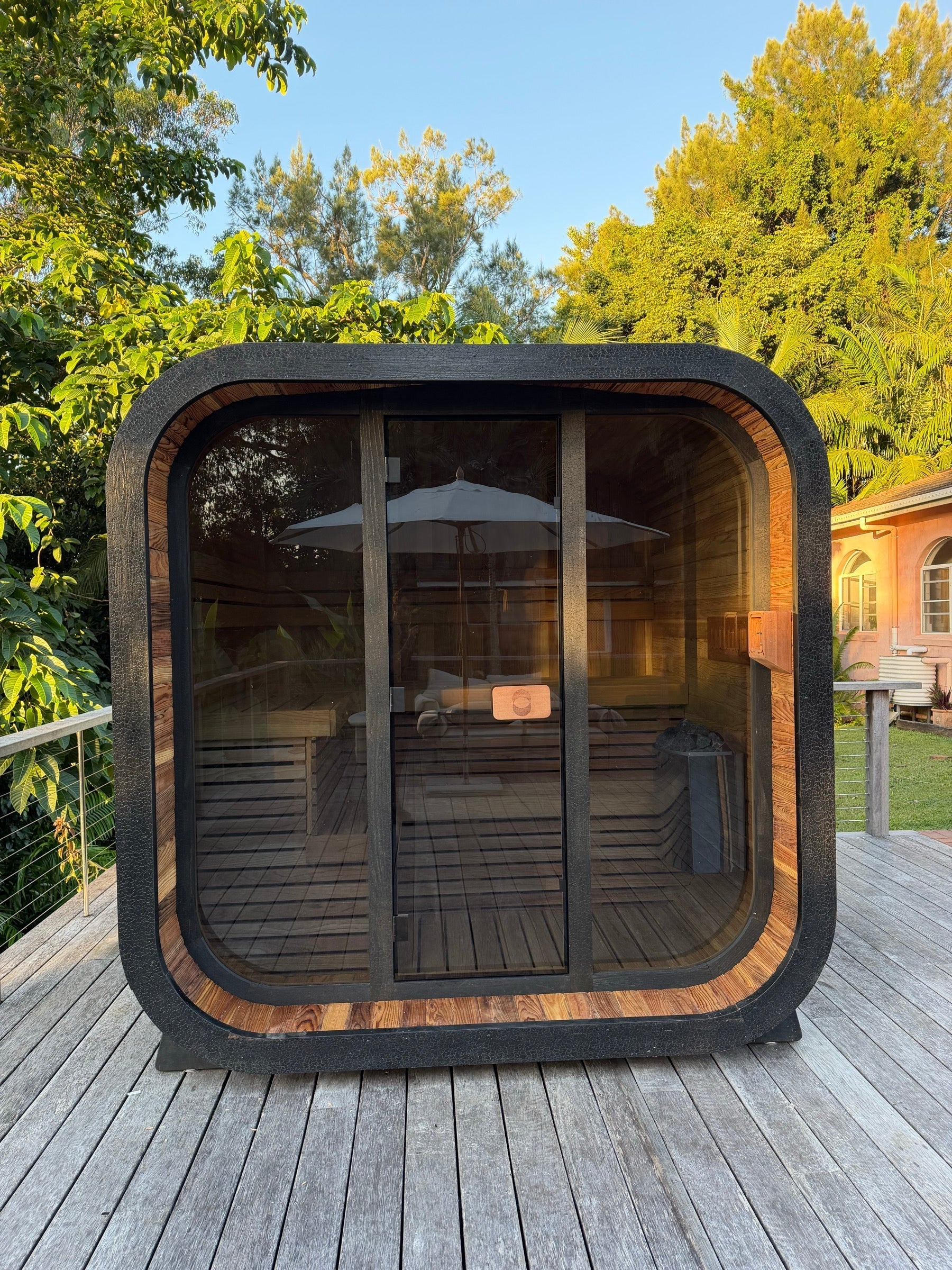
The Genesis is Psycle's flagship 3–5 person traditional Finnish sauna. It was engineered specifically to address the failures that show up in the barrel sauna category — and to do so with materials and mechanical systems that do not compromise.
Japanese Cedar — Not European Spruce
The Genesis uses Japanese Cedar throughout — a dense, naturally oily timber with high inherent moisture resistance and a proven track record in humid climates. Wall thickness is 38mm, compared to the 28mm stave standard in most barrel builds. Japanese Cedar does not crack, warp, or absorb ambient moisture the way European spruce does. It ages well, develops a rich patina, and remains structurally sound across Australian temperature and humidity extremes.
There is no glue in the construction — zero-glue mechanical joints throughout. When you heat that cabin to 90°C, nothing off-gasses. You are breathing Japanese Cedar at altitude-level heat, not formaldehyde vapour from adhesives burning off in the walls.
Active Mechanical Ventilation at 88–120 m³/hr
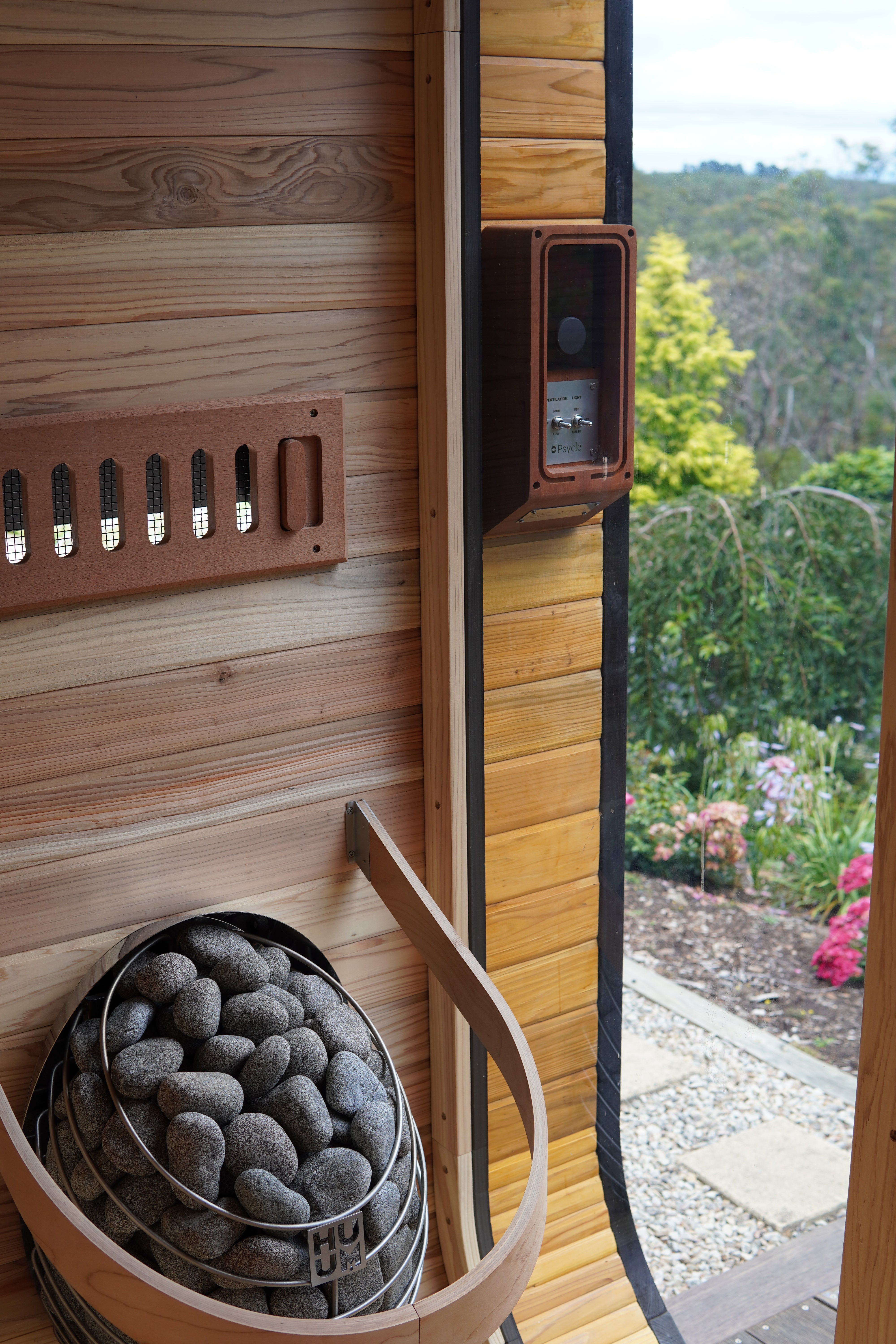
The Genesis runs active mechanical ventilation with two settings: 88 m³/hr low and 120 m³/hr high. This is not a passive vent. It is forced air exchange that continuously cycles fresh air in and exhausts heat and moisture out. The air in a Genesis session is clean for the full duration. The temperature remains stable. CO₂ does not accumulate.
This is what separates a performance sauna from a sealed hot box. If you are doing the reading on why sauna ventilation matters — and you should be — our dedicated sauna ventilation guide explains the mechanics and the research in full.
HUUM Drop 9kW — Heater Built for Serious Sessions
The Genesis is fitted with either the HUUM Drop 9kW or the Harvia Vega 9kW — both rated for the full 80–100°C range regardless of outdoor ambient conditions. The HUUM Drop carries 60kg of Olivine diabase stones, which is the volcanic stone mass that holds heat through repeated löyly throws. The Harvia Vega carries 20kg. Both are 9kW, and both are controlled with precision — the HUUM via the WiFi UKU app, the Harvia via mechanical controls.
A 9kW heater with proper wall insulation in a 38mm Japanese Cedar cabin is not marginal. It sustains temperature. The stone mass ensures the heat does not drop when you throw water. That is what an authentic löyly experience requires, and it is what a 6kW heater in a thin-walled barrel cannot reliably deliver. For the full picture on why löyly steam is central to Finnish sauna tradition, see our löyly guide.
Blue-Light-Free Lighting and Zero-VOC Finish
The Genesis uses IP67-rated LED lighting in amber (585–590nm) and red (630–635nm) wavelengths — both below the blue-light threshold that suppresses melatonin. If you are using your sauna as a pre-sleep recovery protocol, the lighting does not undermine it. The internal finish is non-VOC oil throughout. No off-gassing from stains, lacquers, or sealants at any temperature.
Two finish options: Natural Cedar or Charcoal — the charcoal finish using Shou Sugi Ban, the Japanese charred timber technique that deepens weather resistance and delivers an architectural aesthetic that looks nothing like a flat-pack sauna.
Barrel Sauna vs Genesis: The Definitive Comparison
| Specification | Barrel Sauna (typical) | Psycle Genesis |
|---|---|---|
| Primary Timber | European spruce or Nordic pine | Japanese Cedar (38mm walls) |
| Construction Method | Stave-and-groove, glue-assisted | Zero-glue mechanical joints |
| Internal Finish | Untreated or stained spruce | Non-VOC oil finish throughout |
| Ventilation | Passive vents only | Active mechanical: 88–120 m³/hr |
| Heater Power | 6–8kW typical | HUUM Drop 9kW or Harvia Vega 9kW |
| Stone Volume | 8–15kg typical | 60kg (HUUM) or 20kg (Harvia) Olivine diabase |
| Effective Temperature | 65–85°C (climate-dependent) | 80–100°C sustained |
| Usable Interior Footprint | 60–65% of floor area (curved walls) | Full rectangular footprint |
| Weather Resistance | Moderate — degrades in coastal humidity | IP67 rated, optional Colorbond roof kit |
| Glass | Single-pane or acrylic | 8mm safety laminated tempered glass (4+4mm dual-layer, grey tint) |
| Longevity in AU Climate | 3–5 years before significant degradation | Engineered for decade-plus performance |
| Warranty | 1–2 years (typical) | 5-year cabin / 3-year heater |
| Lighting | Standard LED or none | Blue-light-free: Amber 585–590nm / Red 630–635nm, IP67 |
What Australians Who Have Made the Switch Say
The pattern among Genesis owners who previously owned or seriously considered a barrel sauna is consistent. The surface appeal of the barrel format — the aesthetic, the price — gives way to the specifics once people start comparing engineering rather than photography.
"I had a barrel sauna for three years. The staves started cracking in year two on the sun-exposed side. By year three, I was topping up sealant every summer. The Genesis has been out there for eighteen months in the same spot and it looks exactly the same as the day it was installed."
What buyers consistently flag is the temperature. A Genesis reaching and holding 95°C is a qualitatively different experience from a barrel struggling to sustain 80°C. The stone volume difference alone — 60kg of Olivine diabase in the HUUM Drop versus 10–15kg in a standard barrel heater — produces a denser, more enveloping heat that you feel differently in the body.
If you are weighing the heat therapy evidence and want to understand what outcomes are actually supported by research, our sauna benefits guide for Australians covers the current evidence base in full.
The Sauna That Does Not Compromise
Active mechanical ventilation. 9kW heater. 60kg stone volume. Japanese Cedar that ages, not rots. Australia-wide delivery with a 3-year cabin warranty.
EXPLORE THE GENESIS →Traditional Sauna vs Barrel Sauna: Understanding the Format Difference
A barrel sauna is a format within the broader category of traditional Finnish sauna. It is not a different philosophy — it uses the same heat source, the same stone-and-water löyly mechanism, and produces the same basic thermal experience. The format differences are structural and mechanical, not experiential in principle.
A traditional Finnish sauna cabin — what the Genesis is — uses rectangular construction, which allows full wall insulation, flat interior surfaces that maximise bench space, and a door and glass configuration that can be engineered to retain heat and handle Australian outdoor conditions. The barrel format sacrifices those engineering advantages in exchange for faster construction and lower material cost.
The debate is not about Finnish tradition versus some other approach. Both formats are Finnish in origin. The debate is about which engineering execution holds up in your specific climate, over your specific time horizon, at the performance level you actually want. For a direct comparison of sauna formats including infrared options that buyers sometimes consider alongside barrel units, our article on traditional sauna vs infrared covers the core differences.
Where a Barrel Sauna Makes Sense
There are situations where a barrel sauna is the right call. If your budget ceiling is firm at $6,000–$8,000 and a purpose-built cabin is not in scope, a quality cedar barrel sauna is substantially better than no sauna at all. If you are in a dry inland climate — not coastal New South Wales or Queensland — the humidity-related degradation is slower. If you are renting or do not plan to stay at a property long-term, the lower capital outlay makes sense.
The case for a barrel sauna weakens when your priority is long-term ownership, performance at genuine Finnish temperatures, clean air quality, or a structure that holds its value as a property asset. In those scenarios, the barrel format is not the right engineering answer.
How to Choose Between the Genesis and Genesis Mini
If the Genesis is the right direction but you are weighing footprint against capacity, the decision is straightforward. The Genesis Mini is the 1–3 person version of the same zero-toxin spec — identical Japanese Cedar, identical zero-glue construction, identical non-VOC oil finish, identical IP67 lighting. The heater steps down to 6kW (HUUM Drop or Harvia Vega), the circuit requirement is 32A rather than 50A, and the external dimensions are 2267H x 1571W x 1950D mm.
If you have the space and use your sauna with two or more people regularly, the Genesis is the right choice. It grows with your household and holds its value as a permanent fixture. The Mini is correct for a single occupant, a tight deck footprint, or an apartment situation where 32A circuit access is more practical than 50A.
Both carry a 3-year cabin warranty and 3-year heater warranty. Both ship Australia-wide. The $1,000 refundable deposit secures your build slot, and the 120-day lead time means ordering now positions you for the season ahead.
Frequently Asked Questions: Barrel Sauna Australia
How much does a barrel sauna cost in Australia?
Barrel saunas in Australia range from approximately $3,000 for a basic imported 2-person unit to $12,000–$15,000 for a larger cedar or thermowood build from a premium supplier. The most common purchase tier — a 4-person cedar barrel with a standard heater — sits between $6,000 and $10,000 delivered. That price does not include electrician costs for heater wiring, which typically add $500–$1,500 depending on your existing electrical setup, or any remediation costs when the stave construction begins to move in high-humidity environments.
Are barrel saunas worth it?
For buyers in dry inland climates with a firm budget under $10,000, a quality cedar barrel sauna can be worth the investment as an entry point into Finnish sauna therapy. For buyers in coastal Australian states — where humidity accelerates timber degradation — or for buyers who want a performance sauna that sustains 80–100°C reliably, the barrel format has structural limitations that are difficult to engineer around at the price points where they are sold. The better question is what your 10-year outcome looks like: a barrel sauna that has been remediated twice, or a purpose-built cabin that is still performing as delivered.
Barrel sauna vs traditional sauna — which is better?
A barrel sauna is a type of traditional sauna — the difference is format and engineering execution, not sauna philosophy. Rectangular Finnish sauna cabins offer better wall insulation, full usable floor area, active ventilation capability, and more heater configuration options than the barrel format allows. For performance, longevity, and air quality, a well-engineered sauna cabin outperforms a barrel at equivalent or higher price points. The barrel wins on visual appeal and lower cost of entry. The cabin wins on everything else a serious buyer cares about.
Do barrel saunas last?
In a dry climate with low ambient humidity, a well-maintained cedar barrel sauna can last 8–12 years before requiring significant structural work. In coastal Australian conditions — Sydney, Brisbane, Gold Coast, Byron Bay — the stave construction of most barrel saunas begins to show cracking, joint movement, and moisture-related degradation within three to five years. The species used matters: European spruce degrades faster than Western Red Cedar or Japanese Cedar. Even the best barrel build has no tolerance for the humidity cycling that is standard in coastal Queensland and New South Wales.
What temperature do barrel saunas reach?
In a controlled indoor environment, a well-specified barrel sauna with a 7–8kW heater can reach 85–90°C. Placed outdoors in Australian summer conditions — high ambient temperature, direct sun on the curved stave walls, no shade — or in winter with strong wind exposure, effective interior temperatures typically land between 65°C and 85°C. The curved stave construction provides limited thermal insulation, and the heater must compensate for heat loss through the walls. Research on sauna health outcomes documents the strongest effects at 80–100°C — sessions that consistently fall short of that range are delivering a reduced dose of the thermal stimulus that produces documented benefits.
Ready to Build This Into Your Routine?
Free Australia-wide delivery. 3-year cabin warranty. $1,000 refundable deposit to secure your build. 120-day lead time — order now for the season ahead.
SHOP THE GENESIS →