
Sauna Etiquette Australia: The Complete Guide | Psycle
Sauna Etiquette Australia: The Complete Finnish Guide

Key Takeaways
- Finnish sauna etiquette is built on hygiene, heat respect, and silence — three principles that apply whether you're in Helsinki or your own backyard in Byron Bay.
- Löyly — the act of pouring water onto hot stones — is a ritual, not a random gesture. Pour 50–100ml at a time onto a 9kW heater carrying 60kg of Olivine diabase stones for a sustained, even steam release.
- Session structure matters: 2–3 rounds of 10–20 minutes at 80–100°C, separated by 5–10 minute cool-downs, is the evidence-backed Finnish protocol.
- The towel is non-negotiable — for hygiene, for the bench, and for your body. It's not optional in public or home settings.
- Post-sauna cold immersion isn't optional for serious practitioners. Research published in Frontiers in Physiology identifies contrast therapy as one of the most effective recovery modalities for reducing muscle soreness.
- Running a Genesis sauna costs approximately AU$0.50–$1.00 per 45-minute session — less than a single commercial sauna drop-in, every time.
- Home sauna ownership eliminates every public etiquette problem entirely — your ritual, your rules, your schedule.
By Psycle Wellness · Last updated: May 2026 · 12 min read
Sauna etiquette in Australia follows the same Finnish foundations that have governed sauna culture for over 2,000 years: enter quietly, sit on a towel, respect the heat, pour löyly with intention, and cool down before you go again. Whether you use a public sauna or own one at home, these principles produce a better session — physically and ritually.
Why Most Australians Are Using Saunas Wrong
Walk into any commercial gym sauna in Sydney or Melbourne on a Tuesday evening and you will see every rule broken at once. Phones out, shoes on, synthetic gym gear soaked in sweat, no towel on the bench, someone running through the door every 90 seconds letting the heat escape. It is not a sauna session. It is a hot cupboard with bad etiquette.
This is not a cultural indictment — it is a knowledge gap. Australians were not raised with sauna culture the way Finns were. Finland has approximately 3.3 million saunas for a population of 5.5 million people. The rituals, the protocols, the unwritten rules — they are passed down at home, at the lake house, in the family backyard. Australians are coming to sauna practice as adults, largely through gym facilities that strip the ritual out entirely.
Most Australians have never experienced a real sauna session. They have experienced a hot room. There is a significant difference, and the difference is entirely about how you use it.
For a broader grounding in what home sauna ownership looks like in Australia — from installation to daily practice — our complete guide to home saunas in Australia covers the full picture.
The Finnish Foundations: What Sauna Etiquette Actually Means
Finnish sauna culture is governed by a handful of principles that have stayed constant across centuries. They are not arbitrary rules — each one exists because it produces a better experience, physically and socially. Understanding why the rule exists makes it far easier to apply.
The first principle is equality. In the Finnish tradition, the sauna is a great equaliser. Status, profession, and social hierarchy are left at the door. This is why silence is respected — conversation, when it happens, tends to be unhurried and honest. The heat demands it. You cannot be performative in a proper sauna.
The second principle is hygiene. You shower before you enter, always. You sit on a towel, always. You do not bring food, you do not wear shoes, and you do not enter in gym gear soaked with someone else's sweat from the weight room. The sauna is clean because every person who uses it treats it that way.
The third principle is heat respect. You do not open the door repeatedly. You do not leave it ajar. You do not enter mid-round if others are seated. Heat is the resource — protecting it is everyone's responsibility.
These three principles — equality, hygiene, heat respect — underpin everything that follows in this guide.
Your Sauna, Your Ritual
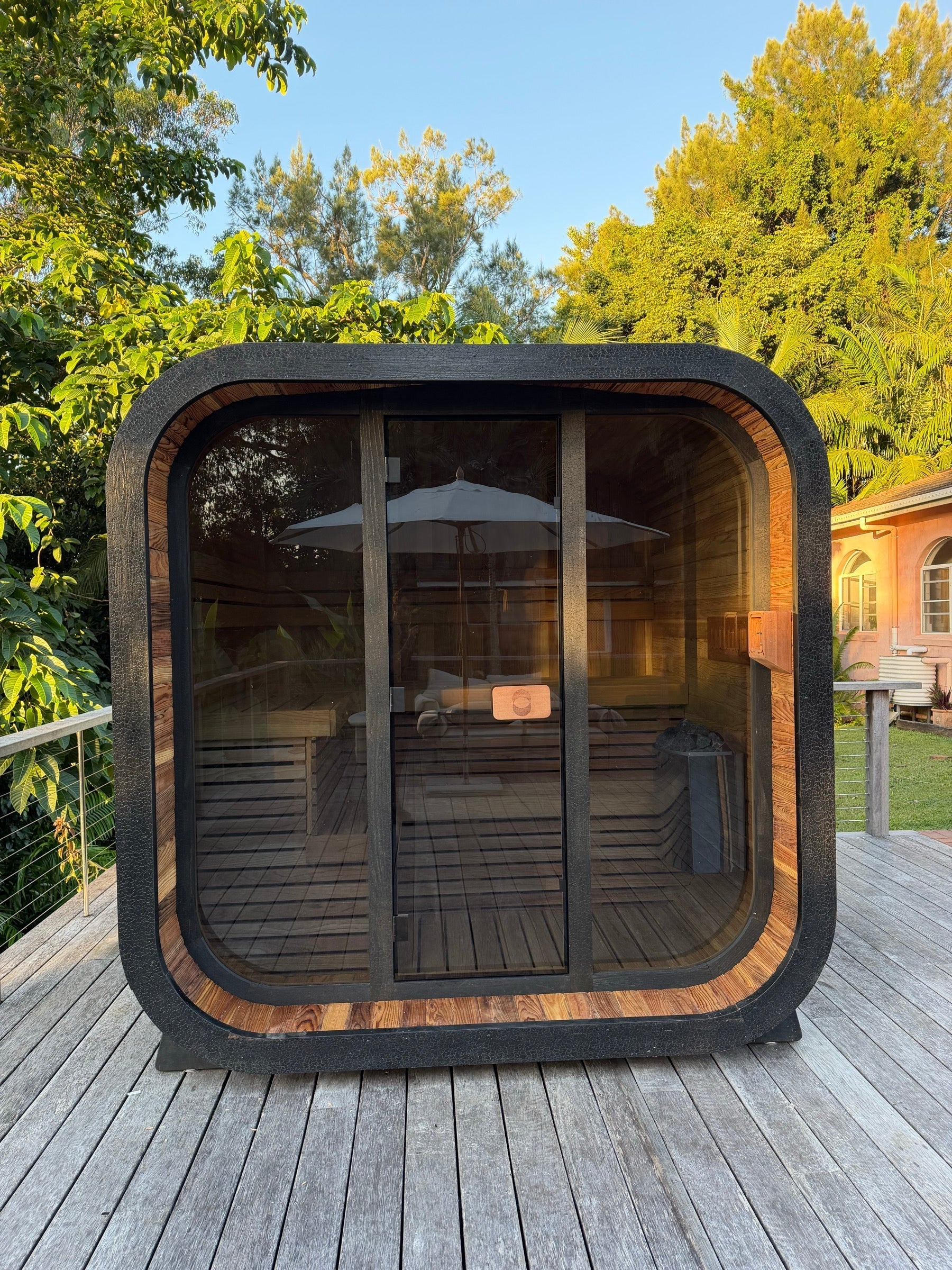
Zero-toxin Japanese Cedar construction. HUUM DROP 9kW heater. 60kg of Olivine diabase stones. Built for the Australian who does this properly.
SEE THE GENESIS →How to Use a Sauna Properly: The Session Structure
A proper Finnish sauna session is built around rounds and recovery — not a single long continuous bake. The evidence supports this approach, and once you understand the physiology, the structure becomes obvious.
The Pre-Session Protocol
Shower before you enter. This is non-negotiable in a public sauna and a strong habit in a home sauna. Clean skin sweats more efficiently — oils, sunscreen, and sweat residue from earlier activity create a barrier that slows the thermal response and degrades the air quality inside the cabin for everyone present.
Hydrate before you sit down. A 500ml glass of water before your first round is a reasonable baseline. You will lose between 500ml and 1 litre of fluid through sweat during a 45-minute session, depending on the temperature and your individual physiology. Starting well-hydrated means the physiological response — vasodilation, increased heart rate, core temperature rise — happens without the complication of early dehydration.
Remove your watch, your phone, and anything metal. Metal heats rapidly at 80–100°C and will burn you. A phone in a sauna is poor etiquette regardless of the setting. Leave it outside.
For a detailed breakdown of what to bring in with you and what stays outside, read our guide on what to wear in a sauna — it covers everything from towels to timber benches.
Round Structure: 2–3 Rounds Is the Standard
The Finnish protocol uses 2–3 rounds of active heat exposure, each 10–20 minutes long, separated by cool-down intervals. This is not a casual recommendation — it is the protocol that produces the cardiovascular, muscular, and neurological adaptations associated with regular sauna use.
Beginners should start with one round of 10 minutes at a lower bench position (where heat is 70–80°C) and extend duration and bench height as tolerance builds over several weeks. The upper bench in a well-designed cabin can reach 90–100°C — not a place to start if you have not built heat tolerance progressively.
For a precise breakdown of duration recommendations by experience level and health goal, our guide to how long to stay in a sauna covers the research in full.
The Cool-Down Interval
Between rounds, you cool down. This is not optional — it is the mechanism through which many of the benefits are driven. Step outside, enter cold water, or simply sit in cool air. The contrast between elevated core temperature and cooling is the physiological stimulus that produces cardiovascular adaptation, improved circulation, and enhanced recovery.
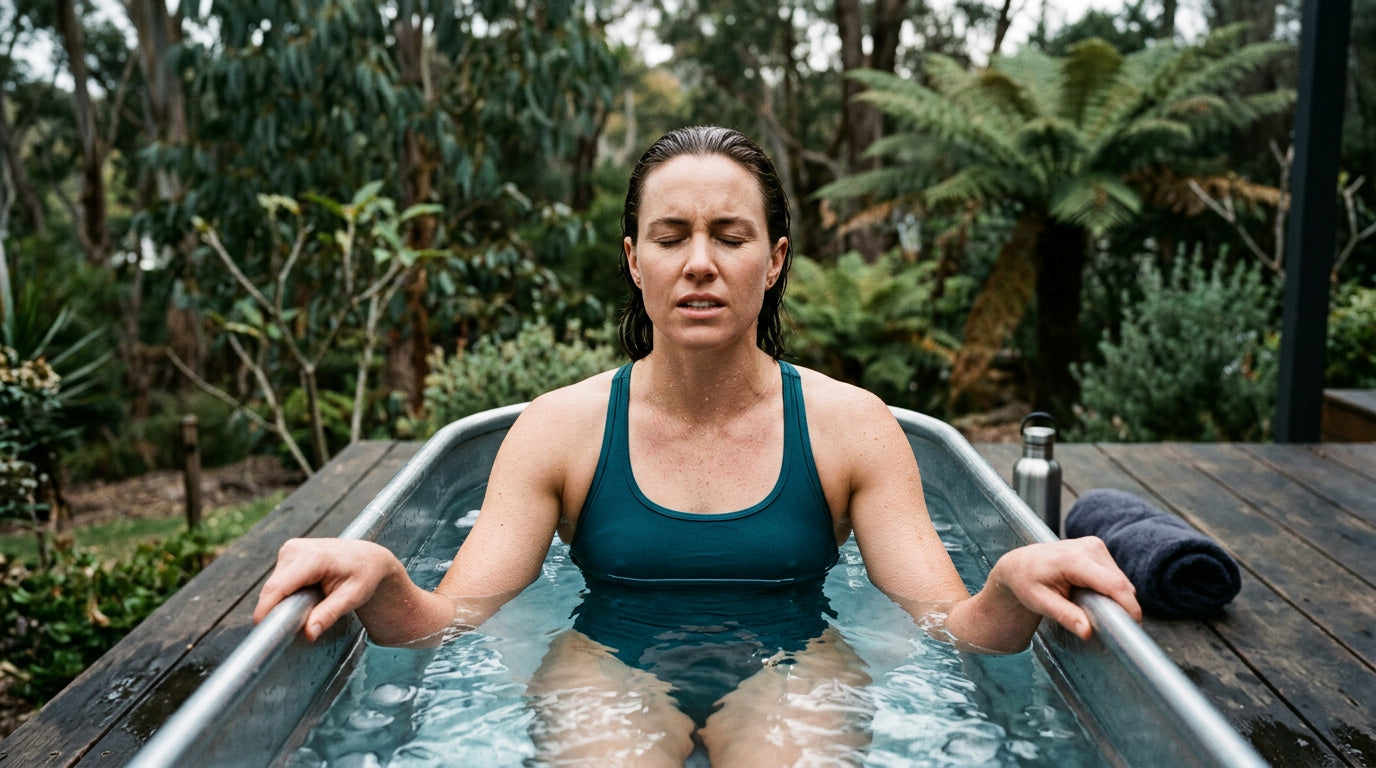
In a home setting with access to a sauna and cold plunge routine, the cool-down becomes a dedicated cold immersion. This is the contrast therapy protocol — and the evidence behind it is substantial. A 2018 meta-analysis by Dupuy et al. in Frontiers in Physiology, covering 99 studies and over 1,000 athletes, found cold-water immersion and contrast water therapy to be among the most effective recovery modalities for reducing muscle soreness and perceived fatigue.
For a full breakdown of the science behind pairing heat and cold, our guide to contrast therapy in Australia covers every protocol in detail.
Löyly: How to Pour Water on Sauna Rocks Properly
Löyly is the steam produced when water is poured onto hot sauna stones. It is the defining act of Finnish sauna culture — the moment when dry heat becomes something entirely different. Done correctly, it intensifies the perceived heat dramatically without raising the air temperature, triggering a sweating response that is far more acute than dry heat alone.
Done incorrectly, löyly produces weak, uneven steam, scalds exposed skin, or floods the heater with water the stones cannot absorb. The technique matters.
The Correct Pour
Use a long-handled ladle — typically 300–500ml capacity. Pour 50–100ml of water at a time, directly onto the centre of the stone mass in a slow, controlled stream. Do not splash or throw water. The goal is even penetration through the stone mass, not surface contact with the metal casing of the heater.
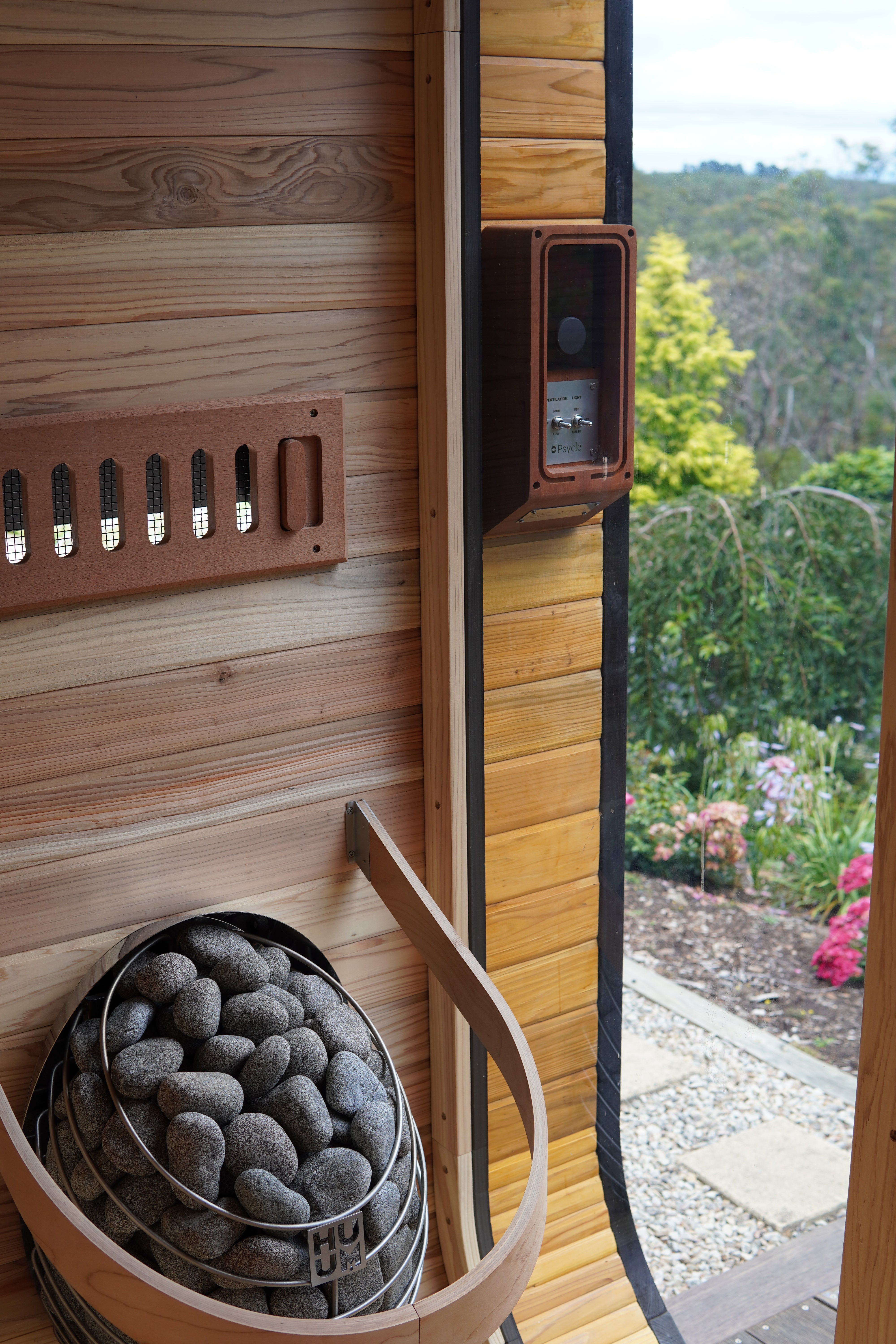
The quality of löyly is directly proportional to the volume and density of the stone mass. The HUUM DROP 9kW heater in the Genesis carries 60kg of Olivine diabase stones — more than three times the stone volume of budget heaters that carry 15–20kg. That stone mass retains heat through multiple pours and produces a soft, sustained steam rather than a sharp blast that dissipates in seconds.
For a complete guide to the löyly ritual — including water temperature, infusion options, and pour frequency — read our dedicated guide to löyly in the sauna.

When to Pour — and When to Ask
In a shared sauna, the unwritten rule is that the person who has been sitting longest — typically the one seated highest — controls the löyly. They understand the current heat state of the room. If you are new to the session, ask before you pour. A simple nod or "shall I?" is sufficient and signals respect for the shared space.
In a home sauna, you control the ritual entirely. The HUUM DROP heater pairs with the UKU WiFi app, which lets you monitor stone temperature and schedule your session remotely. You know exactly when the stones are at optimal temperature before you pour — there is no guesswork involved.
What to Add to the Water
Traditional Finnish löyly uses plain water. Some practitioners add a few drops of birch tar, eucalyptus, or other essential oils to the ladle — a practice that is accepted in home settings but inappropriate in public facilities where others may have sensitivities. In your own Genesis, this is entirely your choice.
One practical note: never add oils directly to the stone mass. Always dilute in water first. Undiluted oils can damage the stones, produce uneven combustion, and leave residue that degrades future löyly quality.
Towel Rules and Sauna Hygiene in Australia
The towel rule is the most consistently broken rule in Australian gym and health club saunas — and the most important one. Every person in a sauna sits on a towel, laid flat across the bench beneath them. The towel protects the timber from sweat absorption, keeps the bench sanitary for the next user, and is basic courtesy in a shared space.
This is not a preference — it is the standard in every serious sauna culture globally. Finnish, Scandinavian, German, Russian — all of them expect a towel on the bench, full stop.
Towel Size and Placement
Use a full-size bath towel, not a hand towel. It should cover the full length of bench you are in contact with — from your lower back to behind your knees. If you are lying down, extend the towel accordingly. No direct skin-to-timber contact from below.
A second smaller towel is useful for wiping sweat from your face and body during the session. Keep it in your lap or draped over your shoulder — do not use it to wipe the bench or walls.
What to Wear in a Home Sauna
Finnish tradition is nude — the reasoning is practical, not cultural. Clothing absorbs sweat and holds it against your skin, reducing the efficiency of the thermal response and increasing the time required to reach a therapeutic core temperature. Loose linen or cotton shorts are an acceptable alternative if that is your preference, particularly in mixed-use or shared home settings.
What you should never wear: synthetic fabrics, tight compression gear, gym shorts with a mesh liner, underwire bras, or jewellery. Our detailed guide on what to wear in a sauna covers every fabric and material decision with specific reasoning behind each.
The Genesis includes 3x Australian wool sauna hats with every purchase. This is not an afterthought — protecting your head from the most intense radiant heat at ceiling level allows you to sit comfortably at the upper bench for longer, increasing session effectiveness without thermal overload.
Breathing in a Sauna: Why Technique Matters at 90°C
Breathing technique in a sauna is a topic almost no Australian guide covers — which is why most new sauna users experience unnecessary discomfort in their first sessions. At 80–100°C, the air is significantly hotter than your body can process through the same shallow chest breathing you use at room temperature.
The correct approach is slow, diaphragmatic nasal breathing. Breathe in through your nose — the nasal passages cool and humidify the air before it reaches your lungs, reducing the sensation of burning airways. Breathe out slowly through your mouth. Short, shallow chest breaths through an open mouth will make high-temperature sauna sessions feel genuinely unpleasant and lead to premature exits.
This matters most immediately after a löyly pour, when the humidity spike creates a wall of steam heat that can feel overwhelming on first contact. Resist the instinct to gasp. Lower your head slightly — temperatures drop measurably at bench level versus head height — breathe slowly through your nose, and the sensation passes within 30–60 seconds as your body adjusts.
Sauna ventilation plays a direct role here. Poor airflow means stale, humid air that becomes genuinely difficult to breathe in. The Genesis runs active mechanical ventilation at 88 m³/hr (low) and 120 m³/hr (high) — forcing fresh air through the cabin and preventing the stale, oxygen-depleted atmosphere that makes many gym saunas feel suffocating rather than restorative. For more on why this matters, read our guide to sauna ventilation in Australia.
Sauna Temperature Rules: How Hot Should It Actually Be?
Finnish sauna temperature is 80–100°C at the upper bench level. This is not aggressive — it is the range at which the full suite of thermal adaptations occurs. The humidity level (typically 10–20% in a dry Finnish sauna, rising to 20–40% after löyly) interacts with the temperature to produce a perceived heat intensity that exceeds either variable alone.
Most Australian gym saunas run at 60–75°C — too low for meaningful physiological response, often because the heater is undersized for the cabin volume, because the door is opened repeatedly, or because ventilation is not managed correctly. The outcome is a warm room, not a sauna.
The HUUM DROP 9kW heater in the Genesis is rated for the 3–5 person cabin volume and reaches operating temperature in approximately 30–45 minutes. Once there, the 60kg stone mass holds that temperature stably through multiple löyly pours and door openings — which a 15kg stone heater simply cannot do. For the full breakdown of target temperatures by experience level and purpose, read our guide to how hot a sauna should be.

Post-Sauna Cool-Down and Cold Plunge Protocol
The cool-down after each sauna round is where the ritual becomes a protocol. Most Australians skip it entirely — they sit until they are uncomfortable, then leave. That is a one-directional heat exposure with none of the contrast stimulus that produces the neurological and circulatory adaptation serious practitioners report.
Research published in the European Journal of Physiology found that cold water immersion produces a sustained 250% increase in dopamine levels — a neurological effect that outlasts the cold exposure itself by several hours. This is a significant, measurable shift in neurochemistry that explains why people who contrast sauna with cold immersion consistently report improved mood, energy, and mental clarity for the remainder of the day.
The Correct Contrast Protocol
Heat — Round 1
10–20 minutes at 80–100°C. Pour löyly at the midpoint. Breathe slowly through the nose.
Cold — Immersion 1
Exit the sauna and enter cold water immediately. Target 10–15°C for 1–3 minutes. Controlled breathing throughout.
Rest
5–10 minutes at ambient temperature. Let your body return toward baseline. Drink water or electrolytes.
Heat — Round 2
Return to the sauna. 10–20 minutes. You will feel the heat more acutely on cold skin — this is correct. Sit with it.
Cold — Immersion 2
Second cold immersion. 1–3 minutes. The physiological contrast is at its strongest here.
Final Rest
15–20 minutes of quiet rest. This is not optional. The adaptation occurs during recovery, not during the stimulus.
The Origin cold plunge is engineered to sit directly alongside the Genesis — the two products are designed as a pair. For the complete protocol integrating both, read our guide to the sauna and cold plunge routine and our overview of the best sauna and cold plunge combinations in Australia.
The Sauna That Lets You Do It Properly
Over 200 Genesis installations across Australia. Zero-glue construction. HUUM DROP 9kW. 3-year cabin warranty. Australia-wide delivery in 120 days.
EXPLORE THE GENESIS →Hydration Rules: Before, During, and After Your Session
Hydration is the most underestimated variable in sauna performance. You will lose between 500ml and 1 litre of fluid through sweat in a single 45-minute session at 90°C. If you entered the sauna already mildly dehydrated — a common state at the end of a training day — that loss compounds quickly.
Before the session: Drink 500ml of water in the 30 minutes prior. If you trained earlier in the day, add electrolytes. Do not enter the sauna after alcohol — it accelerates dehydration and masks the early warning signals of heat stress.
During the session: Most traditional Finnish sauna practitioners do not drink water inside the cabin. The session length (10–20 minutes per round) does not demand it, and drinking inside the sauna can slow the sweating response. Exception: if you are a beginner building tolerance or sitting a longer third round, sipping water is fine and prudent.
Between rounds and after: Drink 250–500ml of water or a light electrolyte drink during each cool-down interval. Post-session, drink to thirst — do not force fluids beyond what feels necessary. If you notice dark urine after a session, you underhydrated in the lead-up. Adjust accordingly next time.
Mixed-Use and Shared Home Saunas: Setting Expectations
One of the most common questions from new home sauna owners is how to manage the sauna when it is used by multiple household members, guests, or family. The Finnish model is instructive: the family sauna is a shared, semi-sacred space with flexible but understood protocols.
In practical terms for an Australian home context, a few house rules create a consistently good experience for everyone:
Book the heat-up time. The Genesis takes 30–45 minutes to reach operating temperature. Whoever is using it first fires it up — either manually or via the HUUM UKU app, which allows remote start from a phone. Establish a household norm for who fires it up and when.
Agree on löyly decisions. Not everyone has the same heat tolerance. In a shared session, the person who is most heat-experienced should control the pour, or you agree before entering what the löyly frequency will be. One pour per round is a reasonable shared default.
Solo versus social sessions. The Genesis comfortably seats 3–5 people. Some households use it socially; others treat it as a solo recovery tool. Both are correct. The only rule is that whoever is in there gets to own the session. No interruptions, no quick entries to grab something, no opening the door mid-round to check on someone.
Guest etiquette. Brief new users on the towel rule, the no-phone rule, and the löyly protocol before they enter. It takes 30 seconds and saves awkwardness inside.
The Real Cost of Doing This at Home vs Commercially
If you use a commercial sauna three times a week, you are spending approximately AU$30–$60 per week, depending on the facility. That is AU$1,500–$3,000 per year, for sessions in an environment where you have zero control over temperature, löyly, cleanliness, or the behaviour of other users. You are also subject to session time limits, travel time, and the unavoidable reality that most Australian commercial saunas do not run at proper Finnish temperatures.
Running a Genesis at home costs approximately AU$0.50–$1.00 per 45-minute session, based on a 9kW heater and an average Australian electricity rate of AU$0.30–$0.35/kWh. At three sessions per week, your annual running cost is AU$75–$150. The infrastructure pays for itself in saved commercial sauna fees within the first year for most regular users.
Compare that to a weekly physio session at AU$100–$160 — a cost many high-performing Australians carry in lieu of a proper recovery infrastructure at home. The Genesis is not a luxury purchase. It is a home sauna cost that competes directly against what you are already spending on recovery.
For the complete financial picture, including installation costs and long-term value calculation, read our guide to the best home saunas in Australia.
Home Sauna vs Commercial Sauna: What You Actually Control
| Variable | Commercial Sauna | Genesis Home Sauna |
|---|---|---|
| Temperature | Fixed — typically 60–75°C, rarely adjustable | 80–100°C target, fully adjustable via HUUM UKU app |
| Löyly | Often prohibited or restricted to staff only | Full control — pour when you want, with what you want |
| Session length | Time-limited — typically 15–20 min per booking | Unlimited — run 2–3 full rounds without interruption |
| Hygiene | Shared surfaces, variable cleaning standards | Your standards, your home, zero-glue Japanese Cedar |
| Cold plunge access | Rare and shared, temperature often poorly controlled | Origin cold plunge adjacent — immediate contrast protocol |
| Scheduling | Fixed facility hours — book ahead, travel required | On demand, 5am or 10pm, no booking |
| Annual cost | AU$1,500–$3,000 at 3 sessions/week | AU$75–$150 running costs at 3 sessions/week |
| Phone-free enforcement | Impossible — no one enforces it | Your rule, your space |
How Often Should You Use a Sauna? Frequency and Recovery
The research on sauna frequency is increasingly specific. Laukkanen et al., whose landmark studies of over 2,300 Finnish men are published in JAMA Internal Medicine and BMC Medicine, found that 4–7 sauna sessions per week were associated with significantly lower all-cause mortality, cardiovascular disease risk, and dementia incidence compared with once-weekly use.
That frequency is not achievable for most people using commercial facilities. It is entirely achievable when your Genesis is 20 metres from your back door. This is precisely why home ownership changes the practice — it removes every barrier between the intention and the execution.
For a complete breakdown of frequency recommendations by health goal, experience level, and training load, read our guide to how often you should sauna.
The relationship between sauna use and specific health outcomes — cardiovascular function, blood pressure, longevity, mental health — is covered in depth in our evidence-based guide to sauna benefits in Australia. For men-specific outcomes, see our guide to sauna benefits for men, and for women-specific research, our guide to sauna benefits for women.
The Genesis: Built for This Protocol
Most home saunas are built with glued MDF panels and particle board. Heat that to 90°C and you are not just sweating — you are breathing in formaldehyde off-gassing with every session. That is not wellness. That is the opposite of it.
The Genesis is built from Japanese Cedar with 38mm walls, zero-glue mechanical joints, and a non-VOC oil finish throughout. Nothing in the construction off-gasses at operating temperature. At 90°C in a Genesis, you are breathing clean air — which is what the ritual requires.
The HUUM DROP 9kW heater with 60kg of Olivine diabase stones holds temperature through multiple löyly pours and repeated door openings. The 8mm safety laminated tempered glass facade (4+4mm dual-layer, grey tint) means the cabin looks like a piece of architecture on your deck rather than a garden shed. The IP67-rated amber lighting at 585–590nm produces no blue light disruption — so an evening session does not compromise your sleep.
Everything in the Genesis is a specification, not a marketing claim. 38mm walls. 60kg stones. Zero-glue joints. Non-VOC finish. IP67 lighting. Active ventilation at 88–120 m³/hr. That is the engineering standard. For Australians who want to understand the full outdoor installation picture, our guide to outdoor saunas in Australia covers placement, weatherproofing, and the optional Colorbond roof kit.
For anyone comparing sauna types before purchasing, our direct comparison of traditional versus infrared saunas is an honest breakdown of the physiological differences — and why the Finnish tradition produces outcomes that infrared cannot replicate. For the full scope of what the evidence says about traditional sauna benefits in Australia, that guide covers the peer-reviewed research from end to end.
What Australians Who Own a Genesis Say
The pattern across Genesis owners in Australia is consistent. The ritual compounds. The first week, the sauna is a new object. By the third week, it is part of the daily structure. By the third month, missing a session feels like missing training.
"I've run this protocol daily for 90 days. My recovery markers don't lie. I'm sleeping better, training harder, and the cold plunge after has become the non-negotiable part."
"I wanted something that actually gets hot and stays hot. The HUUM heater doesn't drop temperature mid-session. That was the thing that sold it — the stones hold the heat. Once you've used a proper heater, you can't go back to a cheap one."
"It looks incredible on the deck. We've had it installed in the backyard and the way the Cedar and the glass look in the afternoon light — it's genuinely beautiful. But the performance is what keeps us in there every day."
These are not outlier responses. They are the pattern. For Australians who train seriously and treat their recovery as infrastructure — not an afterthought — the Genesis delivers on every dimension.
Frequently Asked Questions: Sauna Etiquette Australia
Do you have to be naked in an Australian sauna?
No — nudity is traditional in Finland but is not required in Australian sauna settings, whether public or private. In most Australian health clubs and gyms, swimwear or light shorts are the accepted norm. In a home sauna, the choice is entirely yours. Loose cotton or linen is the best clothed option if you prefer coverage — synthetic fabrics trap sweat against the skin and reduce the efficiency of the thermal response significantly.
Do you need a towel in a sauna?
Yes — always sit on a towel in a sauna. A full-size bath towel laid flat on the bench beneath you is the standard. It protects the timber from sweat absorption, maintains hygiene for the next user, and is expected in every serious sauna culture globally. In a home sauna the rule is less enforced but still worth following — it keeps your Cedar bench in better condition over years of use.
How many rounds should you do in a Finnish sauna session?
Two to three rounds is the Finnish standard. Each round is 10–20 minutes at 80–100°C, separated by 5–10 minutes of cool-down at ambient temperature or in cold water. Beginners should start with one round of 10 minutes and build from there. The cool-down between rounds is not optional — it is the physiological mechanism through which many of the cardiovascular and recovery benefits are produced.
When should you pour water on sauna rocks?
Pour löyly approximately 5–10 minutes into each round, once the cabin has reached operating temperature and your body has adjusted to the dry heat. Use 50–100ml of water at a time, poured slowly onto the centre of the stone mass. In a shared sauna, the person sitting highest — who has been there longest — typically controls the pour. Always ask in a shared setting before adding löyly.
Is it rude to talk in a sauna?
In the Finnish tradition, silence or quiet, unhurried conversation is the norm. The sauna is not a social venue in the gym-chat sense. Loud conversation, phone use, and disruptive behaviour are universally considered poor sauna etiquette. In a home sauna with people you know well, the atmosphere is naturally more relaxed — but the phone stays outside regardless of the setting.
Should you shower before or after a sauna?
Both — shower before you enter and after you finish. Pre-session: a quick rinse removes oils, sunscreen, and sweat residue that reduce sweating efficiency and degrade air quality inside the cabin. Post-session: a cool or cold shower (or full cold plunge) is the recommended close to each round, transitioning your body from heat stress back toward baseline. Never skip the pre-session rinse in a shared sauna.
Can you use a sauna every day in Australia?
Yes — daily sauna use is safe and beneficial for most healthy adults. The research by Laukkanen et al. published in JAMA Internal Medicine found that 4–7 sessions per week produced significantly better health outcomes than 2–3 sessions per week. Daily use is most practical with a home sauna, where there is no travel time, no booking, and no session length limit. For a full guide to frequency and safety, read our article on how often you should sauna.
Ready to Build This Into Your Routine?
Free Australia-wide delivery. 3-year cabin warranty. Zero-toxin Japanese Cedar. Order now — 120-day build, ready for your first proper Finnish session.
SHOP THE GENESIS →