
How Hot Should a Sauna Be? The Complete Guide
How Hot Should a Sauna Be?
Key Takeaways
- A traditional Finnish sauna should run at 80-100°C - anything below 70°C blunts the cardiovascular and hormonal response the research documents
- Men using a sauna at 80°C or above 4-7 times per week had a 50% lower risk of fatal cardiovascular events compared to once-per-week users (Laukkanen et al., 2018)
- 15 minutes at 80°C significantly reduced both systolic and diastolic blood pressure, according to a Journal of Human Hypertension study
- Infrared saunas operate at 50-70°C - the long-term cardiovascular and all-cause mortality data was collected exclusively on traditional sauna users at 80°C and above
- Temperature stability is as critical as peak temperature - a sauna that drops from 85°C to 70°C during a löyly pour is not delivering the research-documented protocol
- Insufficient stone volume is a key failure point in cheap home saunas - a heater carrying only 10-15kg of stone cools rapidly when water is poured, compared to 60kg in a properly specified unit
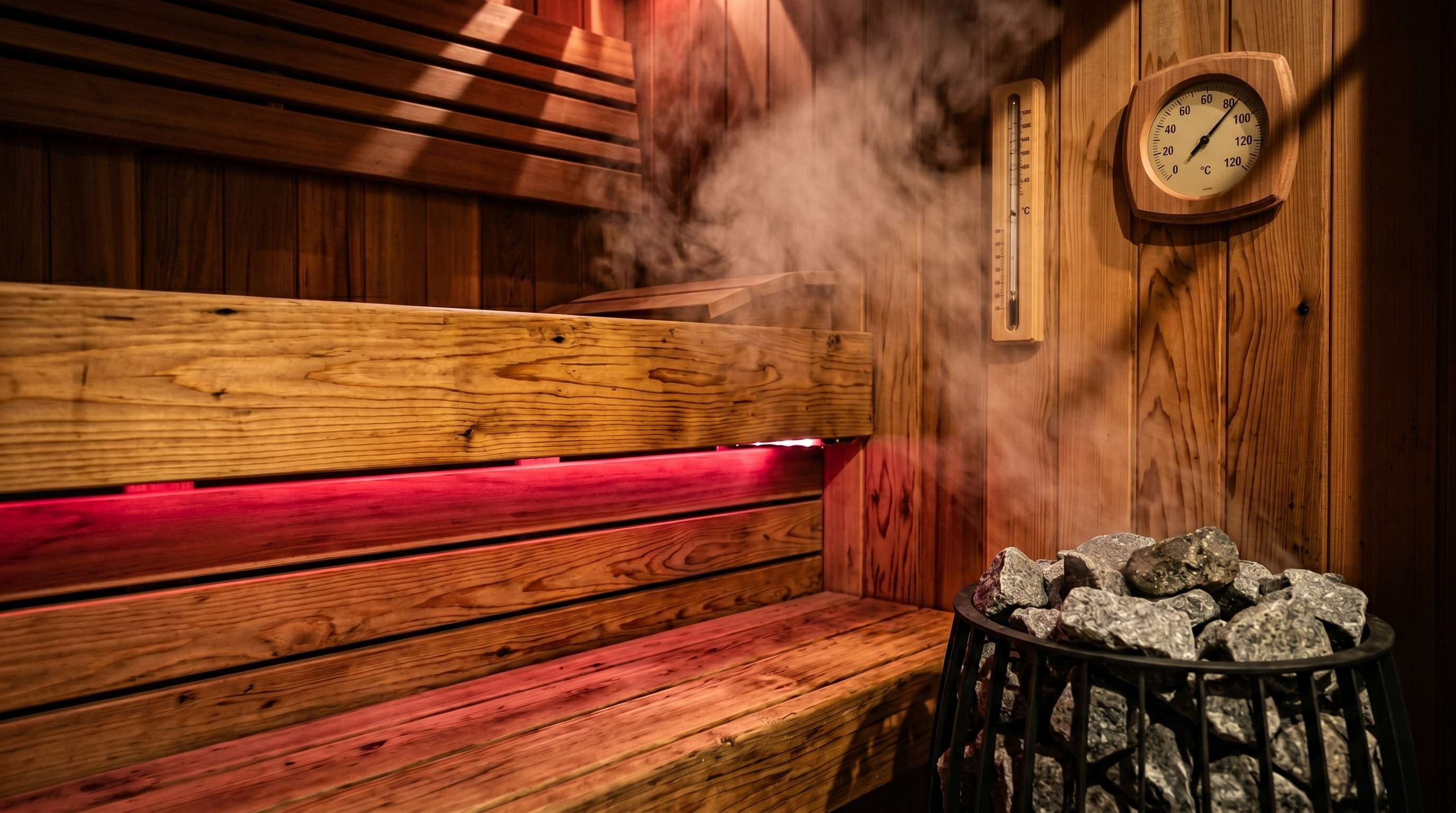
A traditional Finnish sauna should run between 80–100°C. That is the temperature range where the cardiovascular, hormonal, and recovery benefits documented in peer-reviewed research actually occur. Anything below 70°C is a compromise. A 2018 study by Laukkanen et al. in Mayo Clinic Proceedings found that men who used a sauna at 80°C or above four to seven times per week had a 50% lower risk of fatal cardiovascular events compared to those who used it once per week.
Most home saunas sold in Australia never reach that temperature — or cannot hold it. Cheap heaters, thin walls, inadequate stone volume, and poor ventilation all erode real heat. If your sauna struggles to hit 80°C and hold it through a pour of löyly, you are not getting the session the research describes. You are getting a warm room.
Zero-Toxin Sauna Therapy, Built for Australians
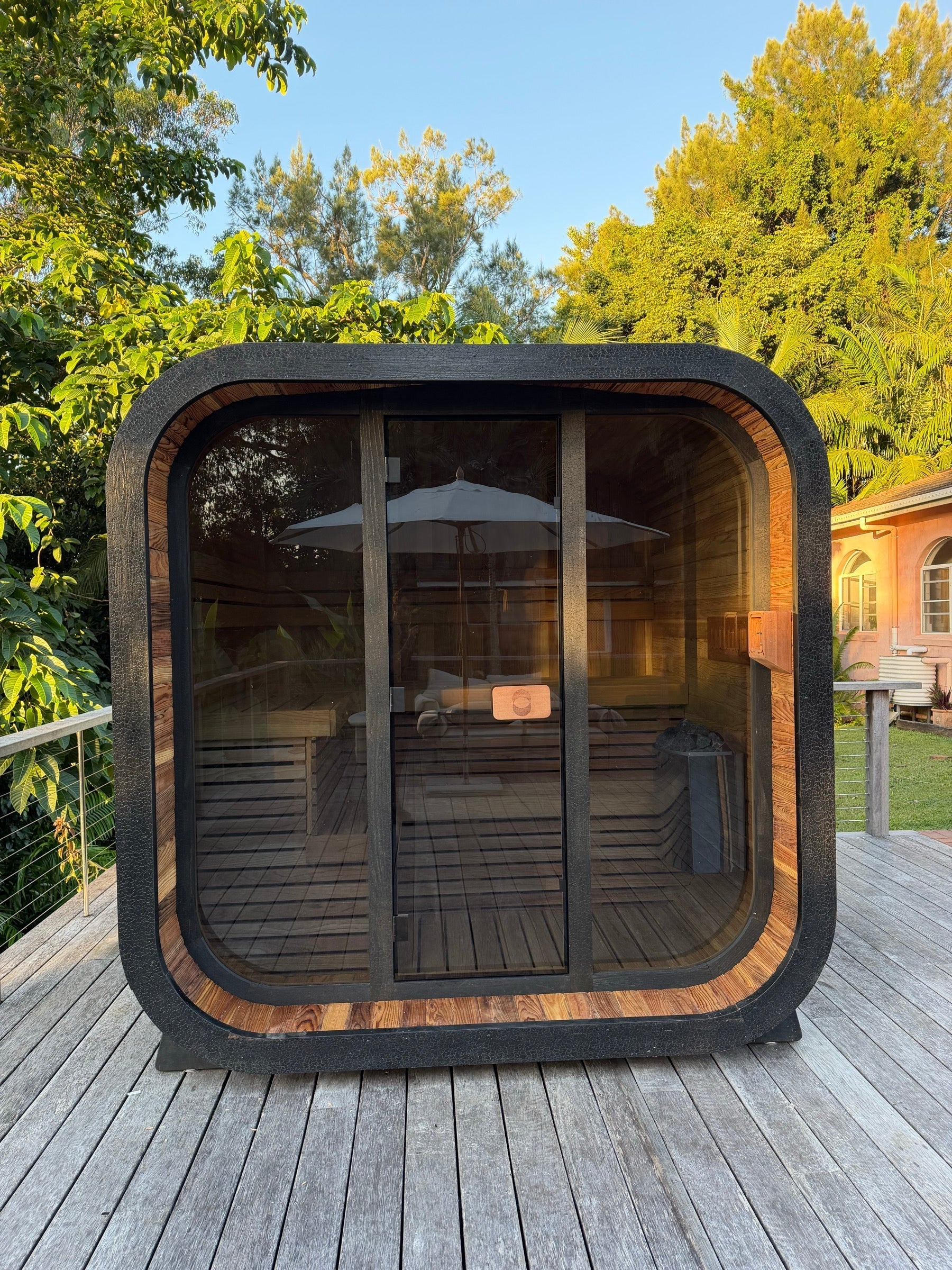
Japanese Cedar exterior. Zero-glue construction. HUUM Drop 9kW heater with 60kg volcanic stone. 80–100°C, held.
SEE THE GENESIS →What Temperature Should a Traditional Finnish Sauna Run?
The Finnish standard — and the one used in every significant longitudinal study on sauna health outcomes — is 80–100°C dry heat. That is not an estimate. It is the documented operating range of public saunas in Finland, where sauna culture has been studied for decades.
At 80°C, your core temperature rises within minutes. Blood vessels dilate. Heart rate increases to 100–150 beats per minute — comparable to moderate cardiovascular exercise. Heat shock proteins are activated. Growth hormone secretion spikes. These are measurable physiological responses, not marketing language.
Below 70°C, the cascade is blunted. You sweat. You feel warm. But the cardiovascular load, hormonal response, and heat acclimation effects are significantly reduced. That is why temperature is not a preference — it is a protocol variable.
How Sauna Temperature Affects Your Results
Temperature is the primary lever in sauna therapy. Duration matters. Frequency matters. But if the temperature is wrong, neither of the others compensates for it.
A study published in the Journal of Human Hypertension found that 15 minutes at 80°C significantly reduced both systolic and diastolic blood pressure. Research from the International Journal of Occupational Medicine and Environmental Health confirmed that sessions at 80–90°C improved vascular function — a direct cardiovascular marker. A paper in the European Journal of Applied Physiology showed that 30 minutes at 80°C increased endurance performance in trained athletes.
These results were achieved at specific temperatures in controlled conditions. They were not achieved in a 60°C infrared box or a steam room. The physics matter: radiant heat from a properly loaded stone heater, held above 80°C, produces a physiological response that lower-temperature formats cannot replicate. If you want to understand the full evidence base behind these outcomes, our guide to sauna benefits in Australia covers the peer-reviewed literature in detail.
Traditional Sauna vs Infrared: Does Temperature Make the Difference?
Yes. And it is not close.
Traditional Finnish saunas operate at 80–100°C. Infrared saunas typically run at 50–70°C — because the heating mechanism is different. Infrared lamps emit radiant heat that penetrates tissue directly, which requires lower ambient air temperature to generate a sweat response.
| Sauna Type | Temperature Range | Session Length | Cardiovascular Load |
|---|---|---|---|
| Traditional Finnish | 80–100°C | 15–20 minutes | High — equivalent to moderate cardio |
| Infrared | 50–70°C | 20–45 minutes | Moderate — lower ambient heat load |
| Steam Room | 43–49°C | 15–30 minutes | Low to moderate — high humidity |
The long-term cardiovascular and all-cause mortality data — Laukkanen, Kunutsor, and the Finnish cohort studies — was collected on traditional sauna users at 80°C and above. The infrared research base is thinner, shorter in duration, and conducted at lower temperatures. That does not make infrared worthless. It makes the comparison clear. For a detailed breakdown of both formats and how to choose, read our full traditional vs infrared sauna comparison.
Why Most Home Saunas Cannot Hold the Right Temperature
This is the part most sauna brands do not want to discuss.
A sauna that peaks at 85°C on a good day but drops to 70°C the moment you pour water over the stones is not delivering the protocol the research documents. Temperature stability matters as much as temperature peak. And stability is an engineering problem — not a marketing claim.
Three variables destroy temperature stability in cheap home saunas:
Undersized heaters. A heater rated for a room larger than it can actually heat will cycle on and off, producing inconsistent temperature. A correctly specified heater — like the HUUM Drop 9kW in the Genesis — is matched to the cabin volume with thermal headroom built in.
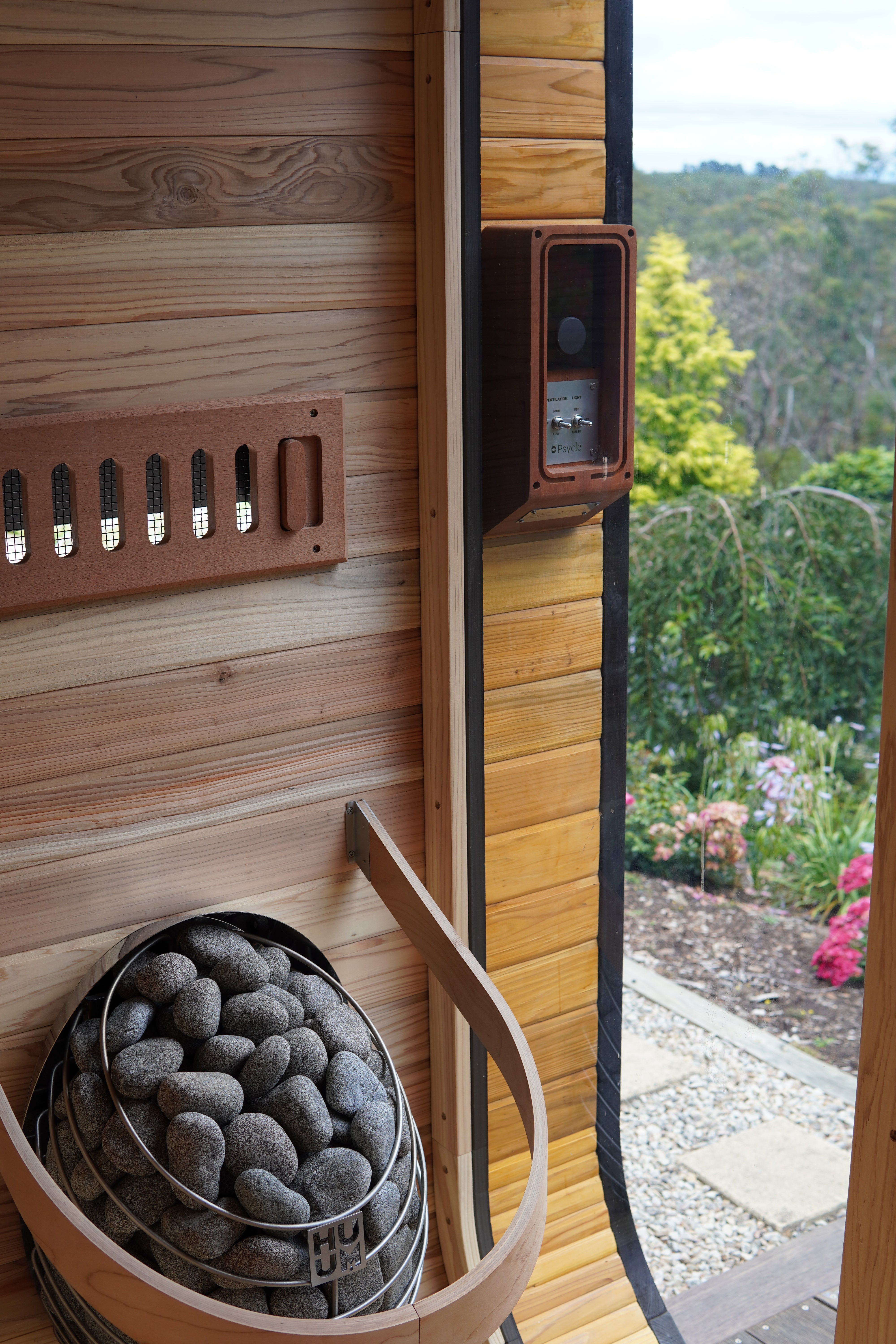
Insufficient stone volume. Stone is the thermal battery of a sauna. The HUUM Drop carries 60kg of volcanic stone. That mass absorbs and radiates heat continuously. A heater with 10–15kg of stone will cool rapidly when water is poured. Your löyly disappears. Your temperature drops. Your session suffers.
Poor ventilation design. Ventilation is the mechanism that keeps the heat clean and the air breathable at high temperatures. Without active mechanical ventilation, hot stale air accumulates near the ceiling while fresh air cannot circulate properly. You feel the heat less, not more. Our dedicated guide to sauna ventilation explains why this is the most overlooked engineering variable in home sauna design.
The Sauna That Holds 80–100°C
HUUM Drop 9kW heater. 60kg volcanic stone. Active mechanical ventilation. Zero-glue Japanese Cedar construction. Built to hold temperature — not just reach it.
EXPLORE THE GENESIS →How Long Should You Stay in a Sauna at Each Temperature?
Duration and temperature work together. Higher temperatures require shorter sessions. Lower temperatures require longer sessions to produce comparable physiological stress — and often do not produce it regardless.
| Temperature | Recommended Duration | Best For |
|---|---|---|
| 70–80°C | 15–20 minutes | New users, acclimatisation phase |
| 80–90°C | 12–18 minutes | Cardiovascular conditioning, recovery |
| 90–100°C | 8–15 minutes | Experienced users, heat acclimation, growth hormone response |
The research-backed target is approximately 57 minutes of heat exposure per week, distributed across three to four sessions. That translates to roughly 15–20 minutes per session at 80–90°C. Going longer at high temperatures does not produce proportionally greater benefit — and increases dehydration risk significantly.
What determines when to exit is not the clock. It is your body. Dizziness, nausea, or lightheadedness means get out. Every time. No protocol is worth overriding that signal. For a detailed breakdown of session length by experience level and goal, read our guide on how long to stay in a sauna.
What Happens to Your Body at Different Sauna Temperatures?
Temperature is the stimulus. Everything else — the hormonal cascade, the cardiovascular adaptation, the recovery effect — is the response. Understanding what happens at each range helps you dial in your protocol with precision.
At 70–80°C: Core body temperature begins to rise within 10 minutes. Sweating is significant. Heart rate elevates to 80–100 bpm. This range is appropriate for beginners and for active recovery sessions where the goal is parasympathetic activation and muscle relaxation.
At 80–90°C: This is the cardiovascular range. Blood pressure drops. Vascular compliance improves. Heat shock proteins activate. Dr. Andrew Huberman, neuroscientist at Stanford University, has described sauna use in this range as capable of activating the parasympathetic nervous system and producing measurable reductions in cortisol — effects that carry over hours beyond the session.
At 90–100°C: Growth hormone secretion peaks. A 1986 study published in Acta Physiologica Scandinavica by Kukkonen-Harjula et al. found that a single sauna session at this temperature range produced a two- to fivefold increase in growth hormone. This is the range used in Finnish competitive protocols and by experienced athletes pursuing body composition and recovery outcomes.
Dr. Rhonda Patrick, biochemist and researcher at the Buck Institute for Research on Aging, notes that regular use at these temperatures increases heat shock protein expression — proteins that protect against cellular stress and support muscle protein synthesis. She recommends aiming for the 80–100°C range to produce the full cascade of adaptations documented in the literature.
The Contrast Therapy Protocol: Heat and Cold Together
Temperature is not just a sauna variable — it is also the active ingredient in contrast therapy. Alternating between high heat (80–100°C in the sauna) and cold immersion (6–15°C in a cold plunge) produces physiological effects that neither modality achieves alone.
Research by Dr. Susanna Søberg, published in Cell Metabolism (2021), found that deliberate cold and heat exposure — particularly when ending on cold — significantly increased the activation of brown adipose tissue (BAT). BAT drives thermogenesis: calorie burning through heat production. The study found that a minimum threshold of 11 minutes of weekly cold exposure and 57 minutes of weekly heat exposure, spread across separate sessions, was sufficient to produce the metabolic adaptation.
The contrast protocol is straightforward:
Enter the sauna at 80–90°C
Spend 15 minutes at temperature. Pour löyly once or twice to sustain heat intensity. Use your breath — not the clock — as your primary guide.
Transition to the cold plunge
1–3 minutes at 6–15°C. Full immersion is ideal. Control your breathing — the cold shock response settles within 60–90 seconds.
Rest at room temperature
5 minutes. Allow your core temperature to normalise before re-entering the sauna. This rest phase is where physiological adaptation consolidates.
Repeat 3–5 cycles
End on cold to maximise BAT activation and norepinephrine response. This is the Søberg principle — finish cold, not hot.
Heat recovers you. Cold hardens you. Together, they transform you. That is the Psycle thesis — and the research behind contrast therapy is why we engineered the Genesis and Origin as a matched system. For guidance on how sauna frequency intersects with a contrast protocol, read our breakdown of how often you should sauna.
Hydration and Safety at High Sauna Temperatures
At 80–100°C, you lose between 0.5 and 1 litre of fluid per 15-minute session through sweat. That is not a small amount. Electrolytes leave with that fluid — sodium, potassium, magnesium — and replacing water alone does not restore electrolyte balance.
The rules are simple and non-negotiable:
Drink 500ml of water before entering. Drink at least 500ml after each session. If you are running multiple rounds of contrast therapy, replenish electrolytes between rounds — not just water.
Exit the sauna immediately if you feel dizzy, lightheaded, or nauseous. These are not signals to push through. They are signals that your thermoregulatory system is approaching its limit. Heatstroke is a medical emergency. No protocol justifies ignoring that warning.
Alcohol before or during sauna use impairs thermoregulation and dramatically increases heatstroke risk. Avoid it entirely.
What Makes a Sauna Actually Capable of Reaching 80–100°C?
Most flat-pack saunas sold in Australia are built with glued MDF panels and particle board. Heat that to 90°C and those adhesives off-gas formaldehyde. That is not a minor concern — it means every session in a cheaper unit is a session breathing chemical vapour while trying to recover. That is the opposite of what you are building the ritual for.
The Genesis was engineered with a different standard from the ground up.
Japanese Cedar exterior. Naturally resistant to moisture and heat cycling. Ages architecturally — it does not warp, degrade, or off-gas.
Nordic Spruce benches. Low thermal conductivity — it stays cool enough to sit on at 100°C. The traditional material for Finnish sauna benches for exactly this reason.
Zero-glue construction. Every joint is mechanical. No adhesives means no off-gassing at temperature. You breathe clean air at 90°C, not chemical steam.
HUUM Drop 9kW heater with 60kg volcanic stone. The stone volume is the thermal engine. 60kg holds heat through repeated löyly pours without temperature collapse. The room stays at 80–100°C because the heater and stone mass are matched to the cabin volume — not undersized to reduce cost.
Active mechanical ventilation. Forced airflow keeps the heat clean and the air fresh. Without it, the atmosphere at 90°C becomes stale and oppressive — and the perceived heat exceeds the actual benefit.
IPX4 rated. Install it outdoors year-round. Australian weather — UV, rain, humidity — does not compromise the unit.
If you are comparing these specifications to what other Australian sauna brands publish, you will notice most do not publish them at all. For a full cost and specification breakdown across the Australian market, our home sauna cost guide covers what you should expect to pay and what you should demand for that price.
Ready to Build This Into Your Routine?
Free Australia-wide delivery. 3-year cabin warranty. 3-year heater warranty. 120-day build — engineered to hold 80–100°C, session after session.
SHOP THE GENESIS →Frequently Asked Questions
How hot should a home sauna be for health benefits?
For the cardiovascular, hormonal, and recovery benefits documented in peer-reviewed research, a traditional home sauna should operate at 80–100°C. Below 70°C, the physiological response is significantly reduced. The Laukkanen et al. cohort studies — the most comprehensive long-term sauna research available — were conducted on Finnish saunas operating in this range.
Is 60°C hot enough for a sauna?
60°C produces a sweat response and some relaxation benefit, but it falls short of the temperature range where the major cardiovascular and hormonal adaptations occur. The research on blood pressure reduction, growth hormone secretion, and all-cause mortality risk reduction was conducted at 80°C and above. If your sauna cannot reach and hold 80°C, it is not delivering the protocol the evidence supports.
How long should I stay in a sauna at 90°C?
At 90°C, a session of 12–18 minutes is the recommended range for experienced users. Exit immediately if you feel dizzy, nauseous, or lightheaded — regardless of where you are in the session. The research-backed weekly target is approximately 57 minutes of heat exposure distributed across three to four sessions, not a single extended session.
What temperature is too hot for a sauna?
Above 100°C, the risk of burns from steam and the physiological stress of the heat load increase without proportional additional benefit. Most Finnish public saunas are set between 80–100°C. Sessions above 100°C should only be undertaken by highly experienced users with full control over ventilation and löyly frequency, and for shorter durations of 8–12 minutes maximum.
Does sauna temperature affect detoxification?
Higher temperatures drive greater sweat volume, which is the mechanism through which heavy metals and certain environmental compounds are excreted through the skin. At 80–100°C, sweat output is significantly higher than at 60–70°C. The evidence for sauna-driven excretion of lead, mercury, cadmium, and other toxins is well-documented — our guide on sauna detoxification and sweat toxins covers the research in full.
Can a sauna be too cold to be effective?
Yes. A sauna operating below 70°C does not produce the core temperature elevation, cardiovascular load, or hormonal response documented in the clinical literature. It may feel pleasant, but it is not the same intervention. If your sauna cannot hold 80°C through a full session — including after löyly pours — the heater and stone volume are likely undersized for the cabin.