
Sauna for Sleep Australia: The Science-Backed Guide
Sauna for Sleep Australia: How Heat Therapy Fixes Broken Sleep
Key Takeaways
- A 2019 meta-analysis by Haghayegh et al. found passive heat therapy before bed improved sleep onset latency by an average of 36%
- The optimal window for sauna use before bed is 1-2 hours - going straight to bed after a session delays sleep onset because core temperature is still elevated
- Sauna sessions of 15-20 minutes at 80-100°C trigger peripheral vasodilation on exit, causing a faster and deeper core temperature drop than normal circadian cooling alone
- Around 1 in 5 Australians regularly get inadequate sleep, with the problem most pronounced in adults aged 35-55
- Melatonin supplement sales in Australia grew by more than 40% between 2019 and 2023, reflecting a structural sleep crisis rather than a simple deficiency
- The Haghayegh meta-analysis drew on 17 qualifying studies and found consistent improvements in slow-wave sleep percentage and sleep efficiency across age groups and both clinical and home settings

A sauna for sleep works by exploiting your body's own thermoregulation system. You heat your core to 38–39°C, exit the sauna, and your body rapidly dissipates that heat — triggering a sharp core temperature drop that signals the brain to initiate sleep onset. A 2019 meta-analysis by Haghayegh et al., published in Sleep Medicine Reviews, found that passive body heating in warm water or a sauna 1–2 hours before bed improved sleep onset latency by an average of 36% and overall sleep quality scores significantly.
If you're searching for a sauna for sleep in Australia, the mechanism matters more than the marketing. This is not about relaxation in the spa sense. This is a physiological protocol — precise temperature, precise timing — that works with your circadian biology, not against it.
Why Australians Are Sleeping Poorly
Australia has a sleep problem. The Australian Institute of Health and Welfare (AIHW) reports that around 1 in 5 Australians do not get adequate sleep on a regular basis — contributing to reduced productivity, elevated cortisol, impaired immune function, and accelerated metabolic dysfunction. That figure rises sharply among adults aged 35–55: the demographic carrying the heaviest professional and domestic load.
Sleep medication use is rising. Melatonin supplement sales in Australia grew by more than 40% between 2019 and 2023. People are reaching for chemical shortcuts because they don't understand that the problem is often structural — a nervous system that never fully transitions out of fight-or-flight mode.
Screen exposure, late training sessions, high-stress careers, alcohol as a wind-down tool — all of them flatten the core temperature curve that healthy sleep depends on. Your body needs to cool down to fall asleep. Modern life keeps it perpetually activated.
Heat therapy directly addresses this. Not by sedating you. By engineering the physiological conditions that make deep sleep inevitable.
The Exact Science of How Sauna Improves Sleep Quality
Sleep onset is governed by your core body temperature rhythm. As part of your natural circadian cycle, core temperature drops in the evening — typically beginning 1–2 hours before sleep — signalling the suprachiasmatic nucleus to ramp up melatonin production and slow adenosine clearance.
Adenosine is the sleep pressure molecule. It accumulates throughout the day and is cleared during sleep. When you're chronically under-slept or your sleep architecture is disrupted, adenosine builds past its threshold without resolution — which is why poor sleepers feel exhausted but wired. Heat therapy does not directly manipulate adenosine, but by improving sleep depth and continuity, it allows more complete adenosine clearance per cycle.
The sauna mechanism is this: 15–20 minutes at 80–100°C elevates core temperature sharply. When you exit, peripheral vasodilation accelerates — blood rushes to the skin, heat radiates out, and core temperature drops faster and further than it would through normal circadian rhythm alone. That accelerated drop is the trigger.
Simultaneously, the sauna activates the parasympathetic nervous system — the rest-and-digest counterpart to the sympathetic fight-or-flight state most high performers are locked in by evening. Heart rate slows. Cortisol drops. The transition from activation to recovery is physiological, not willed.
Dr. Matthew Walker, neuroscientist and professor at UC Berkeley, has written extensively on thermoregulation and sleep: “To fall asleep and stay asleep, your body temperature needs to drop about 1–3 degrees Fahrenheit. A warm bath or sauna before bed can actually accelerate this process by drawing heat to the body's surface and away from the core.”
The Haghayegh et al. 2019 meta-analysis confirmed this across 17 qualifying studies: passive body heating 1–2 hours before bed produced statistically significant improvements in sleep onset latency, slow-wave sleep percentage, and sleep efficiency. The effect was consistent across age groups and replicated in both clinical and home settings.
This is not anecdote. This is replicated physiological mechanism. For more on the broader evidence base behind heat therapy, read our Sauna Benefits Australia: Evidence-Based Heat Therapy Guide.
Better Sleep Starts With Real Heat
The Genesis Mini delivers authentic Finnish heat up to 100°C — zero-glue Japanese Cedar, blue-light-free amber lighting, and HUUM Drop heater technology. Engineered for Australian homes.
SEE THE GENESIS MINI →Optimal Timing: When to Use a Sauna Before Bed
Timing is not optional. It is the variable that determines whether your sauna session helps you sleep or wrecks it.
If you step out of the sauna and go directly to bed, your core temperature is still elevated. You will lie awake, restless, waiting for your body to cool. The thermoregulatory drop that triggers sleep onset has not occurred yet. The sauna worked — you just didn't wait for the payoff.
The Haghayegh meta-analysis identified the 1–2 hour window as optimal. This gives your body enough time to shed the heat load, for peripheral vasodilation to complete, and for core temperature to settle below its waking baseline — the physiological state associated with the deepest sleep stages.
| Exit Sauna Time | Bedtime | Gap | Sleep Outcome |
|---|---|---|---|
| Immediately before bed | 10:00 pm | 0 min | Core temp still elevated — delays onset |
| 30–45 min before bed | 10:00 pm | 30–45 min | Marginal — partial temperature drop only |
| 1–2 hours before bed | 10:00 pm | 60–120 min | Optimal — full thermoregulatory drop, peak sleep onset |
| 3+ hours before bed | 10:00 pm | 180+ min | Benefit diminishes — temperature effect dissipated |
Practical application: if you go to bed at 10:00 pm, exit the sauna between 8:00 and 9:00 pm. Use the buffer time for low-stimulation activities — reading, stretching, dim-light environments. No screens. No heavy meals. Let the cool-down complete.
Ideal Sauna Temperature and Session Length for Sleep
For sleep-specific sessions, the goal is not maximum heat stress. It is sufficient thermal load to trigger the thermoregulatory response — without overcooking the nervous system to the point that recovery becomes the problem.
Target temperature: 80–90°C. This is the lower end of Finnish sauna range — enough to elevate core temperature meaningfully, without the full cardiovascular demand of a 100°C+ performance session. For sleep, you want the parasympathetic activation, not the full-body stress stimulus.
Session duration: 15–20 minutes. A single round is sufficient. You do not need multiple rounds followed by cold exposure for a sleep-optimisation protocol — though the contrast therapy approach offers its own benefits, which we cover in our Contrast Therapy Australia: The Complete Science Guide.
For a detailed breakdown of how temperature affects different health outcomes, read How Hot Should a Sauna Be? The Complete Guide. For session duration guidance calibrated to your experience level and goals, our How Long to Stay in a Sauna: By Goal & Experience covers the full protocol.
The Role of Blue-Light-Free Lighting
Most home saunas are installed with standard white LEDs. That is a problem for any sleep-focused session. Blue-spectrum light (400–500nm) suppresses melatonin production — directly counteracting the sleep-onset benefit you are trying to create.
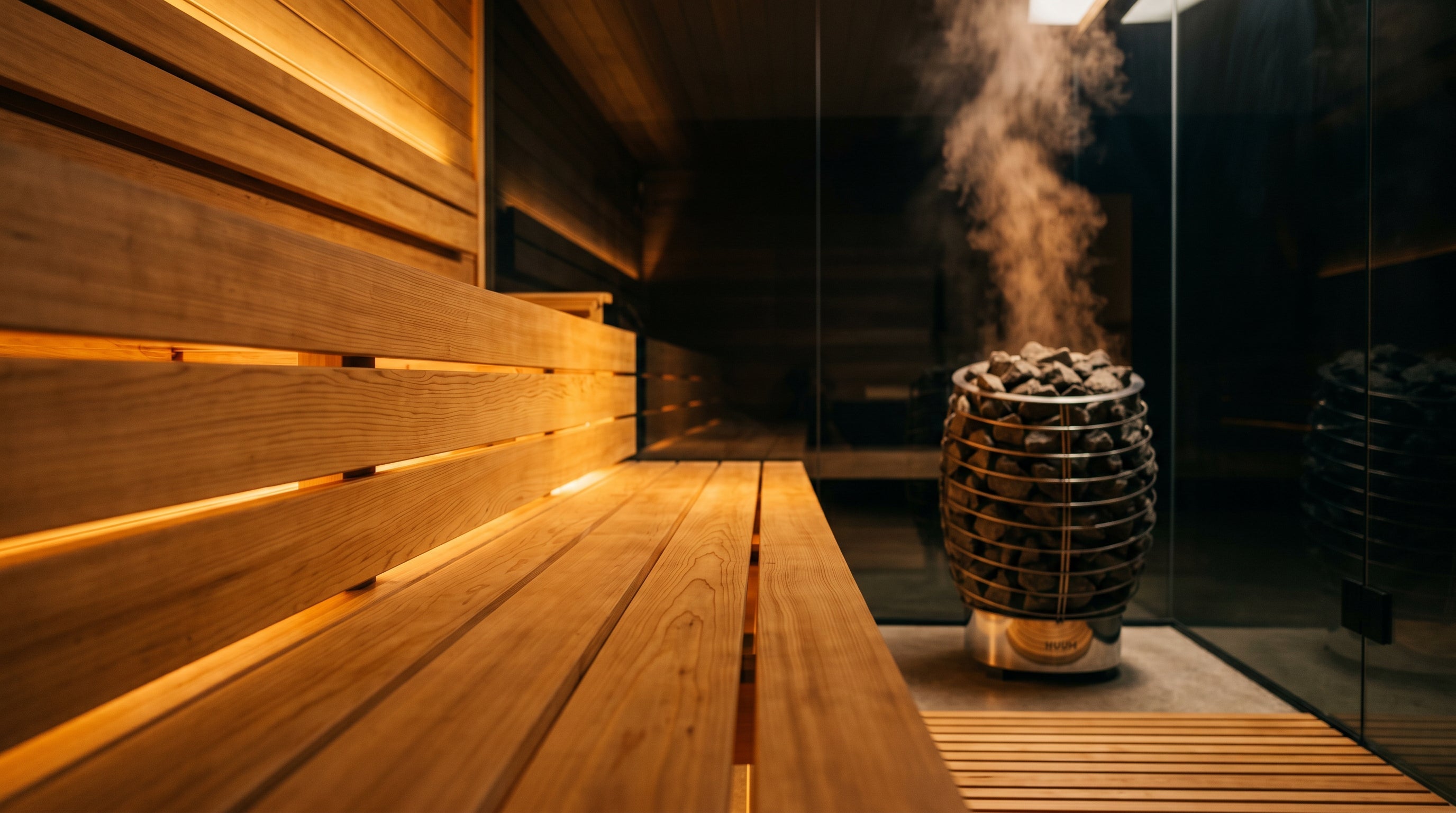
The Genesis Mini is fitted with amber 585–590nm and red 630–635nm LEDs — IP67 rated, designed to withstand 200°C. Both wavelengths sit outside the melatonin-suppression range. A pre-sleep sauna session in the Genesis Mini runs in low-stimulus, circadian-compatible light from start to finish.
This is not a feature on a spec sheet. It is an engineering decision that directly serves the sleep protocol.
Traditional Sauna vs Infrared for Sleep: Which Actually Works?
Infrared sauna companies have aggressively marketed sleep benefits over the past decade. The core claim: lower temperatures (50–70°C) with longer exposure times produce the same thermoregulatory effect as traditional Finnish heat.
The research does not support that equivalence. The Haghayegh meta-analysis, along with the broader passive body heating literature, consistently demonstrates that the sleep-onset mechanism requires sufficient core temperature elevation — typically 0.5–1°C above baseline — to trigger the rebound cooling response. Infrared saunas operating at 50–60°C produce surface warming and some core temperature rise, but the effect is shallower and less reliable than a 15-minute session at 80–100°C.
Traditional Finnish heat — convective air temperature, stone-generated humidity from löyly — drives core temperature efficiently and predictably. The protocol is measurable. The outcome is consistent.
Beyond efficacy, there is the materials question. Most infrared cabins are built with treated pine, glued MDF, or composite panels. Heat those materials to operating temperature and you are introducing VOC off-gassing into the session environment. For a detailed breakdown of why this matters, see our comparison guide: Traditional vs Infrared Sauna: Science, Benefits & Truth.
Psycle does not build infrared saunas. The Genesis Mini is a traditional Finnish sauna — zero-glue Japanese Cedar construction, non-VOC oil finish, HUUM or Harvia heater — because the mechanism the sleep science validates is the one we engineered for.
What Australians Are Saying After 90 Days of Consistent Use
The pattern we see consistently across Australian Genesis Mini owners is this: week one, they notice faster sleep onset. By week three, they are reporting fewer waking episodes during the night. By week eight to twelve, the protocol is non-negotiable — the evening sauna has replaced the glass of wine as the wind-down ritual.
“I've tracked my HRV for two years. Within three weeks of adding an evening sauna session four nights a week, my overnight HRV average went up 14 points. My resting heart rate dropped. The data doesn't lie.” — Genesis Mini owner, Melbourne.
“I was waking at 2 am every night, couldn't get back to sleep. Three months in with the Genesis Mini, that's gone. I'm not making medical claims — I'm just telling you what happened.” — Genesis Mini owner, Sydney.
These are not outliers. They are the expected outcome of a consistent, correctly-timed thermal protocol. The science explains it. The data confirms it.
Genesis Mini installations are now live across Australia — Byron Bay, Sydney, Melbourne, Brisbane, Perth, Adelaide. Lead time is currently approximately 120 days. If improved sleep is a priority this year, the time to order is not later.
The Sauna Built for Your Evening Routine
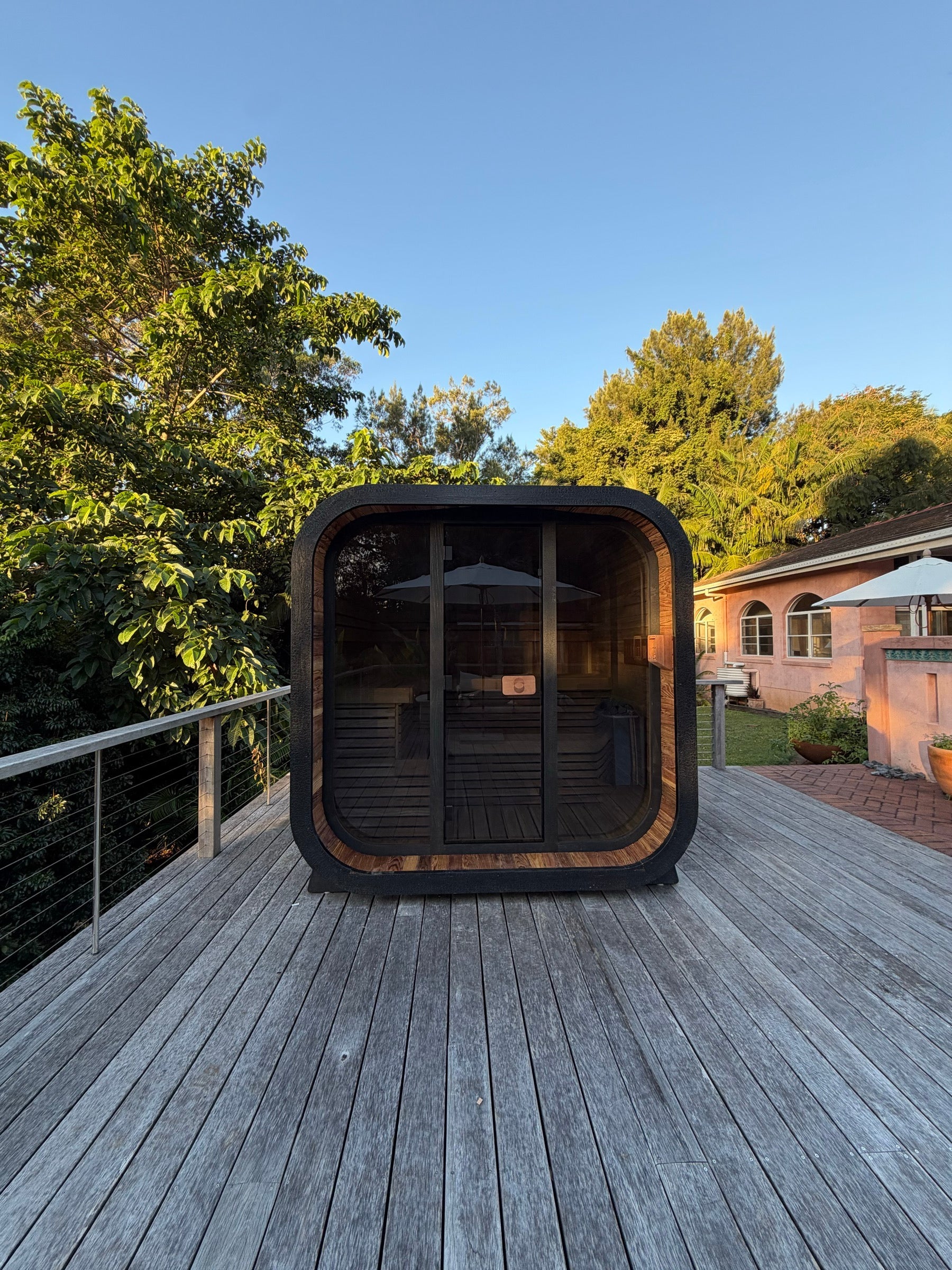
Genesis Mini: 1–3 person Finnish sauna. Japanese Cedar, zero-glue construction, amber LED lighting, HUUM 6kW heater. Australia-wide delivery. 5-year cabin warranty.
EXPLORE THE GENESIS MINI →Building Your Home Sauna Sleep Protocol
The protocol is not complicated. Its power is in consistency, not complexity. Four sessions per week, same timing window, same temperature range — within two to four weeks, your nervous system learns the cue. The sauna becomes the trigger. Your body begins preparing for sleep before you even exit the cabin.
Pre-heat 30 minutes before entry
Set the HUUM UKU app to begin heating 30 minutes before you plan to enter. Target cabin temperature: 80–90°C for a sleep session. Lower than your training-day protocol — this is recovery, not stimulus.
Enter at 8:00–9:00 pm (for a 10:00 pm bedtime)
Time your entry so you exit the sauna 1–2 hours before bed. No screens while inside — the amber LED environment supports melatonin, your phone does not.
15–20 minutes, single round
One round is sufficient for the sleep protocol. Pour löyly at 10–12 minutes to add humidity and deepen the heat response. Exit when you feel fully flushed — not when you're at your limit.
Cool down passively — no ice bath for sleep sessions
For performance and recovery, contrast therapy is powerful. For pre-sleep sessions, skip the cold plunge. Cold water immersion activates the sympathetic nervous system — the opposite of what you need. Room-temperature shower or natural cool-down only. Read our Cold Plunge Benefits Australia guide to understand when cold fits into your broader routine.
Hydrate and wind down
500ml of water post-session. Dim lights. No alcohol — it fragments sleep architecture and negates the benefit. Aim for bed 60–90 minutes after exiting the sauna. Let the thermoregulation do its job.
Repeat 3–5 nights per week
Consistency is the protocol. Three to five sessions per week produce measurable improvements in sleep quality within two to four weeks. For frequency guidance calibrated to your health goals, see How Often Should You Sauna? Frequency Guide.
Why does this need to be at home to work? Because the protocol depends on controlling the environment — timing, temperature, lighting, post-sauna wind-down. Commercial saunas with fluorescent lighting, unpredictable occupancy, and a drive home in the middle break the chain. A home sauna is the only reliable delivery mechanism for a sleep protocol this precise.
For everything you need to know about setting one up in an Australian home — electrical requirements, outdoor placement, council considerations — read our Home Sauna Australia: Buyer's Guide to Real Finnish Quality.
Frequently Asked Questions: Sauna for Sleep Australia
Does sauna before bed actually improve sleep quality?
Yes — and the mechanism is well-documented. A 2019 meta-analysis by Haghayegh et al. in Sleep Medicine Reviews analysed 17 studies on passive body heating and found that sessions conducted 1–2 hours before bed improved sleep onset latency by 36% on average and increased slow-wave sleep proportion. The effect is driven by post-sauna core temperature drop, which signals the brain to initiate sleep onset. This is not a relaxation effect — it is a thermoregulatory mechanism.
How long should I stay in the sauna before bed?
For sleep optimisation, 15–20 minutes at 80–90°C is the target. A single round is sufficient — you do not need the multi-round protocols used for cardiovascular or performance goals. The aim is enough thermal load to trigger the thermoregulatory response, not maximum physiological stress. Exit when you feel fully flushed and warm throughout. For a full breakdown across experience levels, see our guide to sauna session duration.
Is an infrared sauna or traditional sauna better for sleep?
The sleep science validates passive body heating that achieves sufficient core temperature elevation — typically a rise of 0.5–1°C. Traditional Finnish saunas operating at 80–100°C achieve this reliably in 15–20 minutes. Infrared saunas at 50–70°C produce a shallower thermal response over longer exposure, with less consistent core temperature elevation. For sleep-specific protocols backed by the Haghayegh meta-analysis research, traditional heat is the more reliable choice.
Can a sauna help with insomnia?
A sauna is not a medical treatment for insomnia disorder, and we do not frame it as one. What the research demonstrates is that regular passive heat therapy — timed correctly — measurably improves sleep onset latency, sleep efficiency, and slow-wave sleep proportion in adults with self-reported poor sleep. For Australians experiencing stress-driven poor sleep or difficulty winding down after high-performance days, a consistent sauna protocol addresses the physiological conditions that enable quality sleep. If you have a diagnosed sleep disorder, consult a medical professional.
What is the best home sauna for sleep in Australia?
The key specifications for a sleep-optimised home sauna are: traditional Finnish heat (80–100°C capability), blue-light-free lighting to preserve melatonin production, zero-toxin construction to avoid VOC off-gassing, and active ventilation for clean air quality throughout the session. The Psycle Genesis Mini meets all four criteria — HUUM 6kW heater, amber and red LED lighting at 585–635nm, zero-glue Japanese Cedar construction, and 88–120 m³/hr active ventilation. It is the only sauna in the Australian market built to this combined specification at its price point.
Ready to Sleep Better? Build the Ritual.
Free Australia-wide delivery. 5-year cabin warranty. $1,000 refundable deposit. 120-day build — order now for delivery this year.
SHOP THE GENESIS MINI →