
Sauna pregnancy australia: Evidence-Based Guide | Psycle
Sauna Pregnancy Australia: The Complete Safety and Recovery Guide

Key Takeaways
- Sauna use during the first trimester carries the highest risk — core body temperature above 39°C in weeks 1–12 is linked to neural tube defects and should be avoided.
- Finnish population data shows sauna has been culturally normative through pregnancy for centuries, but modern clinical guidance recommends caution — particularly in the first trimester and at temperatures above 80°C.
- The postpartum window (6+ weeks after birth, with OB/midwife clearance) is where sauna is best supported by evidence — hormonal reset, mood recovery, musculoskeletal relief, and sleep improvement.
- Safe sauna rules during pregnancy: session duration under 15 minutes, air temperature below 80°C, never alone, always hydrated, always with OB or midwife clearance.
- A home sauna like the Genesis Mini gives you full control over temperature and session length — unlike public facilities where you cannot regulate the environment.
- The Genesis Mini runs on a 32A circuit and costs approximately AU$0.50–$1.00 per session — less than a single physio visit at AU$100–$160.
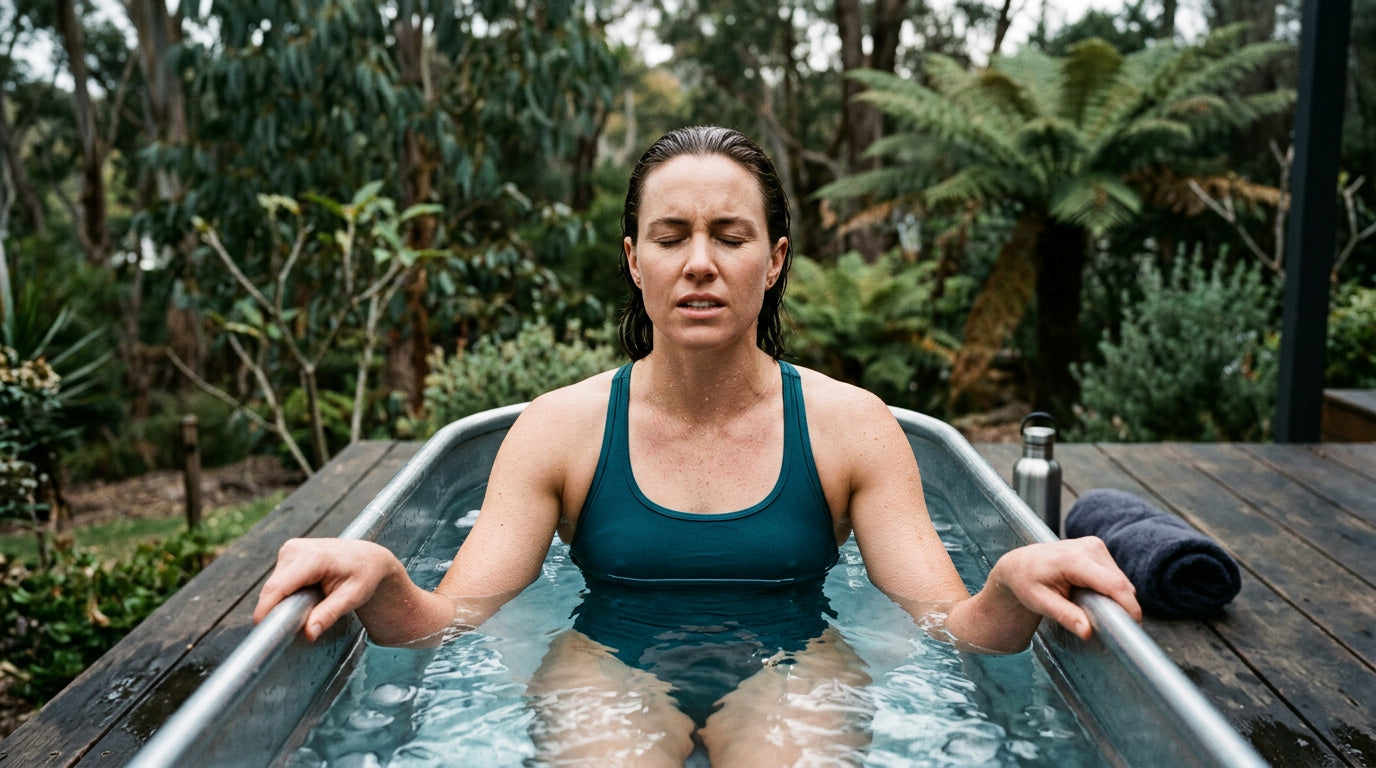
- Cold plunge is not appropriate during pregnancy but is a powerful postpartum recovery tool — always introduce it gradually and with medical clearance.
By Psycle Wellness · Last updated: May 2026 · 12 min read
Sauna use during pregnancy in Australia requires a trimester-specific approach: avoid it entirely in the first trimester when core temperature elevation poses the greatest risk, apply strict limits in the second and third, and embrace it fully — with medical clearance — in the postpartum period, where the evidence for recovery is strong.
Why the Question Matters — and Why Most Answers Get It Wrong
Most content on this topic defaults to a single answer: avoid saunas during pregnancy. That answer is not wrong. But it is incomplete — and for the many Australian women approaching postpartum recovery, it leaves the most useful chapter unwritten.
The real picture is more granular. Risk is not uniform across pregnancy. The physiological concern — maternal core temperature exceeding 39°C — is most critical in the first trimester. That same concern does not apply to a postpartum mother eight weeks after birth, cleared by her midwife, running a 70°C session for 12 minutes.
Finland is the reference point here. A country of 5.5 million people has approximately 3.3 million saunas — roughly one per household. Finnish women have used saunas through pregnancy and postpartum recovery for generations. The clinical literature underpinning modern guidance largely originates from Finnish research. Understanding that context is essential to reading the evidence correctly.
This guide covers the full picture: trimester-by-trimester risk, the specific physiological mechanisms that matter, the postpartum recovery case, and the practical safety rules that apply if you are pregnant or recently postpartum. It also covers the one advantage a home sauna provides that no public facility can match — complete environmental control. For a deeper look at sauna safety across the general population, see our complete guide to sauna health risks in Australia.
Is Sauna Safe During Pregnancy? The Core Physiological Risk
The primary concern with sauna use during pregnancy is maternal hyperthermia — specifically, core body temperature rising above 39°C (102.2°F). At normal sauna temperatures of 80–100°C, this threshold can be reached in as little as 10–20 minutes, depending on the individual, hydration status, and ambient humidity.
The mechanism is direct. Elevated maternal core temperature increases fetal temperature, which the fetus cannot independently regulate. In the first trimester — when neural tube closure occurs between weeks 3 and 6 — sustained hyperthermia has been associated with neural tube defects, miscarriage risk, and impaired organ development. This is the hardest line in the evidence base.
A 1992 study by Milunsky et al. published in the Journal of the American Medical Association found that periconceptional hyperthermia, including hot tub and sauna exposure, was associated with a significantly elevated risk of neural tube defects. This remains a foundational reference in obstetric guidance globally.
The risk profile is not static across all three trimesters. It shifts substantially after the first trimester — and disappears entirely once the baby is born. Understanding that gradient is how you read this evidence correctly, rather than applying a blanket prohibition that ignores what happens after birth.
Trimester-by-Trimester Risk Breakdown
First Trimester (Weeks 1–12): Avoid
The first trimester is the one window where the guidance is clear and consistent: avoid sauna use. Neural tube development — the formation of the brain and spinal cord — is complete by approximately week 6. This is the developmental stage most sensitive to temperature elevation, and where the consequences of hyperthermia are most severe.
Many women do not yet know they are pregnant during weeks 3–6. If you are trying to conceive or your cycle is irregular, this is worth factoring into your sauna habits before a confirmed positive test.
Finnish obstetric guidance has historically been more permissive than Australian or American recommendations — but even in Finland, the clinical consensus now supports avoiding sauna use in the first trimester, particularly at traditional Finnish temperatures of 80–100°C.
Second Trimester (Weeks 13–27): Caution With Strict Limits
The neural tube risk is past. In the second trimester, concern shifts to blood pressure regulation, dehydration, and cardiovascular load. Pregnancy already increases blood volume by approximately 50% and raises resting heart rate — adding heat stress compounds these adaptations.
Some clinicians permit brief, low-temperature sessions in the second trimester for women with uncomplicated pregnancies. If your OB or midwife clears you, the parameters are conservative: air temperature below 80°C, session duration under 12–15 minutes, immediate exit if you feel dizzy, overheated, or uncomfortable, and a companion present at all times.
This is not a green light. It is a conditional yellow. The decision belongs to your OB or midwife — not a wellness blog, and not the temperature dial on a sauna controller.
Third Trimester (Weeks 28–40): Higher Caution Still
The third trimester brings additional considerations. Thermoregulation becomes less efficient as pregnancy progresses. The cardiovascular demand of heating is greater. Lying down or sitting in the typical sauna posture can compress the inferior vena cava and reduce blood return to the heart, particularly in the supine position.
Most Australian obstetricians and midwives advise against sauna use in the third trimester unless there is a compelling clinical reason. If you have any history of placental abnormalities, hypertension, or preterm labour risk, the answer is straightforward: do not use a sauna.
The better move in the third trimester is to redirect the conversation entirely. The postpartum period — which begins the moment you give birth — is where sauna use has genuine, well-supported evidence behind it. That is the chapter worth investing in.
| Trimester | Key Risk | Guidance | Max Temp / Duration |
|---|---|---|---|
| First (Wks 1–12) | Neural tube defects, miscarriage | Avoid entirely | N/A |
| Second (Wks 13–27) | Hyperthermia, dehydration, BP load | Conditional — OB/midwife clearance only | <80°C / <15 min |
| Third (Wks 28–40) | Thermoregulation decline, vena cava compression | Avoid — most clinicians advise against | N/A for most |
| Postpartum (6+ wks) | Wound healing, blood pressure normalisation | Well-supported — with clearance | 70–85°C / 15–20 min |
Zero-Toxin Sauna Therapy — Built for Australian Families
Japanese Cedar exterior. Zero-glue construction. HUUM DROP 6kW heater. Full temperature control from your phone. The Genesis Mini is the clean, compact sauna built for real home life.
SEE THE GENESIS MINI →What Finnish Research Actually Tells Us About Sauna During Pregnancy
Finland is the only country where population-scale sauna use during pregnancy has been observed across generations. That makes Finnish epidemiological data uniquely relevant — but it also requires careful interpretation.
Historically, Finnish women used the sauna through all stages of pregnancy and childbirth. The sauna was the cleanest, warmest space available — many Finnish births through the early 20th century occurred in the sauna. This cultural history is often cited as evidence that sauna is safe during pregnancy.
The clinical reading is more careful. Finnish research has documented that many pregnant women self-regulate instinctively — shortening session duration, lowering temperature, and exiting earlier as pregnancy progresses. The absence of harm at the population level reflects modified behaviour, not unlimited exposure. Modern Finnish obstetric guidance aligns with international consensus: avoid in the first trimester, apply strict limits thereafter.
What the Finnish data does establish convincingly is the postpartum picture. For non-pregnant adults — including women who have recently given birth and received medical clearance — regular sauna use carries a well-documented cardiovascular, hormonal, and psychological benefit profile. That evidence base, built in Finland over decades, is exactly what supports the postpartum recovery case. For a full review of the evidence on traditional sauna benefits, see our science-backed guide to traditional sauna benefits in Australia.

Postpartum Sauna Recovery: Where the Evidence Is Strongest
The postpartum period is where sauna use shifts from a risk management conversation into a recovery tool with strong clinical backing. Once you have received clearance from your OB or midwife — typically at the six-week postnatal check, or later following a caesarean section — the case for regular sauna use is compelling.
Hormonal Reset and Mood Recovery
The postpartum hormonal environment is one of the most dramatic physiological transitions the human body undergoes. Oestrogen and progesterone drop sharply within 24 hours of birth. Prolactin rises with breastfeeding. Cortisol, disrupted sleep, and physical recovery demands compound the stress load significantly.
Heat stress from sauna use triggers a cascade of endocrine responses relevant to this picture. Endorphin release during sauna sessions is well-documented and provides a direct mood signal. Core body heating also stimulates norepinephrine release, which plays a role in alertness and stress regulation.
Research from the University of New Mexico found that sauna use can increase growth hormone levels by 200–300%, with two 20-minute sessions separated by a 30-minute cool-down period producing the most pronounced effect. In the postpartum context — where muscle tone, tissue repair, and metabolic recovery are all active — this hormonal signal has practical relevance.
Musculoskeletal Relief and Physical Recovery
Pregnancy places significant mechanical load on the lumbar spine, pelvis, hips, and lower limbs. Postural changes, relaxin-mediated joint laxity, and the physical demands of labour and delivery mean that most postpartum women carry a significant musculoskeletal recovery debt.
Heat therapy is one of the most evidence-supported interventions for musculoskeletal pain and tissue recovery. Sauna heat penetrates deeply, increases blood flow to soft tissue, and promotes myofascial relaxation. For postpartum back pain — one of the most commonly reported physical complaints — this is a meaningful, non-pharmaceutical tool.
The landmark 20-year cohort study of 2,315 Finnish men by Laukkanen et al., published in JAMA Internal Medicine (2015), found that sauna use 4–7 times per week reduced the risk of fatal cardiovascular disease by 50% compared to once-weekly bathing. The cardiovascular mechanisms — improved arterial compliance, reduced peripheral vascular resistance, improved cardiac output — apply broadly. For postpartum women managing blood pressure normalisation after pregnancy, these mechanisms are directly relevant. For a deeper review of the research on cardiac outcomes, see our guide to sauna and cardiovascular health in Australia.
Sleep and Psychological Recovery
Sleep disruption is a near-universal feature of the postpartum period. Sauna use — specifically the rapid core temperature drop that follows a session — activates the thermoregulatory sleep signal. The body's natural sleep onset is triggered by a drop in core temperature, and sauna amplifies this signal by raising temperature sharply before allowing it to fall.
A 2019 meta-analysis published in Sleep Medicine Reviews by Haghayegh et al. found that passive body heating — including via hot baths and sauna — taken 1–2 hours before sleep improved sleep onset latency and sleep quality significantly. For a postpartum mother managing fragmented sleep, a late-afternoon sauna session timed before the first sleep window is a practical, evidence-backed intervention. For more on the sauna-sleep connection, see our science-backed guide to sauna for sleep in Australia.
The psychological dimension matters too. A regular sauna ritual — 15 minutes of heat, alone or with a partner, with no phone and no demands — is one of the few structured recovery practices that postpartum mothers can build into a daily routine without equipment, expertise, or leaving home. That accessibility is not a small thing.

The Problem With Public Saunas During Pregnancy and Postpartum
Public saunas and commercial wellness facilities offer no meaningful temperature control to the individual user. You enter a shared space already set to a fixed temperature — typically 85–100°C — with no ability to modify it. You cannot reduce the stone mass, lower the heater output, or verify when the space was last used and at what humidity level.
For a healthy adult, this is fine. For a pregnant woman in her second trimester who needs to stay below 80°C and exit after 12 minutes, it is not a controlled environment. The risk is not just the temperature — it is the absence of control over the temperature.
Postpartum, the public sauna problem becomes different but equally real. New mothers building a consistent daily recovery practice cannot schedule around a facility's opening hours, pay per session, and share a space with strangers while managing a newborn's unpredictable rhythm. The economics also shift quickly. A commercial sauna drop-in in any major Australian city costs AU$25–$50 per session. Three sessions per week over 12 months is AU$3,900–$7,800. A Genesis Mini owned outright, running at approximately AU$0.50–$1.00 per 45-minute session on a 32A home circuit, pays for itself within the first few years while remaining available 24 hours a day, every day.
The comparison sharpens further against the cost of the postpartum care ecosystem. Weekly physio at AU$100–$160 per session, postnatal yoga classes, recovery supplements — the category spend adds up fast. A home sauna consolidates several of those outcomes into a single infrastructure investment that the whole household uses. For more on what home ownership actually costs versus ongoing facility fees, see our complete guide to home sauna costs in Australia.
Why a Zero-Toxin Home Sauna Matters More When You're Pregnant or Postpartum
Most home saunas on the Australian market are built with glued MDF panels, particle board framing, and standard wood finishes. Heat those materials to 80–90°C and you are not just sweating — you are inhaling formaldehyde off-gassing and VOC vapour with every breath. That is not a theoretical risk. It is a chemical reality of how those materials behave at temperature.
For a postpartum mother — or a pregnant woman who has received clinical clearance for low-temperature sauna use in her second trimester — the material quality of the sauna is not a premium consideration. It is the baseline requirement. Breathing clean air matters more in recovery, not less.
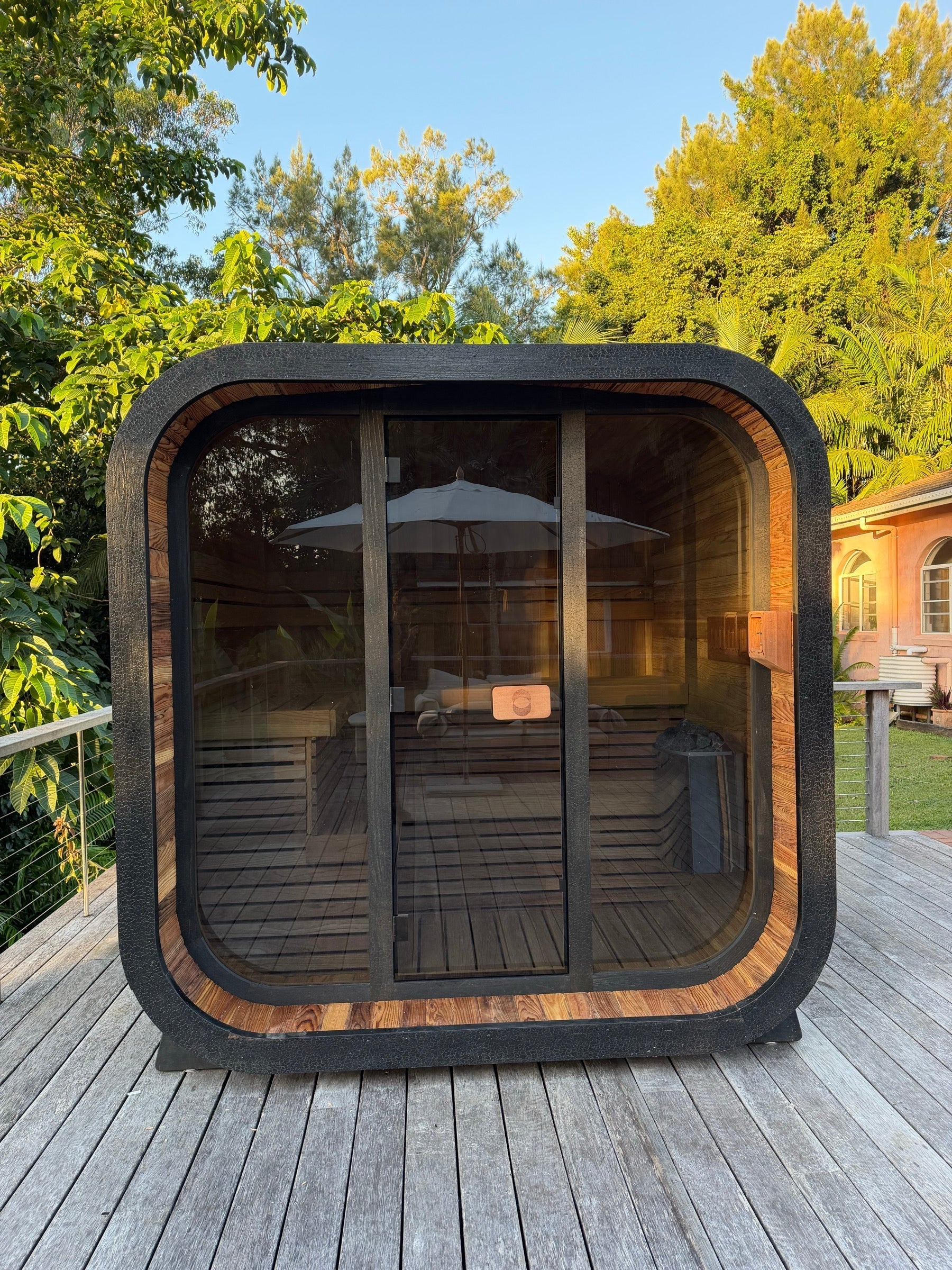
The Genesis Mini is built to a different standard. Japanese Cedar timber at 38mm wall thickness — the same species Finnish sauna builders have used for centuries — with zero-glue mechanical construction and a non-VOC oil finish throughout. There is no adhesive off-gassing at temperature. There is no formaldehyde in the steam. The air inside the Genesis Mini at 80°C is chemically clean.
The lighting is also relevant. Standard LED sauna lighting typically outputs in the blue-spectrum range, which suppresses melatonin. The Genesis Mini uses amber 585–590nm and red 630–635nm IP67-rated lights — both outside the blue light range, both supportive of the hormonal wind-down a postpartum mother is specifically trying to optimise. For more on how the Genesis Mini compares to what is on the Australian market, see our guide to the best home saunas available in Australia.
Inside the Genesis Mini — Engineered for Home Life
The Genesis Mini is the compact unit in the Psycle range — 1–3 person capacity, built to the same zero-toxin standard as the flagship Genesis. It is designed for Australian homes where space is real but the commitment to quality is not negotiable.
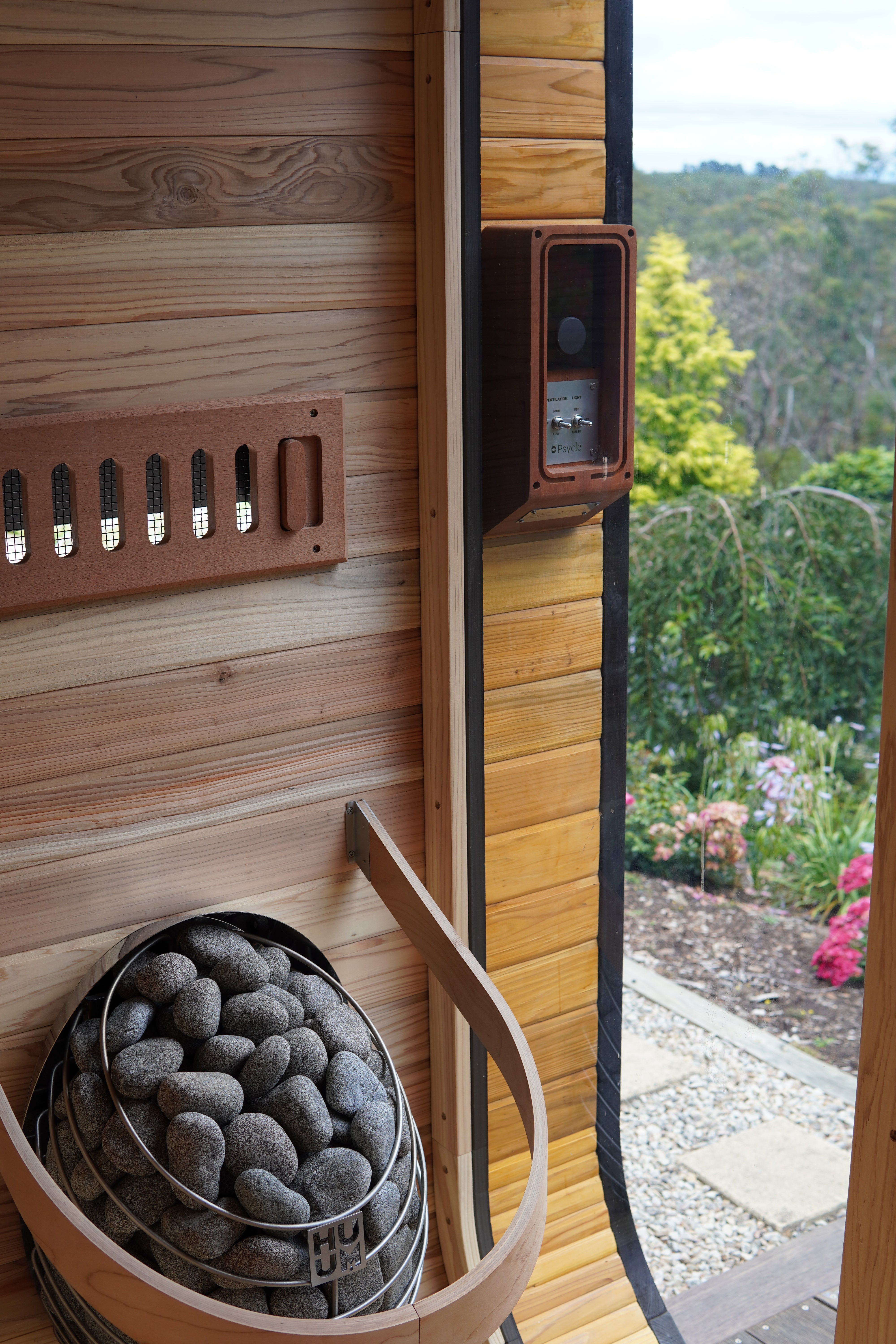
The heater choice matters here. The HUUM DROP 6kW option is fitted with 60kg of Olivine diabase stones — the same volcanic stone used in traditional Finnish saunas for its heat-retention qualities. 60kg of stone holds temperature through a full session, including when you pour water for löyly. The Harvia Vega 6kW alternative carries 20kg of stones and offers mechanical controls — simpler, lower cost, equally reliable.
The HUUM option includes the UKU WiFi controller, which lets you pre-heat the sauna remotely from your phone. For a postpartum mother managing a feed, a nap window, and an unpredictable schedule, the ability to set the sauna to reach 75°C in 45 minutes — without being present — is a practical operational advantage. For more on how temperature control works across different sauna configurations, see our guide on how hot a sauna should be.
The Genesis Mini requires a 32A dedicated circuit — single or three phase. It ships at approximately 350kg and is delivered Australia-wide. Build lead time is approximately 120 days from order. The $1,000 deposit is fully refundable — meaning you can place your order now, research during the build window, and take delivery when you are ready. That lead time also works practically for a woman in mid-pregnancy planning postpartum infrastructure: order at 20 weeks, take delivery around the six-week postpartum clearance window.
The Sauna That Earns Its Place in Your Home
Zero-glue Japanese Cedar. HUUM DROP 6kW heater with WiFi UKU app. Blue-light-free amber and red IP67 lighting. Full temperature control — no shared facility, no fixed hours, no off-gassing at temperature. Built for Australian families who take recovery seriously.
EXPLORE THE GENESIS MINI →Postpartum Sauna Protocol — A Practical Starting Point
The following protocol is a starting framework for postpartum sauna use, based on current evidence and conservative clinical practice. It is not a substitute for your OB or midwife's guidance. Do not begin until you have received explicit clearance from your healthcare provider.
Get Medical Clearance
Wait until at least 6 weeks postpartum (longer if you had a caesarean section or complications). Receive explicit clearance from your OB or midwife before any sauna use.
Start Low — 65–70°C
Begin your first sessions at the lower end of the temperature range. Your thermoregulatory system has been through significant disruption — do not start where you left off pre-pregnancy.
10 Minutes, Single Round
Keep initial sessions to 10 minutes, single round. Exit immediately if you feel dizzy, lightheaded, or nauseous. Never use the sauna alone in the early postpartum weeks.
Hydrate Before and After
500ml water before the session. Replace fluids immediately after. If you are breastfeeding, your baseline fluid requirement is already elevated — account for that before adding sweat loss.
Progress Over 4–6 Weeks
Gradually extend sessions to 15–20 minutes and raise temperature to 75–85°C as your tolerance builds. Most postpartum women reach a comfortable regular practice within 6 weeks of starting.
Consider Frequency
3–4 sessions per week is a strong target for postpartum recovery benefits. Daily use is appropriate as you build consistency. For a full guide to optimal session frequency, see our sauna frequency guide.
For a full evidence-based review of how long sauna sessions should run by goal and experience level, see our guide to how long to stay in a sauna. For a complete picture of the documented health benefits that apply once you are postpartum and into a regular practice, see our evidence-based guide to sauna benefits in Australia.
Safe Sauna Rules for Pregnancy — The Non-Negotiables
If you are pregnant and have received conditional clearance from your OB or midwife for low-temperature sauna use in your second trimester, these rules are not optional. Every one of them applies every time.
- Temperature ceiling: below 80°C. This is the most commonly referenced clinical limit in the literature. Traditional Finnish saunas run at 80–100°C — you must consciously set and verify a lower temperature.
- Duration: maximum 12–15 minutes per round. Time your session. Do not rely on how you feel to gauge duration — heat tolerance is deceptive and early discomfort signs can lag behind actual core temperature elevation.
- Never alone. Always have another adult present or within immediate earshot. This is non-negotiable at any stage of pregnancy.
- Hydrate before, during, and after. Pregnancy already elevates your fluid requirement. Sauna adds significant additional sweat loss — 500ml before and 500ml after at minimum.
- Exit immediately if you feel dizzy, nauseated, faint, short of breath, or overheated. The sensation of overheating can develop rapidly in a sauna — do not wait to feel certain before leaving.
- No löyly (water on stones) in second trimester. Pouring water raises the perceived heat and humidity rapidly. Even if the air temperature is below 80°C, steam can push the effective heat stress above safe limits.
- Your OB or midwife has final authority. This guide reflects published research and clinical consensus. Your individual obstetric history may change the calculus entirely — only your treating clinician can assess that.
For the full framework on safe sauna use across different health conditions and life stages, see our complete guide to sauna health risks in Australia.
The Home Sauna Advantage — Control That Commercial Facilities Can't Offer
The single most important safety variable for sauna use during pregnancy or postpartum recovery is temperature control — specifically, the ability to set a precise temperature, verify it independently, and maintain it without interference from other users or facility management.
Public saunas do not offer this. Their temperature is fixed by the facility. You cannot lower a commercial sauna to 72°C for a 12-minute postpartum session, then raise it to 82°C the following week as your tolerance builds. The environment is set for the average user, not for your specific protocol.
A home sauna — specifically one with a WiFi-enabled controller like the HUUM UKU app — gives you complete environmental ownership. You set the temperature before you arrive. You verify it on your phone. You control the session length from the moment you step in. For a pregnant or postpartum woman operating within strict clinical parameters, this is not a luxury. It is the difference between a safe session and an uncontrolled one.
The Genesis Mini also operates in a clean chemical environment — zero-glue Japanese Cedar construction with non-VOC oil finish means the air at any temperature is free from formaldehyde and adhesive off-gassing. This matters more in recovery contexts, not less. For an overview of how a home sauna fits into the broader Australian outdoor lifestyle — deck installations, QLD humidity, year-round use — see our guide to outdoor sauna in Australia.
Traditional Sauna vs Infrared: Which Applies Here?
Much of the online content on sauna use during pregnancy — including several of the most visible Australian pages on this topic — focuses primarily on infrared saunas. This is worth addressing directly, because the two technologies are meaningfully different and should not be treated as interchangeable.
Traditional Finnish saunas — like the Genesis Mini — heat the air to 70–100°C using a stone heater. The heat is convective and radiant simultaneously. Your body responds to the ambient air temperature and the heated surfaces around you. Infrared saunas operate at lower air temperatures (typically 50–65°C) and use near, mid, and far infrared wavelengths to heat the body directly, bypassing the surrounding air to a significant degree.
The clinical concern — core body temperature exceeding 39°C — applies to both. Lower air temperature in an infrared sauna does not automatically mean lower core temperature elevation, because infrared penetrates tissue directly. The mechanisms differ; the outcome risk does not disappear.
| Factor | Traditional Finnish Sauna | Infrared Sauna |
|---|---|---|
| Air temperature | 70–100°C | 50–65°C |
| Heat mechanism | Convective + radiant (air + stone mass) | Direct tissue penetration (infrared wavelengths) |
| Population evidence base | Deep — 2,000+ years, Finnish cohort studies | Limited — technology is recent, few large trials |
| Core temp elevation risk | Present — manageable with temp and duration limits | Present — lower air temp does not eliminate risk |
| Material risk (off-gassing) | Zero in Genesis Mini — no glue, no VOC finish | Varies by brand — heater elements and cabinet materials vary widely |
| Pregnancy guidance | Avoid T1, strict limits T2–T3, supported postpartum | Most clinicians advise avoidance in all trimesters |
For a full comparison of traditional and infrared sauna technology — mechanisms, evidence base, and what each is actually suited for — see our traditional vs infrared sauna guide. For a specific look at traditional sauna benefits and the science behind heat therapy, our sauna benefits Australia guide covers the evidence in detail.
What Australian Families Are Building at Home
The home sauna category in Australia has grown substantially in the past four years. Australian households — particularly in Queensland, New South Wales, and Victoria — are integrating saunas into outdoor deck and alfresco setups in ways that were previously rare outside of Scandinavia.
The typical buyer at Psycle is not someone looking for a spa aesthetic. It is someone who trains consistently, takes recovery seriously, and is tired of relying on commercial facilities for infrastructure they want to own. Postpartum recovery — with its need for a daily, on-demand, fully controlled heat protocol — fits this profile exactly.
The Genesis Mini is a compact 1–3 person unit — practical for a couple or a single user — and its 32A circuit requirement means it can be installed in most Australian homes without a panel upgrade. The 120-day build time is a real constraint, but also a planning asset: order early, take delivery timed to your recovery window. The complete guide to home sauna installation in Australia covers everything you need to know about site preparation, electrical requirements, and positioning.
Running cost is a common question. At AU$0.30–$0.35 per kWh — the approximate residential rate in most Australian states — a 45-minute Genesis Mini session costs approximately AU$0.50–$1.00. That is less than a single commercial sauna entry, less than a daily coffee, and a fraction of the weekly physio spend most postpartum women are already carrying. For a detailed breakdown of total ownership costs, see our home sauna cost guide.
Frequently Asked Questions: Sauna Pregnancy Australia
Can you use a sauna while pregnant in Australia?
Sauna use is not recommended during the first trimester and requires strict precautions — temperature below 80°C, duration under 15 minutes, never alone — in the second trimester with OB or midwife clearance. Most Australian obstetricians advise against sauna use in the third trimester. The risk centres on maternal core temperature exceeding 39°C, which in the first trimester is linked to neural tube defects and miscarriage risk. No decision should be made without individual clinical assessment from your treating healthcare provider.
Is sauna safe in the first trimester?
No — the first trimester is the highest-risk window and sauna use should be avoided entirely. Neural tube development — the formation of the brain and spinal cord — occurs in weeks 3–6. Core temperature elevation above 39°C during this period has been associated with neural tube defects in multiple studies, including the foundational 1992 research by Milunsky et al. in JAMA. Many women are not yet aware of their pregnancy during this critical window, which is an additional reason to be conservative if you are trying to conceive.
When can you use a sauna after birth?
Most healthcare providers clear postpartum women for sauna use at the six-week postnatal check for vaginal deliveries, and later — typically 8–12 weeks — following a caesarean section. Always receive explicit clearance from your OB or midwife before beginning. When you do start, begin at lower temperatures (65–70°C) for shorter durations (10 minutes) and build gradually over 4–6 weeks toward a standard practice of 15–20 minutes at 75–85°C.
What are the benefits of sauna for postpartum recovery?
Postpartum sauna use is supported by evidence across several recovery domains: hormonal reset (heat stress triggers endorphin and growth hormone release), musculoskeletal relief (deep tissue heat for postpartum back and pelvic pain), cardiovascular recovery, and improved sleep quality via the core temperature drop that follows a session. A 2019 meta-analysis by Haghayegh et al. in Sleep Medicine Reviews found passive body heating taken 1–2 hours before sleep significantly improved sleep onset and quality — directly relevant for postpartum mothers managing disrupted sleep cycles.
Can you use an infrared sauna during pregnancy?
Most Australian clinicians advise against infrared sauna use during pregnancy — particularly in the first trimester. While infrared saunas operate at lower air temperatures than traditional Finnish saunas (50–65°C vs 80–100°C), the technology heats body tissue directly, meaning core temperature elevation remains a risk. Psycle Wellness builds traditional Finnish-style saunas only — if you are researching infrared sauna safety during pregnancy, consult your OB or midwife and review the evidence independently. Our traditional vs infrared comparison guide covers the key differences in heat mechanism and evidence base.
What temperature is safe for sauna use during pregnancy?
The clinical guidance for conditional second-trimester sauna use sets a temperature ceiling of below 80°C — below the 80–100°C range of a standard traditional Finnish sauna. This limit is intended to reduce the risk of core temperature exceeding 39°C. Duration should be kept under 12–15 minutes per round. These parameters apply only with explicit OB or midwife clearance and do not apply to first or third trimester use, where avoidance is recommended. A home sauna with app-based temperature control — like the Genesis Mini with the HUUM UKU controller — lets you set and verify this limit precisely, which a public sauna cannot offer. For more detail on sauna temperature settings across different goals, see our guide on how hot a sauna should be.
Is sauna good for postpartum mental health?
Heat stress from sauna sessions triggers endorphin release and norepinephrine production — both relevant to postpartum mood regulation. Regular sauna use has been associated with reduced depression and anxiety symptoms in multiple studies. The ritual dimension also matters: a structured, daily 15-minute practice with no phone and no external demands provides a form of psychological recovery that postpartum women rarely have access to through other means. For a full review of the evidence, see our guide to sauna and mental health in Australia.
Ready to Build This Into Your Recovery?
Free Australia-wide delivery. 3-year cabin warranty — the longest in the Australian market. $1,000 refundable deposit. 120-day build — order now to time your Genesis Mini delivery to your postpartum recovery window.
SHOP THE GENESIS MINI →