
Home Sauna Installation Australia: The Complete Guide
Home Sauna Installation Australia: The Complete Guide

Home sauna installation in Australia requires a licensed electrician, a dedicated 32A or 50A circuit, a concrete or timber slab rated for up to 600kg, and in most states, a quick check on exempt development thresholds before you start. Done correctly, the whole process — from site prep to first session — takes roughly one to two days of assembly and four to six weeks to complete the electrical and site work. The 120-day lead time for a quality pre-cut sauna cabin means you have time to get every detail right before delivery day.
This guide covers the full installation journey specific to Australia: site selection, electrical requirements under AS/NZS 3000, state-by-state planning permit rules, ventilation, drainage, delivery logistics, running costs, and ongoing maintenance. If you are in late-stage research and want to understand exactly what is involved before committing, this is the page you need. For a broader overview of the category, start with our home sauna Australia buyer's guide.
Why Most Home Sauna Installations Go Wrong Before a Single Panel Is Installed
Most people underestimate the infrastructure side of a sauna build. They order the cabin, then discover the electrical panel can't support a 9kW heater, the deck they planned to install it on isn't rated for the load, or the council in their LGA treats an outdoor structure differently than they expected. The sauna sits in a shipping container for three weeks while the electrical work is organised.
The other failure mode is buying cheap. Flat-pack saunas built with glued MDF panels and particle board look fine in a product photo. Heat them to 90°C and you are breathing formaldehyde off-gassing with every session. That is not a minor compromise — it is the opposite of the reason you wanted a sauna in the first place. A 2024 review published in Building and Environment confirmed that volatile organic compound (VOC) off-gassing in small enclosed heated spaces can reach concentrations 10–50 times higher than ambient indoor air levels, depending on adhesives and substrate materials used in construction.
Solve the infrastructure questions first. Choose materials that do not create a new problem while solving an old one. Everything else follows.
How to Select the Right Site for an Outdoor or Indoor Home Sauna in Australia
Site selection is where most Australians get the most leverage — and where Australian conditions differ most from the European and North American content that dominates search results.
Indoor vs Outdoor Placement
Indoor installation in a garage, basement, or spare room gives you year-round protection from the elements, simpler electrical runs, and no weatherproofing requirements on the cabin exterior. The constraint is ventilation — you need active air exchange that exhausts steam and heat outside the building envelope, not into the room.
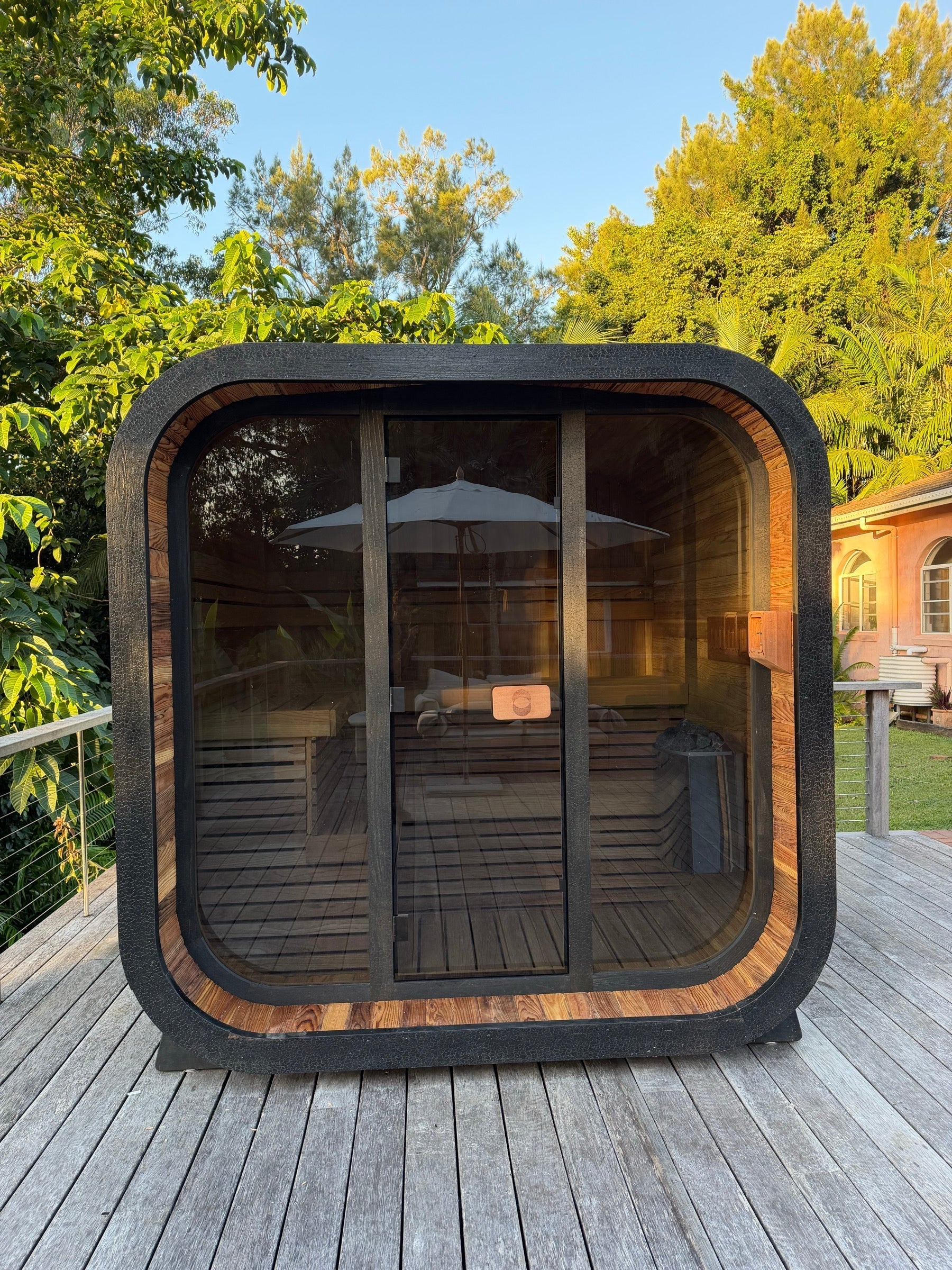
Outdoor placement is the more common choice for Australian homes, particularly for a 3–5 person sauna like the Genesis. It keeps the steam, heat, and drainage away from the main structure. The tradeoff is exposure. A sauna cabin specified for outdoor use needs either an IP-rated finish or an external roof kit designed for full weather exposure. For a deeper look at placement options, our outdoor sauna Australia guide covers siting, exposure grades, and orientation in detail.
Slab, Deck, or Pavers: What Your Foundation Needs to Support
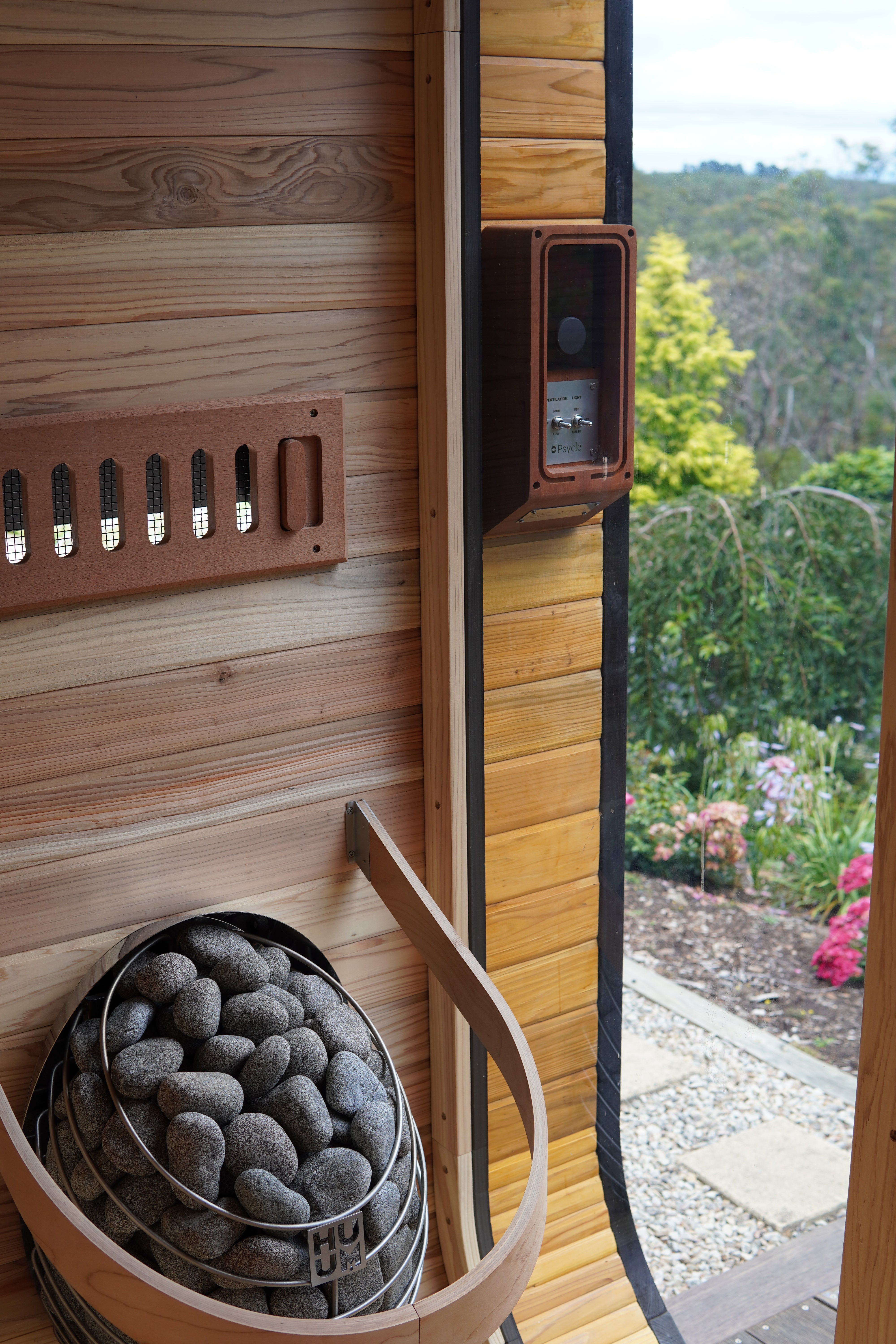
A Genesis ships at approximately 600kg. That figure does not include the heater stones (60kg for the HUUM DROP configuration), water, and occupants. Your foundation needs to support a dynamic load of 800–900kg across the footprint without flexing. Concrete slabs are the straightforward answer — a 100mm reinforced slab on a compacted base handles the load with margin.
Timber decks can work if the structure is engineered for the purpose. A standard 90 x 45mm joist deck at 450mm centres is generally not adequate. You need a structural engineer's sign-off if you are placing a 600kg cabin on a raised timber deck. Do not skip this step — an undersized deck will show deflection within 12 months and can void both your sauna warranty and your home insurance.
Pavers are not suitable as a primary base. They shift, create unlevel surfaces, and do not provide the rigid, moisture-managed substrate a sauna cabin needs. A paved area around a concrete slab is fine. Pavers alone are not.
Sun, Shade, and Australian Climate Orientation
Northern Europe builds saunas with no concern about solar gain. Australia requires a different approach. In Queensland, NSW, and WA, a west-facing sauna with no shade can reach 50°C inside before you even turn the heater on during summer. That is not a health benefit — it is a structural stress problem and a potential burn risk for unprotected cedar surfaces.
Orient the glass facade toward a view rather than toward afternoon sun. Install a shade structure, pergola, or plant screening on the western and northern aspects if the site is exposed. In southern states (VIC, TAS, SA), passive solar gain on the north face can actually reduce your heating time and energy cost — lean into it.
Drainage matters as much as orientation. The foundation must be either level or slightly graded away from the cabin so condensate and pour water does not pool under the structure. In high-rainfall areas (Brisbane north coast, northern NSW, Darwin), elevating the slab base 50–100mm above surrounding grade prevents ground moisture wicking into the cabin floor over time.
Zero-Toxin Sauna, Built for Australian Conditions
Japanese Cedar exterior. Zero-glue construction. HUUM DROP 9kW heater pre-specified to meet Australian electrical requirements. Designed to install once and run for decades.
SEE THE GENESIS →Sauna Electrical Requirements Australia: What AS/NZS 3000 Actually Demands
This is the section most competitor guides skip. It is also the section that determines whether your sauna is legal, insurable, and safe.
In Australia, all electrical installation work must comply with AS/NZS 3000:2018 — the Wiring Rules. Section 7.4 specifically governs sauna heater installations. The core requirements are: a dedicated circuit for the heater (no shared circuits), an isolator switch within reach of the sauna entry, and a licensed electrician for all installation work. You cannot legally wire a sauna heater yourself under any state's electrical licensing framework.
Circuit Requirements by Heater Specification
| Sauna Model | Heater | Output | Circuit Required |
|---|---|---|---|
| Genesis (3–5 person) | HUUM DROP 9kW | 9kW | 50A dedicated (single or 3-phase) |
| Genesis (3–5 person) | Harvia Vega 9kW | 9kW | 50A dedicated (single or 3-phase) |
| Genesis Mini (1–3 person) | HUUM DROP 6kW | 6kW | 32A dedicated (single or 3-phase) |
| Genesis Mini (1–3 person) | Harvia Vega 6kW | 6kW | 32A dedicated (single or 3-phase) |
Three-phase power is not required, but it simplifies the installation if your home already has it. Single-phase 240V at 50A is sufficient for both Genesis configurations. What matters is that the circuit is dedicated — it feeds nothing else. Share it with a hot water system or air conditioner and you are creating a tripping hazard and a compliance risk.
Budget $800–$1,800 for the electrical installation depending on the run length from your switchboard to the sauna site. Longer cable runs, trenching through paving, and switchboard upgrades all add cost. Get three quotes. Ask each electrician to confirm they are quoting to AS/NZS 3000:2018 Section 7.4 compliance — that question alone tells you whether they have done sauna installations before.
The HUUM DROP 9kW heater integrates with the WiFi UKU app, which allows pre-scheduling from your phone. This does not change the electrical spec — it still needs the 50A dedicated circuit — but it means you can have the sauna at temperature before you finish your training session, rather than waiting 20–30 minutes after you get home.
Sauna Planning Permits Australia: State-by-State Exempt Development Rules
Whether your sauna installation needs a council permit depends on your state, your local government area, and the footprint of the structure. There is no single national rule. Here is the current framework as of 2026 — always verify with your LGA before committing to a site plan.
| State | Exempt Development Threshold | Key Conditions |
|---|---|---|
| NSW | Up to 20m² floor area, max 3m wall height | Must comply with SEPP (Exempt & Complying Codes) 2008. Setbacks from boundaries apply. Heritage overlays may restrict. |
| VIC | Up to 10m² floor area without a permit in most zones | Larger structures may qualify under ResCode. Bushfire Management Overlay (BMO) areas have additional requirements. |
| QLD | Outbuildings up to 10m² typically exempt as class 10a buildings | Genesis footprint (~4.5m²) typically qualifies. Confirm with your LGA. Flood overlays may restrict placement. |
| WA | Outbuildings up to 10m² exempt under State Planning Policy | Must be behind the front setback line. Strata and survey-strata lots have separate rules — check your titles office. |
| SA | Up to 15m² floor area, max 3m height in residential zones | Development Act 1993 and Planning and Design Code 2021 apply. Verify setback requirements with your council. |
The Genesis external dimensions are 2289H × 2288W × 1945D mm — a footprint of approximately 4.5m². Under most state exempt development frameworks, this falls well inside residential outbuilding thresholds. The Genesis Mini at 2267H × 1571W × 1950D mm has a footprint of approximately 3.1m² — even more clearly within exempt categories.
Where permit requirements are most likely to apply: heritage precincts, bushfire-prone land overlays, flood plains, and lots smaller than 450m². If any of these apply to your property, check before you order. A planning pre-application query with your LGA typically costs nothing and gives you a written response you can rely on.
Ventilation and Drainage: The Two Details That Determine Long-Term Performance
Ventilation is not a comfort feature. It is a structural protection and air quality requirement. A sauna without adequate air exchange builds up CO², degrades the timber over time from moisture cycling, and creates a heat-trap that punishes occupants rather than restoring them. Our detailed sauna ventilation guide covers the engineering behind correct air exchange rates — but the installation-specific points are these.
The Genesis runs active mechanical ventilation at 88 m³/hr (low) and 120 m³/hr (high). For indoor installation, the exhaust path must vent directly to outside the building — not into a ceiling cavity, not into the room. For outdoor installation, this is naturally resolved by the open environment around the cabin. Ensure the intake vent (near floor level) and exhaust vent (near ceiling) are not obstructed by landscaping, screening, or stored items after installation.
Drainage beneath the cabin foundation prevents ground moisture from being drawn up through the slab. A 50mm sand-and-gravel drainage layer beneath a concrete slab, or a moisture barrier membrane where a slab is not possible, is sufficient. Inside the cabin, the floor is solid cedar — it handles the condensate load. What you are protecting against is long-term moisture accumulation under the structure.
Delivery, Assembly, and the Zero-Toxin Difference During Install
The Genesis ships as pre-cut, pre-drilled cedar panels with mechanical joint connections. Assembly does not require specialised tools — a standard power drill, a rubber mallet, and two people complete the cabin in one to two days. The panels are numbered and the connection points are machined for alignment. If you have built flat-pack furniture, you will find a pre-cut sauna cabin straightforward. If you prefer a hands-off experience, a qualified builder can complete assembly in four to six hours.
The zero-glue construction is not just a health specification — it is relevant during assembly. There is no adhesive stage, no off-gassing from freshly cut joints, and no waiting period before the cabin is safe to use. The mechanical joints connect with wood screws and timber clips. The non-VOC oil finish is applied at the factory. You are assembling a clean structure from day one.
The Genesis ships at approximately 600kg. You need a delivery access point that a flatbed truck can reach within reasonable proximity — ideally within 20–30 metres of the final install site. Psycle delivers Australia-wide. For sites with access challenges (steep driveways, narrow gates, upper-floor apartments), discuss your access conditions at the time of ordering to confirm delivery logistics. The Genesis Mini ships at approximately 350kg and is more manageable in constrained access situations.
Your Full Installation Timeline: Order to First Session
Place your order — $1,000 refundable deposit
Your build slot is confirmed. 120-day production and shipping timeline begins. Use this time to sort electrical, site prep, and any planning queries.
Weeks 1–4: Site preparation and electrical quote
Concrete slab poured or deck assessed. Licensed electrician engaged for dedicated circuit installation. Planning query submitted to LGA if applicable.
Weeks 5–10: Electrical work completed
Dedicated 50A circuit run to the install site, isolator switch installed, switchboard upgraded if required. Electrician issues compliance certificate on completion.
Week 17–18: Delivery and assembly
Genesis delivered to site. Pre-cut cedar panels assembled in one to two days. Heater connected by your electrician. Ventilation inlets and outlets confirmed clear.
First session: Season the cabin, then go
Run the heater at full temperature for 60 minutes with no occupants to season the cedar and burn off any residual surface treatments. After that, your first session is ready.
Home Sauna Running Costs in Australia: What to Expect on Your Power Bill
The running cost of a home sauna in Australia is predictable and, at the usage levels serious users maintain, far cheaper per session than any commercial alternative. Here is the actual calculation.
The Genesis HUUM DROP 9kW heater draws 9kW at full load. In practice, once the cabin reaches operating temperature (70–100°C), the heater cycles — actual average draw is closer to 4.5–6kW over a one-hour session. Using Australia's average residential electricity rate of approximately $0.33 per kWh (Australian Energy Regulator, 2025), a 60-minute session costs between $1.49 and $1.98 in electricity. Call it $1.75 per session.
| Usage Frequency | Sessions per Year | Est. Annual Cost ($0.33/kWh) | Cost per Session |
|---|---|---|---|
| Daily (7x/week) | 365 | ~$639 | ~$1.75 |
| 5x per week | 260 | ~$455 | ~$1.75 |
| 3x per week | 156 | ~$273 | ~$1.75 |
| Weekly | 52 | ~$91 | ~$1.75 |
A commercial sauna drop-in in a Sydney or Melbourne recovery facility typically costs $35–$55 per session. At three sessions per week, that is $5,460–$8,580 per year in session fees alone — before travel time, booking friction, and the compounding benefit of a protocol you can actually maintain. The electricity cost of a Genesis at the same frequency is $273 per year. The maths does not require further commentary.
For a full breakdown of purchase price, installation costs, and long-term ownership economics, our home sauna cost Australia guide covers every cost variable in detail.
What 200+ Australian Installations Have Demonstrated
The installations Psycle has completed across Australia have one consistent pattern: the people who did the infrastructure work properly — concrete slab, dedicated circuit, licensed electrician — have zero ongoing issues. The people who cut corners on the foundation or tried to share a circuit have had problems that cost more to fix than the original shortcut saved.
The other consistent pattern is usage frequency. Homeowners who install a Genesis report using it four to six times per week within the first month. The friction of a commercial facility — booking, travel, shared space — was the primary barrier to consistent practice. Remove the friction and the protocol locks in. That is not a marketing claim. That is what people report when there is no barrier between them and a 90°C sauna at 6am.
“I've run this protocol daily for 90 days. My recovery markers don't lie. The HRV data moved in the right direction from week two.” — Genesis owner, Byron Bay NSW.
If you are comparing sauna types beyond just installation logistics, our guide to traditional vs infrared sauna covers the functional and physiological differences in detail — relevant context if you are still evaluating whether a Finnish-style sauna is the right choice for your goals.
The Sauna That Handles Australian Conditions Without Compromise
IP67-rated lighting. Active mechanical ventilation at 120 m³/hr. Optional Colorbond roof kit for full outdoor exposure. 3-year cabin warranty. Free Australia-wide delivery.
EXPLORE THE GENESIS →Sauna Maintenance After Installation: What the First 12 Months Require
A correctly installed zero-toxin sauna with Japanese Cedar construction requires minimal maintenance. The cedar weathers predictably — it darkens slightly with heat cycling and develops a natural patina that improves the aesthetic rather than degrading it. The non-VOC oil finish applied at the factory protects the timber through the first year of use. Reapplication with a compatible sauna timber oil every 18–24 months is sufficient for indoor installations. Outdoor-exposed cabins may benefit from annual inspection and recoating on the most exposed surfaces.
Heater stone maintenance is the one active task. The HUUM DROP uses 60kg of Olivine diabase stones — inspect them after the first three months of regular use and replace any that have cracked or fractured. Stone deterioration is normal; it is not a heater fault. A full stone replacement typically costs $80–$150 and takes 30 minutes. Replace stones every two to three years under daily use.
The electrical components — heater element, control unit, WiFi module — carry a 3-year warranty. The cabin carries 5 years. The most common maintenance request in year one is not a defect — it is owners asking how to increase the heat retention time. The answer is almost always: check that the door seal is flush and the ventilation dampers are in the right position for the session phase.
Frequently Asked Questions: Home Sauna Installation Australia
Do I need council approval to install a home sauna in Australia?
In most residential zones across NSW, QLD, VIC, and WA, a sauna cabin with a footprint under 10–20m² (depending on state) qualifies as exempt development and does not require a planning permit. The Genesis footprint is approximately 4.5m² — well within typical thresholds. You should confirm with your local government area before installation, particularly if your property is subject to heritage, bushfire, or flood overlays. The electrical work always requires a licensed electrician and an electrical compliance certificate regardless of planning status.
What electrical work does a home sauna installation require in Australia?
A 9kW sauna heater requires a dedicated 50A single or three-phase circuit under AS/NZS 3000:2018. A 6kW heater requires a dedicated 32A circuit. All installation work must be performed by a licensed electrician. You cannot legally complete this work yourself. Budget $800–$1,800 for the electrical installation depending on run length from the switchboard. The electrician must provide a Certificate of Electrical Compliance on completion.
How long does it take to install a home sauna in Australia?
Site preparation (slab, electrical rough-in) takes two to six weeks depending on trades availability and site complexity. The Genesis cabin assembly itself takes one to two days with two people. Total time from order to first session is approximately 17–20 weeks when the 120-day production lead time is included. Starting your site preparation immediately after ordering means everything is ready when the cabin arrives.
How much does it cost to run a home sauna in Australia?
A 9kW sauna heater in a one-hour session draws an average of 4.5–6kWh due to thermostat cycling. At Australia's average residential rate of $0.33/kWh (AER, 2025), each session costs approximately $1.49–$1.98. At daily use, annual electricity cost is approximately $550–$720. This compares to $35–$55 per session at a commercial recovery facility.
Can a home sauna be installed outdoors in Australia year-round?
Yes. The Genesis is rated for outdoor installation with the optional Colorbond roof kit for fully exposed placement. The IP67-rated lighting and mechanical ventilation system operate in all Australian weather conditions. In high UV and high-rainfall regions (QLD, northern NSW, NT), orient the glass facade away from afternoon sun and ensure drainage is managed at foundation level. Japanese Cedar is a naturally moisture-resistant, thermally stable timber that performs well in outdoor conditions across all Australian climate zones.
What foundation does a home sauna need?
A 100mm reinforced concrete slab on a compacted base is the standard and most reliable foundation. The Genesis ships at 600kg and must be sited on a rigid, level surface rated for a dynamic load of 800–900kg. Timber decks can be used if structurally engineered for the load — standard residential decking is typically inadequate without modification. Pavers alone are not suitable. Include a moisture barrier or drainage layer beneath the slab in high-rainfall areas.
Ready to Install. Ready to Go.
$1,000 refundable deposit holds your build slot. 120-day lead time. Free Australia-wide delivery. 3-year cabin warranty — the longest available in the Australian market.
SHOP THE GENESIS →