Best Outdoor Sauna Australia: Complete 2026 Guide | Psycle
Best Outdoor Sauna Australia: The Complete 2026 Buyer's Guide

Key Takeaways
- The best outdoor saunas in Australia use 38mm Japanese Cedar walls, zero-glue construction, and a high-mass stone heater — not glued MDF, particle board, or flat-pack assembly.
- A landmark 20-year study of 2,315 Finnish men found sauna use 4–7 times per week reduced fatal cardiovascular disease risk by 50% — making the quality of your home sauna a genuine health decision.
- The Genesis runs at approximately AU$0.50–$1.00 per 45-minute session at current Australian electricity rates — less than a single commercial sauna drop-in.
- Outdoor saunas in Australia require a 50A dedicated circuit (Genesis) or 32A (Genesis Mini), a concrete slab or engineered deck base, and may require council approval in some LGAs.
- The HUUM DROP 9kW heater carries 60kg of Olivine diabase stones — that stone mass is what sustains the heat wave when you pour löyly, rather than spiking and collapsing.
- Pairing an outdoor sauna with a cold plunge unlocks contrast therapy — a recovery protocol with peer-reviewed evidence for reducing muscle soreness, lifting dopamine, and improving cardiovascular adaptation.
- The Genesis ships Australia-wide with a 120-day build lead time, a 3-year cabin warranty, and a $1,000 refundable deposit — the risk of getting this decision wrong is lower than most buyers assume.
By Psycle Wellness · Last updated: June 2026 · 16 min read
The best outdoor sauna in Australia is a traditional Finnish-style cabin built from natural timber — zero glues, zero synthetic binders, zero off-gassing — with a high-mass electric stone heater capable of reaching 80–100°C and holding it. For Australian buyers at the serious end of the market, the Psycle Genesis sets the current benchmark for zero-toxin backyard sauna engineering.
This guide covers everything you need to make the right decision: materials, heater types, size, installation, Australian climate considerations, pricing across the full market, and why the timber and the heater you choose matter more than almost any other variable. If you want a shortcut to the product comparison, skip to the complete sauna buying guide for Australia — but the buyers who read this in full make better decisions.
Why Australians Are Installing Outdoor Saunas at Record Rates
Australia is one of the fastest-growing sauna markets in the world, and the outdoor category is driving it. The reason is simple: Australians already live outside. The deck, the backyard, the garden — these are not secondary spaces. They are where Australians spend the best hours of their day. Adding a high-function sauna to that space is not a renovation. It is an infrastructure decision.
The wellness data backs the investment. A landmark 20-year cohort study of 2,315 Finnish men by Laukkanen et al., published in JAMA Internal Medicine (2015), found that sauna use 4–7 times per week reduced the risk of fatal cardiovascular disease by 50% compared to once-weekly bathing. That is not a marginal gain. That is a finding that belongs in the same conversation as exercise and diet.
Property valuers are paying attention too. A dedicated wellness structure on a residential property — particularly one with architectural quality — consistently adds more to a property's perceived value than it costs to install. The outdoor sauna has become what the pool was in the 1980s: the signal that a home takes lifestyle seriously.
Post-2020, the appetite for home-based recovery infrastructure accelerated sharply. Australians who were spending $120 per week on gym memberships, commercial sauna drop-ins, and physio sessions started asking the obvious question: what would it cost to own this?
The answer, spread across a decade of daily use, is considerably less than most people expect. More on that in the running costs section below. For a full breakdown of what home sauna ownership costs across the Australian market, our guide to home sauna costs in Australia covers the full price spectrum from flat-pack to engineered.
What Most Outdoor Saunas Get Wrong
Most outdoor saunas sold in Australia are built to a price, not a standard. That distinction matters more than almost any other variable in this category.
Here is what the cheaper end of the market typically delivers: glued MDF or particle board panels dressed in a thin timber veneer, infrared heating elements that never approach genuine Finnish temperatures, and construction tolerances that fail within three Australian summers. Heat that MDF to 90°C — which is what a real sauna requires — and you are not creating a wellness space. You are off-gassing formaldehyde into an enclosed room while you breathe deeply. That is not a small compromise. That is the opposite of what you came here for.
The infrared category compounds this problem. Infrared saunas operate at 50–70°C. They do not produce löyly — the Finnish steam ritual that drives genuine cardiovascular and thermoregulatory response. They are convenient. They are not the same thing. This article is about traditional Finnish outdoor saunas: real heat, real stone, real steam. For a direct comparison of what each modality actually delivers, our traditional vs infrared sauna science guide covers the physiological differences without hedging.
The outdoor environment adds another layer of failure modes. UV exposure, coastal salt air, humidity cycling, and temperature extremes all stress low-quality construction. A sauna built with glued joints, synthetic finishes, and thin walls will show it within 18 months of outdoor installation in Brisbane, let alone Byron Bay.
The Australian outdoor sauna market is not short of options. It is short of options built to the right standard.
The Right Materials for an Outdoor Home Sauna in Australia
Timber selection is the single most consequential decision in outdoor sauna construction. The species, the wall thickness, and the joining method determine longevity, heat retention, and whether your sauna off-gasses chemicals every time you use it.
Japanese Cedar vs Nordic Spruce vs Pine
Japanese Cedar (Cryptomeria japonica) is the correct timber for a high-performance outdoor sauna in Australian conditions. It is naturally aromatic, dimensionally stable through humidity and temperature cycling, resistant to rot, and low in resin — which matters when you are heating a space to 90°C. Its natural oils mean it does not require synthetic treatments to survive outdoors.
Nordic spruce and pine are common in lower-cost saunas. They are softer, higher in resin content, and less stable under repeated heat-cool cycling. Pine tends to bleed resin at sauna temperatures — which creates surface tackiness and, depending on the finish applied, can add to indoor air quality concerns.
Wall thickness determines heat retention. The Genesis uses 38mm solid Japanese Cedar walls. Cheaper saunas often use 28mm or thinner. Thinner walls mean more heat loss, longer warm-up times, higher running costs, and a noticeably less immersive experience. In Australian outdoor conditions — where ambient temperatures swing from 5°C winter mornings in Melbourne to 35°C summer afternoons in Queensland — wall mass matters.
Zero-Glue Construction and Why It Changes Everything
Conventional sauna construction uses adhesives at panel joints. Those adhesives off-gas volatile organic compounds (VOCs) when heated. In a sauna operating at 80–100°C, you are breathing that air deeply, repeatedly, in an enclosed space. The concentration effect is significant.
Zero-glue construction uses precision mechanical joints — timber-on-timber, no synthetic binders anywhere in the cabin. The Genesis is built this way throughout: zero-glue joints, non-VOC oil finish on every surface, no synthetic binders in the wall panels. The result is clean air at temperature — which is what a sauna is supposed to deliver.
This is not a marketing claim. It is an engineering specification. Ask any competitor for their VOC emissions data at operating temperature. Most cannot provide it because they have not tested it.
| Material | Outdoor Durability | VOC Risk | Heat Retention |
|---|---|---|---|
| Japanese Cedar (38mm, zero-glue) | Excellent — stable through humidity and UV | None — non-VOC finish, no adhesives | High — 38mm wall mass |
| Nordic Spruce (28mm, standard) | Moderate — resin bleed in high heat | Low-moderate — depends on finish | Moderate — thinner walls |
| Pine veneer over MDF panel | Poor — delamination within 2–3 years outdoors | High — formaldehyde from MDF adhesives | Poor — no thermal mass |
| Thermally modified timber | Good — dimensionally stable | Low — if finish is non-VOC | Moderate |
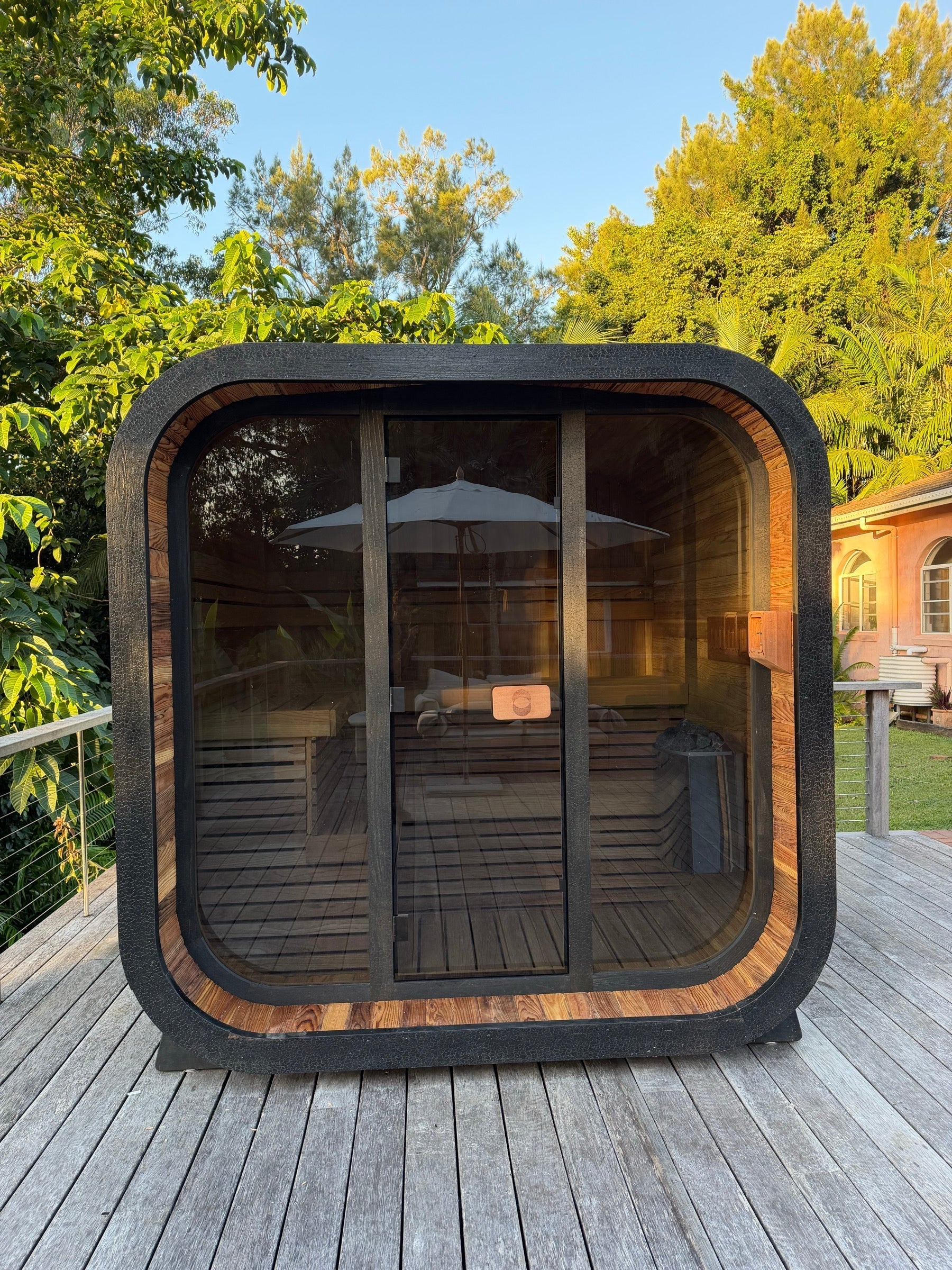
The Genesis is available in two exterior finishes: Natural cedar — warm, aromatic, ages to a silver-grey patina in outdoor conditions — and Charcoal (Shou Sugi Ban), the Japanese charred timber technique that carbonises the surface for superior moisture resistance and a bold architectural finish. Both options carry identical zero-toxin construction throughout. For a deeper look at how timber and heater choice interact with your specific climate, our complete sauna buying guide for Australia breaks down every variable.

Heater Choice: Why the HUUM DROP Changes the Session
The heater is the engine of the sauna. Everything else — the timber, the glass, the ventilation — serves the heat. Get the heater wrong and nothing else compensates.
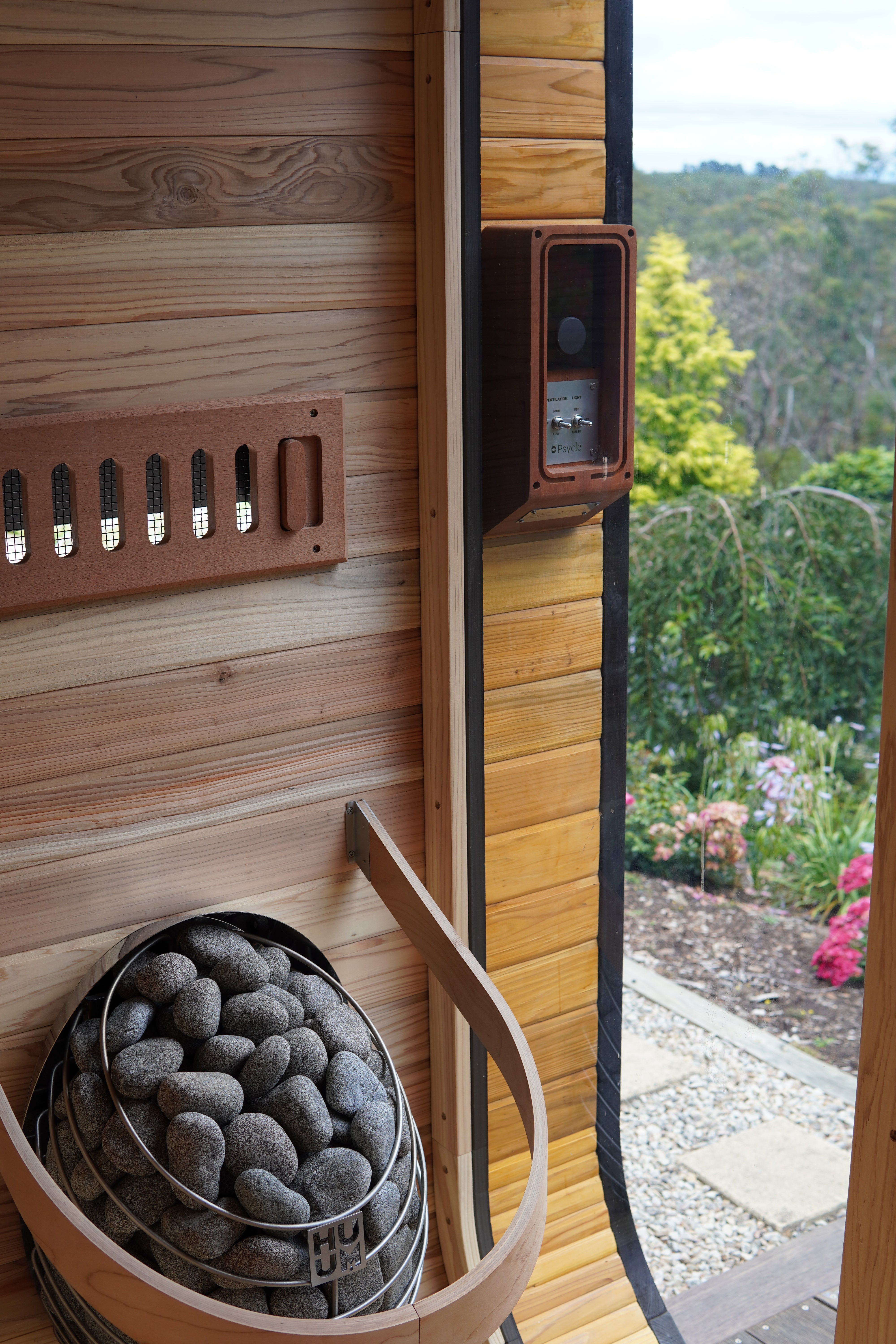
The Genesis offers two heater options: the HUUM DROP 9kW with 60kg of Olivine diabase stones and WiFi control via the UKU app, or the Harvia Vega 9kW with 20kg of Olivine diabase stones and mechanical controls. Both are Finnish-engineered. Both reach operating temperature in 30–45 minutes. The difference is stone volume — and stone volume is everything.
Why Stone Mass Determines Löyly Quality
60kg of Olivine diabase stones holds more thermal mass than 20kg. When you pour water — löyly — onto the stones, the heat stored in that mass converts to steam instantly and consistently. A low-stone-volume heater spikes briefly and drops. A high-stone-volume heater sustains the wave. That is the difference between a sauna session that feels like a public bathroom and one that feels like a Finnish lakeside ritual.
Olivine diabase is selected for its thermal properties: low silica content, high iron-magnesium composition, and exceptional resistance to thermal shock. It does not crack under repeated heat-and-pour cycles the way granite or generic sauna stones do. For the full science on stone selection, our guide to sauna stones in Australia explains what to look for and what to avoid.
The HUUM DROP connects to the UKU app — which means you can preheat the sauna remotely. In practical terms: you finish a workout, open your phone on the drive home, and the sauna is at 90°C when you walk through the back gate. The Harvia Vega operates with mechanical controls — no app, no connectivity, no complexity. Both are engineered to last. The choice comes down to how you use it.
Zero-Toxin Finnish Engineering, Built for Australian Backyards
Japanese Cedar. Zero-glue construction. HUUM DROP 9kW with 60kg stone volume. 3-year cabin warranty. Ships Australia-wide.
SEE THE GENESIS →Inside the Genesis: What You Actually Get
The Genesis is a 3–5 person traditional Finnish home sauna. External dimensions: 2289H × 2288W × 1945D mm. That is a generous footprint — large enough to accommodate two people lying flat on the upper bench, or four to five sitting. It is designed for real sessions, not token heat exposure.
The 8mm safety laminated tempered glass — a 4+4mm dual-layer, grey-tinted construction — runs full-height across the front. This is not a porthole. It is a full wall of glass. In a Natural cedar finish, the amber and red IP67 lighting (585–590nm amber, 630–635nm red) glows through the glass at night the way a lantern does. In the Charcoal finish, the contrast between the charred exterior and the warm cedar interior is architectural rather than rustic.
The lighting specification matters more than it appears. Standard saunas use white or blue-white LEDs — which suppress melatonin production and work against the recovery and sleep benefits you are trying to achieve. The Genesis uses blue-light-free amber and red wavelengths only. If you are using your sauna in the evening as a sleep protocol, this is not a small detail. It is the difference between a session that helps you sleep and one that quietly undermines it. Our guide to sauna use for sleep improvement in Australia explains the melatonin and thermoregulation mechanisms in full.
Active mechanical ventilation runs at 88 m³/hr (low) or 120 m³/hr (high). Forced ventilation keeps the air clean and fresh at operating temperature — eliminating the stale, suffocating feeling of poorly ventilated saunas — and supports the heater in maintaining consistent heat distribution from floor to ceiling. For an evidence-based deep dive on why ventilation design is the most under-appreciated variable in sauna performance, see our sauna ventilation guide for Australia.

Every Genesis ships with an accessories kit: sand timer, thermometer, hygrometer, bucket and ladle, towel hooks, and three Australian wool sauna hats. The Colorbond roof kit is available as an optional add-on for fully exposed outdoor placement — meaning the Genesis can sit in direct weather, year-round, without additional shelter structures.
The Genesis Mini delivers identical zero-toxin engineering in a compact 1–3 person form: 2267H × 1571W × 1950D mm. It uses the same 38mm Japanese Cedar walls, the same glass specification, and the same blue-light-free lighting. The heater drops to 6kW (HUUM DROP 6kW with 60kg stones, or Harvia Vega 6kW with 20kg stones) and the circuit requirement drops to 32A. It ships at approximately 350kg. For households with a single primary user or a tighter footprint, the Genesis Mini is the correct call. For those with three or more regular users or the space to accommodate a larger structure, the Genesis justifies itself immediately.
The Health Case for a Traditional Outdoor Sauna — Evidence, Not Opinion
Traditional Finnish sauna use carries one of the strongest evidence bases in preventive health research. This is not wellness marketing. The data is peer-reviewed, longitudinal, and replicable.
The cardiovascular finding from Laukkanen et al. in JAMA Internal Medicine (2015) is the headline — a 50% reduction in fatal cardiovascular events with 4–7 weekly sauna sessions. Regular sauna use is also associated with improvements in blood pressure regulation, arterial stiffness, resting heart rate, and autonomic nervous system function. For the Australian-specific breakdown of the cardiovascular science, our guide to sauna and cardiovascular health in Australia covers every mechanism.
For athletes, the recovery application is equally compelling. The heat stress of a genuine Finnish sauna — 80–100°C air temperature, löyly-driven humidity spikes — drives significant plasma volume expansion, growth hormone release, and heat shock protein production. These are not passive relaxation effects. They are active physiological adaptations that improve performance and accelerate tissue repair. Our performance guide for athletes using sauna in Australia details the full protocol and timing recommendations.
Mental health outcomes are equally documented. Regular sauna use is associated with reduced symptoms of depression and improved mood regulation. When paired with cold immersion, the neurochemical effects are significant: research published in the European Journal of Physiology found that cold water immersion produces a sustained 250% increase in dopamine levels — an effect that outlasts the cold exposure itself by several hours. That is a clinically meaningful neurochemical shift, and it is one of the primary reasons the contrast therapy protocol — sauna followed immediately by cold plunge — has moved from athlete recovery rooms into mainstream wellness. For more on the mental health evidence, our sauna and mental health science guide covers the research in full.
The full spectrum of traditional sauna benefits — cardiovascular, metabolic, immunological, and cognitive — is documented in our evidence-based guide to traditional sauna benefits for Australians.
Who Is Actually Buying an Outdoor Sauna in Australia
The Genesis sits in Australian backyards, on coastal decks, and at rural retreats from Byron Bay to the Mornington Peninsula. The buyers are not uniform — but the pattern holds.
A Byron Bay coastal deck installation typically features the Charcoal (Shou Sugi Ban) finish — the carbonised exterior holds up better against salt-laden air and UV, and the architectural contrast with a natural timber deck is striking. A coastal buyer is usually pairing the sauna with a cold plunge. The contrast therapy protocol is the draw: sauna for recovery and parasympathetic activation, cold immersion for dopamine and sympathetic reset. This buyer has already built their diet, training, and sleep protocols. The sauna is the last infrastructure piece.
A suburban Melbourne backyard installation tends toward the Natural cedar finish, often positioned on a concrete slab adjacent to the main dwelling. Melbourne winters — cold, damp, grey — make the sauna a daily tool rather than a seasonal one. These buyers report using the sauna as a morning protocol anchor: 20–30 minutes at 85°C, then a cold shower, then work. The daily ritual is the point. Everything else is context.
A Queensland rural retreat installation is typically a Genesis on a purpose-built elevated hardwood deck, positioned for a view. The buyer is often not the primary user — they are building something for family and guests. The quality standard of the Genesis matches the quality standard of the property. Anything less would be a mismatch.
“I have run this protocol daily for 90 days. My recovery markers don't lie. HRV up, resting heart rate down, the post-session clarity is something I did not expect.” That is the language Psycle hears from buyers who commit to the daily ritual. Not life-changing. Not miraculous. Measurable, consistent, compounding.
The Sauna That Earns Its Place in Your Backyard
Active ventilation. Blue-light-free lighting. HUUM DROP 9kW heater. Zero-glue Japanese Cedar. Designed for Australians who take recovery seriously.
EXPLORE THE GENESIS →Australian Climate Considerations by Region
Australia is not a single climate. The outdoor sauna decisions that make sense in Byron Bay are different from those that make sense in Melbourne or rural Queensland. Here is what to factor in by region.
Coastal Queensland and Northern NSW — Humidity and UV
High ambient humidity, sustained UV exposure, and salt air are the primary outdoor stress factors in this zone. The Charcoal (Shou Sugi Ban) exterior performs best here — the carbonised surface is naturally more resistant to moisture ingress and UV degradation than untreated or oiled cedar. Position the sauna with prevailing sea breezes in mind: good airflow around the structure prevents moisture accumulation at the base.
The heat differential between ambient temperature (often 28–35°C in summer) and sauna operating temperature (80–100°C) is smaller in this region — meaning warm-up times may be slightly shorter. The humidity of the surrounding environment makes sauna humidity control more important, though. The Genesis active ventilation system — 88–120 m³/hr — handles this directly. Our guide to sauna humidity for Australian conditions explains the settings that work best in each climate zone.
Melbourne and Southeast Australia — Cold Winters, Wet Conditions
Melbourne winters are the best argument for owning a sauna. Ambient temperatures of 5–10°C, persistent grey skies, and damp conditions mean the sauna becomes a daily anchor rather than a weekend indulgence. The heat differential is larger here — which means the experience inside the cabin is more dramatic and the contrast with the outdoor temperature after a session is immediately felt.
For Melbourne installations on a concrete slab, ensure adequate drainage away from the base and consider the Colorbond roof kit if the sauna is fully exposed. The Genesis IP67 electrical rating means it is rated for direct weather exposure, but standing water at the base is the enemy of any outdoor timber structure over time. Our complete home sauna installation guide for Australia covers slab, deck, and drainage specifications in detail.
Rural and Regional Australia — Temperature Extremes
Rural installations — inland Queensland, the NSW highlands, Western Australia's southwest — face the widest temperature range. Summer maximums above 40°C and winter nights below zero are both possible within the same calendar year. The 38mm Japanese Cedar wall mass handles this range well: the thermal mass buffers against both heat and cold infiltration. Mechanical joints — not glued panels — allow for seasonal timber movement without cracking or delamination.
Rural buyers often position the sauna as the centrepiece of a larger wellness or retreat setup — pairing it with a cold plunge pool, an outdoor shower, and a dedicated relaxation space. That is not excess. That is infrastructure. For the full setup guide on pairing an outdoor sauna with cold plunge in the Australian context, our outdoor sauna and cold plunge setup guide for Australia covers every configuration.
Outdoor vs Indoor Sauna — Which Is Right for You?
The outdoor sauna is not automatically the right choice for every buyer. Here is the honest comparison.
| Factor | Outdoor Sauna | Indoor Sauna |
|---|---|---|
| Installation complexity | Slab or deck + dedicated circuit — more involved | Simpler if bathroom or laundry adjacent |
| Experience quality | Higher — natural surroundings, outdoor air, contrast access | Controlled, convenient, year-round |
| Contrast therapy access | Direct — cold plunge can be co-located | Requires dedicated space or cold shower |
| Property value impact | Higher — visible lifestyle asset | Moderate — adds function, less visible |
| Council approval | May apply depending on size and LGA | Generally not required |
| Weather exposure | Relevant — quality construction required | Not a factor |
| Ritual experience | Superior — entering a dedicated structure outdoors is qualitatively different | Functional and consistent |
For most Australian homeowners with a usable outdoor space, the outdoor sauna wins on experience quality, contrast therapy access, and lifestyle signal. The indoor sauna wins on installation simplicity and council certainty. If you are still weighing the full decision, our complete guide to home sauna ownership in Australia covers the indoor vs outdoor decision across every buyer type.
Planning and Installation — What You Need to Know Before Buying
The installation conversation is where many buyers underestimate the complexity — and where some installers underestimate the quality standards required for a high-performance outdoor sauna.
Electrical Requirements
The Genesis requires a 50A dedicated circuit — single or three phase. This is not a standard power point. It requires a licensed electrician to run a dedicated feed from the switchboard, which in most Australian homes means a service upgrade if the board does not have available capacity. Budget $800–$2,000 for this work depending on the distance from the board to the installation site and your state's specific electrical code requirements.
The Genesis Mini requires a 32A dedicated circuit. Still a dedicated circuit, but more commonly accommodated within existing switchboard capacity. If the installation site is close to the house, the electrical run cost drops significantly.
Concrete Slab vs Engineered Deck
The Genesis ships at approximately 600kg. That weight, combined with two to five adults and the thermal mass of the structure, requires a base with engineered load capacity. A 100mm reinforced concrete slab is the most cost-effective solution. An engineered hardwood or composite deck can also work, but must be specified to carry the load — consult a structural engineer rather than assuming a standard deck will suffice.
The base must be level. A 10mm deviation across the base footprint will stress the cabin frame over time and affect door seal integrity. Get the slab right before delivery. The lead time is 120 days from deposit — that is enough time to complete the base work comfortably before the cabin arrives.
Council Approvals and Permits
Council approval requirements vary by local government area, state, and the dimensions of the structure. A sauna cabin with a footprint under a specific threshold is classified as a secondary structure in many LGAs and may not require development approval. This is not universal, though — particularly in heritage overlays, coastal zones, or properties with specific covenant conditions.
Contact your local council before committing to a placement decision. In most cases, a pre-purchase council enquiry takes less than a week to resolve. Our guide to home sauna installation across Australia maps the permit requirements state by state and includes specific questions to ask your LGA.
Genesis vs Genesis Mini — Which Outdoor Sauna Is Right for You?
The decision between the Genesis and the Genesis Mini comes down to three variables: how many people will use it simultaneously, what footprint you have available, and what electrical capacity your property can support.
| Specification | Genesis | Genesis Mini |
|---|---|---|
| Capacity | 3–5 persons | 1–3 persons |
| External dimensions | 2289H × 2288W × 1945D mm | 2267H × 1571W × 1950D mm |
| Wall construction | 38mm Japanese Cedar, zero-glue | 38mm Japanese Cedar, zero-glue |
| Heater options | HUUM DROP 9kW (60kg stones) or Harvia Vega 9kW (20kg stones) | HUUM DROP 6kW (60kg stones) or Harvia Vega 6kW (20kg stones) |
| Circuit requirement | 50A dedicated | 32A dedicated |
| Shipping weight | ~600kg | ~350kg |
| Glass specification | 8mm safety laminated tempered (4+4mm dual-layer, grey tint) | 8mm safety laminated tempered (4+4mm dual-layer, grey tint) |
| Accessories included | Sand timer, thermometer, hygrometer, bucket, ladle, towel hooks, 3x wool sauna hats | Sand timer, thermometer, hygrometer, bucket, ladle, towel hooks, 2x wool sauna hats |
| Cabin warranty | 5 years | 5 years |
| Right for | Households with 2+ regular users, families, those with the space and circuit capacity | Solo or dual users, compact footprints, apartments with outdoor space |
If you have the space and the circuit capacity for the Genesis, take it. The 3–5 person capacity means it grows with your household, holds its value as a lifestyle asset, and delivers a qualitatively different experience to the Mini — the interior volume changes the session. The Mini is the correct call when the footprint or electrical constraint is real, not hypothetical.
Both carry identical zero-toxin construction. Both are the right answer to the wrong question if the baseline is a flat-pack sauna from a big-box retailer. The question is not Mini or Genesis — it is Genesis Mini or Genesis, and both are serious pieces of engineering.
Outdoor Sauna + Cold Plunge — The Contrast Therapy Protocol
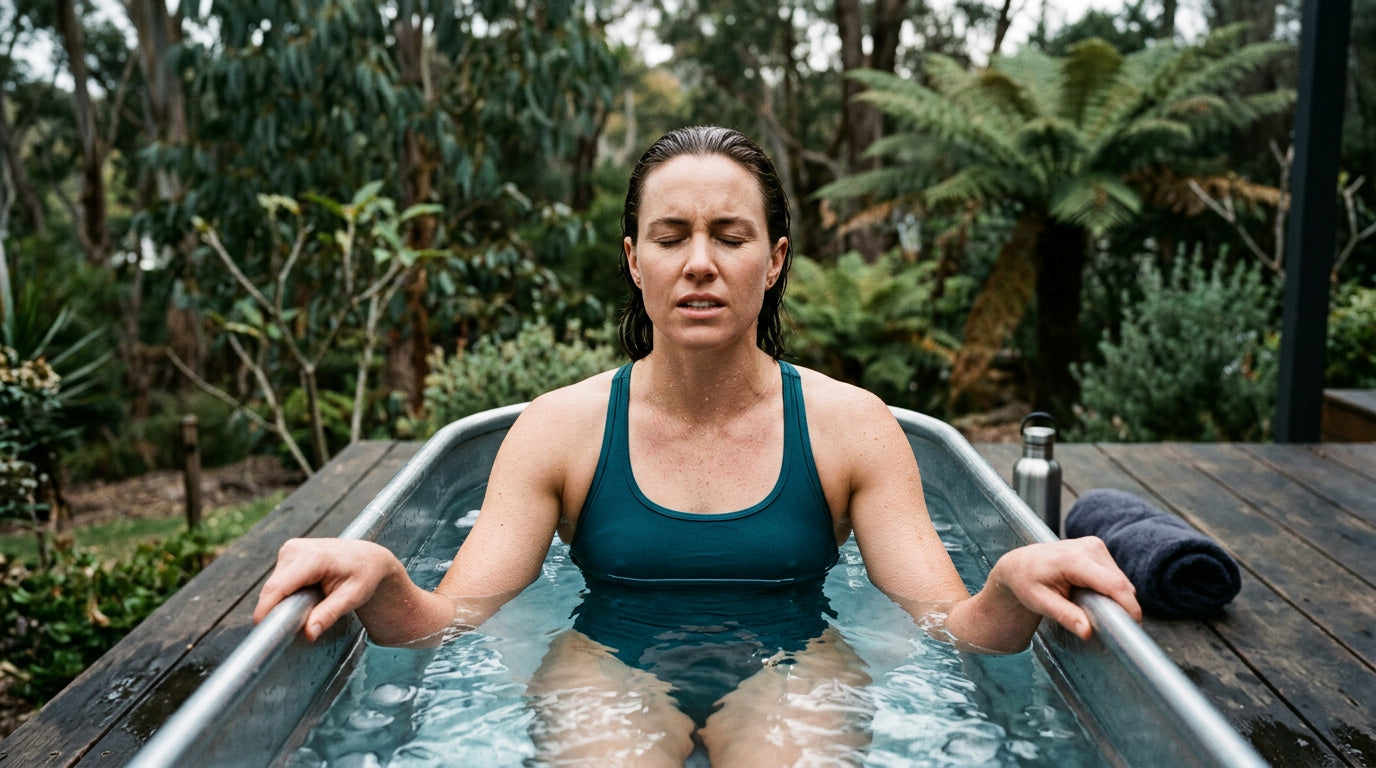
Pairing an outdoor sauna with a cold plunge is not a trend. It is a physiologically grounded recovery protocol with a growing body of peer-reviewed evidence behind it — and it is the single most powerful upgrade available to anyone who already owns or is planning a sauna.
The contrast therapy mechanism works through alternating vasodilation and vasoconstriction: heat drives blood vessels to dilate and peripheral circulation to surge; cold causes rapid vasoconstriction, flushing metabolic waste and driving blood back to core organs. The alternation — typically 15–20 minutes of sauna followed by 2–5 minutes of cold immersion, repeated two to three times — produces cardiovascular adaptation, lymphatic clearance, and a neurochemical response that no single modality can replicate.
A 2018 meta-analysis by Dupuy et al. in Frontiers in Physiology, covering 99 studies and over 1,000 athletes, found cold-water immersion and contrast water therapy to be among the most effective recovery modalities for reducing muscle soreness and perceived fatigue. That is a 99-study dataset. The sample is large enough to be decisive.
The Psycle Contrast Kit pairs the Genesis with the Origin cold plunge. The Origin is a premium ice bath engineered to the same zero-compromise standard as the Genesis. Together, they create a self-contained contrast therapy installation in your backyard. The brand's core statement for this pairing is precise: heat recovers you, cold hardens you, together they transform you. That is not a slogan. That is physiology.
For a complete guide to contrast therapy protocols, timing, and temperature targets for the Australian context, our contrast therapy routine guide covers the evidence-based protocol in full. For the specific benefits of cold immersion paired with sauna, our guide to sauna and cold plunge benefits cites the relevant research across cardiovascular, neurocognitive, and recovery outcomes.
Outdoor Sauna Price Guide Australia — What to Expect at Each Level
The Australian outdoor sauna market spans a wide price range. What you get at each level varies more than most buyers expect — not in appearance, but in construction standards, material quality, and long-term durability.
| Price Range (AUD) | What You Typically Get | Key Limitations |
|---|---|---|
| $2,000 – $5,000 | Flat-pack kits, MDF or thin pine panels, low-wattage infrared elements | Off-gassing risk, poor outdoor durability, no stone heater |
| $5,000 – $10,000 | Spruce or pine cabin, 4–6kW element heater, basic construction | Glued joints, thin walls, limited warranty, no active ventilation |
| $10,000 – $20,000 | Cedar or thermally modified timber, quality stone heater, better construction | Variable VOC standards, inconsistent certification, mixed warranty terms |
| $20,000 – $40,000 (Psycle Genesis) | 38mm Japanese Cedar, zero-glue, HUUM DROP 9kW, full-height glass, active ventilation, IP67 lighting, 5yr warranty | 120-day lead time — not an impulse purchase |
| $40,000 – $120,000+ | Custom European installations, architect-designed structures, bespoke fitout | Long project timelines, high variation in quality, not purpose-built for Australian conditions |
Custom European sauna installations in Australia can run from $40,000 to well above $100,000 when you factor in architecture, project management, and bespoke fitout. US-imported commercial-grade cabin saunas sit in the $15,000–$30,000 range for comparable specifications. The Genesis was engineered to deliver that standard at a price that reflects genuine engineering rather than compromised materials or imported prestige markup.
The running cost calculation matters more than most buyers model before purchasing. The Genesis costs approximately AU$0.50–$1.00 per 45-minute session, based on the 9kW HUUM heater at current Australian electricity rates of $0.30–$0.35/kWh. Spread across a daily protocol, that is roughly $180–$365 per year in electricity — less than a single month of a premium gym membership ($100–$200/month), and a fraction of weekly physio ($100–$160/session). The question is not whether a Genesis is expensive. The question is what you are currently spending on recovery infrastructure you do not own. For the full financial analysis, our comprehensive guide to home sauna costs in Australia models the 10-year ownership economics in detail.
Maintaining an Outdoor Sauna in Australian Conditions
Outdoor sauna maintenance in Australia is straightforward when the sauna is built correctly. The problems that require extensive maintenance — delaminating panels, cracking joints, rusting fittings, degrading finishes — are almost exclusively products of poor initial construction. Zero-glue Japanese Cedar, correctly finished, requires minimal intervention.
Timber Care
The exterior of a Natural cedar finish will silver-grey over time with UV exposure — this is natural patination, not degradation. If you want to maintain the original warm amber colour, an annual application of a UV-stabilising non-VOC cedar oil keeps the surface protected and the colour consistent. The Charcoal (Shou Sugi Ban) exterior requires less intervention — the carbonised surface is self-protecting and weathers well without treatment.
Interior timber — benches, walls, ceiling — requires no treatment. Wipe down with a dry cloth after sessions to remove sweat residue. Do not use chemical cleaners inside the cabin. If bench staining becomes an issue, a light sand with 120-grit paper once per year is all that is needed.
Heater and Stone Maintenance
Olivine diabase stones last 3–5 years with regular use. Inspect them annually for cracking or degradation. Cracked stones absorb water unevenly and can compromise the steam quality of the löyly. Replacement stones are straightforward to source in Australia. For the full guide on stone selection, replacement timing, and the specific properties that differentiate sauna stone types, our sauna stone guide for Australia covers everything in detail.
The HUUM DROP heater carries a 3-year warranty and is engineered for decade-plus lifespan with standard use. The UKU app provides session logging and diagnostic alerts — so you know about a heater issue before it interrupts a session. Keep the heater guard clear of debris between uses.
Ventilation System
Active ventilation systems require a quarterly check of inlet and outlet pathways. In coastal environments, salt particulate can accumulate on grille surfaces — a soft brush clean once per quarter is sufficient. In bushfire-prone areas, ember guards over inlet vents are a sensible addition. The Genesis ventilation system has no moving parts exposed to the interior — the mechanisms are external and accessible without entering the cabin.
For a complete seasonal maintenance checklist covering timber, heater, glass, ventilation, and base inspection, our outdoor sauna maintenance guide for Australia maps the full annual care schedule.
Frequently Asked Questions — Outdoor Sauna Australia
What is the best outdoor sauna for Australian conditions?
The best outdoor sauna for Australian conditions is a traditional Finnish-style cabin with 38mm Japanese Cedar walls, zero-glue mechanical joints, a high-mass electric stone heater, and IP67-rated electrical components. The Psycle Genesis meets all of these criteria — and is the only Australian-market sauna built to this full specification with a 3-year cabin warranty and Australia-wide delivery.
The key variables for Australian outdoor performance are moisture resistance, UV stability, and structural integrity through temperature cycling. Japanese Cedar handles all three better than pine, spruce, or MDF-based alternatives. The Charcoal (Shou Sugi Ban) finish adds an additional layer of surface protection for high-humidity coastal installations.
Do I need council approval for an outdoor sauna in Australia?
Council approval requirements vary by local government area and state. Many LGAs classify a sauna cabin below a specific footprint threshold as an exempt development — but this is not universal, particularly in heritage overlays, coastal zones, or properties with specific covenant conditions.
Contact your local council before committing to a site and placement. A pre-purchase enquiry typically resolves within a week. Our home sauna installation guide for Australia maps the approval requirements state by state.
How much does an outdoor sauna cost in Australia?
Outdoor saunas in Australia range from approximately $2,000 (flat-pack, infrared, MDF panels) to over $120,000 (custom architect-designed installation). High-quality traditional Finnish cabin saunas with cedar construction and stone heaters sit in the $10,000–$40,000 range. The Psycle Genesis is positioned in the premium-engineered tier — zero-toxin construction, HUUM DROP 9kW heater, 5-year warranty.
Running costs for the Genesis are approximately AU$0.50–$1.00 per 45-minute session at current Australian electricity rates. Over 10 years of daily use, the total cost of ownership compares favourably to ongoing commercial sauna memberships or weekly physio. The full cost breakdown, including installation, electrical, and base costs, is in our home sauna cost guide for Australia.
What power does an outdoor sauna need in Australia?
A traditional Finnish sauna requires a dedicated electrical circuit — not a standard 10A power point. The Psycle Genesis requires a 50A dedicated circuit (single or three phase). The Genesis Mini requires a 32A dedicated circuit. Both must be installed by a licensed electrician, and most homes will require switchboard assessment to confirm available capacity.
Budget $800–$2,000 for electrical work depending on the distance from the switchboard to the installation site. This is a one-time cost. Running costs thereafter are approximately $0.50–$1.00 per session.
How long does an outdoor sauna last in Australian weather?
A well-constructed outdoor sauna built from Japanese Cedar with zero-glue mechanical joints should last 20–30 years in Australian outdoor conditions with standard annual maintenance. The failure modes that reduce lifespan — joint delamination, panel warping, surface finish breakdown — are products of poor construction, not inevitable timber ageing.
The Genesis carries a 3-year cabin warranty — the longest in the Australian market for a pre-engineered outdoor sauna. The Colorbond roof kit extends fully exposed outdoor suitability further by managing direct UV and rain load on the cabin roof.
Is a traditional sauna better than an infrared sauna for outdoor use in Australia?
For outdoor installation, a traditional Finnish sauna outperforms infrared on nearly every meaningful metric: operating temperature (80–100°C vs 50–70°C for infrared), physiological response depth, löyly capability, and the sheer experience quality of a high-mass stone heater. Infrared saunas are convenient for indoor use. Outdoors, the full-cabin experience of a traditional sauna is what the space and investment deserve.
The cardiovascular and recovery evidence base is built on traditional sauna use — the Laukkanen et al. JAMA study, the Dupuy meta-analysis, the dopamine research — not infrared exposure. If you are investing in outdoor wellness infrastructure, invest in the modality the research is built around. For the full evidence comparison, see our traditional vs infrared sauna science comparison.
How often should I use my outdoor sauna for health benefits?
The strongest health outcomes in the research are associated with 4–7 sessions per week. The Laukkanen et al. study found 4–7 weekly sessions delivered a 50% reduction in fatal cardiovascular events versus once-weekly use. Even 2–3 sessions per week shows meaningful benefit for most health markers.
For a complete evidence-based frequency guide covering cardiovascular, recovery, mental health, and sleep outcomes, our sauna frequency guide for Australians maps the optimal protocols by health goal and experience level.
Ready to Build This Into Your Backyard?
Free Australia-wide delivery. 3-year cabin warranty. $1,000 refundable deposit. 120-day build — order now for summer delivery.
SHOP THE GENESIS →