
Best Sauna Cold Plunge Combo Australia: 2026 Guide
Sauna Cold Plunge Combo Australia: The Complete Buyer's Guide

Key Takeaways
- Contrast therapy — alternating heat at 80–100°C and cold immersion at 10–15°C — produces measurably superior recovery outcomes compared to either modality alone, including a 250% sustained dopamine increase from cold water immersion.
- The clinically supported protocol is 3–4 rounds of 10–15 minutes sauna followed by 2–3 minutes cold plunge, finishing on cold for neurological and metabolic benefits.
- A Psycle Contrast Kit (Genesis + Origin) requires a minimum outdoor footprint of approximately 5m x 4m and a dedicated 50A electrical circuit — both achievable on a standard Australian residential block.
- Running cost for a Genesis sauna session is approximately AU$0.50–$1.00 per 45 minutes at current Australian electricity rates — less than a single gym recovery suite visit.
- The Genesis is built from 38mm Japanese Cedar with zero-glue construction and a HUUM DROP 9kW heater carrying 60kg of Olivine diabase stone — engineered to operate without off-gassing at 90°C.
- Buying a bundled Contrast Kit costs less than purchasing the Genesis and Origin separately, and removes the logistical complexity of sourcing, delivering, and installing two premium units independently.
- Psycle delivers Australia-wide with a 120-day build lead time, a 5-year cabin warranty, and a fully refundable $1,000 deposit — so you are not locked in before production begins.
By Psycle Wellness · Last updated: May 2026 · 14 min read
The best sauna cold plunge combo in Australia is a purpose-built contrast therapy setup pairing a Finnish-style traditional sauna at 80–100°C with a cold plunge at 10–15°C, cycled in structured rounds. Used correctly, this combination produces physiological adaptations that neither heat nor cold achieves independently — and it is now achievable at home, at a lower long-term cost than most Australians realise.
Why Most Australian Recovery Setups Fall Short
Most Australians who take their training seriously have tried one end of the contrast spectrum. A post-session ice bath in a cheap chest freezer. A commercial sauna at the gym — flat-packed particleboard walls, two heat settings, a timer on the wall. Neither is wrong. But neither is what the research is actually pointing to.
The problem with a chest freezer is that it is a chest freezer. No insulation engineered for immersion, no temperature control that holds under load, no structural design for daily use in Australian conditions — UV exposure, humidity, coastal salt air. It works until it does not, and when it fails, it fails permanently.
The problem with a gym sauna is that you do not control it. You cannot control the temperature, the cleanliness, the timing between heat and cold, or the hour you use it. The contrast protocol depends entirely on the transition window — the shorter the gap between exiting heat and entering cold, the sharper the physiological response. A gym does not give you that precision.
And then there is the material question. Most flat-pack home saunas are built with glued MDF panels and particleboard. Heat that to 90°C and you are not just sweating — you are breathing formaldehyde off-gassing with every session. That is not wellness. That is the opposite of it. If you want to understand exactly what makes a zero-toxin build different, our science-backed guide to traditional sauna benefits in Australia breaks down what the research actually says about heat therapy quality.
What a Sauna Cold Plunge Combo Actually Does to Your Body
Contrast therapy — the deliberate alternation of heat and cold — triggers a series of overlapping physiological responses that researchers have been studying for decades, and the mechanism is now well understood.
Heat exposure in a Finnish-style sauna at 80–100°C drives core temperature elevation, vasodilation, and a dramatic increase in heart rate — comparable in cardiovascular load to moderate aerobic exercise. A landmark 20-year cohort study of 2,315 Finnish men by Laukkanen et al., published in JAMA Internal Medicine (2015), found that sauna use 4–7 times per week reduced the risk of fatal cardiovascular disease by 50% compared to once-weekly bathing. That is not a minor effect. That is the kind of outcome that changes how clinicians think about preventive health.
Cold immersion reverses the cascade. Vasoconstriction, noradrenaline spike, metabolic rate increase, and a sustained neurochemical response that most people describe as the clearest-headed they feel all day. Research published in the European Journal of Physiology found that cold water immersion produces a sustained 250% increase in dopamine levels — a neurological effect that outlasts the cold exposure itself by several hours. That is not a placebo. That is dopamine synthesis at a rate your brain does not reach through almost any other natural mechanism.
Put the two together in structured alternation and you amplify both. The rapid temperature swing between vasodilation and vasoconstriction works like a pump for the cardiovascular system — increasing nitric oxide production, improving endothelial function, and accelerating the clearance of metabolic byproducts from muscle tissue. For a deeper breakdown of the physiological mechanisms, see our complete guide to contrast therapy in Australia.
The Science-Backed Contrast Therapy Protocol
Contrast therapy protocol matters as much as the equipment. The wrong sequence, wrong timing, or too long a gap between heat and cold blunts the physiological response significantly.
A 2018 meta-analysis by Dupuy et al. in Frontiers in Physiology, covering 99 studies and over 1,000 athletes, found cold-water immersion and contrast water therapy to be among the most effective recovery modalities for reducing muscle soreness and perceived fatigue. The protocol that most closely matched the studied interventions: multiple alternating rounds, starting with heat and finishing with cold.
Preheat — 10 minutes
Enter the sauna cold — no pre-warm shower. Allow core temperature to climb gradually. Target ambient temperature: 80–100°C.
First heat round — 12–15 minutes
Pour löyly — 100–200ml of water over the stones — to spike perceived heat and humidity. Exit when breathing becomes laboured or at 15 minutes, whichever is first.
Cold transition — 2–3 minutes
Enter the cold plunge within 30 seconds of leaving the sauna. 10–15°C. Immerse to the neck. Control breathing — slow exhale through pursed lips. Do not fight the cold response.
Rest — 5 minutes
Exit the plunge and allow body temperature to normalise passively. No towel immediately — air drying extends the cold response. Sit or lie down.
Repeat — 2–3 total rounds
Return to the sauna for rounds 2 and 3. Each subsequent heat round can extend to 15–20 minutes as heat adaptation builds.
Finish on cold
Always finish on the cold plunge — not the sauna. Finishing cold maximises noradrenaline and dopamine carry-through into the hours after your session.
One detail most people miss: transition time matters more than duration. Getting from sauna to cold plunge in under 30 seconds is meaningfully different from taking 3 minutes to towel off, put on thongs, and walk around the side of the house. The Contrast Kit is designed to sit within metres of itself — that proximity is not aesthetic convenience, it is protocol engineering.
If you want to understand how sauna session timing interacts with recovery outcomes specifically after training, our guide to sauna after workout: how long to sit for recovery covers the evidence in detail.
Zero-Toxin Contrast Therapy, Built for Australian Conditions
Japanese Cedar exterior. Zero-glue construction. HUUM DROP 9kW heater. 316 marine-grade stainless Origin cold plunge. Built for daily use — not daily compromise.
SEE THE CONTRAST KIT →The Genesis and Origin: What You Are Actually Buying
The Psycle Contrast Kit pairs the Genesis sauna with the Origin cold plunge in a single bundle — engineered to work together and priced below what it costs to source each unit independently.
Genesis: The Sauna
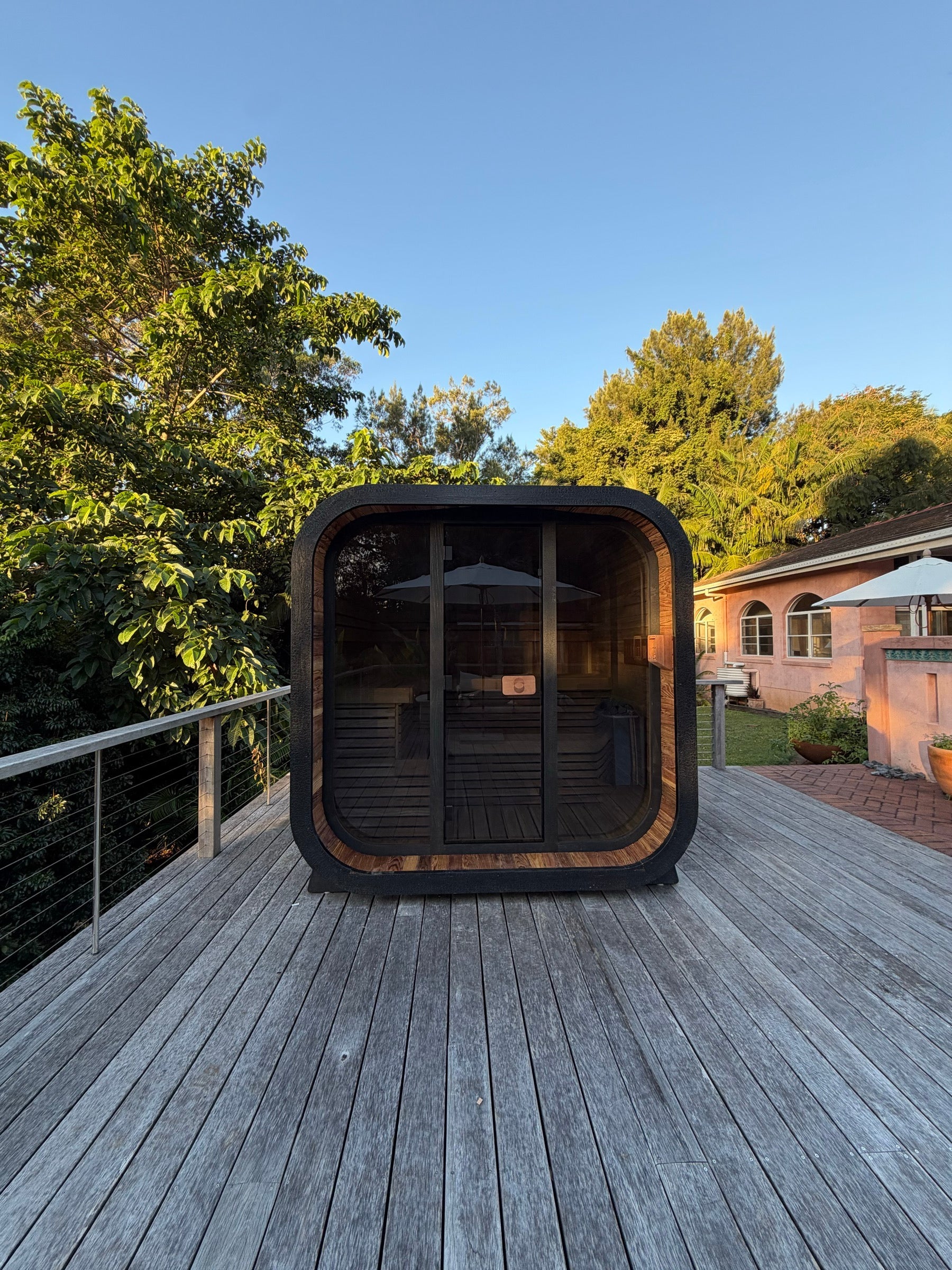
The Genesis is a 3–5 person traditional Finnish-style sauna built from 38mm Japanese Cedar with zero-glue mechanical joints and a non-VOC oil finish applied throughout. There is no glue in this structure — no formaldehyde, no off-gassing, no chemical steam at 90°C. Cedar is chosen for its natural antimicrobial properties, its dimensional stability in the heat cycle, and because it ages with the kind of character that makes a sauna look better in year ten than it did on delivery day.
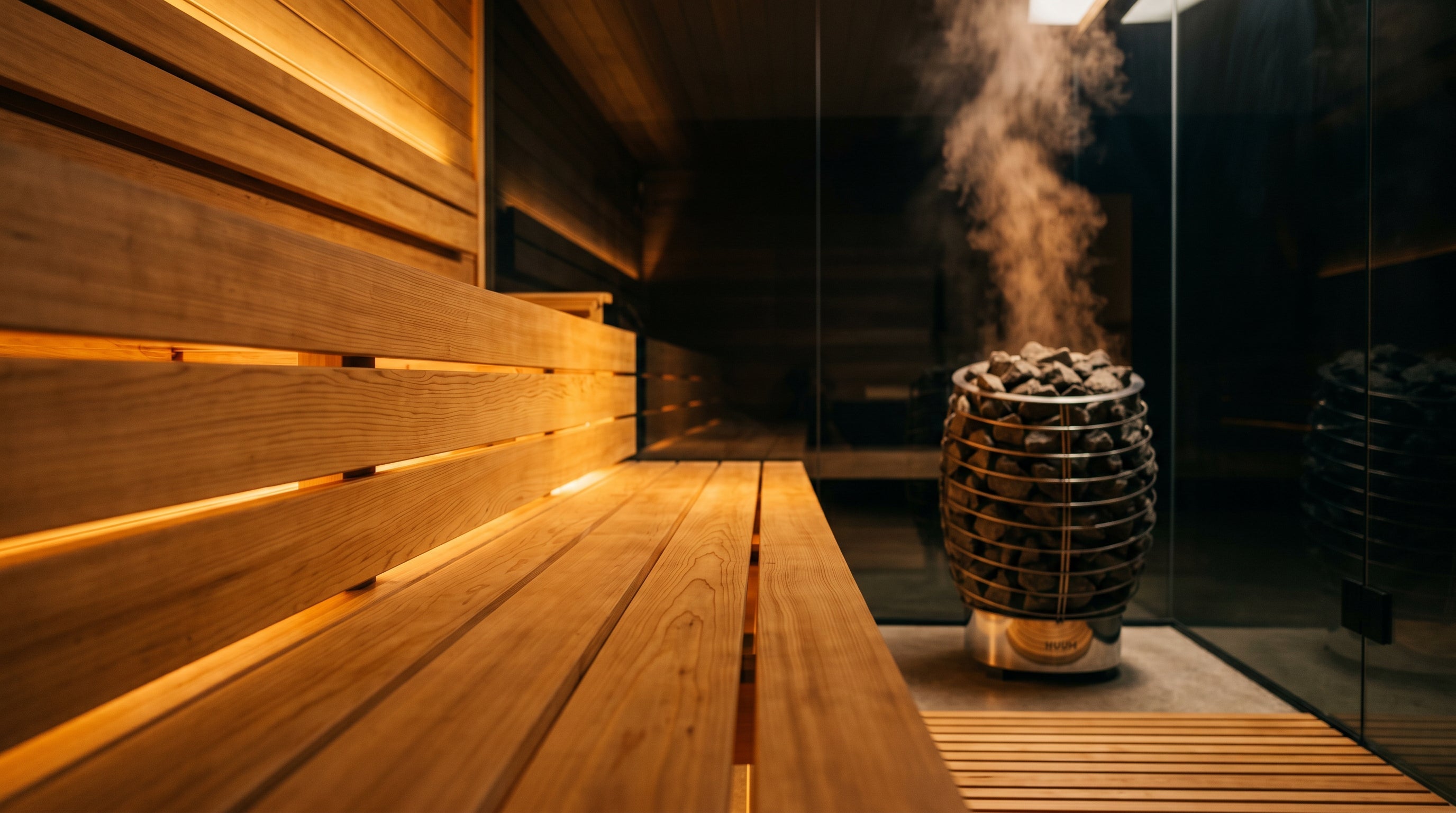
Heater choice matters more than most buyers realise. The Genesis ships with either the HUUM DROP 9kW or the Harvia Vega 9kW. The HUUM DROP carries 60kg of Olivine diabase volcanic stone — a stone mass that holds heat through a full session without temperature drop when you pour löyly. The Harvia Vega carries 20kg of stone and suits buyers who prefer mechanical controls over app-based operation. Both are 9kW units requiring a dedicated 50A circuit (single or three phase). Both are built for Australian voltages.
Lighting throughout is blue-light-free — Amber 585–590nm and Red 630–635nm, IP67 rated to withstand 200°C ambient and full moisture exposure. Active mechanical ventilation runs at 88 m³/hr on low and 120 m³/hr on high — pulling fresh air through the cabin rather than letting heat stagnate. External dimensions: 2289H x 2288W x 1945D mm. Optional Colorbond roof kit allows fully exposed outdoor placement year-round.
Two finishes: Natural cedar or Charcoal — the latter using a Shou Sugi Ban charred timber process that produces a surface which does not fade, does not peel, and does not require periodic re-treatment. Both carry a 5-year cabin warranty and a 3-year heater warranty. For a broader comparison of what separates a true Finnish build from everything else on the Australian market, read our complete home sauna buyer's guide.

Origin: The Cold Plunge
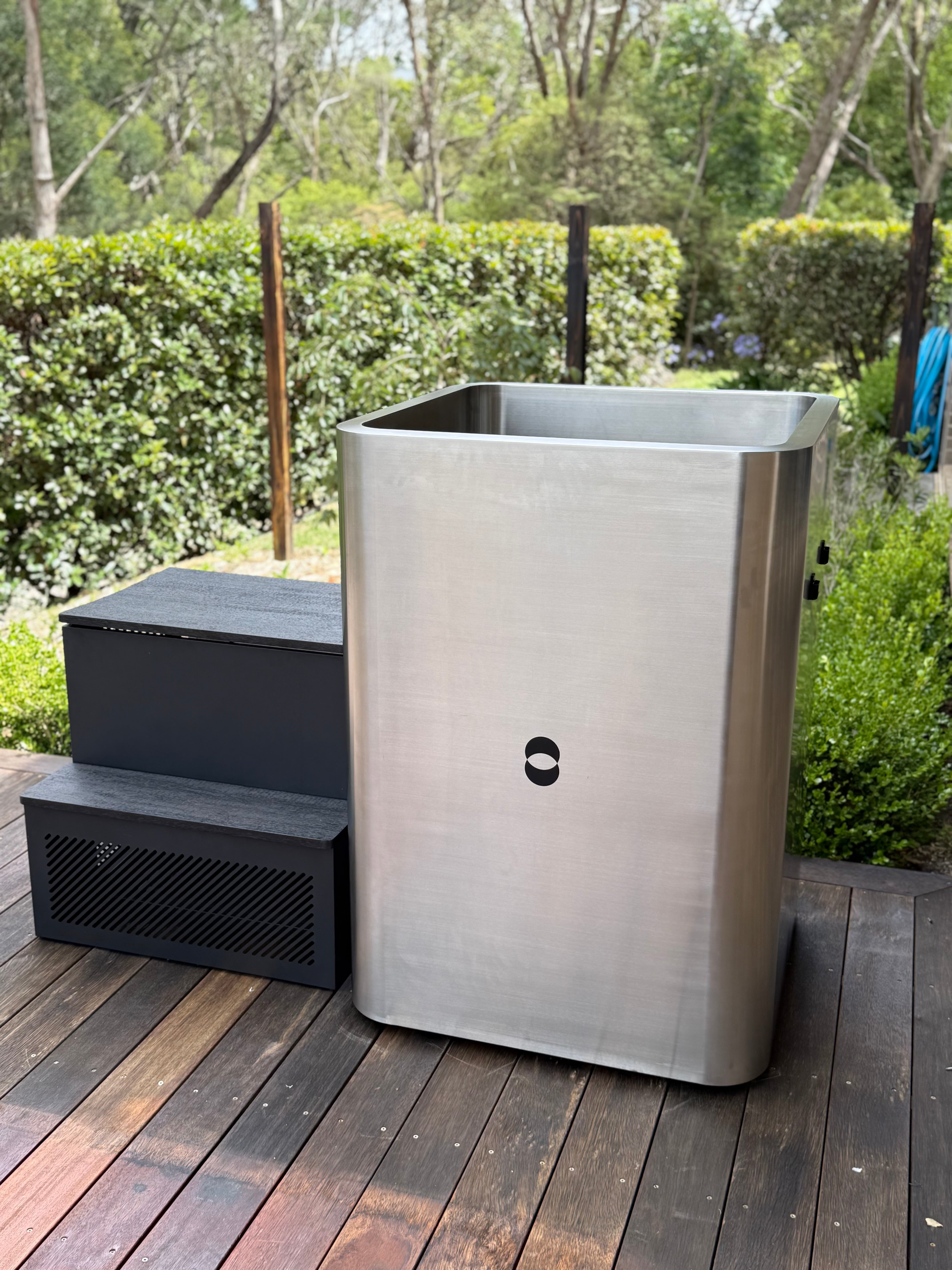
The Origin is Psycle's premium cold plunge, engineered for residential installation in Australian conditions. 316 marine-grade stainless steel construction means it holds up to coastal salt air, chlorinated water, and year-round outdoor UV exposure without surface corrosion or structural compromise.
The insulated roll cover holds water temperature between sessions, which matters in an Australian summer when ambient temperatures work against you. Temperature precision at the target range of 10–15°C is what separates a purpose-built cold plunge from a repurposed chest freezer — the latter cannot hold a stable temperature under load, and the former is engineered to do exactly that.
For a standalone deep-dive into cold plunge selection, our sauna and cold plunge guide and cold plunge tub buyer's guide for Australia covers what to look for in temperature range, construction materials, and running costs.
What Australian Customers Are Actually Experiencing
The buyers who choose the Contrast Kit are not buying a luxury item. They are building a performance system. The language they use when they describe the protocol after 60–90 days of consistent use is consistent: clearer sleep, faster recovery markers, a sharper neurological baseline that they did not expect from heat and cold.
“I run the contrast protocol every morning before my workstation. My resting heart rate is down 6bpm from where it was three months ago. I do not need the data to know it is working — but it is there anyway,” — Psycle customer, Sydney.
The pattern is consistent: the first two weeks are discipline. After that, it becomes the non-negotiable part of the day — the ritual that everything else organises around. That is not marketing language. That is what people say when something works.
The recovery application is particularly strong for Australian athletes and weekend competitors who train hard enough to accumulate real tissue damage but do not have access to clinical recovery infrastructure during the week. A home contrast setup at this specification level removes that access barrier permanently. Our dedicated guide to cold plunge benefits in Australia covers the athlete-specific evidence in full.

The Sauna That Does Not Compromise
Active mechanical ventilation. Blue-light-free IP67 lighting. 60kg volcanic stone mass. Zero-glue Japanese Cedar construction. Every detail has a reason.
EXPLORE THE CONTRAST KIT →Running Costs and ROI for Australian Homeowners
The most common objection to a home contrast setup at this specification level is upfront cost. It is a legitimate consideration — and one that looks very different when you run the numbers across a 5–10 year horizon.
The Genesis operates a 9kW heater. At current Australian electricity rates of AU$0.30–$0.35 per kWh, a 45-minute session costs approximately AU$0.50–$1.00. That includes preheat time. Daily use across a full year runs to approximately AU$180–$365 in electricity — a figure that compares directly against a gym membership at AU$1,200–$2,400 per year that does not give you a private, on-demand sauna and cold plunge at the standard you need for genuine contrast therapy.
Weekly physiotherapy at AU$100–$160 per session — which many serious athletes run as their primary recovery investment — costs AU$5,200–$8,320 per year. The Contrast Kit replaces a significant portion of what that expenditure is trying to achieve, and it does so at home, at the time that suits your schedule, without booking a week in advance.
Custom European sauna installations run AU$40,000–$120,000 and above. Commercial-grade infrared units from US brands — which operate at 50–70°C rather than the 80–100°C of a traditional Finnish sauna — are priced at AU$15,000–$30,000 and do not include any cold exposure component. The Psycle Contrast Kit is engineered to deliver the traditional Finnish standard. It is not cheap. It is not meant to be. But it is not priced like the custom installations it matches on engineering quality. For a full breakdown of what home sauna ownership actually costs across the purchasing lifecycle, our home sauna cost guide for Australia covers every variable.
Space Requirements and Installation for Australian Homes
Installation is simpler than most buyers anticipate — and Australian residential architecture suits a contrast setup better than almost any other market globally, given the outdoor deck lifestyle, year-round climate access in coastal regions, and typical block sizes.
The Genesis external dimensions are 2289H x 2288W x 1945D mm. The Origin cold plunge adds approximately 0.8–1.2m² depending on configuration. A combined Contrast Kit installation requires a minimum outdoor footprint of approximately 5m x 4m — achievable on most Australian residential blocks from Byron Bay to the inner suburbs of Melbourne or Sydney.
Electrical requirement: the Genesis requires a dedicated 50A circuit (single or three phase). This is the most common installation question and the one most buyers underestimate. A licensed electrician is required — the circuit must be dedicated to the sauna and cannot be shared. In most Australian homes, the cost of running a dedicated 50A circuit from the main board to the backyard installation point is AU$500–$1,500 depending on distance and board configuration. It is a one-time cost, not a recurring one.
The optional Colorbond roof kit allows the Genesis to be installed in a fully exposed outdoor position — unprotected from rain — without affecting the 5-year cabin warranty. In northern Queensland, northern NSW, and coastal WA, this means year-round outdoor placement with no shelter required. In Melbourne and southern climates, most buyers install under an existing pergola or deck cover, which works equally well. Our outdoor sauna buyer's guide covers installation positioning, drainage, and council considerations across Australian states.
Delivery weight for the full Contrast Kit is approximately 600kg. Psycle delivers Australia-wide. Build lead time from order confirmation is approximately 120 days — long enough to plan your installation, arrange your electrician, and ensure the site is ready for delivery. The $1,000 deposit is fully refundable, which means you are not financially committed until you are certain. For detailed installation guidance, see our home sauna installation guide for Australia.
Contrast Kit vs Buying Separately vs Competitor Bundles
The commercial decision — bundle or buy separately — is simpler than it appears. Here is the honest breakdown.
| Factor | Psycle Contrast Kit | Genesis + Origin Separately | Competitor Bundles |
|---|---|---|---|
| Price | Bundle discount applied | Full RRP on each unit | Variable — often priced lower on cheaper materials |
| Sauna construction | 38mm Japanese Cedar, zero-glue, non-VOC finish | Same — Genesis spec unchanged | Typically MDF or pine, glued panels, VOC finishes |
| Heater | HUUM DROP 9kW (60kg stone) or Harvia Vega 9kW | Same — heater choice unchanged | Generic heaters, typically 4–6kW, lower stone mass |
| Cold plunge material | 316 marine-grade stainless, insulated cover | Same — Origin spec unchanged | Typically acrylic, fibreglass, or 304-grade steel |
| Delivery logistics | Single coordinated delivery, AU-wide | Two separate deliveries to coordinate | Often separate suppliers, separate delivery windows |
| Warranty | 5yr cabin, 3yr heater — single warranty contact | Same warranties — two separate warranty contacts | Typically 1–2yr on cabin, variable on cold plunge |
| Temperature capability | 80–100°C sauna / 10–15°C cold plunge | Same | Sauna often caps at 70–80°C, cold plunge at 15–18°C |
| Off-gassing risk | Zero — no glue, no VOC finishes | Zero | High — MDF and particle board off-gas at heat |
The case for the bundle over buying separately is straightforward: the price difference is real, the delivery coordination is simpler, and there is a single point of contact for warranty and service. The case against competitor bundles at lower price points is equally straightforward: the materials are not comparable, the temperature capability is not comparable, and the long-term ownership experience is not comparable.
If you are evaluating a 2-person configuration rather than the 3–5 person Genesis, the Genesis Mini + Origin bundle (Contrast Kit Mini) uses identical zero-toxin specifications — 38mm Japanese Cedar, zero-glue construction, non-VOC finish — with a HUUM DROP 6kW or Harvia Vega 6kW heater and requires a 32A circuit rather than 50A. Our 2-person sauna buyer's guide covers exactly when the Mini is the right call versus the Genesis.
One thing worth knowing when evaluating infrared alternatives: infrared saunas operate at 50–70°C — roughly half the ambient temperature of a traditional Finnish sauna. The physiological response is different, the cardiovascular load is lower, and the protocol evidence base is thinner. If you are weighing that temperature difference as part of your decision, our comparison of traditional sauna versus infrared covers what the science actually shows about each modality.
How a Sauna Cold Plunge Combo Performs Across Australian Climates
One question Australian buyers consistently raise is whether a home contrast setup performs differently in Brisbane versus Melbourne — and the honest answer is yes, in ways that favour both ends of the country.
In northern Australian climates — Byron Bay, the Gold Coast, Cairns, Darwin — ambient summer temperatures mean the Genesis reaches operating temperature faster and the Origin requires more active cooling work to maintain 10–15°C. The insulated cover on the Origin is not a marketing detail in these climates — it is the difference between hitting protocol temperature and not. Cold water immersion in a 22°C tub is refreshing. It is not contrast therapy.
In southern climates — Melbourne, Hobart, Adelaide — ambient winter temperatures actually assist the cold plunge, reducing the energy required to maintain target temperature during cooler months. The sauna session is arguably more viscerally satisfying in winter — stepping from 90°C cedar heat into a Melbourne July morning at 8°C produces a transition that most people describe as the best their nervous system has felt in years. The outdoor deck culture in coastal Australian cities makes a contrast setup architecturally natural — not an afterthought, but a feature.
The Genesis is rated for fully exposed outdoor placement year-round with the optional Colorbond roof kit. Japanese Cedar is one of the few timbers that handles the Australian UV and humidity cycle — expanding and contracting without cracking, without warping, and without the surface degradation that kills lesser saunas in their third or fourth year of outdoor exposure. For everything you need to know about positioning, drainage, and council requirements for an outdoor installation, our outdoor sauna guide for Australia is the complete reference.
The sleep and recovery benefits of regular contrast therapy are also particularly relevant in Australian contexts — where early-morning surf sessions, evening sport commitments, and high ambient temperatures make sleep quality a consistent challenge for active Australians. The neurological reset from a contrast session — driven by the dopamine and serotonin response — consistently moves sleep onset earlier and improves subjective sleep quality within two to three weeks of consistent use. Our guide to sauna and sleep in Australia covers the evidence behind that specific outcome.
Frequently Asked Questions
How do I set up a sauna and cold plunge at home in Australia?
Setting up a home sauna and cold plunge in Australia requires a flat outdoor area of approximately 5m x 4m, a licensed electrician to install a dedicated 50A circuit for the sauna, and a cold water supply connection for the plunge. The Psycle Contrast Kit ships as two units — the Genesis sauna and the Origin cold plunge — with a coordinated Australia-wide delivery and a 120-day lead time from order confirmation. Position the sauna and cold plunge within 3–5 metres of each other to minimise the transition gap between heat and cold, which directly affects protocol efficacy.
Is a contrast kit worth it compared to a gym or wellness centre membership?
A home contrast kit is worth it for anyone who uses it at least 3–4 times per week — at that frequency, the per-session cost drops well below the equivalent commercial visit cost within the first year of ownership. A Genesis sauna session costs approximately AU$0.50–$1.00 in electricity per 45 minutes. A commercial contrast therapy session at a premium wellness centre typically costs AU$40–$90 per visit. At 4 sessions per week, a commercial protocol costs AU$8,000–$18,000 per year — a figure that compares very differently against a home setup when spread across a 5–10 year horizon. The additional factors — on-demand access, no booking, private environment, no travel — are non-trivial for anyone with a performance-oriented schedule.
What order do you do sauna and cold plunge in?
Always start with the sauna and finish with the cold plunge. The clinical evidence — including the Dupuy et al. meta-analysis covering 99 studies — consistently shows that finishing on cold produces superior neurological and metabolic outcomes compared to finishing on heat. The correct sequence: sauna 12–15 minutes, cold plunge 2–3 minutes, passive rest 5 minutes, repeat for 2–3 total rounds. The final exit must be from the cold plunge, not the sauna, to maximise the dopamine and noradrenaline carry-through into the hours after the session.
How cold should the cold plunge be for contrast therapy?
The target temperature range for contrast therapy cold immersion is 10–15°C. Below 10°C, the risk of cold shock and involuntary hyperventilation increases without proportional benefit for most users. Above 15°C, the vasoconstriction response and noradrenaline spike are blunted. The Origin cold plunge is engineered to hold a stable temperature within this range under load — meaning the water stays at your target temperature throughout the immersion, not just at the surface or at the beginning of the session.
How much space does a sauna and cold plunge combo need in Australia?
A Psycle Contrast Kit installation requires a minimum outdoor footprint of approximately 5m x 4m. The Genesis external dimensions are 2289H x 2288W x 1945D mm. The Origin cold plunge adds approximately 0.8–1.2m² depending on orientation. Standard Australian residential blocks — from inner-city Sydney courtyards to suburban backyards in Melbourne or Brisbane — typically accommodate this footprint on an outdoor deck or paved area without structural modification. A flat, load-bearing surface and proximity to an electrical board are the two critical site requirements.
Can I use a sauna and cold plunge every day?
Daily use is safe and evidence-supported for most healthy adults. The Laukkanen et al. JAMA Internal Medicine study found the strongest cardiovascular outcomes at 4–7 sessions per week — daily use falls within that range. Most Psycle customers run a full contrast protocol 4–6 days per week, with at least one lighter day. If you are new to contrast therapy, build from 2–3 sessions per week across the first month to allow heat adaptation to develop before moving to daily use. Our guide to sauna frequency covers exactly how to structure your weekly protocol. Anyone with cardiovascular conditions, pregnancy, or active illness should consult a physician before beginning a contrast therapy protocol — for a full safety overview, see our sauna health risks and safety guide for Australia.
What electrical requirements does a home sauna need in Australia?
The Genesis requires a dedicated 50A circuit (single or three phase) installed by a licensed electrician. This circuit cannot be shared with other appliances. In most Australian homes, the cost of installing a dedicated 50A circuit is approximately AU$500–$1,500 depending on distance from the main board to the installation point. The Genesis Mini requires a dedicated 32A circuit. Psycle can provide electrical specification documentation for your electrician on request — the installation requirement is one-time, and once the circuit is in place, no further electrical work is required for the life of the unit.
Ready to Build This Into Your Routine?
Free Australia-wide delivery. 5-year cabin warranty. 120-day build lead time — order now for summer installation. Fully refundable $1,000 deposit.
SHOP THE CONTRAST KIT →Heat recovers you. Cold hardens you. Together, they transform you — and on a per-session cost basis, doing it at home at the standard the Genesis and Origin deliver is the most rational decision a performance-focused Australian can make.
If you are still building your understanding of either modality independently, start with our science-backed guide to traditional sauna benefits in Australia and our complete guide to cold plunge benefits in Australia. When you are ready to evaluate the full contrast setup, the contrast therapy guide is the most complete clinical reference we publish.
For buyers still deciding between the Genesis and Genesis Mini, our home sauna buyer's guide breaks down the decision framework clearly. And if you want to understand the full cost picture before you commit, the home sauna cost guide covers every variable from purchase through to long-term running costs.
The people who buy the Contrast Kit have already decided they are done settling. The only question left is the timeline.