
3 Person Sauna Australia: Complete Buyer Guide | Psycle
3 Person Sauna Australia: The Complete Buyer's Guide

Key Takeaways
- A 3-person sauna is the optimal size for most Australian households — large enough for two adults comfortably, compact enough to fit a standard deck, courtyard or granny flat footprint.
- The Psycle Genesis Mini measures 2267H x 1571W x 1950D mm and requires only a 32A dedicated circuit — significantly less infrastructure than a 4–5 person cabin.
- Japanese Cedar 38mm walls, zero-glue construction and a non-VOC oil finish mean zero formaldehyde off-gassing at 80–100°C — unlike MDF flat-pack competitors in the $3,999–$4,779 range.
- The HUUM DROP 6kW heater carries 60kg of Olivine diabase stones — producing dense, stable löyly that holds temperature for a full session without dropping when steam is poured.
- Running cost is approximately AU$0.50–$1.00 per 45-minute session at current Australian electricity rates of AU$0.30–0.35/kWh — cheaper than a single gym recovery suite visit.
- A landmark 20-year Finnish study found sauna use 4–7 times per week reduces fatal cardiovascular risk by 50% — the health case for daily home access is clinically backed.
- Paired with the Origin cold plunge, the Genesis Mini becomes a full contrast therapy setup in under 4 square metres of deck space.
By Psycle Wellness · Last updated: May 2026 · 14 min read
A 3-person sauna in Australia typically measures 1500–1600mm wide and 1900–2000mm deep, requires a 6kW heater and a 32A dedicated circuit, and fits comfortably on a standard residential deck or courtyard. It is the most space-efficient configuration for couples, small families and apartment dwellers who want genuine Finnish heat at home without a full outdoor cabin footprint.
Most Australians searching for a compact home sauna end up torn between a 2-person unit that is too cramped to use with a partner and a 4-person cabin that needs more deck space than they have. The 3-person category solves both problems — and in Australia, where outdoor deck culture and subtropical humidity shape how people use and maintain saunas, it is the configuration that works for the widest range of households.
This guide covers everything you need to decide: dimensions and installation requirements, material standards and what they mean for your health, Australian climate considerations by city, running costs in AUD, and how the home sauna Australia market has reached the point where premium Finnish engineering is available without a $40,000 custom build.
Why Most Home Saunas in Australia Are Built to the Wrong Standard
The competitor saunas ranking for this search term — units priced between $3,999 and $4,779 — share one thing in common: glued MDF panels, hemlock offcuts and particle board framing. Heat those materials to 80–100°C and you are not just sweating. You are breathing formaldehyde off-gassing from the adhesives and resins in the timber composite panels. That is not a minor compromise. That is the chemical opposite of a health practice.
Infrared options in the 3-person category — which dominate the budget end of the Australian market — operate at 50–70°C, generate electromagnetic radiation from heating elements, and cannot produce löyly at all. They are not Finnish saunas. They are heated rooms. If you want the cardiovascular, respiratory and neurological effects that decades of Finnish research have validated, you need traditional convective heat: 80–100°C, stone mass, and steam.
A 20-year cohort study of 2,315 Finnish men by Laukkanen et al., published in JAMA Internal Medicine (2015), found that sauna use 4–7 times per week reduced the risk of fatal cardiovascular disease by 50% compared to once-weekly bathing. That research was conducted in traditional Finnish saunas operating at 80–100°C with stone heaters and steam — not infrared cabins at 55°C. The distinction matters enormously when you are making a $10,000+ infrastructure decision for your home.
The real question is not whether a 3-person sauna is right for your space. It is whether the one you buy will still be worth using in a decade — or whether it will be off-gassing adhesives, warping in coastal humidity, and underperforming from session one. Read our complete guide to the best home sauna in Australia for the full category comparison.
The Genesis Mini: A 3-Person Sauna Built to a Different Standard
The Psycle Genesis Mini is a 1–3 person traditional Finnish sauna built to the same zero-toxin specification as the flagship Genesis — Japanese Cedar throughout, zero-glue mechanical joints, non-VOC oil finish, and no MDF or particle board anywhere in the structure. The external footprint is 2267H x 1571W x 1950D mm. It ships at approximately 350kg. It requires a 32A dedicated circuit — single or three phase — and is designed for installation on residential decks, courtyards, granny flats and covered outdoor areas across Australia.
The timber is Japanese Cedar at 38mm wall thickness. That is a structural and thermal choice, not an aesthetic one. Cedar's low density and natural oils give it exceptional thermal insulation and moisture resistance — properties that matter in the humidity range experienced from Byron Bay through Brisbane to Sydney. It does not warp, does not rot, and does not need re-sealing in coastal salt air the way hemlock and pine alternatives do.
The glazing is 8mm safety laminated tempered glass — a 4+4mm dual-layer panel with grey tint. That specification meets Australian safety glazing standards for structures subject to human impact. The flat-pack alternatives in the $4,000 range use 5mm single-pane glass that cannot legally be installed in residential structures under the National Construction Code in many configurations.

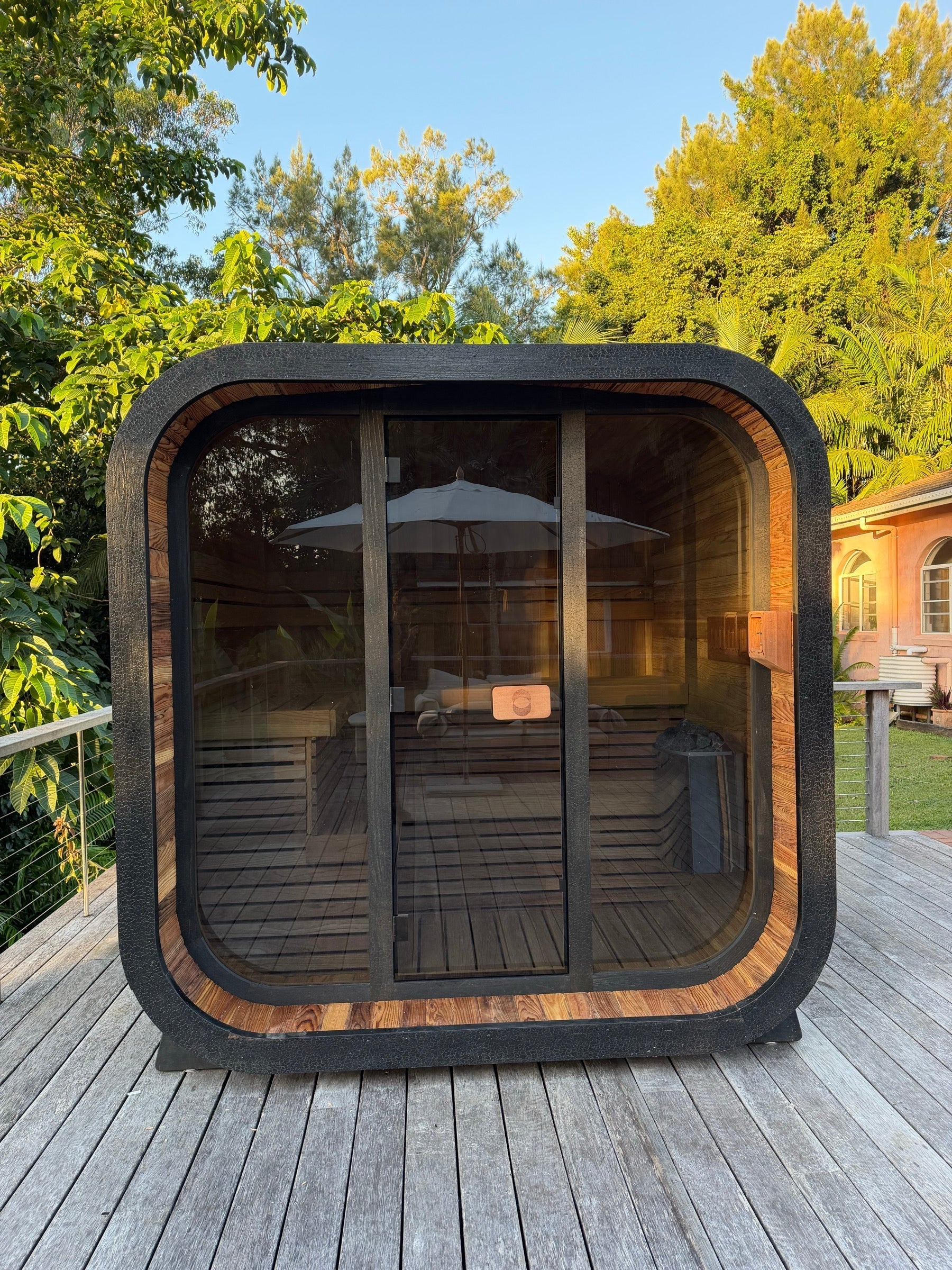
Two finish options: Natural cedar — the warm honey tone that deepens over time — or Charcoal, the shou-sugi-ban charred finish that is architecturally striking and provides additional weather resistance for fully exposed outdoor placements. Both finishes use a non-VOC oil throughout. No lacquer. No chemical topcoat. Nothing that will gas off under heat.
See the Genesis Mini in its natural environment in this exterior cedar install shot from a recent Australian installation — it gives you an accurate read on how the natural finish sits in a coastal residential context.
Zero-Toxin Construction. Real Finnish Heat.
Japanese Cedar. 38mm walls. Zero-glue joints. HUUM DROP 6kW heater. The Genesis Mini is built to last decades — not seasons.
SEE THE GENESIS MINI →The Heater: Where Most 3-Person Saunas Fail and the Genesis Mini Does Not
The heater is the single most important component in a traditional sauna. Everything else is a box. The heater determines the quality of heat, the quality of steam, the recovery between sessions, and the longevity of the thermal experience. Budget saunas in the 3-person category use 4kW–4.5kW heaters with 8–12kg of stone. That is not enough mass to produce meaningful löyly — the moment you pour water, the temperature drops and the steam dissipates within seconds.
The Genesis Mini is available with two heater configurations:
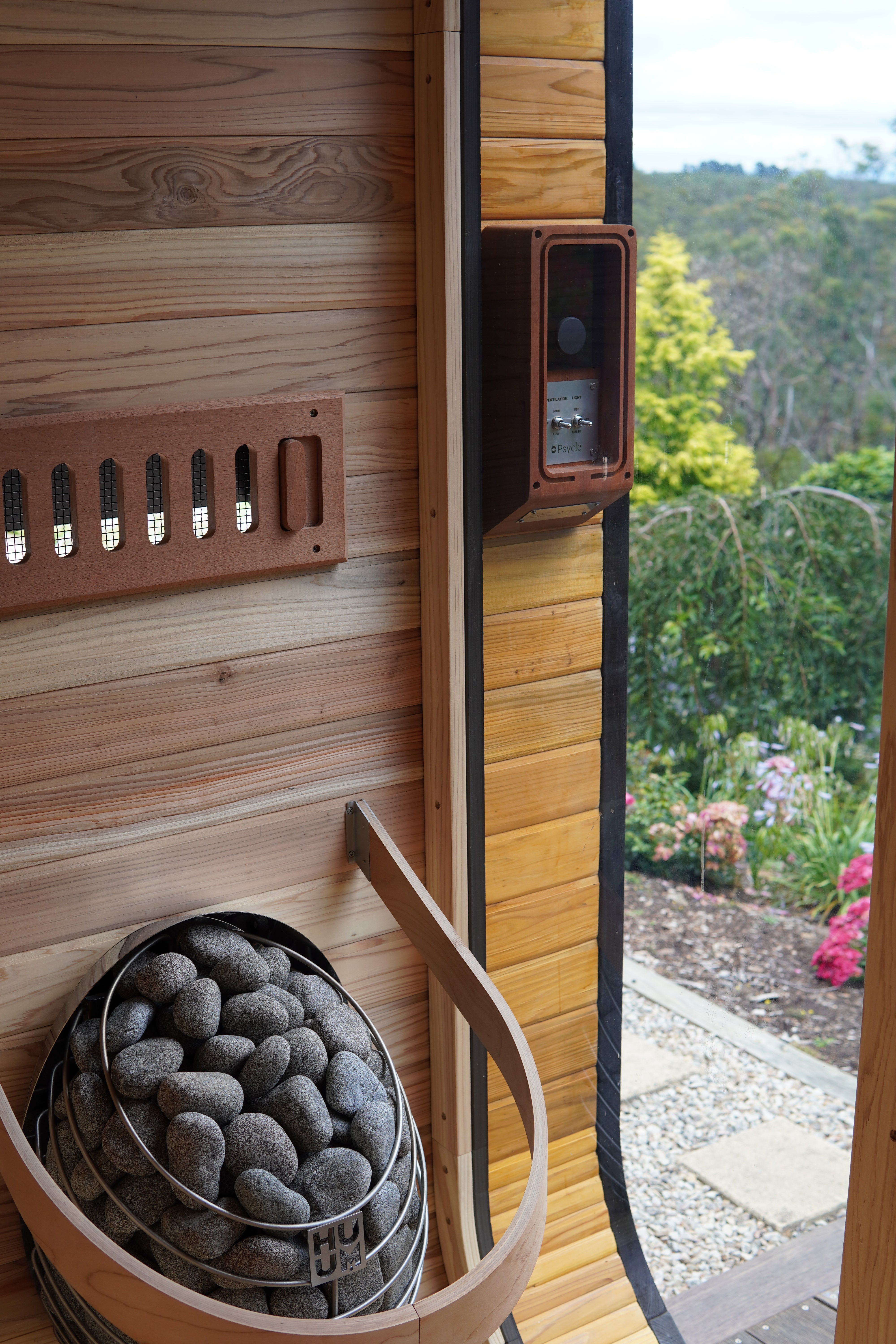
HUUM DROP 6kW — Finnish engineering, 60kg of Olivine diabase stones, WiFi-enabled UKU app control. The stone volume on this heater is exceptional for a 6kW unit — most competitors at this output run 15–20kg of stone. That 60kg mass means thermal stability: the temperature does not crater when you pour löyly, and the steam rises slowly and evenly rather than in a sharp blast. Preheat from ambient in 45–60 minutes. App-controlled, so you can start the session before you finish your cool-down.
Harvia Vega 6kW — Finnish-made mechanical controls, 20kg of Olivine diabase stones. No app, no WiFi — a clean analogue dial and a timer. For users who want a lower-maintenance setup or prefer to operate without a connected device, this is the right call. The Harvia Vega is a proven workhorse heater with decades of commercial use in Finnish public saunas.
Both heaters use Olivine diabase — a volcanic basalt that retains heat at higher density than the granite used in cheaper units. It does not crack under thermal cycling, which matters if you are pouring cold water on hot stones several times per session. For a deeper look at what stone type and mass do to the löyly experience, read our complete guide to löyly in Finnish sauna.

Lighting, Ventilation and the Details That Competitors Skip
The Genesis Mini uses blue-light-free LED lighting rated at Amber 585–590nm and Red 630–635nm. That is a deliberate engineering decision. Blue-spectrum light suppresses melatonin production, which directly undermines the sleep and recovery outcomes that evening sauna sessions are designed to produce. The amber and red spectrum preserves your circadian rhythm. It is IP67 rated and tolerates 200°C without degradation.
Active mechanical ventilation runs at 88 m³/hr low and 120 m³/hr high. Forced ventilation pulls fresh air in and exhausts hot, CO₂-rich air out — so the heat stays clean across a full session, not stale and oxygen-depleted by the third round. Most flat-pack saunas use passive ventilation — a vent cut in the wall. That is adequate for a single 15-minute session. It is not adequate for daily contrast protocols or multiple users in sequence. For a full breakdown of why ventilation determines session quality, see our guide to sauna ventilation in Australian conditions.
The Genesis Mini also comes with a full accessories kit: sand timer, thermometer, hygrometer, bucket and ladle, towel hooks, and 2x Australian wool sauna hats. The wool hats protect your head from radiant heat during high-temperature sessions and are standard kit in Finnish bathhouse culture. The overhead interior view of the Genesis Mini's bench layout is visible in the Genesis Mini overhead interior reference.
Size Comparison: 2-Person vs 3-Person vs 4-Person Sauna Australia
Choosing the wrong cabin size is the most common and most expensive mistake Australian buyers make. Too small and the sessions become uncomfortable — particularly if you sauna with a partner or want to lie flat during the heat phase. Too large and you are heating dead space, paying more per session, and potentially running into council setback issues in a tighter outdoor area.
The table below compares the three most common residential sauna configurations available in Australia. Dimensions, heater requirements, circuit requirements, minimum installation footprint and estimated running costs are all drawn from current Australian market specifications.
| Specification | 2-Person Sauna | 3-Person Sauna (Genesis Mini) | 4–5 Person Sauna (Genesis) |
|---|---|---|---|
| External Width | ~1200–1350mm | 1571mm | 2288mm |
| External Depth | ~1100–1200mm | 1950mm | 1945mm |
| External Height | ~2000mm | 2267mm | 2289mm |
| Heater Output | 4–5kW | 6kW | 9kW |
| Circuit Requirement | 20–25A | 32A dedicated | 50A dedicated |
| Min. Deck Footprint | ~2.0 m² | ~3.1 m² | ~4.5 m² |
| Running Cost (45 min) | ~AU$0.35–0.65 | ~AU$0.50–1.00 | ~AU$0.75–1.50 |
| Preheat Time | 30–45 min | 45–60 min | 60–75 min |
| Ideal For | Solo user, studio apartment courtyard | Couples, small families, granny flats | Families, frequent entertaining, larger outdoor areas |
For Australians deciding between a Genesis Mini and the full Genesis, available deck space is the clearest filter. With 3–4 square metres of usable outdoor area, the Mini is the right call. If your outdoor area exceeds 5 square metres and you have two or more regular sauna users, the Genesis delivers meaningfully better headroom, bench length and social capacity. Our detailed comparison of the 4-person sauna options available in Australia covers this decision in full.
If you are comparing the Genesis Mini against a 2-person configuration, our 2-person sauna Australia buyer's guide sets out exactly where the Mini outperforms smaller units for the additional footprint investment.
What Fits a 3-Person Sauna: A Spatial Planning Guide for Australian Homes
The Genesis Mini's external footprint is 1571mm wide by 1950mm deep. On your deck or courtyard, that is a rectangle roughly 1.6 x 2.0 metres. You will need additional clearance on all sides for maintenance access, air circulation and — if you are in a bushfire-prone area — ember guard compliance. The minimum planning envelope for a Genesis Mini installation is approximately 2.2m x 2.6m of clear, level outdoor space.
Deck and Courtyard Installations
A standard 3.6m x 4.8m timber deck — the most common deck size in Australian suburban residential builds — comfortably accommodates a Genesis Mini with room for a lounger and an Origin cold plunge beside it. The cabin sits on a flat-level base: either an existing concrete slab, a hardwood or composite deck rated to 400kg minimum, or a purpose-built treated pine platform. All four base types are suitable. The cabin does not require anchor bolting in most residential configurations, but high-wind coastal sites should consult a structural engineer on tie-down requirements.
For the full scope of what an outdoor installation involves — from base preparation to electrical connection — our home sauna installation guide for Australia walks through every step with real lead times and cost estimates.
Granny Flat and Enclosed Outdoor Room Placements
The Genesis Mini is frequently installed inside a granny flat utility room, an enclosed alfresco, or a converted shed. In these configurations the cabin connects directly to the 32A circuit inside the structure, and the ventilation system exhausts into the room rather than outdoors — which is compliant provided the room has adequate air exchange. The cabin's active ventilation at 120 m³/hr is sufficient for a standard enclosed outdoor room of 12–20 m².
Apartment Courtyards
Ground-floor apartments with private courtyards of 15 m² or more are viable Genesis Mini installations, subject to strata approval and the availability of a 32A circuit at the courtyard boundary. Most strata-managed buildings have 15A or 20A circuits serving outdoor GPOs — a licensed electrician will need to run a dedicated 32A line from the switchboard. This is a half-day job in most existing buildings. Budget approximately AU$800–1,500 for the electrical upgrade, depending on the run distance from the switchboard.
Council Setback Rules
In most Australian councils, a free-standing sauna cabin falls under the Class 10a building category — the same classification as a garden shed or pergola. Under the National Construction Code and most state planning codes, Class 10a structures under 10 m² in floor area and under 2.4m in wall height are exempt from development application in residential zones, provided they comply with setback rules. Standard residential setbacks are 900mm from a side boundary and 600mm from the rear boundary in most LGAs, but these vary. Always confirm your specific council's rules before installation. The Genesis Mini at 1571 x 1950mm has a floor area of approximately 3.1 m² — well under the exemption threshold in all Australian states.
See a real-world example of how the Genesis sits in an Australian outdoor residential space at our deck installation reference photo.
Bushfire Zone Compliance (BAL Ratings)
If your property carries a Bushfire Attack Level (BAL) rating — BAL-12.5, BAL-19, BAL-29, BAL-40 or BAL-FZ — the sauna cabin is a combustible structure and must comply with the relevant standard for your BAL zone. At BAL-12.5 through BAL-19, a standard Cedar cabin is generally permissible with ember-resistant vents (covered by fine mesh) and appropriate setbacks from vegetation. At BAL-29 and above, additional ember protection and potentially non-combustible cladding modifications are required. The Charcoal (Shou Sugi Ban) finish provides additional char-layer protection and is worth specifying if your site is in a BAL-12.5 to BAL-19 zone. For BAL-40 and BAL-FZ, consult your local fire authority and a registered building surveyor before ordering.
Psycle's 120-day build lead time means you have time to obtain a BAL assessment and confirm compliance before production begins. The $1,000 refundable deposit means you are not locked in if your compliance assessment changes your installation plans.
Australian Climate Considerations: Sydney, Melbourne, Brisbane and Byron Bay
Australia's climate diversity directly affects how a sauna performs, how much maintenance it requires, and what installation decisions matter most. A sauna installed in coastal Brisbane faces entirely different humidity, UV and salt air conditions to one in inner-city Melbourne. Getting this right at the specification stage saves money over a 10-year ownership period.
| City / Region | Climate Profile | Sauna Impact | Recommended Specification |
|---|---|---|---|
| Byron Bay / Northern NSW | Subtropical, high humidity (70–85% RH), salt air year-round | Timber must be moisture-resistant; hardware subject to corrosion; preheat faster in warm ambient temps | Japanese Cedar essential; non-VOC oil finish mandatory; Charcoal finish for added weather resistance; stainless hardware only |
| Brisbane / SE Queensland | Subtropical, 60–80% RH summer, dry winters, UV index very high | UV degrades finishes; summer ambient 30–35°C reduces preheat time; wet season can affect deck surfaces | UV-stable finish critical; covered placement or Colorbond roof kit for direct sun exposure; Cedar ages well in these conditions |
| Sydney / Coastal NSW | Temperate coastal, 50–75% RH, mild winters, salt air in eastern suburbs | Year-round outdoor use viable; salt air in 10km coastal zone; winter sauna use increases sharply | Cedar performs well; coastal properties should apply non-VOC oil annually; standard electrical spec adequate |
| Melbourne / Victoria | Temperate continental, 40–65% RH, cold winters (5–10°C), four seasons in one day | Longer preheat in cold ambient; covered installation preferable; sauna use peaks in winter months | Covered or semi-enclosed placement preferred; Colorbond roof kit for exposed installs; active ventilation more critical in cold climates |
Australia's humidity variance between coastal subtropical and temperate continental climates has a direct effect on session quality — specifically, how the heat feels and how you should manage steam. Read our in-depth explainer on sauna humidity in Australian conditions to understand how to calibrate your sessions by season and location.
You can also see how the Genesis sits in a real Queensland coastal residential setting in our coastal Queensland install portrait.
Running Costs: What a 3-Person Sauna Actually Costs to Run in Australia
Running cost anxiety stops more sauna purchases than price anxiety. The fear is that a 6kW heater running daily will blow out the electricity bill. At current Australian electricity rates, the numbers tell a different story — and the comparison to the alternatives makes the case clearly.
At AU$0.30–0.35/kWh — the current residential rate across most of eastern Australia — a 6kW Genesis Mini heater running a 45-minute session costs approximately AU$0.50–$1.00 including the preheat phase. That is the cost of a single espresso. A gym membership in Australia runs AU$1,200–$2,400 per year. A single physio session costs AU$100–$160. Weekly massage therapy runs AU$200–$400 per month. The Genesis Mini pays for itself in avoided recovery costs within 18–24 months for regular users.
At 5 sessions per week — the protocol supported by the cardiovascular research — your annual electricity cost for sauna sessions is approximately AU$130–$260. That is less than two physio sessions.
| Recovery Method | Cost Per Session (AUD) | Annual Cost at 5x/Week (AUD) |
|---|---|---|
| Genesis Mini (home sauna) | ~$0.75 | ~$195 |
| Commercial sauna drop-in | $25–$45 | $6,500–$11,700 |
| Gym recovery suite membership | $25–$50 (weekly) | $1,300–$2,600 |
| Sports physio | $100–$160 | $5,200–$8,320 |
| Weekly remedial massage | $90–$140 | $4,680–$7,280 |
For a complete cost breakdown including installation, electrical upgrade, and 10-year total cost of ownership, see our home sauna cost guide for Australia.
The Löyly Ritual in a 3-Person Sauna
Löyly — pronounced loy-loo — is the steam produced when water is poured onto hot sauna stones. It is the defining sensory element of traditional Finnish sauna and the reason stone mass matters more than heater output alone. In a 3-person cabin, the löyly dynamics are intimate and intense: the steam fills the room quickly, the humidity spike is immediate, and heat perception rises sharply without the dilution you get in a larger 5-person cabin.
The HUUM DROP 6kW heater in the Genesis Mini carries 60kg of Olivine diabase stones. That stone mass holds thermal energy across multiple löyly pours without the temperature dropping. A standard session protocol for a 3-person sauna using this heater looks like this:
Preheat — 45 to 60 minutes
Start the HUUM via the UKU app before your session ends. Target 80–90°C air temperature, stones radiating red. Do not enter until the stone mass is fully saturated with heat.
First Round — 12 to 15 minutes
Sit on the upper bench. Pour 100–150ml of water on the stones at 3–4 minute intervals. The steam should rise slowly and spread evenly — not blast and dissipate.
Cool Down — 5 to 10 minutes
Exit the cabin. Cold shower, cold plunge, or rest in ambient air depending on your protocol. Core body temperature drops, heart rate decreases, the parasympathetic system activates.
Second and Third Rounds — 10 to 15 minutes each
Repeat the heat-cool cycle two to three times. The physiological benefits compound across rounds — cardiovascular load increases, sweat rate accelerates, and post-session recovery depth improves with each completed cycle.
Final Rest — 15 to 20 minutes
Rest fully before rehydrating. Electrolyte water or mineral water. No alcohol during the session. The post-sauna rest period is when the deepest recovery effects occur — do not skip it.
For a deeper understanding of löyly technique, stone selection and how to maximise steam quality, read our complete löyly guide. For session duration calibrated to your goal — cardiovascular health, sleep, or recovery — see how long to stay in a sauna by goal and experience level.
What Australians Who Own a Genesis Mini Actually Experience
The people who buy a Genesis Mini have already decided they are done settling. They have been to a commercial sauna. They know what real heat feels like. They are not buying a wellness appliance — they are building a daily protocol into their home infrastructure.
The pattern is consistent: the first two weeks are about the ritual. Getting the preheat timing right. Working out the löyly cadence. Finding the session duration that fits your schedule. By week four, the protocol is locked in and the outcomes are measurable — sleep quality improves, morning HRV is higher, post-training recovery is noticeably faster.
What changes most is access. When the sauna is 10 metres from your back door, the frequency of use is fundamentally different to driving to a gym or booking a commercial wellness centre. Frequency is the variable that determines outcome in sauna research. The Laukkanen data showing 50% cardiovascular mortality reduction was for 4–7 sessions per week — not one occasional visit. Home access is how you actually hit that frequency.
The sauna performs well in the deck lifestyle context central to how Australians actually live — evening sessions after summer training, morning sessions before the heat of the day in Brisbane and Byron, winter ritual in Melbourne where you are using the sauna daily from April through September. See a golden-hour install shot that captures exactly this use context at our Genesis deck golden-hour install reference.
The Sauna That Does Not Compromise
Active ventilation. Blue-light-free lighting. IP67 rated. 3-year cabin warranty. 120-day Australian build. Free delivery nationwide.
EXPLORE THE GENESIS MINI →Pairing the Genesis Mini With the Origin: Compact Contrast Therapy
Contrast therapy — alternating heat and cold immersion — is the most evidence-backed recovery protocol available outside a clinical setting. The mechanism is direct: heat dilates blood vessels and activates the cardiovascular system; cold triggers vasoconstriction, reduces inflammation and produces a sustained neurochemical response. Used together, they produce an adaptive stress greater than either modality alone. That is the basis of the Psycle brand line: 1 + 1 = 3.
A 2018 meta-analysis by Dupuy et al. in Frontiers in Physiology, covering 99 studies and over 1,000 athletes, found cold-water immersion and contrast water therapy among the most effective recovery modalities for reducing muscle soreness and perceived fatigue. Research published in the European Journal of Physiology found that cold water immersion produces a sustained 250% increase in dopamine levels — a neurological effect that outlasts the cold exposure itself by several hours.
These are not marginal gains. They are outcomes that compound across weeks and months of consistent practice.
The Genesis Mini and the Origin cold plunge together occupy a combined footprint of approximately 3.5–4.0 square metres — achievable on any standard Australian suburban deck. The Contrast Kit Mini bundles both products at a single price point, with a single $1,000 refundable deposit and a single 120-day build timeline. Both units ship Australia-wide and are installed on the same day.
For the complete science and protocol guide on running contrast therapy at home, read our contrast therapy Australia guide. For the specific cold plunge protocol, see our sauna cold plunge routine and complete protocol guide. For a deeper look at how the Origin performs as a standalone cold therapy tool, read our complete guide to cold water therapy in Australia.
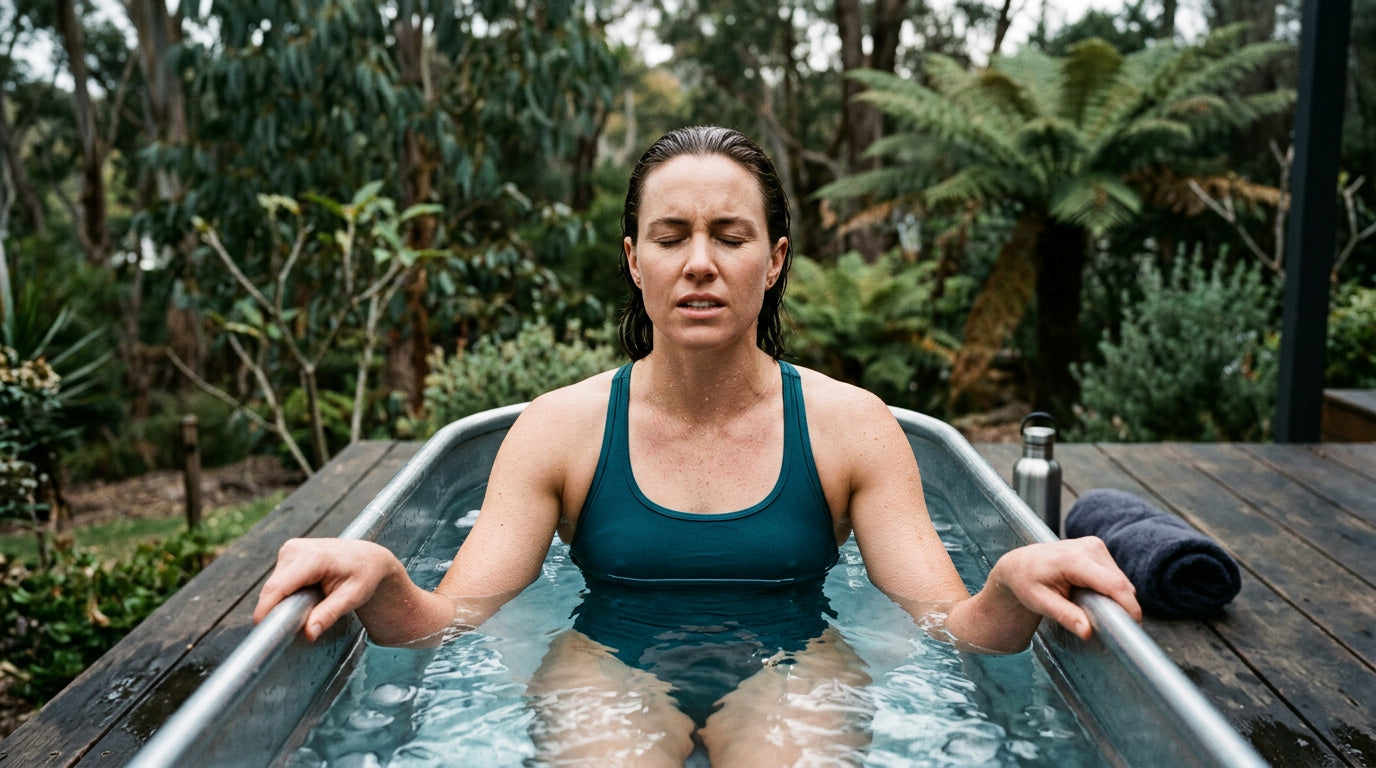
The Origin in use alongside the Genesis is captured in our Origin lifestyle in-use reference shot — it gives you a real spatial read on how the two units sit together on a residential deck.
How the Genesis Mini Compares to Traditional Sauna vs Infrared Options
The Australian 3-person sauna market is dominated by two categories: budget infrared units at $3,999–$5,000 and mid-range traditional steam saunas built with hemlock or MDF at $4,500–$8,000. The Genesis Mini sits above both. Here is the honest comparison.
| Feature | Budget Infrared (3-person) | Mid-Range Traditional (3-person) | Genesis Mini |
|---|---|---|---|
| Operating Temperature | 50–70°C | 70–90°C | 80–100°C |
| Löyly (Steam) Capable | No | Yes (limited stone mass) | Yes — 60kg Olivine stones |
| Timber Construction | Hemlock / MDF / particle board | Hemlock or pine, glued panels | Japanese Cedar, 38mm, zero-glue |
| Off-Gassing Risk | High — adhesives + low temp | Medium — glued panels | Zero — no glue, non-VOC finish |
| Glazing | 5mm single-pane | 6mm toughened | 8mm 4+4mm safety laminated |
| Ventilation | Passive vent | Passive vent | Active mechanical: 88–120 m³/hr |
| Lighting | Standard LED (blue spectrum) | Standard LED or halogen | Amber/red 585–635nm, IP67 |
| Warranty | 1–2 years | 2–3 years | 5-year cabin, 3-year heater |
| Outdoor Rated | Indoor only | Covered outdoor only | Fully outdoor with Colorbond roof kit |
For an evidence-based comparison of traditional Finnish sauna versus infrared across health outcomes, see our traditional vs infrared sauna science comparison. For the broader category view across all home sauna options in Australia, our complete outdoor sauna Australia guide covers every format and price tier.
If you are at the early stage of your research, start with our home sauna Australia buyer's guide, which frames the full decision — from cabin type and size to installation requirements and budget planning.
Frequently Asked Questions: 3 Person Sauna Australia
How big is a 3-person sauna?
A 3-person sauna is typically 1500–1600mm wide, 1900–2000mm deep and 2100–2300mm high externally, with a floor area of approximately 2.8–3.2 m². The Psycle Genesis Mini is 1571W x 1950D x 2267H mm externally — one of the most space-efficient 3-person cabin configurations available in Australia. Internally, that provides a bench length long enough for two adults to sit comfortably side by side on the upper tier, with a lower bench for acclimatisation or a third user.
How much does a 3-person sauna cost in Australia?
A 3-person sauna in Australia ranges from approximately $4,000 to $15,000+ AUD depending on construction quality, heater specification and material grade. Budget flat-pack units with MDF panels and 4kW heaters start around $3,999. Mid-range hemlock or pine traditional saunas sit in the $6,000–$9,000 range. Premium zero-toxin Japanese Cedar cabins with Finnish heaters — like the Genesis Mini — sit above $10,000. Budget the full cost of ownership: add $800–$1,500 for electrical installation and $500–$1,500 for base preparation. For a complete cost model, see our 2026 home sauna cost guide for Australia.
Can I install a sauna on a deck in Australia?
Yes, you can install a sauna on a residential deck in Australia, provided the deck is rated for the load — typically 400kg minimum for a 3-person cabin — and the electrical supply meets the circuit requirements. Most councils classify free-standing saunas under 10 m² as Class 10a structures exempt from development approval, subject to standard setback rules (typically 900mm from a side boundary). A 32A dedicated circuit is required for the Genesis Mini and must be installed by a licensed electrician. Properties in bushfire-prone areas require a BAL compliance assessment before installation. Full installation guidance is in our home sauna installation guide for Australia.
Is a 3-person sauna big enough for a family?
A 3-person sauna is the right size for most Australian households — sufficient for two adults to use comfortably together with room for a third person, and practical for couples with a child. It is not the right choice for households of four or more regular adult users who want to sauna simultaneously. If your household has 3+ adults sauna-ing together regularly, or if you anticipate entertaining, the Genesis (3–5 person) is the correct step up. The key distinction is bench length: a 3-person cabin provides approximately 1400–1500mm of upper bench — comfortable for two adults sitting upright. The Genesis provides 2000mm+ of upper bench.
What electrical supply does a 3-person sauna need in Australia?
A 3-person sauna with a 6kW heater requires a 32A dedicated circuit — a single-phase or three-phase feed run directly from the switchboard to a purpose-installed outlet adjacent to the cabin. This is standard residential electrical work in Australia and must be completed by a licensed electrician (Class A licence in NSW, VIC, QLD; equivalent in other states). The circuit cannot share a breaker with other appliances. Total electrical installation cost is typically AU$800–$1,500 depending on switchboard distance and site conditions. The Genesis Mini ships with a hardwired lead and requires no plug — the connection point is a permanent outlet.
How often should I use a 3-person sauna to see health benefits?
The research most clearly supports 4–7 sessions per week for cardiovascular health outcomes. The Laukkanen et al. 20-year Finnish cohort study found the 50% reduction in fatal cardiovascular events associated specifically with 4–7 weekly sessions, not occasional use. For recovery and sleep benefits, 3–5 sessions per week is sufficient for most users. Daily home access — which a Genesis Mini provides — is the practical enabler of the frequency the research supports. For a full frequency guide calibrated by health goal, see how often you should sauna based on your goals.
What is the best 3-person sauna available in Australia in 2026?
The Psycle Genesis Mini is the best-specified 3-person sauna available in Australia on construction quality, material safety, heater performance and warranty terms. It uses Japanese Cedar at 38mm wall thickness, zero-glue mechanical joints, a non-VOC oil finish, and a choice of HUUM DROP 6kW (60kg stone volume) or Harvia Vega 6kW heater. The 3-year cabin warranty and 3-year heater warranty are the longest available in the Australian residential sauna market. It is fully outdoor rated with an optional Colorbond roof kit and ships Australia-wide with a $1,000 refundable deposit and a 120-day build lead time.
Ready to Build This Into Your Routine?
Free Australia-wide delivery. 3-year cabin warranty. $1,000 refundable deposit. 120-day build — order now to lock in your delivery window.
SHOP THE GENESIS MINI →