
2 Person Sauna Australia: Complete Buyer's Guide 2026
2 Person Sauna Australia: The Complete Buyer's Guide 2026

Key Takeaways
- A quality 2 person sauna in Australia requires 38mm timber walls — not the 16mm panels found in most flat-pack imports — to reach and hold 80-100°C efficiently.
- The Genesis Mini's external footprint is 1571W x 1950D mm — it fits a standard 3m x 3m deck or courtyard with room for clearances on all sides.
- A 6kW HUUM DROP heater with 60kg of Olivine diabase stone mass is the correct heater specification for a compact cabin — more stone volume means stable heat, not just fast startup.
- Running costs for the Genesis Mini are approximately AU$0.40-$0.80 per 45-minute session — less than a single commercial sauna drop-in at most Australian gyms.
- Most cheap compact saunas use glued MDF or hemlock with generic heaters — at 90°C, formaldehyde off-gassing from glued panels is a documented health risk, not a marketing claim.
- The Genesis Mini requires a 32A dedicated circuit and ships at approximately 350kg — deck structural load and electrical access must be confirmed before ordering.
- A landmark 20-year Finnish cohort study found sauna use 4-7 times per week reduced fatal cardiovascular disease risk by 50% — frequency only becomes achievable when the sauna is in your own backyard.
By Psycle Wellness · Last updated: May 2026 · 16 min read
The best 2 person sauna for Australia is a compact traditional Finnish sauna built with 38mm Japanese Cedar walls, a correctly sized 6kW heater, and zero-glue construction — not a flat-pack import with 16mm panels and a generic element. If you have a deck, courtyard, or small backyard, this guide covers every specification, dimension, and decision you need to get it right.
Why Most Australians Searching for a Small Outdoor Sauna Australia End Up Disappointed
Most compact saunas sold in Australia are built to a price, not a standard. The wall panels are 16mm — sometimes 20mm at best — cut from kiln-dried spruce or hemlock sourced from the cheapest available mills. The heaters are generic 3-4kW elements with a handful of rocks on top. The glass is single-pane. The joins are glued.
Heat that to 90°C and you are not sitting in a sauna. You are sitting in a box that smells of resin and adhesive off-gassing while a small element struggles to push the air temperature past 70°C. That is not a small compromise. That is the opposite of what you are trying to build.
The reason this matters is that most people searching for a 2 person sauna in Australia are not buying a luxury item — they are buying a recovery tool they plan to use every day. A landmark 20-year cohort study of 2,315 Finnish men by Laukkanen et al., published in JAMA Internal Medicine (2015), found that sauna use 4-7 times per week reduced the risk of fatal cardiovascular disease by 50% compared to once-weekly bathing. That frequency only becomes achievable when the infrastructure is right.
A sauna you use twice then stop using is not a health asset. It is an expensive garden ornament. The engineering matters from session one.
Understanding the full evidence base for traditional sauna benefits in Australia makes it clear why cutting corners on wall thickness and heater specification undermines everything the practice is designed to deliver.
Who Actually Needs a 2 Person Sauna in Australia
A 2 person sauna is the right choice for a specific type of Australian buyer — and not a compromise version of something bigger. It is the precision choice for people whose space, budget, or household demands it.
Couples and solo users. If you and a partner are the primary users, a 1-3 person cabin is correctly sized. You are not undershooting — you are eliminating wasted volume that the heater has to work harder to heat. A quality 6kW heater in a compact cabin reaches temperature faster and holds it more consistently than a 9kW heater trying to fill a cabin twice the size.
Inner-city homes in Sydney and Melbourne. Terrace houses, semi-detached homes, and post-war bungalows in suburbs like Surry Hills, Fitzroy, Newtown, and Collingwood routinely have rear courtyards or side access areas of 3m x 3m or less. A full-size 3-5 person sauna does not fit. A compact cabin does — and does it without requiring major landscaping or structural work.
Apartment ground-floor courtyards. Strata rules vary widely, but ground-floor apartments with exclusive courtyard access in New South Wales, Victoria, and Queensland are increasingly installing compact saunas as fixed outdoor structures. The smaller footprint means fewer strata objections and a more manageable electrical installation.
Budget-conscious buyers who refuse to compromise on quality. The Genesis Mini delivers identical zero-toxin specification to the full-size Genesis — same 38mm Japanese Cedar walls, same zero-glue mechanical joints, same HUUM heater quality — at a lower price point because it is a smaller structure. This is not a budget sauna. It is the same engineering standard in a smaller format.
Deck installations with structural load constraints. Elevated timber decks in Australian homes are typically engineered to carry 1.5-2.0 kPa (150-200kg/m²). A compact sauna at approximately 350kg distributed across a 1.571m x 1.950m footprint creates a load of roughly 115kg/m² — within safe range for most standard residential decks. A full-size sauna at 600kg+ may require a structural engineering assessment before placement.
If you are still weighing up whether a full-size unit might be the better long-term investment, our complete guide to the best home saunas in Australia covers both formats side by side with detailed decision criteria.
What Separates a Quality Compact Sauna Australia from a Cheap Flat-Pack
Wall thickness is the single most important specification in any sauna, and it is the number that cheap manufacturers hide most aggressively. The difference between 16mm and 38mm is not cosmetic — it is the difference between a cabin that holds 90°C with minimal energy draw and a cabin that bleeds heat the moment you open the door.
Timber Species and Sourcing
Japanese Cedar (Cryptomeria japonica) is the benchmark timber for high-function sauna construction. It is naturally resistant to moisture, dimensionally stable under repeated heat and humidity cycles, and low in resin — meaning it does not bleed or become tacky at high temperatures the way spruce and pine do. It also ages beautifully, which matters when the cabin is a permanent outdoor architectural feature of your home.
Hemlock and spruce are the standard timber species in budget flat-pack saunas. Both are cheaper to source, both are acceptable in dry conditions, and both are inadequate for the thermal cycling of regular outdoor sauna use in Australian conditions — particularly in high-humidity coastal environments from Brisbane to Sydney to the Margaret River region.
The Genesis Mini uses Japanese Cedar throughout — exterior cladding, interior lining, benches, door frame. There is no hemlock interior with a cedar-look façade. The specification is consistent.
Zero-Glue Construction — Why It Matters at Temperature
Most flat-pack saunas are assembled with construction adhesives and glued MDF panel systems. At ambient temperature, this is invisible. At 90°C, it is not. Formaldehyde — a known carcinogen classified by the International Agency for Research on Cancer — is released from urea-formaldehyde resins in MDF and glued panel products when heated. You are deliberately breathing deeply in a sauna session. The air quality inside the cabin is not a secondary concern.
The Genesis Mini uses zero-glue mechanical joints throughout the cabin construction. The panels interlock without adhesives. The finish is a non-VOC oil — no solvent off-gassing at temperature. This is not a marketing claim. It is an engineering decision with a documented health rationale.
For a detailed breakdown of what goes wrong with poorly built saunas — and what zero-toxin construction actually means in practice — our home sauna Australia buyer's guide covers the full specification standard.
Glass Specification: 8mm Safety Laminated vs Single-Pane
The Genesis Mini uses 8mm safety laminated tempered glass — a dual-layer 4+4mm construction with a gray tint. This is structural glass rated for the thermal expansion and contraction of outdoor sauna use. It does not delaminate in UV. It does not crack from thermal shock when rain hits a hot surface.
Most budget compact saunas use single-pane 4-6mm glass. In Australian conditions — where the cabin may sit in direct sun at 35°C before being heated to 90°C — single-pane glass is a failure risk. Cracked glass in a hot outdoor sauna is not a warranty claim. It is a safety incident.
Zero-Toxin Compact Sauna, Built for Australian Conditions
38mm Japanese Cedar. Zero-glue mechanical joints. HUUM 6kW heater with 60kg stone mass. 8mm safety laminated glass. This is not a flat-pack. It is engineered infrastructure.
SEE THE GENESIS MINI →Genesis Mini Dimensions: Footprint, Deck Sizing, and Clearances

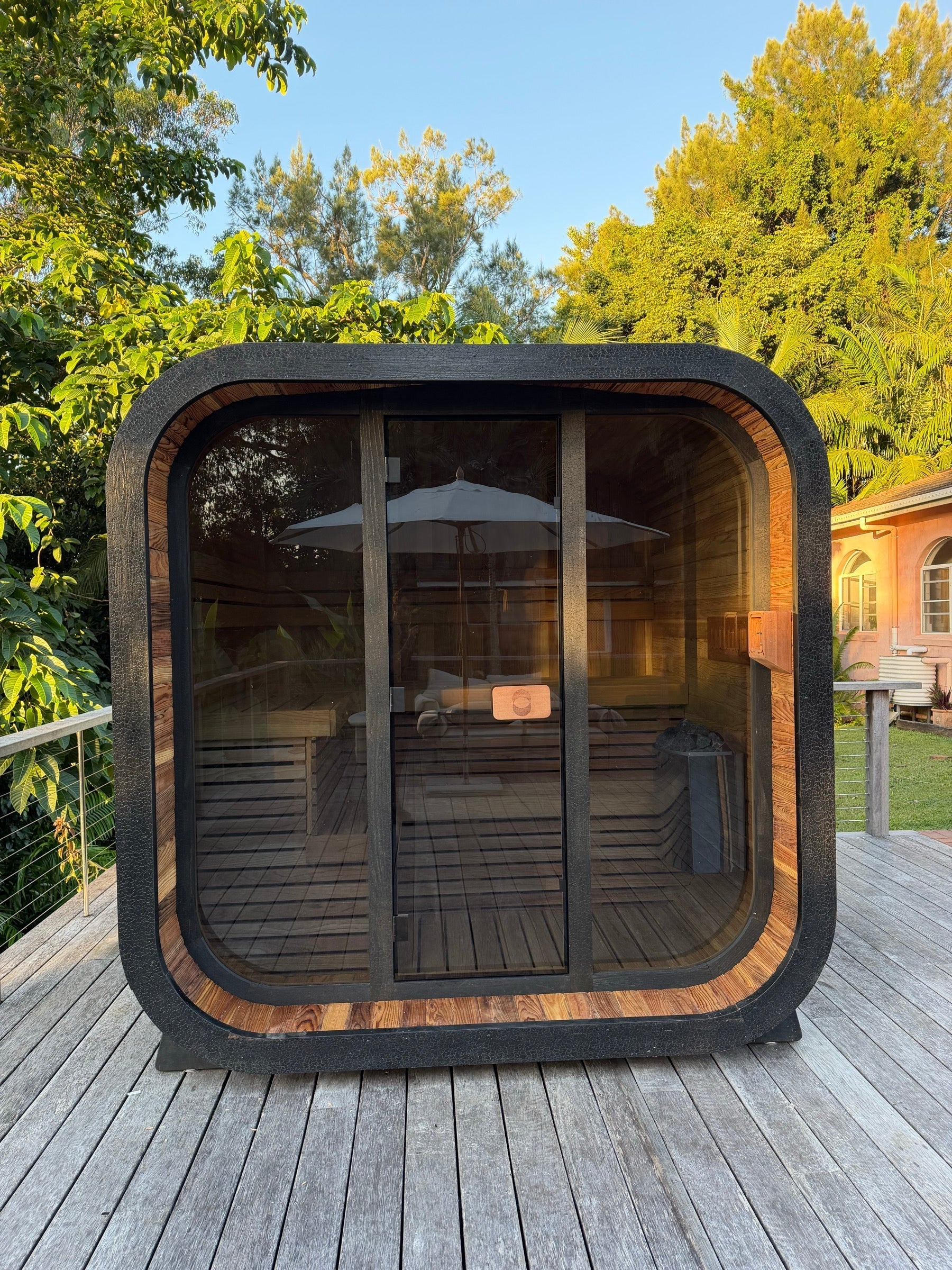
The Genesis Mini's external dimensions are 2267H x 1571W x 1950D mm. On a standard rectangular deck, this requires a minimum usable area of approximately 2.2m x 2.5m for the cabin alone — before clearances.
For safe outdoor placement, allow:
- 300mm minimum clearance on both sides and the rear for air circulation and maintenance access
- 600mm clearance at the door-front for comfortable entry and exit
- 300mm overhead clearance from any overhead pergola, eave, or structure — hot air exhausts from the top of the cabin
Total practical footprint with full clearances: approximately 2.5m x 3.0m. This fits comfortably on a standard 3m x 4m Australian deck, a rear courtyard, or a side-access area alongside the house.
Weight loading on elevated decks. The Genesis Mini ships at approximately 350kg. Distributed across its 1.571m x 1.950m base footprint (approximately 3.06m²), this creates a load of approximately 115kg/m². Most standard residential timber decks in Australia are engineered for 150-200kg/m² imposed load. If your deck is older, has any visible deflection, or uses posts at 1800mm spacing or wider, commission a structural engineering inspection before placement.
For a concrete slab or pavers at ground level, there is no structural concern. The unit sits flat, connects to a 32A dedicated circuit, and operates without any anchoring or fixed base requirement.
Understanding the full installation process — including electrical requirements, permit considerations, and site preparation — is covered in detail in our complete guide to home sauna installation in Australia.
Heater Sizing for a Compact Sauna Australia: Why 6kW Is Correct
Heater sizing is where the flat-pack sauna industry makes its worst decisions. The instinct is to put the smallest, cheapest heater into a small cabin to reduce cost. The result is a heater that runs at maximum capacity continuously, cannot reach 80°C in a reasonable timeframe, and degrades within three years.
A quality 6kW heater is the correct specification for a compact 2 person sauna — not because it is the minimum viable option, but because it is precisely matched to the thermal load. In a well-insulated 38mm-walled cabin of the Genesis Mini's volume, a HUUM DROP 6kW heater reaches 80-90°C in approximately 30-40 minutes from cold start. That is the target range. Heat it faster and you are wasting electricity. Heat it slower and you are using the sauna wrong.
The Stone Volume Difference
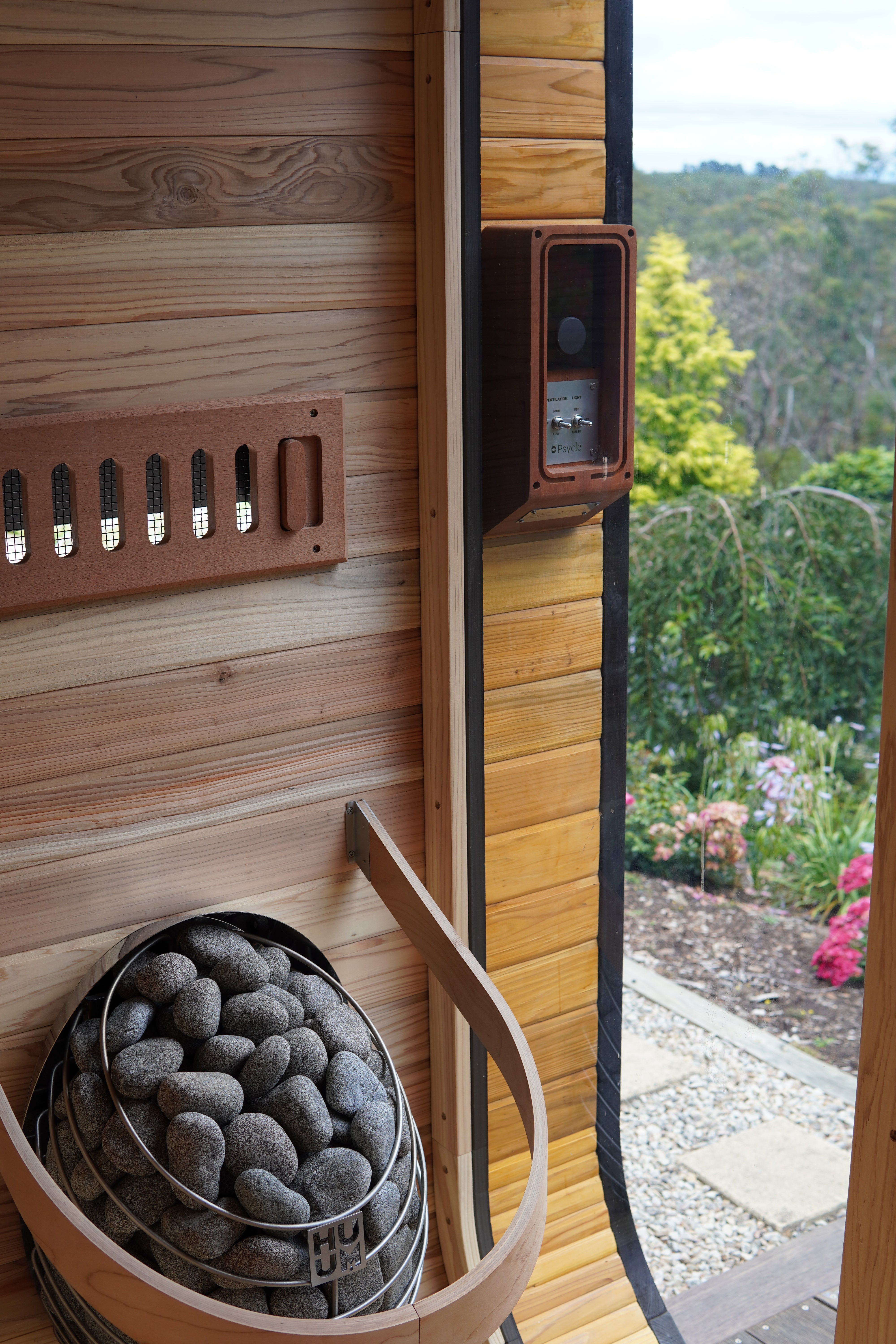
This is the specification that matters most and gets discussed least. The HUUM DROP 6kW carries 60kg of Olivine diabase stones. A typical budget 6kW heater carries 8-15kg of rocks.
Stone mass is thermal mass. Sixty kilograms of dense volcanic stone absorbs heat over the warm-up period and radiates it steadily throughout the session. When you pour water on 60kg of properly heated stone, you get a wave of steam — löyly — that fills the cabin and raises the apparent temperature by 5-10°C within seconds. When you pour water on 10kg of rocks, you get a brief hiss and a temperature drop.
Research published in the Journal of Human Kinetics found that a 30-minute sauna session raises heart rate to 100-150 bpm — equivalent to moderate-intensity exercise — increasing caloric expenditure beyond resting metabolic rate, particularly when combined with strength training. That cardiovascular response requires consistent, sustained heat. A low-mass heater in a thin-walled cabin cannot deliver it reliably.
Understanding what löyly is and why it defines the sauna experience makes the stone volume specification immediately tangible — it is not an abstract engineering metric.
Heater Options: HUUM DROP vs Harvia Vega
The Genesis Mini ships with your choice of two heater configurations — both at 6kW, both using Olivine diabase stones, both carrying Australian electrical certifications.
| Specification | HUUM DROP 6kW | Harvia Vega 6kW |
|---|---|---|
| Power | 6kW | 6kW |
| Stone mass | 60kg Olivine diabase | 20kg Olivine diabase |
| Controls | WiFi UKU app (iOS and Android) | Mechanical dial controls |
| Preheat scheduling | Yes — remote preheat from anywhere | Manual only |
| Best for | Daily users who want maximum stone mass and remote control | Users who prefer analogue simplicity and lower upfront cost |
The HUUM DROP is the clear choice for daily use. Three times the stone mass means three times the thermal stability. The WiFi UKU app means you can start the preheat cycle from your office, your car, or your morning workout — the sauna is at temperature when you walk in the door.
For a detailed comparison of how hot a sauna should be and how to reach and maintain the right temperature, including how stone mass affects heat consistency, that guide covers the full physics.
Indoor vs Outdoor Placement: Compact Saunas in Australian Climates
Australian conditions create placement challenges that European sauna specs do not account for. A compact sauna in Byron Bay, Sydney, or Brisbane is exposed to UV radiation levels 5-8 times higher than northern Europe in summer. An outdoor sauna in Melbourne or Adelaide faces temperature swings from 4°C winter nights to 42°C summer days within the same week.
Outdoor Placement in Australian Conditions
The Genesis Mini is engineered for permanent outdoor placement without a protective structure. The Japanese Cedar exterior is finished with a non-VOC oil that allows the timber to breathe and weather naturally — it will silver over time if left untreated, which is intentional. The Charcoal (Shou Sugi Ban) finish is charred cedar that is inherently UV-resistant; the carbonisation process creates a surface that is dimensionally stable under direct sun and resistant to moisture penetration.
The optional Colorbond roof kit is available for fully exposed placements in high-rainfall environments — the Hunter Valley, the Gold Coast hinterland, coastal Tasmania — where a solid roof over the timber ceiling reduces long-term maintenance requirements. In protected courtyard positions with overhead coverage from a pergola or eave, the standard cabin roof is adequate.
IP67-rated lighting means every electrical component in the lighting system is rated for full water immersion to one metre. Australian summer storms, garden irrigation overspray, and coastal humidity do not affect the electrical system.
For a full breakdown of outdoor placement considerations, weatherproofing, and which Australian climates need which protective measures, our complete guide to outdoor saunas in Australia covers every variable.
Ventilation in Tight Outdoor Spaces
Active mechanical ventilation in a compact sauna is non-negotiable — not a premium feature. In a small enclosed outdoor space like a courtyard with walls on three sides, exhaust air from the sauna needs a clear path out. The Genesis Mini's active ventilation system operates at 88 m³/hr low and 120 m³/hr high, pushing fresh air in through a low intake vent and exhausting stale air through a high outlet.
Passive ventilation — a vent hole cut in the wall — does not work reliably in still-air courtyard environments. On a hot, still Sydney summer evening, passive venting creates a stale, oxygen-depleted environment inside the cabin within two sessions. Active mechanical ventilation prevents this entirely.
The full engineering logic behind sauna ventilation — why placement, airflow rate, and vent positioning determine session quality — is explained in our detailed sauna ventilation guide.
Indoor Placement in Apartments and Compact Homes
Indoor placement of a compact sauna is possible in a laundry, garage, or dedicated room with adequate ceiling height (minimum 2400mm recommended — the Genesis Mini stands 2267mm), a 32A dedicated circuit, and a drain point or impermeable floor surface within 2m. Indoor placement eliminates UV and weather concerns entirely but requires a ventilation extraction point to outdoors — the active ventilation system must exhaust outside, not into the room.
Garages in Australian homes — particularly detached garages in suburbs with older post-war housing stock — are the most practical indoor placement option. Concrete floor, no UV exposure, easy electrical access, and the ability to run the exhaust through the wall or ceiling.
What Australians Who Build This Into Their Routine Actually Notice
The shift that happens when the sauna is in your backyard — not at the gym two suburbs away — is not subtle. Daily access changes the protocol from "occasional recovery session" to "the last thing I do before I sleep."
"I've been using it post-training every day for four months. My sleep is different — deeper, faster. My morning HRV numbers have moved consistently. And the habit is easy because it's just there," says one Genesis Mini owner in Fitzroy North, Melbourne. "I looked at three other compact saunas before this one. The wall thickness was the thing that made the decision for me. Everything else was the same on paper until you stood inside them."
This tracks with the evidence. A landmark 20-year cohort study of 2,315 Finnish men by Laukkanen et al., published in JAMA Internal Medicine (2015), found that sauna use 4-7 times per week reduced the risk of fatal cardiovascular disease by 50% compared to once-weekly bathing. The frequency that drives those outcomes is only achievable with home infrastructure built to last.
For a detailed look at how sauna use affects sleep quality specifically — including the thermoregulation mechanisms involved — our guide to sauna for sleep in Australia covers the science directly.
If you are adding contrast therapy to the protocol — pairing sauna heat with cold immersion — our complete guide to contrast therapy in Australia explains the physiology and outlines the protocol used by most high-performing Australian users.
The Compact Sauna That Does Not Compromise
Same zero-toxin spec as the full-size Genesis. Japanese Cedar. Zero-glue. HUUM 6kW with 60kg stone mass. A 3-year cabin warranty. Built for Australian conditions.
EXPLORE THE GENESIS MINI →Running Costs and Total Cost of Ownership for a Small Home Sauna Australia
The purchase price is only part of the calculation. A compact sauna you use daily for ten years has a total cost of ownership that looks very different from a cheap unit that fails in three.
Electricity Costs: What a 2 Person Sauna Actually Costs to Run in Australia
The Genesis Mini uses a 6kW heater. At Australian residential electricity tariffs of AU$0.30-0.35/kWh — the standard range across New South Wales, Victoria, and Queensland as of 2026 — a 45-minute session (including approximately 35 minutes of preheat and 10 minutes of active session time) draws approximately 1.2-1.5 kWh of energy in a well-insulated 38mm cabin.
Total running cost per session: approximately AU$0.40-$0.80. At daily use, that is AU$145-$290 per year in electricity — a fraction of what most Australians spend on gym recovery memberships.
Compare that to:
- Commercial gym sauna access: AU$1,200-$2,400/year in membership fees — plus the commute
- Weekly physiotherapy: AU$100-$160/session — AU$5,200-$8,320/year for weekly sessions
- Sports massage: AU$90-$150 per session — even fortnightly that is AU$2,340-$3,900/year
Importantly, the 38mm wall specification matters directly to running cost. A 16mm-walled flat-pack cabin loses heat faster, requiring the heater to run longer and draw more energy to maintain temperature. Over a ten-year period, the wall thickness difference translates to a measurable electricity cost differential — not just a comfort differential.
For a full breakdown of purchase price, installation cost, and lifetime running cost across all home sauna formats, our complete guide to home sauna costs in Australia covers every line item.
Maintenance: What a Zero-Toxin Build Actually Costs to Maintain
A zero-glue, non-VOC oil finished Japanese Cedar cabin requires minimal maintenance compared to a glued or painted alternative. The timber does not peel, crack, or require repainting. A light sand and re-oil of interior surfaces every 12-18 months maintains the finish. The HUUM heater element has no moving parts and a documented reliability record across Scandinavian commercial installations.
The Genesis Mini carries a 3-year cabin warranty and a 3-year heater warranty — the longest terms in the Australian compact sauna market. That warranty is the practical expression of the engineering standard: Psycle Wellness backs the build because the build does not fail.
Top 5 Compact 2 Person Saunas Available in Australia: Ranked
The Australian market for compact saunas has expanded significantly since 2022. Most of the growth has come from imported flat-pack units sold through online marketplaces and home improvement retailers. Here is an honest assessment of what is available and how the specifications compare.
| Sauna | Wall Thickness | Timber | Heater / Stone Mass | Glass | Warranty |
|---|---|---|---|---|---|
| Psycle Genesis Mini | 38mm | Japanese Cedar | HUUM 6kW / 60kg Olivine | 8mm laminated tempered (4+4mm) | 5yr cabin / 3yr heater |
| Harvia Sirius Compact (imported) | 28mm | Nordic spruce | Harvia 6kW / 20kg | 6mm single-pane | 2yr cabin / 2yr heater |
| Generic flat-pack (marketplace brand) | 16mm | Hemlock / spruce mix | Generic 4kW / 8-10kg | 4mm single-pane | 1yr parts only |
| Infrared 2-person unit (various brands) | 15-20mm | Hemlock / basswood | Far-infrared panels / no stones | 5mm single-pane | 2yr parts |
| Barrel sauna (compact 2-person format) | 28-32mm | Nordic spruce or cedar | Various / 15-25kg | No glass (door panel) | 2-3yr varies |
The Genesis Mini is the only compact sauna in this comparison with 38mm walls, zero-glue construction, a 60kg stone mass heater, and 8mm laminated glass — all under the one specification. Every other format requires a trade-off on at least two of those four criteria.
Note on infrared saunas: infrared units operate at 50-70°C and use panels rather than stones, which means they cannot produce löyly. They are a fundamentally different product to a Finnish steam sauna and should not be compared on the same performance criteria. For a detailed breakdown of the physiological and experiential differences, our guide to traditional sauna vs infrared covers the science directly.
For those comparing a compact cabin sauna to a barrel format, our complete guide to barrel saunas in Australia outlines where the format works well and where it falls short for Australian conditions.
Common Mistakes When Buying a Compact Sauna Australia
The mistakes that lead to buyer's remorse in this category are predictable. They are always about engineering compromises that are invisible at point of purchase and visible within the first six months of use.
Buying the cheapest heater spec to save upfront
A 4kW heater with 8kg of stones in a compact cabin will never deliver a proper session. It reaches 65-70°C on a warm day and drops temperature the moment you open the door. Stone mass cannot be retrofitted. The heater spec is permanent.
Assuming 16mm walls are "fine for a small sauna"
Wall thickness determines heat retention, energy draw, and thermal comfort — not just structural integrity. A 16mm wall cabin in a Sydney winter evening will struggle to hold 80°C without running the heater continuously. Running cost goes up. Session quality goes down.
Ignoring ventilation in a compact space
Passive ventilation works in open outdoor environments. In a walled courtyard, it does not move enough air. Within a few sessions, stale humid air builds up, oxygen concentration drops, and the session feels oppressive rather than restorative. Active ventilation is an engineering requirement, not an optional upgrade.
Not confirming the electrical supply before ordering
The Genesis Mini requires a 32A dedicated circuit — single or three phase. Most Australian homes do not have a spare 32A circuit run to the back deck. Electrical installation cost must be factored into the total budget. This is typically AU$500-$1,500 depending on distance from the switchboard and local electrician rates.
Buying cheap glass and learning why it matters in Australian summer
Single-pane 4mm glass in a sauna that has been sitting in direct sun at 40°C before being heated rapidly to 85°C is a thermal shock risk. Cracked glass in a hot outdoor structure is not a minor inconvenience. 8mm safety laminated tempered glass is not a luxury spec — it is the correct spec for Australian outdoor placement.
Understanding how often you should be using a sauna to achieve measurable health outcomes also clarifies why engineering matters — a cheap unit you stop using after three months delivers none of the frequency-dependent benefits the research documents.
If you want to understand the full spectrum of what consistent sauna use delivers physiologically, our evidence-based guide to sauna benefits in Australia and our guide to sauna after workout recovery cover the mechanisms and the protocols.
The Genesis Mini: Full Specifications
The Genesis Mini is Psycle Wellness's compact 1-3 person traditional Finnish sauna. It is built to the same zero-toxin standard as the full-size Genesis — not a scaled-down budget version of it.
| Specification | Genesis Mini |
|---|---|
| Capacity | 1-3 persons (optimal 2 persons) |
| External dimensions | 2267H x 1571W x 1950D mm |
| Timber | Japanese Cedar throughout — 38mm wall construction |
| Finish options | Natural Cedar OR Charcoal (Shou Sugi Ban) |
| Construction | Zero-glue mechanical joints. Non-VOC oil finish. |
| Glass | 8mm safety laminated tempered (4+4mm dual-layer, gray tint) |
| Heater option A | HUUM DROP 6kW — 60kg Olivine diabase stones, WiFi UKU app |
| Heater option B | Harvia Vega 6kW — 20kg Olivine diabase stones, mechanical controls |
| Lighting | Amber 585-590nm / Red 630-635nm. IP67. Blue-light-free. |
| Ventilation | Active mechanical: 88 m³/hr low / 120 m³/hr high |
| Electrical requirement | 32A dedicated circuit — single or three phase |
| Shipping weight | Approximately 350kg |
| Included accessories | Sand timer, thermometer, hygrometer, bucket and ladle, towel hooks, 2x Australian wool sauna hats |
| Warranty | 3-year cabin warranty / 3-year heater warranty |
| Build lead time | Approximately 120 days from deposit |
| Deposit | AU$1,000 refundable pre-order deposit |
| Delivery | Australia-wide |
The Charcoal (Shou Sugi Ban) finish is the architectural choice. The Japanese carbonisation process creates a surface that is UV-resistant by nature — no additional treatment required for outdoor placement in high-UV Australian environments. The Natural Cedar finish ages to a silver-grey patina over time if left untreated, or can be maintained with periodic re-oiling to preserve the warm amber tone.
Both finishes are available with either heater configuration. The decision is aesthetic and operational — not a quality differentiation.
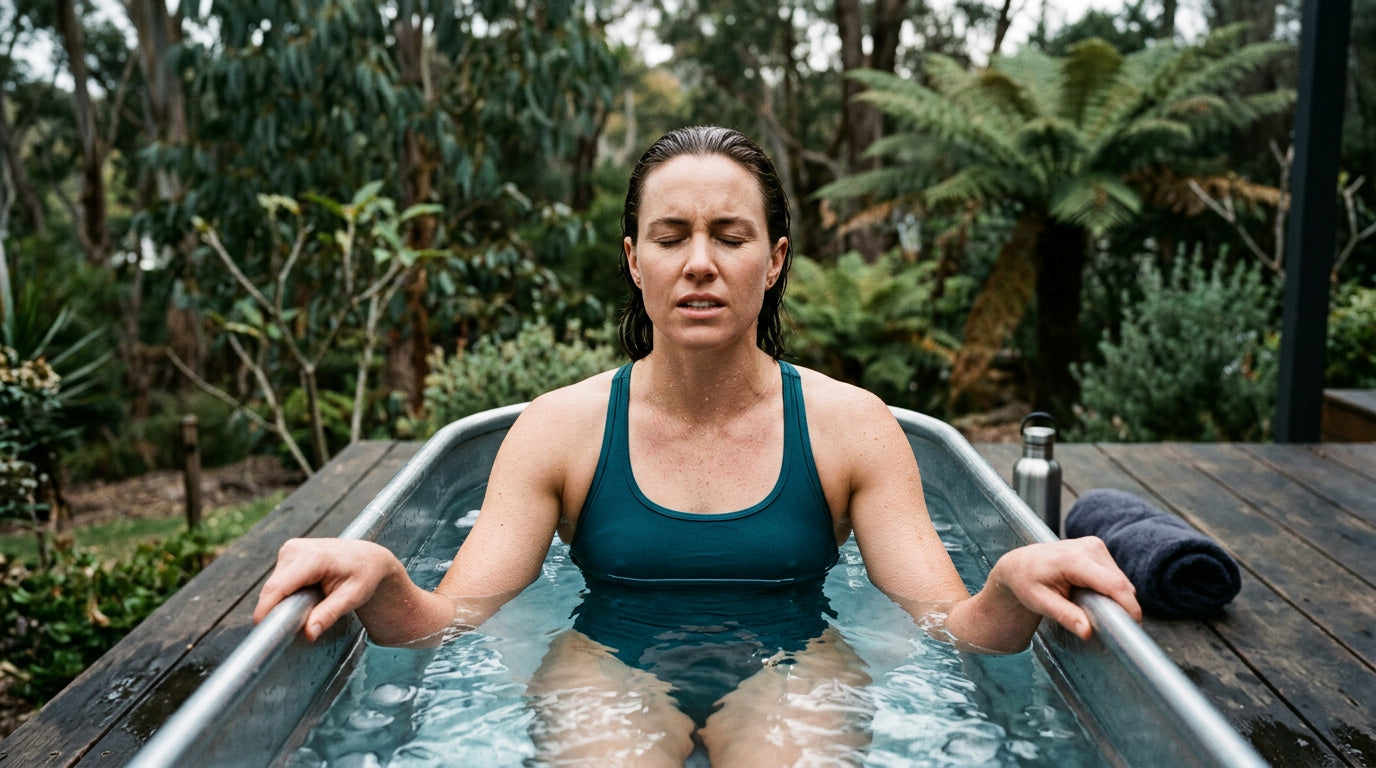
If you are weighing up whether to add cold immersion to the protocol from the outset, the Contrast Kit Mini pairs the Genesis Mini with the Origin cold plunge. The physiological case for combining heat and cold is covered in full in our guide to sauna and cold plunge in Australia, and the Origin specifically is covered in our complete cold plunge tub buyer's guide for Australia.
Frequently Asked Questions: 2 Person Sauna Australia
What size deck do I need for a 2 person sauna in Australia?
A 2 person sauna requires a minimum deck or courtyard footprint of approximately 2m x 2.5m to accommodate the cabin and safe clearance on all sides. The Genesis Mini's external dimensions are 2267H x 1571W x 1950D mm — allow at least 300mm clearance on each exposed side for ventilation and maintenance access, plus overhead clearance of at least 300mm from any overhead structure. In practice, a 3m x 3m deck is the comfortable minimum for installation with room to move around the unit.
How much does a 2 person sauna cost in Australia?
Quality 2 person saunas in Australia range from approximately $4,000 for flat-pack imported units to $9,000+ for premium zero-toxin models like the Genesis Mini. Budget units use thin 16mm walls, hemlock or spruce, and generic heaters. Premium units use 38mm Japanese Cedar walls, zero-glue construction, and HUUM or Harvia heaters — materials that make a measurable difference to heat retention, air quality, and longevity. For a full cost comparison across all home sauna formats, see our complete guide to home sauna costs in Australia.
How much does it cost to run a 2 person sauna in Australia?
A compact 2 person sauna with a quality 6kW heater costs approximately AU$0.40-$0.80 per 45-minute session at standard Australian electricity tariffs of AU$0.30-0.35/kWh. At daily use, that is approximately AU$145-$290 per year — less than two months of a mid-range gym membership. Thicker 38mm walls reach temperature faster and hold heat more efficiently than 16mm flat-pack panels, meaningfully reducing running costs over the lifetime of the unit.
Can I install a 2 person sauna on an apartment balcony in Sydney or Melbourne?
Most apartment balconies cannot support the load of a quality 2 person sauna. The Genesis Mini ships at approximately 350kg and requires a 32A dedicated electrical circuit — rarely available on a residential balcony. Balcony structural load ratings are typically 200-300kg/m² and are not uniformly distributed in the way a sauna requires. Ground-floor courtyards with exclusive use rights are the practical alternative for apartment dwellers. Always check with a structural engineer and your strata manager before proceeding.
What is the best 2 person sauna in Australia in 2026?
The Psycle Wellness Genesis Mini is the best 2 person sauna available in Australia in 2026. It uses 38mm Japanese Cedar walls, zero-glue mechanical construction, a HUUM DROP 6kW heater with 60kg Olivine diabase stone mass, IP67-rated blue-light-free lighting, active mechanical ventilation at 88-120 m³/hr, and carries a 3-year cabin warranty. No other compact sauna in the Australian market matches this specification at this price point. For a full comparison of every home sauna format and brand, our guide to the best home saunas in Australia covers the complete market.
Is a 6kW heater enough for a 2 person sauna?
Yes — a quality 6kW heater is correctly sized for a compact 2 person sauna cabin. The HUUM DROP 6kW heater in the Genesis Mini carries 60kg of Olivine diabase stones, which absorbs and radiates heat with exceptional thermal mass. In a well-insulated 38mm-walled cabin, this heater reaches 80-90°C in approximately 30-40 minutes and holds temperature consistently throughout the session. The stone volume matters more than the kilowatt rating — a 6kW heater with 60kg of stones outperforms a 9kW heater with 10kg of rocks in every practical measure.
Do I need planning permission for a 2 person outdoor sauna in Australia?
In most Australian states, a freestanding outdoor sauna under a certain size threshold is classified as an exempt structure and does not require a building permit — but this varies significantly by council and state. Victoria, NSW, and Queensland all have different threshold dimensions and setback requirements. Always check with your local council before installation. Our complete guide to home sauna installation in Australia covers state-by-state permit requirements, setback rules, and what to ask your council in detail.
How long does it take to heat a compact sauna?
A Genesis Mini with the HUUM DROP 6kW heater reaches 80-90°C in approximately 30-40 minutes from a cold start at ambient Australian temperatures. In winter conditions in Melbourne or Canberra, allow 40-50 minutes. The WiFi UKU app allows remote preheat scheduling — start the cycle from your phone 40 minutes before you finish training and walk into a sauna that is already at temperature. For guidance on how long to stay in a sauna by goal and experience level, that guide covers session duration protocols in full.
Ready to Build This Into Your Routine?
Free Australia-wide delivery. 3-year cabin warranty. AU$1,000 refundable deposit. 120-day build — order now for summer delivery. The Genesis Mini is in stock and building.
SHOP THE GENESIS MINI →