
Sauna and Cold Plunge Australia: 2026 Contrast Guide
Sauna and Cold Plunge Australia: Complete 2026 Guide to Contrast Therapy, Protocols and What to Buy

Key Takeaways
- Contrast therapy — alternating between 80–100°C sauna heat and 10–15°C cold immersion — produces cardiovascular, recovery, and mood benefits that neither modality achieves alone.
- A landmark 20-year study of 2,315 Finnish men found sauna use 4–7 times per week reduced fatal cardiovascular disease risk by 50% compared to once-weekly bathing (Laukkanen et al., JAMA Internal Medicine, 2015).
- The evidence-based protocol ratio is 3:1 heat-to-cold — typically 15–20 minutes in the sauna followed by 3–5 minutes in the cold plunge, repeated 2–3 rounds per session.
- The Genesis runs on a 9kW HUUM or Harvia heater at approximately AU$0.50–$1.00 per 45-minute session — less per use than a single commercial sauna drop-in.
- Zero-glue Japanese Cedar construction and IP67-rated lighting mean the Genesis and Genesis Mini are engineered for year-round outdoor installation across all Australian climates.
- The Psycle Contrast Kit bundles the Genesis (or Genesis Mini) with the Origin cold plunge — the only pre-engineered, zero-toxin contrast system built specifically for Australian conditions.
- A $1,000 refundable deposit holds your build with a 120-day lead time and Australia-wide delivery included.
By Psycle Wellness · Last updated: May 2026 · 18 min read
Sauna and cold plunge in Australia is no longer a trend. Combined contrast therapy — alternating between 80–100°C Finnish heat and 10–15°C cold immersion — delivers measurable cardiovascular, recovery, sleep, and metabolic benefits that peer-reviewed science has been documenting for decades. A 2015 study by Laukkanen et al. in JAMA Internal Medicine found that Finnish men who used a sauna 4–7 times per week had a 50% lower risk of fatal cardiovascular disease compared to once-weekly users. This is the complete guide to the science, the protocols, and the equipment worth owning.
Contrast therapy is the deliberate alternation of heat exposure and cold immersion to drive specific physiological adaptations. It is the combination — not either modality alone — that produces the most significant results. Heat dilates blood vessels and drives heat shock protein synthesis. Cold constricts them and spikes norepinephrine by up to 300%. Together, they create a vascular pump effect that neither stimulus can replicate independently.
Zero-Toxin Contrast Therapy, Built for Australians
Japanese Cedar. Zero-glue construction. IP67-rated lighting. The Contrast Kit is the only pre-engineered hot-cold system built to this standard in Australia.
SEE THE CONTRAST KIT →Why Most Australians Are Getting Recovery Wrong
Most high performers train hard. They track sleep, monitor HRV, optimise nutrition. And then they recover in a $400 portable ice bath and a flat-pack sauna built from glued MDF and particle board.
Heat that MDF to 90°C and the adhesives off-gas formaldehyde directly into the cabin air. You breathe it in with every inhale. That is not wellness. That is the opposite of what you are trying to achieve.
The cold plunge side is no better. Thin-walled units with no insulation lose temperature within 20 minutes of use. The water sits above 15°C before you have completed a single round. The physiological stimulus you are chasing — the vasoconstriction, the norepinephrine spike, the cold shock protein activation — requires sustained cold, not lukewarm water.
Buying a sauna from one brand and a cold plunge from another is not a contrast system. It is two pieces of equipment that were never designed to work together, sitting in a backyard that was never set up to support them. Our full comparison of cold plunge vs ice bath options in Australia breaks down exactly what to look for before committing to either.
The problem is not commitment. The problem is infrastructure. Australians who take recovery seriously deserve equipment built to the same standard as their training.
What Is Contrast Therapy and Why Is the Combination Superior?
Contrast therapy is the structured alternation of heat and cold to force repeated cardiovascular adaptation. In the heat phase, core body temperature rises, peripheral blood vessels dilate, heart rate climbs to 100–150 bpm, and the body initiates a cascade of heat shock protein synthesis, plasma volume expansion, and growth hormone release.
Research published in the Journal of Human Kinetics found that a 30-minute sauna session raises heart rate to 100–150 bpm — equivalent to moderate-intensity exercise — increasing caloric expenditure beyond resting metabolic rate, particularly when combined with strength training.
In the cold phase, blood vessels constrict rapidly, norepinephrine surges to 200–300% above baseline, inflammatory markers drop, and metabolic rate spikes as the body generates heat. Cold water immersion at 10–15°C for as little as 3 minutes has been shown to reduce muscle soreness markers in trained athletes by up to 20% in the 24 hours following high-intensity exercise (Bleakley et al., British Journal of Sports Medicine, 2012).
The alternation between these two states creates what researchers call a vascular pump effect — the repeated dilation and constriction of blood vessels that drives nutrient-rich blood into peripheral tissues and flushes metabolic waste products out. Neither sauna alone nor cold plunge alone replicates this effect.
For the full evidence base on cold immersion, our complete guide to cold plunge benefits in Australia covers every peer-reviewed outcome in detail. For the cardiovascular and cognitive science behind Finnish heat, the traditional sauna benefits science guide covers two decades of Finnish cohort research.
The Peer-Reviewed Science Behind Hot-Cold Therapy
The science on heat therapy is robust, longitudinal, and consistent. The landmark study by Laukkanen et al., published in JAMA Internal Medicine (2015), followed 2,315 Finnish men over 20 years. Men bathing 4–7 times per week had a 50% lower risk of fatal cardiovascular disease than once-weekly users. This is not a small-sample pilot. It is two decades of prospective data.
On the stress side, a 2021 study in the International Journal of Environmental Research and Public Health found that regular sauna bathing — three or more sessions per week — produced measurable reductions in cortisol levels and self-reported psychological stress within four weeks. Cortisol is the primary chronic stress hormone. Reducing it structurally through consistent heat exposure is a different mechanism than meditation or supplementation. It is physiological.
Sleep is where the synergy between heat and cold becomes most practical. A 2019 systematic review and meta-analysis by Haghayegh et al., published in Sleep Medicine Reviews, found that passive body heating 1–2 hours before bedtime improved sleep onset, sleep efficiency, and slow-wave deep sleep. The mechanism is thermoregulatory: heating the body triggers a rapid core temperature drop as you cool, and that drop is one of the primary signals the brain uses to initiate deep sleep. A contrast session ending on cold accelerates that drop and amplifies the signal. Our guide to sauna for sleep in Australia covers the full evidence and practical timing protocols.
“The evidence for repeated sauna use as a cardiovascular intervention is now strong enough that it should be considered alongside exercise and dietary modification as a lifestyle factor with meaningful protective effects,” says Dr Jari Laukkanen, Professor of Medicine at the University of Eastern Finland and lead author of the JAMA Internal Medicine cohort study.
What this body of research makes clear is that frequency and consistency drive outcomes. Four to seven sessions per week outperforms two. A home contrast system removes every logistical barrier to that frequency — no booking windows, no travel time, no shared facilities. For a detailed look at how sauna frequency affects outcomes, our sauna frequency guide covers the dose-response evidence directly.
Contrast Therapy Protocols by Goal — With Exact Timing Ratios
Protocol matters as much as equipment. The physiological stimulus changes based on duration, sequence, and intensity. These are the evidence-informed protocols for the three most common goals among Australian high performers.
Heat phase — 15–20 minutes at 80–100°C
Allow core temperature to rise fully. Pour löyly at the 10-minute mark to intensify steam and raise perceived heat. Stay seated or reclined — the higher the bench, the hotter the air.
Transition — under 60 seconds
Move from sauna to cold plunge immediately. The faster the transition, the more pronounced the vascular pump effect. Do not towel off — water contact accelerates the cold shock response.
Cold phase — 3–5 minutes at 10–15°C
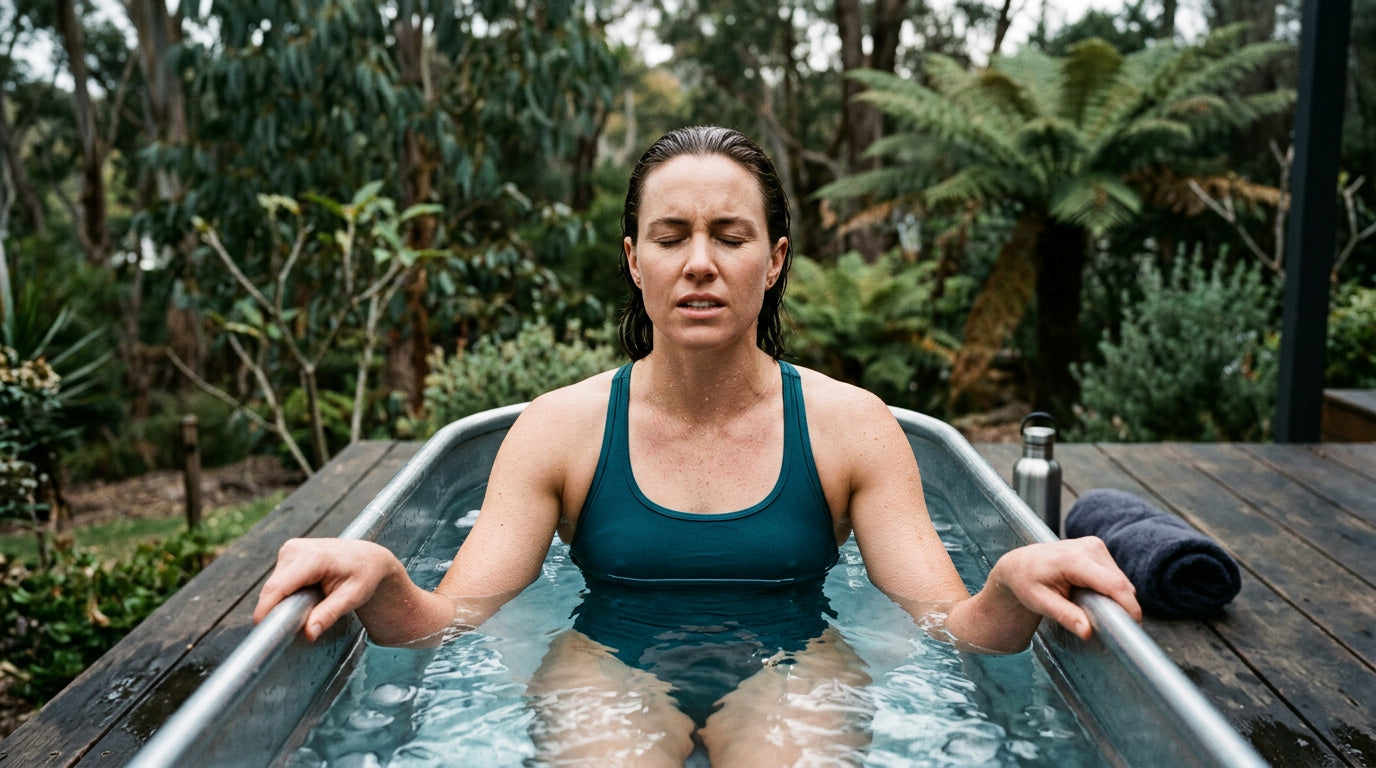
Submerge to shoulder level. Control breathing — slow exhales reduce the cold shock response and allow you to extend immersion time. Three minutes is the minimum effective dose for norepinephrine activation.
Rest — 5 minutes passive recovery
Exit the cold plunge and allow your body to rewarm passively. Do not enter a heated space. This passive rewarming phase drives additional thermogenic activity and extends the metabolic stimulus.
Repeat — 2–3 rounds total
Two to three full cycles per session is the evidence-supported dose. Total session time: 45–75 minutes depending on round count and passive rest intervals.
| Goal | Heat Duration | Cold Duration | Rounds | Timing |
|---|---|---|---|---|
| Post-training recovery | 15–20 min | 3–5 min | 2–3 | Within 2 hrs of training |
| Sleep optimisation | 20 min | 3–4 min | 2 | 90 min before bed, end on cold |
| Cardiovascular adaptation | 20 min | 5 min | 3 | 4–7 sessions per week |
| Stress and cortisol reduction | 15–20 min | 3 min | 2 | Morning or midday |
| Muscle hypertrophy (post-training) | 20 min | 3 min max | 2 | Limit cold immediately post-training — cold blunts mTOR signalling |
One important nuance: if hypertrophy is your primary training goal, limit cold immersion directly after resistance training sessions. A 2021 study by Fuchs et al. in Acta Physiologica confirmed that cold water immersion in the 30 minutes following resistance training attenuates mTOR signalling — the molecular pathway driving muscle protein synthesis. For muscle building, use contrast therapy on rest days or separate cold immersion by at least four hours from your resistance sessions.
For a full breakdown of session duration science across different experience levels and goals, our guide on how long to stay in a sauna covers the evidence and practical benchmarks in detail.
What to Look For in a Home Sauna for Contrast Therapy
If you are building a contrast setup at home, the sauna is where most buyers make the critical mistake. The market is flooded with flat-pack timber cabins that look the part and fail the function. Here is what separates engineering from aesthetics.
Timber species and wall thickness. Japanese Cedar is the correct choice for a high-heat, high-humidity environment. It is dimensionally stable, naturally resistant to moisture and microbial growth, and does not warp at repeated 90°C cycling. 38mm solid wall panels are the minimum for effective heat retention. Thinner walls lose temperature between rounds.
Zero-glue construction. Every standard flat-pack sauna uses glued MDF panels or particle board with formaldehyde-based adhesives. At 90°C, those adhesives off-gas continuously. Zero-glue mechanical joints eliminate this entirely — the timber holds itself together through joinery, not chemistry. Zero-glue also means the cabin can be disassembled and relocated without destroying it.
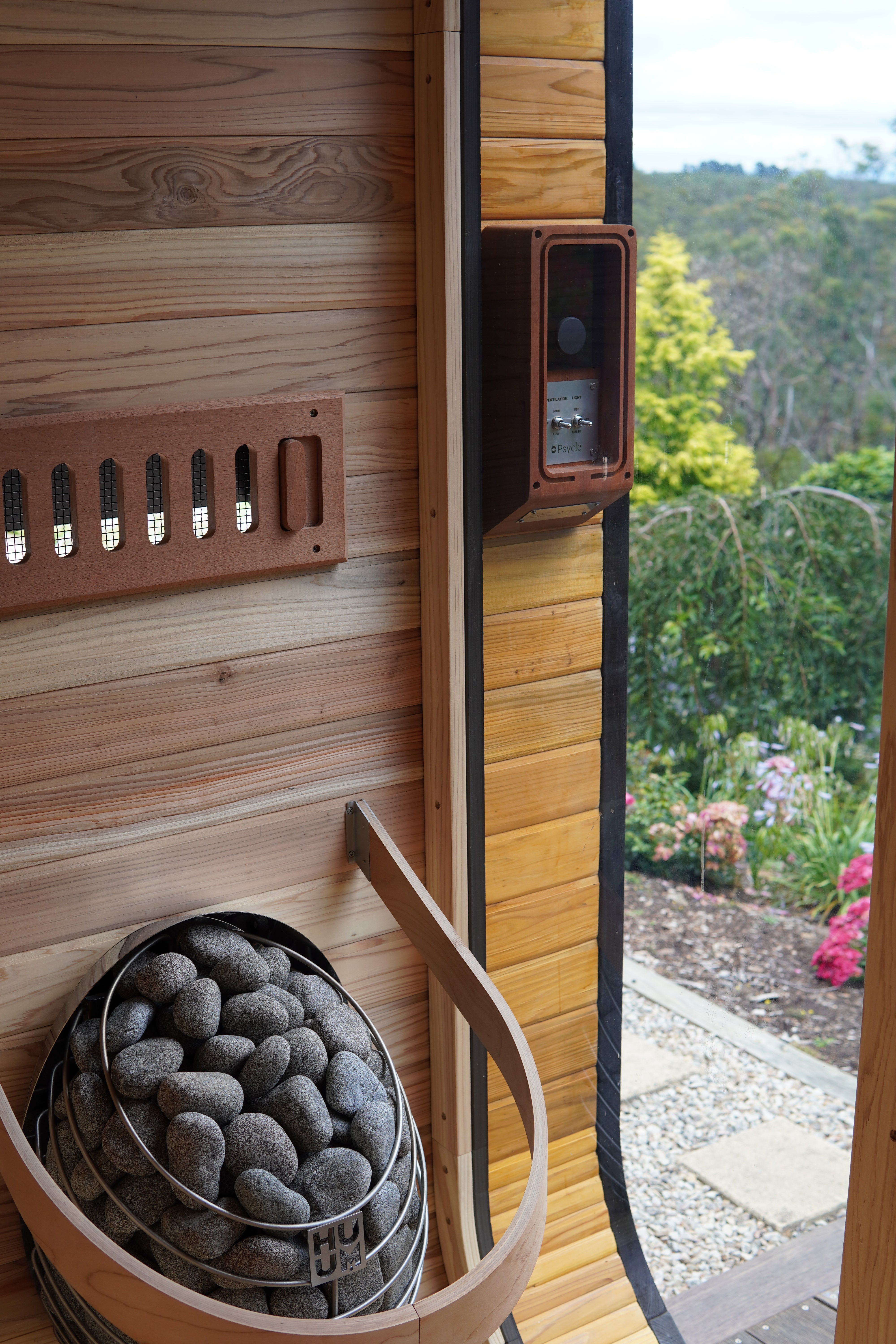
Heater specification. The heater drives the entire session. A 9kW heater with substantial stone mass — the HUUM DROP carries 60kg of Olivine diabase stones — delivers sustained, stable heat that does not drop when you pour löyly. A lightweight 6kW heater with 15kg of stones recovers slowly after steam generation and produces a thinner, less satisfying heat. Stone mass is not a marketing metric. It is the functional difference between a real Finnish sauna and a hot box.
Ventilation. Active mechanical ventilation at 88–120 m³/hr keeps cabin air fresh and prevents the stale, oxygen-depleted environment that makes long sessions uncomfortable or unsafe. Passive vent slots — the standard on budget cabins — do not move enough air to sustain multiple rounds of high-intensity heat use. Our sauna ventilation guide covers exactly why this specification is the most overlooked buying criterion in the Australian market.
Outdoor rating. IP67-rated lighting and an optional Colorbond roof kit mean the Genesis is rated for fully exposed outdoor installation — year-round, in every Australian climate zone from tropical Queensland to alpine Victoria. Most imported saunas carry no outdoor rating at all.
The Psycle Contrast Kit — Engineered as a System, Not Two Products
Most Australians building a home contrast setup buy a sauna from one brand and a cold plunge from another. The result is two pieces of equipment with different drainage requirements, different installation footprints, and no design coherence. It works — but it is not a system.
The Psycle Contrast Kit pairs the Genesis with the Origin cold plunge as a pre-engineered unit. The dimensions, installation requirements, and aesthetic are designed to sit together. The outdoor-rated hardware means both units can live permanently outdoors, side by side, without covers, enclosures, or protective infrastructure.
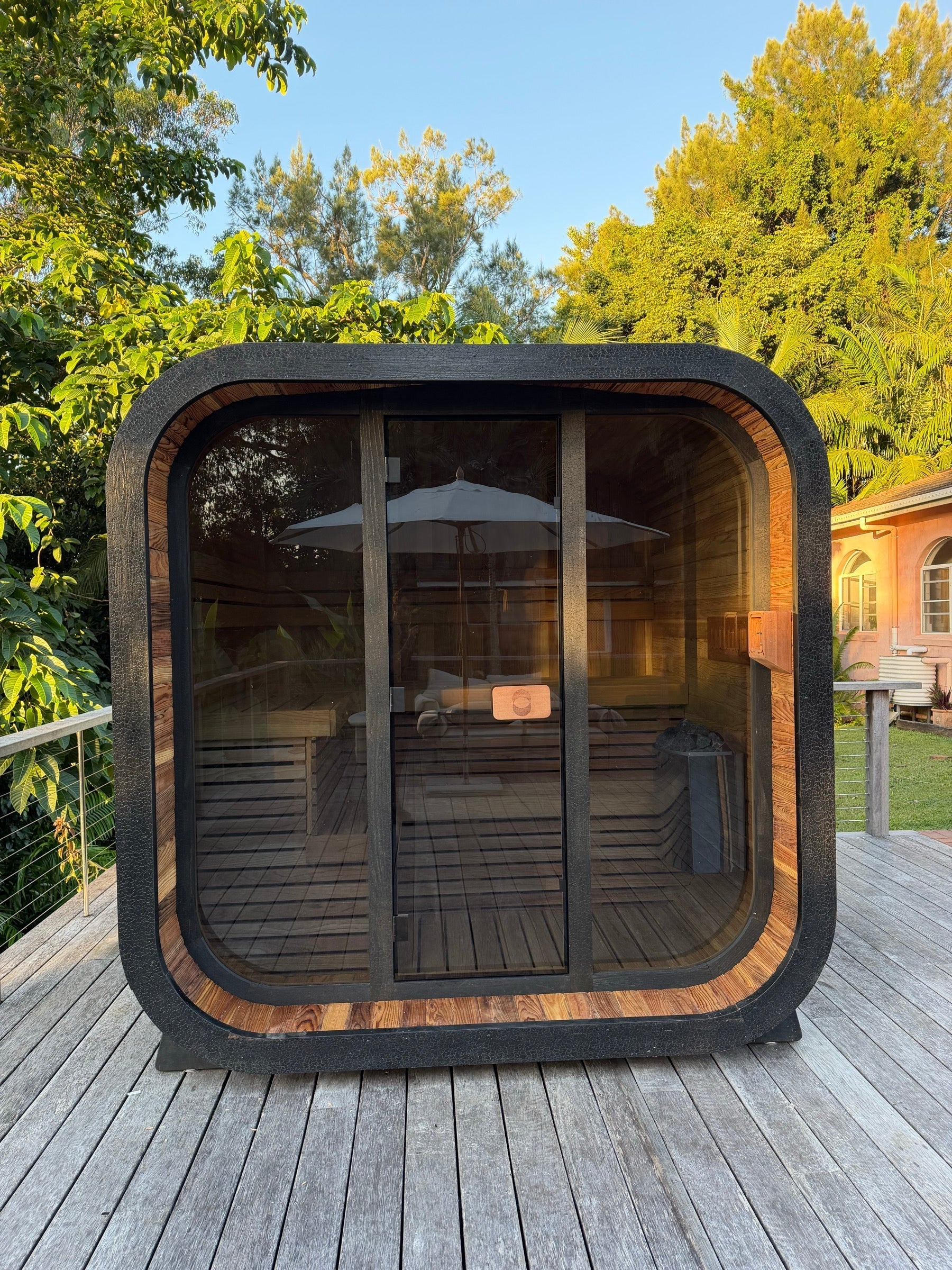
The Genesis: 2289H x 2288W x 1945D mm. Japanese Cedar, 38mm walls, zero-glue construction. HUUM DROP 9kW (60kg Olivine diabase stones, WiFi UKU app control) or Harvia Vega 9kW (20kg stones, mechanical controls). 8mm safety laminated tempered glass — 4+4mm dual-layer, grey tint. IP67 amber and red lighting (585–590nm and 630–635nm — zero blue light). Active ventilation at 88–120 m³/hr. Requires a 50A dedicated circuit.
The Origin cold plunge: engineered for sustained temperature maintenance at 10–15°C, with the structural integrity and insulation to hold temperature across multiple daily sessions. The thermal performance that makes the protocol work — not just the first plunge, but the fifth.
Heat recovers you. Cold hardens you. Together, they transform you. That is not a tagline. That is the physiology.
The Sauna That Does Not Compromise
Active ventilation. Zero-glue Japanese Cedar. IP67 outdoor-rated. HUUM DROP 9kW with 60kg stone volume. Every detail engineered — nothing borrowed from the flat-pack category.
EXPLORE THE GENESIS →Genesis vs Genesis Mini — Which Sauna for a Contrast Setup?
Two Australians or fewer using the system daily: the Genesis Mini is the right choice. It carries the identical zero-toxin specification — 38mm Japanese Cedar walls, zero-glue construction, HUUM DROP 6kW (60kg stones) or Harvia Vega 6kW, IP67 lighting, active ventilation — in a footprint of 2267H x 1571W x 1950D mm. It ships at approximately 350kg and requires a 32A dedicated circuit.
Three or more users, or anyone who wants the option to use the sauna for post-event recovery, family use, or social sessions: the Genesis is the correct choice. The 3–5 person capacity means the sauna grows with your household and holds its value as a lifestyle asset. If you have the space, the Genesis is the obvious answer.
Both units ship Australia-wide. Both carry a 3-year cabin warranty and a 3-year heater warranty — the longest in the Australian market. The $1,000 deposit is fully refundable. The build lead time is 120 days. For a full side-by-side analysis of sizing, electrical requirements, and capacity, our complete home sauna buyer guide for Australia covers every variable in the purchase decision.
| Specification | Genesis (3–5 person) | Genesis Mini (1–3 person) |
|---|---|---|
| Timber | Japanese Cedar, 38mm walls | Japanese Cedar, 38mm walls |
| Heater options | HUUM DROP 9kW (60kg stones) or Harvia Vega 9kW | HUUM DROP 6kW (60kg stones) or Harvia Vega 6kW |
| External dimensions | 2289H x 2288W x 1945D mm | 2267H x 1571W x 1950D mm |
| Electrical circuit | 50A dedicated (single or three phase) | 32A dedicated (single or three phase) |
| Glass | 8mm safety laminated tempered (4+4mm, grey tint) | 8mm safety laminated tempered (4+4mm, grey tint) |
| Lighting | Amber 585–590nm / Red 630–635nm, IP67 | Amber 585–590nm / Red 630–635nm, IP67 |
| Ventilation | 88–120 m³/hr active mechanical | 88–120 m³/hr active mechanical |
| Cabin warranty | 5 years | 5 years |
| Sauna hats included | 3x Australian wool | 2x Australian wool |
What Does a Home Contrast System Cost in Australia?
A custom European sauna installation runs $40,000–$120,000. Commercial-grade infrared units from US brands sit at $15,000–$30,000 before installation. Commercial sauna memberships or drop-in recovery suites cost $30–$80 per session in most Australian capital cities.
The Genesis is engineered to deliver the standard of those European installations. The price reflects that. It is not cheap. It is not meant to be. But over a 10-year operational lifespan, the per-session cost sits below $1.00 — less than a coffee, less than a gym recovery fee, and less than the compounding cost of inadequate recovery infrastructure.
The $1,000 refundable deposit is not a commitment to purchase — it holds your build slot while you complete due diligence. The 120-day lead time means you can inspect, research, and decide before production begins. For a full breakdown of total cost of ownership, electrical installation, and ongoing operating costs, our home sauna cost guide for Australia covers every line item.
Is a Sauna and Cold Plunge Safe for Everyone?
For healthy adults, contrast therapy is safe and well-tolerated. The research population in the major Finnish cohort studies is general adult males — not athletes, not clinical populations. The cardiovascular and longevity benefits apply broadly.
There are populations who should consult a GP before beginning a contrast protocol. These include people with diagnosed cardiovascular conditions, hypertension, Raynaud's syndrome, or those who are pregnant. The heat and cold stimulus both produce significant cardiovascular responses — heart rate elevation, blood pressure fluctuation, vasomotor changes — that require medical clearance in these groups. Our sauna health and safety guide for Australia covers contraindications, warning signs, and safe entry protocols in full.
For healthy adults with no contraindications: begin with one round, assess tolerance, and build to two or three rounds over two to four weeks. Hydrate before and after every session. Do not use alcohol before or during contrast therapy.
Frequently Asked Questions
What is the best contrast therapy protocol for recovery after training?
The evidence-supported protocol for post-training recovery is 15–20 minutes at 80–100°C in the sauna, followed by 3–5 minutes in a cold plunge at 10–15°C, repeated for 2–3 rounds. The 3:1 heat-to-cold ratio maximises the vascular pump effect — the repeated dilation and constriction of blood vessels that drives nutrient delivery and metabolic waste clearance. Complete the session within two hours of training for the most significant acute recovery benefit.
How long should you stay in a cold plunge after a sauna?
Three to five minutes is the evidence-based range for cold plunge duration following sauna heat. Research by Srámek et al. (2000) found that norepinephrine increases of up to 300% occur with cold water immersion at 14°C — and the primary neurochemical response initiates within the first 60–90 seconds of immersion. Extending beyond five minutes per round does not proportionally increase benefit and increases the risk of hypothermia in colder plunge temperatures. Total cold exposure across a full contrast session of 2–3 rounds should not exceed 15 minutes.
Should you finish a contrast session on hot or cold?
It depends on your goal. For sleep optimisation, end on cold — the accelerated core temperature drop after cold immersion amplifies the thermoregulatory signal the brain uses to initiate deep sleep, and a 2019 meta-analysis by Haghayegh et al. in Sleep Medicine Reviews supports finishing cool before bed. For energy and alertness — morning training prep or a midday reset — end on heat. The heat phase produces a more sympathetically activated state; the cold phase produces a calm, alert recovery state. Most practitioners use cold as the final phase by default.
What temperature should a cold plunge be for contrast therapy?
The optimal cold plunge temperature for contrast therapy is 10–15°C. This range is cold enough to drive the full norepinephrine and cold shock protein response while remaining tolerable for 3–5 minute immersion durations. Temperatures below 10°C do not proportionally increase physiological benefit but significantly increase the cold shock response and discomfort, particularly for new users. Our complete guide to ice bath temperature in Australia covers the research thresholds and how to calibrate your plunge for different goals.
Can you use a sauna and cold plunge every day?
Yes — and the research supports it. The landmark Laukkanen et al. (2015) study found the greatest cardiovascular benefit in participants using a sauna 4–7 times per week. Daily contrast therapy is safe for healthy adults without cardiovascular contraindications. The key variable is duration and intensity management — daily sessions of 2 rounds at moderate duration are more sustainable and more beneficial than infrequent extreme sessions. Build frequency before you build intensity.
Ready to Build This Into Your Routine?
Free Australia-wide delivery. 3-year cabin warranty — the longest in the Australian market. 120-day build lead time with a $1,000 refundable deposit. Order now and have your contrast system installed before summer.
SHOP THE CONTRAST KIT →