
Sauna Rocks Australia: The Complete Stone Guide | Psycle
Sauna Rocks Australia: The Complete Guide to Stones That Actually Perform

Key Takeaways
- Sauna rocks are not interchangeable — Olivine diabase (peridotite) is the gold standard for heat retention, crack resistance, and clean steam output.
- Cheap, untested rocks crack under thermal cycling, releasing silica dust into the air you breathe at 90°C — a real health risk, not a marketing claim.
- The HUUM DROP heater in the Genesis uses 60kg of pre-certified Olivine diabase stones — significantly more stone mass than most competitor heaters at the same kilowatt rating.
- Correct stone placement (larger at base, smaller at top, no voids) is essential for even heat distribution and preventing steam pockets that crack stones.
- In Australian coastal and high-humidity climates, sauna rocks should be inspected every 6 months and replaced every 2–4 years depending on use frequency and salt-air exposure.
- Löyly — the Finnish steam ritual — is only possible with sufficient stone mass. Under-stoned heaters produce wet, uncomfortable steam, not the dry radiant heat of an authentic session.
- The Genesis and Genesis Mini ship with HUUM heaters pre-loaded with certified stones — no sourcing, no guesswork, no compromise.
By Psycle Wellness · Last updated: May 2026 · 12 min read
Sauna rocks in Australia are most commonly made from Olivine diabase or black diabase — dense volcanic stone chosen for thermal stability, crack resistance, and the ability to store and radiate heat evenly. The right rocks define the quality of every session. The wrong ones crack, release dust, and kill the steam before it reaches your skin.
Most Australian sauna content ignores stone quality entirely. It focuses on cabinet size, timber species, or price — and leaves you to figure out the rocks yourself. That's a problem, because the stones sitting on your heater are the engine of every session you'll ever have. Get them wrong and nothing else matters.
This guide covers what sauna rocks are, why material and mass both matter, how HUUM's pre-certified Olivine diabase stones outperform generic alternatives, correct placement and löyly technique, and how often to replace rocks in Australian conditions — including coastal salt-air environments that accelerate stone degradation.
Why Most Australian Saunas Are Under-Stoned and Over-Promised
Walk into any big-box sauna retailer in Australia and you'll see heaters rated at 6–9kW sitting with 15–20kg of rocks. The spec sheet looks fine. The session doesn't.
Stone mass is the single most important variable in heat retention. When you pour water over under-stoned rocks, the heater temperature drops immediately. The steam is wet and thin. The heat spike is gone in seconds. You're not getting löyly — you're getting a face full of warm moisture that dissipates before it penetrates.
The problem runs deeper than mass alone. Generic sauna rocks sold through Australian pool and spa suppliers are often sourced with minimal quality control. They're not pre-tested for thermal cycling — the repeated heating and cooling that happens every time you run a session. Rocks that haven't been stress-tested crack. And cracked rocks don't just perform poorly — they shed silica dust into the air you're breathing at 90°C.
This isn't a marginal concern. A 2021 review published in Environmental Research and Public Health identified fine silica particulate as a respiratory hazard in confined high-temperature environments, with prolonged exposure linked to pulmonary inflammation. A sauna cabin is exactly that kind of environment — hot, enclosed, and poorly ventilated if the rocks are shedding.
The fix is not complicated. Use the right stone material. Use enough of it. Source it from a manufacturer who tests it. But most Australian sauna brands don't tell you this — because they'd have to admit their heaters ship under-stoned.
For more on the health outcomes of a correctly built traditional sauna environment, see our guide to traditional sauna benefits in Australia.
What Are Sauna Rocks? Material, Geology, and Why It Matters
Sauna rocks are dense igneous or metamorphic stones placed on a sauna heater to absorb, store, and radiate heat — and to vaporise water into steam when löyly is poured. Not all rocks can do this. The wrong material shatters, splinters, or absorbs moisture and explodes under thermal stress.
The best sauna rocks share four characteristics: high density, low porosity, chemical stability at temperatures above 600°C (the surface temperature of a heater element), and resistance to thermal shock. Volcanic and metamorphic rock types that meet these criteria include:
- Olivine diabase (peridotite) — the benchmark. Dense, non-porous, extremely stable under thermal cycling. Used in HUUM heaters globally and specified for the Genesis and Genesis Mini.
- Black diabase — a common alternative. Good heat retention, widely available. Less uniform in density than Olivine diabase but an acceptable commercial choice when properly sourced.
- Vulcanite / basalt — sometimes used in budget heaters. Variable porosity means inconsistent performance. Prone to cracking in cheaper grades.
- Granite, sandstone, or river stones — never use these. High silica content and porous structure make them explosive under rapid heating. A safety hazard, not a cost saving.
Olivine diabase is the standard because of its molecular structure. The olivine mineral group — a silicate — forms tightly interlocked crystal matrices that resist fracture even under repeated thermal cycling. When heated to 600°C and then rapidly cooled by water, it does not crack. That's the test. That's why it's specified.
Stone geology also matters for managing sauna humidity in Australian conditions — where ambient humidity varies dramatically between coastal and inland environments, and the interaction between stone temperature and water volume determines the quality of every steam release.
HUUM Sauna Stones: What Pre-Certified Olivine Diabase Actually Means
HUUM is an Estonian heater manufacturer that supplies Olivine diabase stones pre-tested and matched to their specific heater geometry. This is not standard practice in the sauna industry. Most heater brands specify a stone weight and leave sourcing to the installer or buyer.
HUUM's pre-certification process subjects stone batches to repeated thermal cycling — heating to operating temperature and rapid cooling — before any stone is approved for inclusion. Stones that crack, fracture, or show surface fissuring are rejected. What remains is a batch of uniform Olivine diabase pieces sized and shaped to fit the HUUM DROP heater cavity without voids or air pockets.
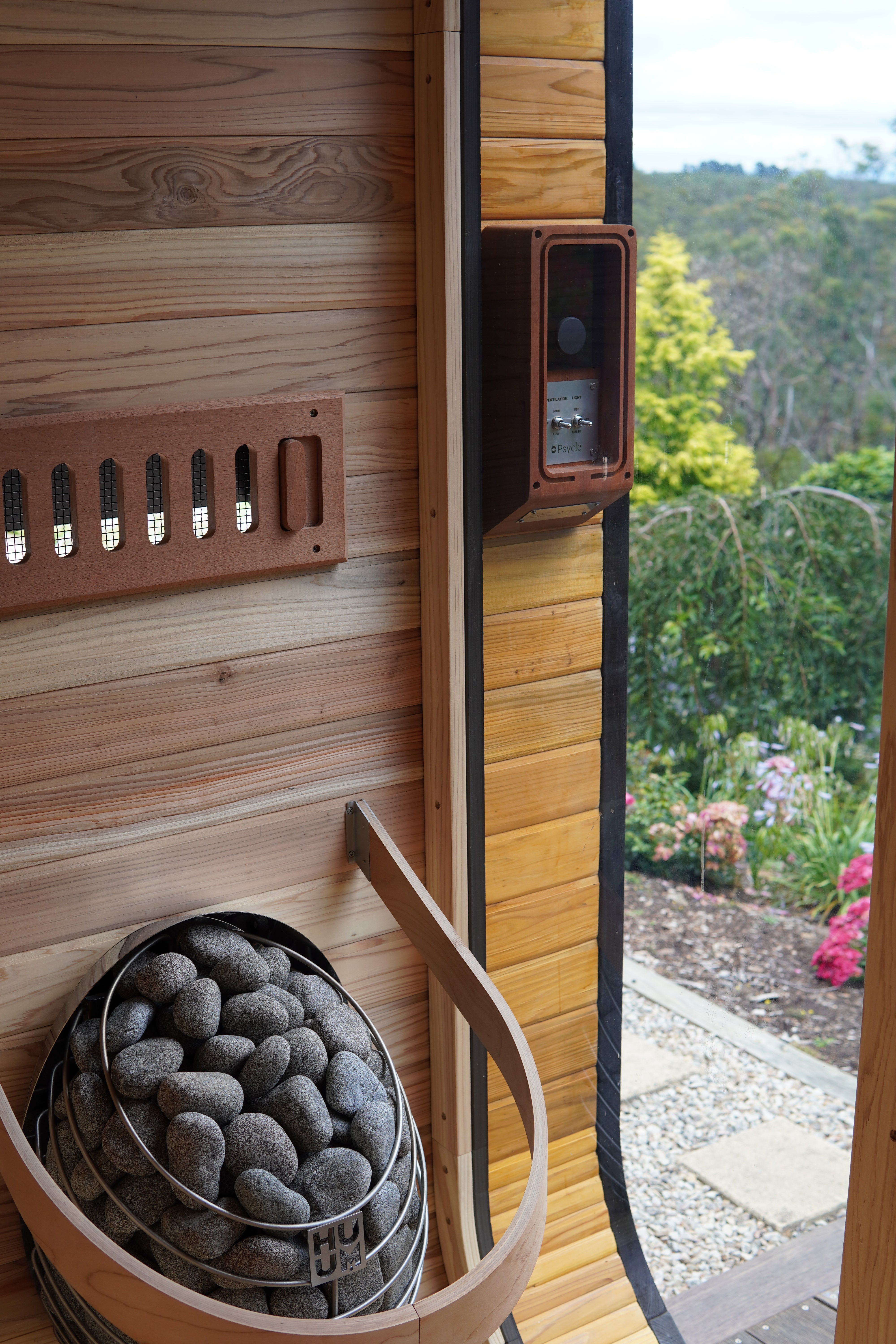
The HUUM DROP 9kW heater fitted in the Genesis holds 60kg of Olivine diabase. The HUUM DROP 6kW in the Genesis Mini also holds 60kg. Compare this to most Australian market competitors at the same kilowatt rating, where stone loads of 15–20kg are standard. That's a 3x stone mass advantage — directly translating to longer heat retention, more stable session temperatures, and dramatically better löyly.
"Stone mass is the primary driver of löyly quality. A heater with 20kg of stone will drop temperature the moment water is poured. A heater with 60kg barely registers the draw — the stones absorb the steam event and recover immediately," says Risto Valtanen, sauna engineer and technical advisor to HUUM, speaking on the design philosophy behind the DROP series.
The HUUM DROP is a top-loading heater — stones are accessible from above, making inspection, rotation, and replacement straightforward. No dismantling. No tools. You open the top, check the stones, and remove any that show surface cracking. That matters in Australian conditions where salt-air and high ambient humidity accelerate surface oxidation of lower-quality stones.

For more on how the Genesis interior is engineered — including active mechanical ventilation and blue-light-free lighting — see our guide to sauna ventilation in Australia.
Zero Guesswork. Pre-Loaded HUUM Stones.
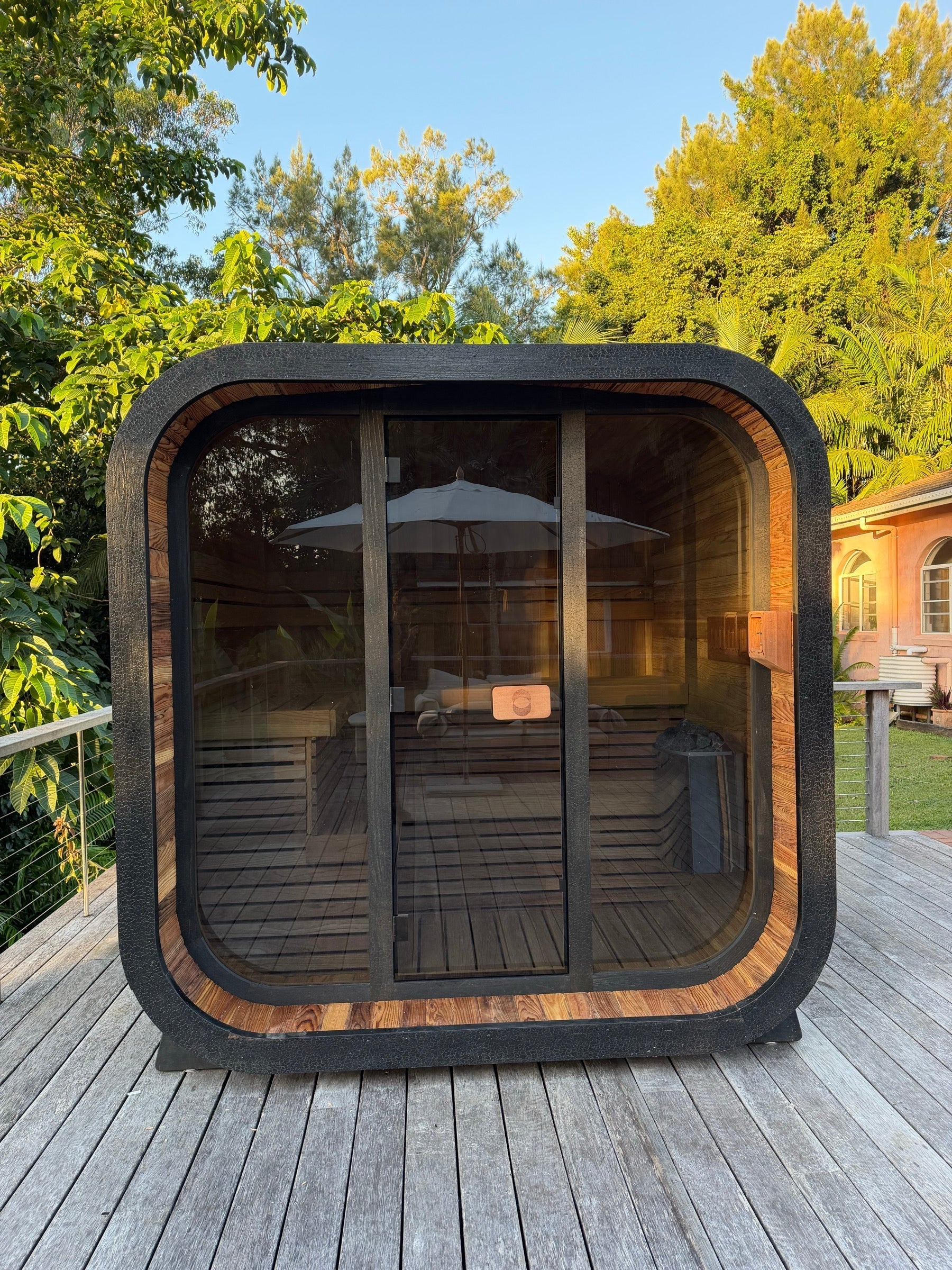
The Genesis ships with a HUUM DROP 9kW heater pre-loaded with 60kg of certified Olivine diabase — tested, placed, and ready. Japanese Cedar construction. Zero-glue. Built in Australia's harshest climates.
SEE THE GENESIS →How to Place Sauna Rocks Correctly for Even Heat and Safe Steam
Correct stone placement is not optional. Poor layering creates voids — air pockets that cause uneven heat distribution, localised overheating of heater elements, and steam pockets that crack stones from the inside when water is poured.
The principle is simple: larger stones at the base, progressively smaller toward the top. Larger stones at the base sit flat against the heating elements and transfer heat efficiently upward. Smaller stones at the top have more surface area exposed to the poured water, vaporising it into steam more evenly.
Stone Placement: Step-by-Step Protocol
Inspect every stone before loading
Check for surface cracks, fissures, or white powdery deposits. Any stone showing these signs should be discarded, not placed. Cracked stones do not heal under heat — they fracture further.
Layer the largest stones first
Place your largest Olivine diabase pieces directly against the heating elements at the base. These anchor the load and conduct heat upward. Avoid placing stones loosely — they should sit stable without rocking.
Fill voids with medium stones
Work medium-sized stones into gaps between the large base layer. The goal is a dense pack with minimal air space — voids concentrate heat and cause element damage over time.
Top layer: smaller stones, dense surface
The top surface receives the water. Smaller stones here vaporise water faster and more evenly. Do not pile stones above the maximum fill line indicated in your heater manual — overflow reduces ventilation airflow through the heater body.
Allow first heat to full temperature before pouring water
On first use after loading or replacing stones, run the heater to full operating temperature — at least 80–100°C cabin temperature — before any löyly. Cold stones receiving water before they're fully heated crack. This is the single most common cause of premature stone failure.
Ideal cabin temperature before your first löyly pour is covered in detail in our guide to how hot a sauna should be.
How to Pour Water for Löyly Without Cracking Your Sauna Rocks
Löyly — the Finnish art of pouring water over heated stones to generate steam — is the defining ritual of authentic sauna culture. Done correctly, it produces a wave of radiant, skin-penetrating heat. Done wrong, it shatters your stones and fills the cabin with a metallic smell that doesn't go away.
The most common mistake is pouring too much water at once. A single generous pour — more than 100–150ml in one go — causes rapid localised cooling on the stone surface. The outside contracts. The core remains hot. That thermal differential creates fracture stress. With cheap, untested stones, one bad pour is all it takes.
With 60kg of Olivine diabase in the HUUM DROP, the thermal mass is substantial enough to absorb a pour without catastrophic temperature differential — but technique still matters. The correct protocol is small, deliberate pours: 50–100ml at a time, distributed across the stone surface, with 30–60 seconds between pours to allow the steam to dissipate and the top layer to recover temperature.
What to Add to Löyly Water
Traditional Finnish löyly uses plain water. Nothing else. Adding essential oils, eucalyptus, or birch extracts directly to the stones deposits organic residue on stone surfaces, accelerating degradation and creating an oily film on the heater guard that becomes a fire risk over time.
If you want aromatic steam, use a dedicated wooden bucket with a few drops of food-grade essential oil mixed into the water before pouring. The steam carries the scent. The stones stay clean.
For a complete guide to the löyly ritual — including humidity ratios, steam temperature, and the traditional Finnish sequence — see our löyly sauna guide.
Managing the humidity output from your löyly pours is also directly connected to sauna humidity control in the Australian climate — where outdoor ambient humidity adds a variable most European sauna guides ignore entirely.
What Happens When Inferior Rocks Are Used: Cracking, Dust, and Dead Heat
Inferior sauna rocks fail in three ways, and each failure compounds the others.
Thermal cracking is the first failure mode. Under-tested rocks — particularly those with porous structure or internal mineral inclusions — develop hairline fractures after 10–20 heat cycles. Visible cracking follows. At this point the stone has reduced effective mass, poor heat transfer, and sharp edges that damage surrounding stones.
Silica dust release is the second and most serious failure mode. Fractured stone surfaces shed fine particulate. In a 90°C enclosed cabin, that particulate is airborne. Repeated inhalation of fine silica dust is a known respiratory hazard — occupational health guidelines across Australia, Europe, and North America identify crystalline silica as a cause of pulmonary fibrosis with chronic exposure. Your sauna cabin should not be a dusty environment.
Uneven heat distribution is the third failure mode. Cracked and fragmented stones don't pack well. Voids form. Airflow through the heater body becomes irregular. Some stones overheat while others remain cool. The result is inconsistent steam output — a spike followed by a rapid drop, rather than the sustained radiant heat that defines an authentic session.
None of these failure modes show up on a spec sheet. They show up in your sessions — and eventually in your lungs, if you're running cracked rocks in a poorly ventilated cabin. The Genesis' active mechanical ventilation (88–120 m³/hr) reduces dust accumulation, but the correct answer is using stones that don't crack in the first place.

The Science Behind Why Sauna Rocks Are Central to Health Outcomes
The health benefits of traditional Finnish sauna are inseparable from the quality of the heat environment — and stone quality determines that environment. You cannot replicate these outcomes in an under-heated, poorly stoned cabin.
A landmark 20-year cohort study of 2,315 Finnish men by Laukkanen et al., published in JAMA Internal Medicine (2015), found that sauna use 4–7 times per week reduced the risk of fatal cardiovascular disease by 50% compared to once-weekly bathing. The sessions in that study were conducted in traditional Finnish saunas operating at 80–100°C with authentic löyly — not in under-stoned electric heaters producing 60°C of dry ambient warmth.
The same KIHD cohort study, following 2,315 men over 20 years in Finland, found that men who used the sauna 4–7 times per week had a 40% lower risk of all-cause mortality compared to once-weekly users. These are large-magnitude effects, observed in authentic traditional sauna conditions, not approximations of them.
The cardiovascular and thermoregulatory mechanisms driving these outcomes — heat stress, plasma volume expansion, nitric oxide release — require genuine high-temperature radiant heat. That requires stones with sufficient mass and thermal stability to sustain temperatures above 80°C for the full session duration. A 20kg stone load in a 9kW heater cannot do this reliably.
For a full breakdown of the evidence on sauna's cardiovascular benefits in the Australian context, see our guide to sauna and cardiovascular health in Australia. For the broader picture on longevity outcomes, our sauna longevity guide covers the full research base.
The rocks in your sauna heater are the difference between approximating a wellness ritual and actually accessing the biological outcomes the research documents. That distinction is worth understanding before you buy.
Real Australians. Real Sessions. What a Dialled-In Stone Setup Feels Like.
Psycle has delivered Genesis saunas to homes across Australia — coastal Queensland, beachfront New South Wales, inner-city Melbourne rooftops, and rural properties in regional Victoria. The feedback on the HUUM DROP stone setup is consistent.
"I'd used commercial saunas for years and thought I knew what a sauna session felt like. The first löyly pour in the Genesis was a different category of heat entirely. It hit the whole body at once — not just the surface. That's the stone mass. You can feel the difference immediately." — Genesis owner, Noosa, QLD.
"We run daily contrast sessions — sauna into the Origin cold plunge. The stones hold temperature for the full 15–20 minutes without any noticeable drop between pours. My HRV data has been trending up for three months straight since we installed." — Contrast Kit owner, Paddington, NSW.
This is the predictable outcome of 60kg of pre-certified Olivine diabase in a correctly engineered heater cavity. Stone mass is thermal battery capacity. More mass means longer sessions, more stable temperature, and better löyly — every time.
For the complete guide on pairing sauna sessions with cold plunge for contrast therapy outcomes, see our sauna cold plunge routine guide.
The Sauna That Gets the Stones Right
The Genesis ships with 60kg of HUUM-certified Olivine diabase — 3x the stone load of most Australian competitors at the same kilowatt rating. Free Australia-wide delivery. 3-year cabin warranty. 120-day build.
EXPLORE THE GENESIS →How Often to Replace Sauna Rocks in Australia — Including Coastal and High-Humidity Environments
In Australian conditions, sauna rock replacement cycles are shorter than European benchmarks because of two factors: coastal salt air and high ambient humidity, particularly in Queensland, northern New South Wales, and Western Australia's coastal strip.
Salt air is corrosive at the microscopic level. Sodium chloride deposits on stone surfaces accelerate surface oxidation and promote micro-fracture propagation in stones already under thermal stress. Stones on a coastal property exposed to ocean air should be inspected every 6 months — not annually.
High ambient humidity also changes the calculus. Outdoor saunas — particularly those on decks near the ocean, a common setup in coastal Australian homes — are exposed to ambient moisture when not in use. Stones that absorb moisture and are then rapidly heated face greater thermal differential stress than stones in dry inland environments. The crack risk is meaningfully higher.
Replacement Guidelines by Environment
| Environment | Inspection Frequency | Replacement Cycle | Key Risk Factor |
|---|---|---|---|
| Coastal (within 5km of ocean) | Every 6 months | 2–3 years | Salt air oxidation, micro-fracture acceleration |
| High humidity (QLD, tropical NT) | Every 6 months | 2–4 years | Moisture absorption between sessions |
| Inland / low humidity (VIC, SA, inland NSW) | Annually | 4–6 years | Standard thermal cycling wear |
| Indoor installation (climate controlled) | Annually | 5–7 years | Thermal cycling only — no environmental exposure |
| Daily use (any environment) | Every 3–4 months | 1–2 years | High cycle count, accelerated wear regardless of stone quality |
Regardless of environment, replace any stone that shows visible cracking, white powder deposits, or that has lost significant mass from spalling. Do not wait for a scheduled replacement date if the stone is visibly compromised.
The HUUM DROP's top-loading design makes this inspection process practical — it takes five minutes. Compare this to side-loading heaters common in cheaper Australian sauna packages, where stone inspection requires partial disassembly and often gets skipped entirely.
For more on setting up an outdoor sauna in the Australian climate — including deck integration, weatherproofing, and site requirements — see our guide to outdoor saunas in Australia.
Sauna Rocks vs Infrared: Why Stone-Based Heat Is the Standard
Infrared saunas do not use rocks. They use ceramic or carbon panels that emit far-infrared radiation — a fundamentally different mechanism from the radiant and convective heat of a traditional Finnish sauna. This distinction matters because the two heat types produce different physiological responses, and the research literature is almost entirely based on traditional stone-heated saunas.
Traditional Finnish saunas operate at 80–100°C. Infrared units typically operate at 50–70°C. The cardiovascular stress response, plasma volume expansion, and heat shock protein upregulation documented in the Laukkanen studies were observed at traditional sauna temperatures — not at 55°C infrared exposure.
| Feature | Traditional Finnish (Stone-Heated) | Infrared |
|---|---|---|
| Operating temperature | 80–100°C | 50–70°C |
| Heat mechanism | Radiant + convective from stone mass | Far-infrared radiation from panels |
| Löyly capable | Yes — core ritual of the experience | No — no stones, no steam |
| Research base | Extensive — 20+ year longitudinal studies | Limited — shorter studies, lower temperatures |
| Cardiovascular evidence | 50% reduction in fatal CVD events (Laukkanen, 2015) | No equivalent long-term data |
| Stone maintenance required | Yes — inspect every 6–12 months | No stones to maintain |
Psycle Wellness builds traditional Finnish saunas. The Genesis and Genesis Mini use stone-heated HUUM DROP or Harvia Vega heaters — not infrared panels. If you are comparing traditional and infrared options, our guide to traditional vs infrared sauna covers the full evidence base.
Running Costs and the Real Price of Getting Sauna Rocks Right
A common objection to investing in a premium stone-heated sauna is running cost. The reality is more favourable than most buyers expect — and the comparison to alternative recovery methods makes it clear.
The Genesis HUUM DROP 9kW heater costs approximately AU$0.50–$1.00 per 45-minute session at typical Australian electricity rates of AU$0.30–$0.35 per kWh. That assumes a 45-minute heat-up plus session — the heater does not run at full draw for the entire duration once the cabin reaches temperature and the stone mass is holding heat.
Compare that to a gym membership at AU$1,200–$2,400 per year, or weekly physio at AU$100–$160 per session — AU$5,200–$8,320 annually if you're managing chronic training load or soft tissue recovery. At $1.00 per session and daily use, the Genesis running cost is AU$365 per year. The comparison is not close.
The stone replacement cost — Olivine diabase at approximately AU$150–$250 per full load — adds a periodic maintenance line to the budget. At 3–5 year replacement intervals for inland or indoor installations, this is not a significant ongoing cost relative to the value of the equipment.
For a thorough breakdown of home sauna costs in Australia — including installation, running costs, and long-term value — see our guide to home sauna costs in Australia.
The Genesis is also available as a Contrast Kit — paired with the Origin cold plunge — for Australians building a complete daily recovery protocol. The sauna and cold plunge Australia guide covers the evidence for contrast therapy and how to structure the protocol.
Frequently Asked Questions About Sauna Rocks in Australia
What are the best sauna rocks available in Australia?
Olivine diabase (peridotite) is the best sauna rock material available in Australia for traditional Finnish saunas — dense, non-porous, and resistant to thermal cracking. Pre-certified HUUM Olivine diabase stones are the benchmark: tested to withstand repeated thermal cycling without fracture, sized to fit the HUUM DROP heater geometry, and supplied in 60kg loads that deliver authentic löyly heat. Generic black diabase from pool and spa suppliers is an acceptable second choice if sourced from a reputable manufacturer that performs thermal testing. Avoid basalt, granite, sandstone, and river stones entirely.
How do I use sauna rocks for löyly steam?
Pour small amounts of water — 50–100ml — slowly and evenly across the top layer of hot stones once the cabin reaches operating temperature (80–100°C). Wait 30–60 seconds between pours to allow steam to dissipate and the stone surface to recover temperature. Use plain water directly on the stones; add essential oils to the bucket only, not the stones. Never pour cold water on stones that have not fully heated — thermal shock is the primary cause of stone cracking.
How often should I replace sauna rocks in Australia?
In Australian coastal environments (within 5km of the ocean), inspect stones every 6 months and replace every 2–3 years. Inland or climate-controlled installations can extend replacement cycles to 4–6 years with annual inspection. Daily use accelerates wear: high-frequency users should inspect every 3–4 months and expect replacement every 1–2 years. Replace any stone showing visible cracking, white powder deposits, or significant spalling regardless of schedule.
Why do my sauna rocks keep cracking?
Sauna rocks crack for three reasons: poor stone quality (porous or untested material), incorrect thermal conditioning (pouring water before stones reach full operating temperature), or excessive water volume per pour. If you are using generic rocks from a pool and spa supplier, cracking is expected — these stones are rarely thermal-cycled tested before sale. Switching to pre-certified Olivine diabase and following correct löyly technique eliminates premature cracking in the vast majority of cases.
What is the difference between Olivine diabase and black diabase sauna stones?
Olivine diabase — also called peridotite — has a tighter crystal matrix and higher density than standard black diabase, making it more resistant to thermal shock and surface fracturing. Black diabase is a legitimate commercial choice when properly sourced and thermal-tested, but it is more variable in quality between batches. HUUM specifies Olivine diabase for the DROP heater because its physical properties are more consistent and its crack resistance under the company's testing protocol is demonstrably higher.
Can I use any rocks in my sauna heater?
No. Only dense, non-porous igneous or metamorphic rocks — specifically Olivine diabase, black diabase, or tested vulcanite — are safe for use in a sauna heater. Granite, sandstone, river stones, and any porous rock type will crack, explode, or spall under rapid heating. Exploding stones in a 90°C enclosed cabin are a safety hazard. Always use stones specified by your heater manufacturer — for HUUM heaters, that means HUUM-certified Olivine diabase.
Does the Psycle Genesis come with sauna stones included?
Yes. The Genesis ships with the HUUM DROP 9kW heater pre-loaded with 60kg of certified Olivine diabase stones — no separate purchase, no guesswork on sizing or placement. The Genesis Mini ships with the HUUM DROP 6kW heater, also pre-loaded with 60kg of the same Olivine diabase. Both are ready for a first session after the required electrical connection is made and the initial heat-up cycle is complete.
Ready to Build This Into Your Routine?
The Genesis. 60kg of HUUM-certified Olivine diabase. Zero-glue Japanese Cedar. Free Australia-wide delivery. 3-year cabin warranty. 120-day build — order now for summer delivery.
SHOP THE GENESIS →If you are still comparing options, our complete home sauna buyer's guide for Australia covers every variable — cabin size, heater type, stone specification, and installation requirements. The sauna benefits Australia guide covers the full evidence base for heat therapy outcomes. And if you are building a complete recovery system, the contrast therapy Australia guide explains how to pair the Genesis with the Origin cold plunge for the full protocol.