Sauna Room Ideas Australia: The Complete Design Guide | Psycle
Sauna Room Ideas Australia: The Complete Design Guide

Key Takeaways
- The Finnish standard for upper bench clearance is 110-120 cm below ceiling - not an arbitrary preference, but the physiological requirement for the heat to work on a reclining body.
- Ventilation placement is the most misunderstood element in sauna design: the VTT 1992 research found that supply air above the heater (not low near the floor) is the only configuration achieving proper air exchange in an electrically heated sauna.
- Japanese Cedar (Cryptomeria japonica) used in the Genesis is resin-free, antimicrobial, and thermally stable - categorically different from Western Red Cedar, which is not appropriate for sauna use.
- Zero-glue mechanical joinery is non-negotiable: MDF and particle board off-gas formaldehyde above 60 degrees C; urea-formaldehyde adhesives release above 80 degrees C.
- Active mechanical ventilation at 88-120 m3/hr is required for a real Finnish session - natural convection alone cannot maintain the air exchange rates specified in Finnish building guidelines (minimum 6 air changes per hour).
- The Genesis (2288W x 1945D mm) sits below the 10m2 permit exemption threshold in most Australian states; the Genesis Mini (1571W x 1950D mm) qualifies in all of them.
- Stone mass determines session quality: the HUUM DROP 9kW carries 60 kg of Olivine diabase - three times the mass of a typical residential heater - which is what sustains temperature during löyly.
By Psycle Wellness · Last updated: June 2026 · 20 min read
Sauna room design in Australia sits at an unusual intersection: Finnish engineering standards developed over decades of systematic research, Australian building codes and climate conditions, and a local market flooded with flat-pack cabins that share almost nothing with a real sauna beyond the word. This guide works from the Finnish technical literature - primarily Dr. Lassi Liikkanen's The Secrets of Finnish Sauna Design and the technical series at LocalMile.org compiled by sauna builder Trumpkin with direct reference to VTT (Technical Research Centre of Finland) studies - and applies it to the decisions you face when designing a home sauna in Australia.
Every specification here has a reason. Understanding those reasons is what separates a sauna room that performs from one that looks correct but never gets hot enough, never achieves proper löyly, and gets replaced in five years.
The Finnish Technical Literature: What It Actually Says
Two resources dominate serious English-language sauna building literature. The first is Dr. Lassi A. Liikkanen's The Secrets of Finnish Sauna Design: A Handbook for Holistic Finnish Sauna Design (Culicidae Architectural Press, second edition 2025, ISBN 978-1-68315-165-4). Liikkanen is a designer and researcher at Aalto University whose work synthesises Finnish Sauna Society standards with ergonomic research across thousands of sauna builds. The book covers heat physics, ventilation fluid dynamics, interior ergonomics, and cultural practice in a single reference used by architects and builders across Europe and North America.
The second is the technical sauna building series at LocalMile.org (Trumpkin's Notes on Building a Sauna), which translates Liikkanen's research and the 1992 VTT ventilation study into English-language build guidance. The ventilation specifications in this guide draw directly from the VTT study findings, which compared four ventilation configurations in a controlled electric sauna environment and remain the definitive experimental reference on sauna air exchange.
Ventilation: The Element That Determines Everything Else
Ask most people to describe a sauna ventilation layout and they will say: intake low near the floor, exhaust high on the opposite wall. That is the correct configuration for a wood-fired sauna running on gravity convection. It is the wrong configuration for an electrically heated sauna, and it is what 90% of residential electric sauna installations in Australia use.
The VTT 1992 study (Technical Research Centre of Finland) measured CO2 levels, temperature stratification, and air exchange rates across four ventilation configurations in an identical electric sauna environment. Only one configuration - supply air delivered above the heater at 2/3 to 3/4 height between the stone top and ceiling, with mechanical exhaust below the foot bench on the opposite wall - achieved CO2 removal below 700 ppm and maintained acceptable temperature stratification at bather level.
The physics explain why. In an electrically heated sauna, the heater creates a rising heat plume. When fresh supply air enters above the heater, it is entrained in this plume and distributed across the room at bather level. When supply air enters low near the floor (the traditional wood-fire position), it short-circuits to the exhaust outlet without ever reaching the seated bather zone, leaving a stagnant CO2-rich layer at bench height.
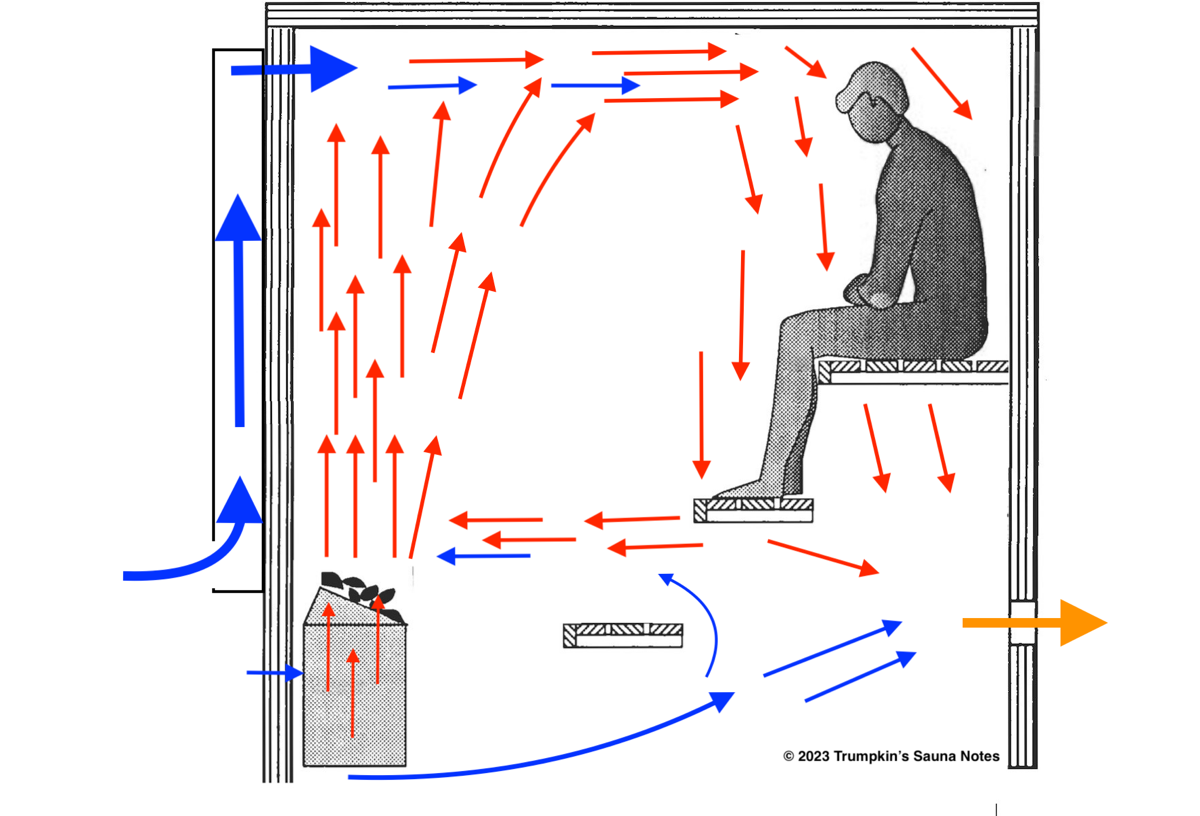
Minimum air exchange rates: Finnish building guidelines specify 6 air changes per hour minimum; 9-12 litres per second per person is the standard residential figure. For a 4-person sauna at active use, that translates to roughly 80-125 CFM of mechanical exhaust. Passive vents sized at 50-100 mm diameter with adjustable grilles handle supply.
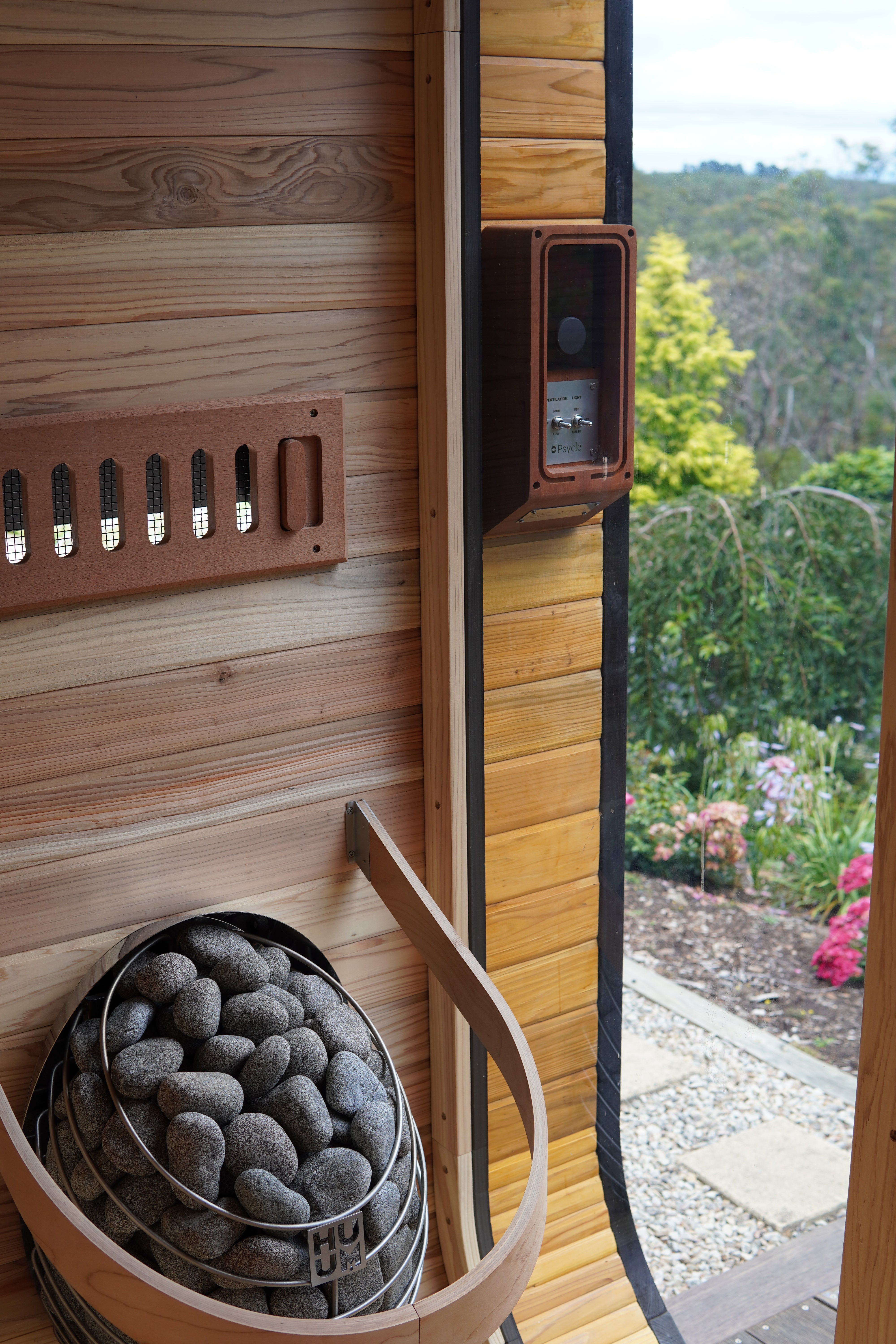
The Genesis uses a dual-speed active ventilation system rated at 88 m3/hr on low (1-2 users) and 120 m3/hr on high (3-5 users), with a passive drying hatch for post-session air circulation. The supply inlet is positioned above the heater; the mechanical exhaust draws from the low zone on the opposite wall. It is the only residential sauna in Australia built to the VTT configuration.
Bench Height: The Finnish Standard

Bench height in Finnish sauna design is ceiling-derived, not floor-derived. The Finnish Sauna Society convention is that the upper bench should sit 110-120 cm below the ceiling - giving a reclining bather's head approximately 40-50 cm of clearance above the hottest air layer. For a 250 cm ceiling, that places the upper bench sitting surface at 130-140 cm from the floor.
The two-fists rule is the traditional field test: seated on the upper bench, you should be able to raise two fists above your head with just enough room to move. If you hit the ceiling with your fists raised, the bench is too high; if you have more than two fist-widths of clearance, the bench is too low and the bather is outside the optimal heat zone.
What happens when bench height is wrong: Too high - the bather's head enters the ceiling heat zone (above 110 degrees C in a well-run sauna), which is uncomfortable and physiologically counterproductive. Too low - the bather drops below the optimal 80-100 degree C zone and the heat stimulus is insufficient to drive cardiovascular adaptation or meaningful sweating.
The Full Bench Stack
| Bench Level | Height from Floor | Notes |
|---|---|---|
| Upper (sitting/reclining) | 110-140 cm (ceiling-derived) | 110-120 cm clearance below ceiling; 80 cm depth minimum for lying |
| Foot bench | 85-100 cm | Must clear the cold floor zone; at or above the top of the heater stones |
| Step/entry bench | 40-45 cm | Seating position for new users or low-heat preference |
| Bench depth (upper) | 60 cm minimum; 80-100 cm ideal | 60 cm for seated; 80+ cm for reclining (recommended) |
| Bench slat spacing | 10-20 mm (15 mm ideal) | Allows steam circulation under the body |
| Per-person bench width | 60 cm sitting; 190 cm lying | Finnish Sauna Society standard |
Pälsi's Law (from Finnish sauna tradition, cited in Saunologia.fi): The foot bench surface must sit at or above the top of the heater stones. Placing a bather's feet below the stone line puts them in the cold zone that exists at floor level even in a hot sauna - defeating the purpose of the two-bench layout.
Timber: What Works in an Australian Climate
Finnish sauna building literature recommends aspen, alder, and Nordic spruce for benches and cladding - species chosen for low thermal conductivity (so the wood does not burn skin), zero resin content, and antimicrobial properties. None of these are commercially available in Australia at sauna grade.
Japanese Cedar (Cryptomeria japonica) is the correct Australian substitute. It shares the low thermal conductivity and antimicrobial profile of aspen and alder, adds natural volatiles that create the characteristic sauna scent, and performs extremely well under repeated heat and moisture cycling. The Genesis uses Japanese Cedar sourced from Japan at 38 mm wall thickness - thick enough to maintain thermal mass without the structural risk of thinner profiles used in budget cabins.
A clarification that matters: Finnish and European sources consistently flag cedar as inappropriate for sauna - but they mean Western Red Cedar (Thuja plicata), which contains thujone, a monoterpene neurotoxin that releases at heat. Japanese Cedar (Cryptomeria japonica) is a different genus with no thujone content. The confusion is common in Australian and North American sauna markets. Japanese Cedar has been used in Japanese sauna and bathing tradition for centuries without issue.
Timber Comparison
| Species | Use | Verdict for Australia |
|---|---|---|
| Japanese Cedar (Cryptomeria japonica) | Benches, cladding, structure | Best available option. Low thermal conductivity, resin-free, antimicrobial, excellent in humidity. |
| Nordic Spruce / Abachi | Benches, cladding | Good. Requires importing at sauna grade; rarely available locally. |
| Thermo-treated timber | Benches, exterior cladding | Acceptable. Resin driven out by heat treatment; more dimensionally stable. |
| Western Red Cedar (Thuja plicata) | Marketed for saunas | Not recommended. Contains thujone; releases at 80-100 degrees C. Common in North American budget market. |
| MDF / particle board | Common in budget kits | Avoid. Urea-formaldehyde off-gasses above 60 degrees C. Structural failure within 2-3 years in Australian humidity. |
| Pine (radiata/hoop) | Cladding | Resin pockets cause weeping at temperature; not appropriate for bench contact surfaces. |
The zero-glue construction standard in the Genesis eliminates the largest off-gassing risk in enclosed hot environments. Every joint is mechanical - no adhesive, no filler, no epoxy. The only finish is a non-VOC oil applied to the exterior cedar, not the interior.
Ceiling Height: The Heat Cavity Principle
Finnish building code specifies a minimum sauna ceiling height of 230 cm. Most practitioners recommend 250-275 cm for a residential sauna that will be used for full Finnish sessions. The ceiling height determines upper bench position, which determines heat zone placement, which determines the physiological stimulus. Getting the ceiling wrong cascades through every other dimension.
The heat cavity: The volume of hot air above the door lintel is retained when the door opens - the lower the lintel, the more heat stays in. Traditional Finnish saunas use door heights as low as 160 cm with a high sill specifically to preserve the heat cavity. Most Australian residential saunas use standard door heights of 200+ cm, which bleeds heat rapidly at every entry. This is a functional compromise; what matters most is that the door seals tightly wood-on-wood when closed.
Ceiling Height Reference
| Ceiling Height | Upper Bench from Floor | Assessment |
|---|---|---|
| 210 cm | 90-100 cm | Minimum viable. Reclining is compromised. Not recommended. |
| 230 cm | 110-120 cm | Finnish minimum standard. Functional for full sessions. |
| 250 cm | 130-140 cm | Preferred. Good clearance; comfortable reclining. |
| 275+ cm | 150-160 cm | Excellent. Allows three-tier bench stack; best heat stratification. |
Room Dimensions and Layout
Finnish sauna design specifies minimum 3 m3 of room volume per person (Finnish official standard; LocalMile suggests 2 m3 as a practical minimum for compact builds). The room shape should approximate a cube or compact rectangle - the longest wall no more than 40% longer than the shortest. Long narrow saunas create temperature stratification problems where the near-heater end runs far hotter than the far end.
Minimum 4-person sauna (Finnish standard): 250 x 250 x 260 cm (approximately 2.5m x 2.5m footprint with 2.6m ceiling). This is the floor area most commonly used in Finnish residential builds.
Heater placement: The heater should be placed with benches running parallel along the wall opposite the heater, or returning along an adjacent wall. The minimum clearance from heater body to any bench surface is 90 cm horizontally. The heater guard must be at minimum 2.5 cm from the heater casing. Both heater and door on the same wall is ideal - it concentrates the cold entry zone to one side and maximises the uninterrupted heat cavity.
Heater Sizing and Stone Mass

Heater sizing is typically specified by manufacturers as kW per cubic metre. The Finnish reference range is 1 kW per 1.5-2 m3 of sauna volume for a well-insulated room. A 9 kW heater is correct for an 14-18 m3 interior. Undersizing the heater is one of the most common budget decisions that destroys the session experience - an undersized heater reaches 65-70 degrees C and stalls; it cannot create true Finnish heat.
Stone mass matters more than kW: Stone mass determines thermal flywheel capacity - how much heat the stones store and release over time. At the moment of löyly (when water hits the stones), a low-mass heater drops temperature sharply and takes several minutes to recover. A high-mass heater (40 kg+) barely registers the water impact and sustains temperature through multiple löyly rounds.
Liikkanen's Secrets of Finnish Sauna Design recommends a minimum of 20 kg stones per session position; experienced practitioners aim for 10 kg per kW of heater output as a baseline. The HUUM DROP 9kW carries 60 kg of Olivine diabase - substantially above the minimum and designed for sustained high-frequency löyly use. Olivine diabase is specifically noted in Finnish sauna stone literature for its low thermal expansion coefficient, which prevents cracking under repeated thermal shock.
Door Design and the Sealing Standard
Finnish and international safety standards require sauna doors to open outward - a bather who loses consciousness cannot be trapped. The door must not be lockable from outside during use. These are non-negotiable safety requirements, not design preferences.
The sealing standard is wood-on-wood - the door frame and door edge create a natural airtight seal through timber contact. Sliding doors, barn doors, and rubber-seal doors all fail at temperature: rubber deteriorates, tracks warp, barn door gaps cannot be sealed. A properly fitted timber sauna door with correct clearances (approximately 3 mm on all sides when cold) will swell to a near-perfect seal at operating temperature.
Glass specification: The Genesis door uses 8 mm safety laminated tempered glass (4+4 mm dual-layer, grey tint). The grey tint reduces solar gain in outdoor installations; the dual-layer laminate satisfies AS/NZS 2208 safety glazing requirements. Single-pane tempered glass is acceptable but lacks the redundancy - a single impact failure means complete glass collapse rather than held fragments.
Lighting: Blue Light at Heat Is Counterproductive
Sauna lighting serves two functions: visibility during session and supporting the recovery state post-session. Standard LED lighting (5000-6500K, blue-dominant spectrum) suppresses melatonin and counteracts the sleep improvement that is one of the primary long-term benefits of regular sauna use.
The Finnish Sauna Society standard is indirect, low-intensity warm light - traditionally incandescent at 2700K or lower. Modern blue-light-free specifications target the 580-650 nm range: amber (585-590 nm) for low-stimulation general use, red (630-635 nm) for maximum melatonin preservation in evening sessions.
The Genesis Psycle Blue-Light-Free Lighting System operates at 585-590 nm amber (CCT 1746K, 99.5% colour purity) and 630-635 nm red (CCT 1001K, 98.7% colour purity), IP67 rated at 24V DC with a withstand temperature of 200 degrees C. IP67 is the critical certification for sauna lighting - it means complete dust exclusion and temporary immersion protection, necessary when steam contacts every surface.
Australian Climate: What the Finnish Literature Does Not Cover
Liikkanen's technical work was developed primarily for Finnish and Northern European conditions. Several adjustments are necessary for Australian installation:
Outdoor placement: Finland has a 9-month shoulder season during which outdoor saunas are not in active temperature gradient management. Australia's outdoor saunas run in ambient temperatures of 5-40 degrees C depending on location, with humidity ranging from 10% (inland) to 90%+ (coastal Queensland, Northern NSW). The design response is heavier insulation on wall panels (38 mm vs the 22 mm used in budget imports), moisture-tolerant construction joints (zero-glue mechanical rather than adhesive), and an optional Colorbond roof kit for fully exposed placement.
Ventilation in coastal humidity: In humid coastal environments (Sydney, Brisbane, Gold Coast, Byron Bay), post-session drying is critical. A passive drying hatch that allows natural air circulation through the interior when not in use prevents the moisture accumulation that causes timber checks and bench warping. The Genesis includes this as standard.
Electrical requirements: Australian residential saunas require a dedicated circuit installed by a licensed A-grade electrician. The Genesis 9kW requires a 50A dedicated circuit (single or three phase); the Genesis Mini 6kW requires 32A. Most Australian homes have 60A or 80A single-phase service, meaning 50A is readily available as a subpanel circuit without a service upgrade. Queensland, NSW, and Victoria all permit sauna installation under development consent exemptions when the structure remains under 10 m2 and is not attached to the dwelling - the Genesis (2288W x 1945D = approximately 4.45 m2) and Genesis Mini (1571W x 1950D = approximately 3.06 m2) both qualify comfortably.
Indoor Sauna Room Conversion: Key Design Decisions
Indoor sauna conversions in Australia are typically bathroom conversions, basement builds, or purpose-built rooms in new construction. The design requirements mirror outdoor builds with additional considerations:
- Subfloor protection: A continuous vapour barrier under the sauna floor is non-negotiable in an indoor installation. The Australian standard is 200 micron polyethylene sheeting turned up the walls and taped. Without it, moisture from post-session evaporation migrates into the subfloor structure.
- Ceiling insulation: Indoor saunas lose heat upward to the room above. 50-75 mm mineral wool in the ceiling cavity is the minimum; this also handles sound attenuation in two-storey homes.
- Drain proximity: Not required for the sauna interior (which should not be hosed down), but a nearby floor waste makes post-session bucket disposal practical and reduces humidity loading in the room.
- Ventilation exhaust routing: Mechanical exhaust from an indoor sauna must be ducted to outside the building envelope - not into the ceiling cavity or wall space. 100 mm insulated flexible duct with a backdraft damper is the standard residential solution.
The Genesis: Finnish Specifications Applied to Australian Conditions

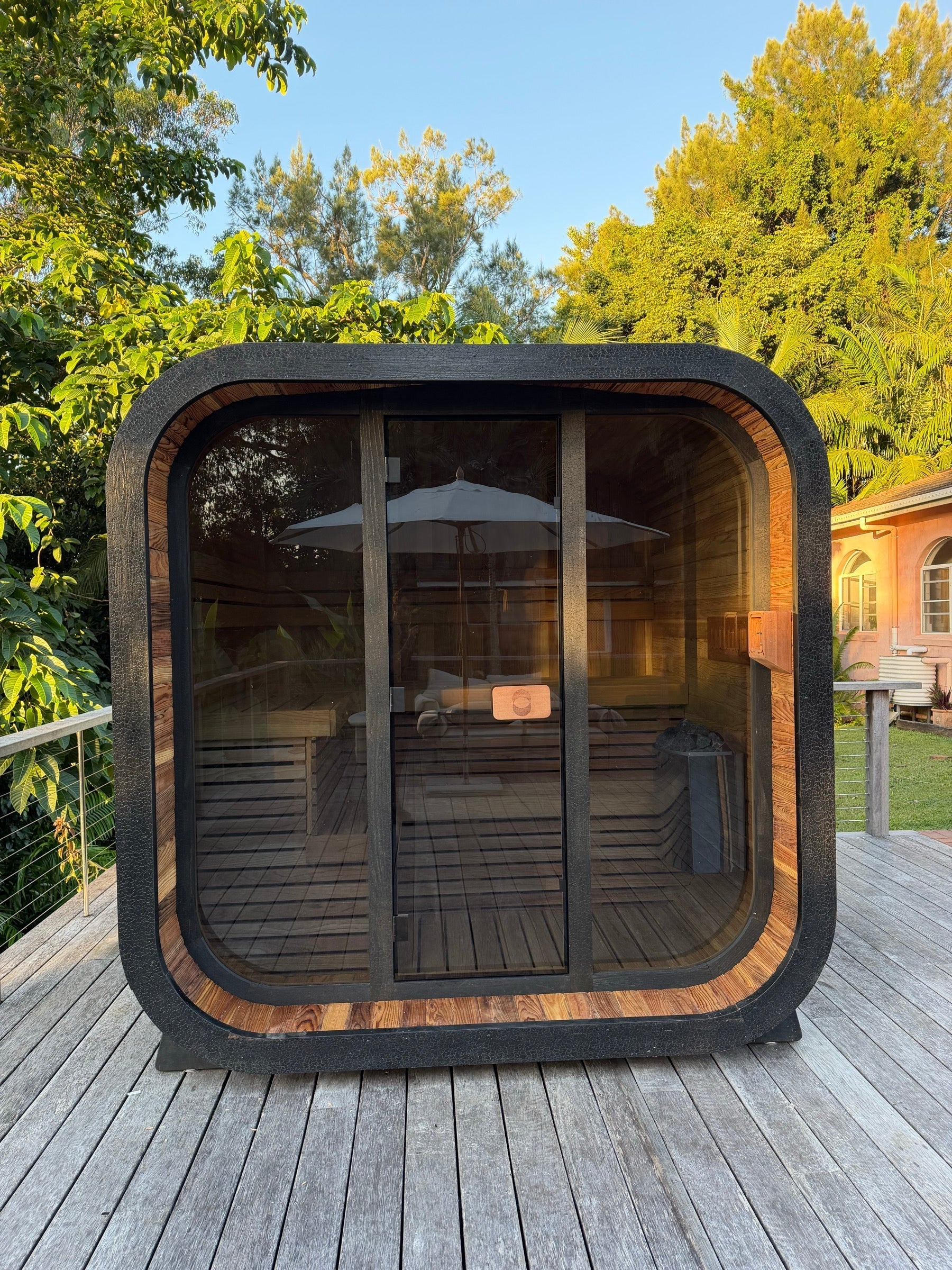
The Genesis was designed to meet Finnish technical standards, not to approximate them. The 38 mm Japanese Cedar walls exceed the thermal mass of European sauna building practice. The HUUM DROP 9kW with 60 kg Olivine diabase stones is the heater specified by Finnish commercial sauna operators for 4-5 person cabins. The two-tier bench stack is positioned to Finnish Society bench height standards. The active ventilation system follows the VTT 1992 recommended configuration.
What differentiates it from European builds is the climate adaptation: mechanical ventilation rated for Australian summer conditions, Colorbond roof compatibility for full outdoor exposure, zero-glue construction tolerant of Queensland coastal humidity cycles, and IP67 lighting rated for 200 degrees C rather than the 120 degrees C typical of European sauna lighting.
Genesis Specifications at a Glance
| Specification | Genesis | Genesis Mini |
|---|---|---|
| Capacity | 3-5 persons | 1-3 persons |
| External dimensions | 2289H x 2288W x 1945D mm | 2267H x 1571W x 1950D mm |
| Timber | Japanese Cedar, 38 mm walls | Identical spec |
| Heater (HUUM option) | HUUM DROP 9kW, 60 kg stones | HUUM DROP 6kW, 60 kg stones |
| Heater (Harvia option) | Harvia Vega 9kW, 20 kg stones | Harvia Vega 6kW, 20 kg stones |
| Ventilation | 88/120 m3/hr active + passive hatch | Identical spec |
| Lighting | Amber 585-590nm / Red 630-635nm, IP67 | Identical spec |
| Glass | 8 mm safety laminated 4+4mm tempered | Identical spec |
| Circuit required | 50A dedicated | 32A dedicated |
| Warranty | 3-year cabin warranty, 3-year heater warranty | 3-year cabin warranty, 3-year heater warranty |
Ready to Build to Finnish Standard?
The Genesis is the only residential sauna in Australia built to Finnish Society bench specifications, VTT-recommended ventilation layout, and clinical-grade stone mass. Free Australia-wide delivery. 3-year cabin warranty. 120-day build - order now for summer delivery.
SHOP THE GENESIS →Frequently Asked Questions
What is the minimum size for a sauna room in Australia?
The Finnish standard is 3 m3 of room volume per person. For a 2-person sauna, a minimum footprint of approximately 1.5 x 1.8 m with a 230 cm ceiling is technically viable, though 1.8 x 2.0 m is far more comfortable. The Genesis Mini (1571W x 1950D external) is designed for 1-3 persons and fits within standard deck panels and most apartment balcony footprints.
Do I need council approval for a home sauna in Australia?
In most Australian states, a freestanding structure under 10 m2 that is not attached to the dwelling is exempt from development approval. Queensland, NSW, and Victoria all have this exemption, though setback requirements from boundaries vary by local council. The Genesis (approx 4.45 m2) and Genesis Mini (approx 3.06 m2) both qualify under this threshold. Confirm with your council before installation - rules differ by LGA and some heritage overlay zones have additional requirements.
Should sauna benches be fixed or removable?
Fixed benches that are individually slat-replaceable are the standard in Finnish sauna design. The benches in the Genesis are designed so individual slats can be removed for replacement without disassembling the full bench structure. Fully removable bench systems (modular units) are easier to clean but introduce more joints and gaps over time, reducing structural integrity at temperature.
What kind of sauna heater is best for Australian conditions?
An electric heater with high stone mass is the correct choice for a residential Australian sauna. Wood-fired is impractical in urban settings (ember attack zones, smoke, council restrictions) and requires daily maintenance. The HUUM DROP delivers 9 kW with 60 kg of stone - the highest stone mass-to-power ratio available in the Australian market at this price point. The Harvia Vega is the alternative for users who prefer mechanical controls and a lower price point; it delivers the same power at 20 kg stone mass.
Can I install a sauna on a timber deck?
Yes, provided the deck can support the load. A Genesis at approximately 600 kg shipping weight (excluding heater) plus 5 persons at 80 kg average generates a live load of roughly 1,000 kg concentrated over 4.45 m2 - approximately 225 kg/m2. Most Australian residential decks are engineered to 480 kg/m2 (decking plus 1.5 kPa live load). Have a structural engineer confirm load capacity before installation if the deck is not purpose-built. Timber decks should also include a moisture barrier under the sauna footprint.
What is the correct ventilation setup for a home sauna?
For an electrically heated sauna: supply air inlet above the heater at 2/3 to 3/4 height between the stone top and ceiling; mechanical exhaust below the foot bench on the opposite wall. This is the VTT 1992 recommended configuration and the only one achieving proper CO2 removal in experimental testing. The minimum exchange rate is 6 air changes per hour; 9-12 litres per second per person is the Finnish residential standard. Do not use the traditional low-inlet configuration (correct for wood-fired, wrong for electric).
Sources and Further Reading
- Liikkanen, L.A., Smith, G., Muecke, M. The Secrets of Finnish Sauna Design, 2nd ed. Culicidae Architectural Press, 2025. ISBN 978-1-68315-165-4.
- Trumpkin (LocalMile.org). Trumpkin's Notes on Building a Sauna and Proper Ventilation for Electrically Heated Sauna. LocalMile.org.
- VTT Technical Research Centre of Finland (1992). Sauna ventilation configuration study - four comparative configurations. Published via Saunologia.fi and summarised at LocalMile.org.
- Finnish Sauna Society (Suomen Saunaseura). Bench height and design conventions. sauna.fi.
- Saunologia.fi - Dr. Lassi Liikkanen's research companion site. Löyly physics, stone mass tables, thermal stratification data.