
Löyly in Sauna: What It Is and Why It Matters
Löyly in Sauna: What It Is and Why It Matters

Key Takeaways
- Löyly is a Finnish term with no direct English translation — it describes the steam, enveloping heat, and overall atmosphere created when water hits hot sauna stones
- Sauna sessions of at least 20 minutes at approximately 79°C are linked to a 40% reduction in all-cause mortality when done 4–7 times per week, according to a 2015 study in JAMA Internal Medicine
- A proper Finnish sauna requires 6–8kg of stone per cubic metre of sauna space — most home electric heaters carry only 20–30kg total, which is insufficient for real löyly
- Active mechanical ventilation should replace sauna air 6–8 times per hour — without it, CO₂ buildup creates a suffocating feeling within 15 minutes
- Good löyly requires a controllable temperature range of 70–100°C combined with the ability to add water to the stones for humidity management
- Saunas built with glued MDF or particle board off-gas formaldehyde when heated — zero-glue construction is a health requirement, not a premium feature
Löyly is the soul of a Finnish sauna. It is the steam that rises when water hits hot stones, the heat that wraps around you, and the atmosphere that makes you want to stay. There is no direct English translation — the word holds the entire experience.
Most home saunas do not get löyly right. They cut stone mass, ignore ventilation, and treat heat as a thermostat setting. The result is a hot box, not a sauna — and the health benefits that depend on sessions of 20 minutes or more at 79°C or above simply do not arrive.
Get löyly right, and the session transforms. You breathe easily, the heat distributes evenly, and your body responds the way the research says it should.
Zero-Toxin Finnish Sauna, Engineered for Australians
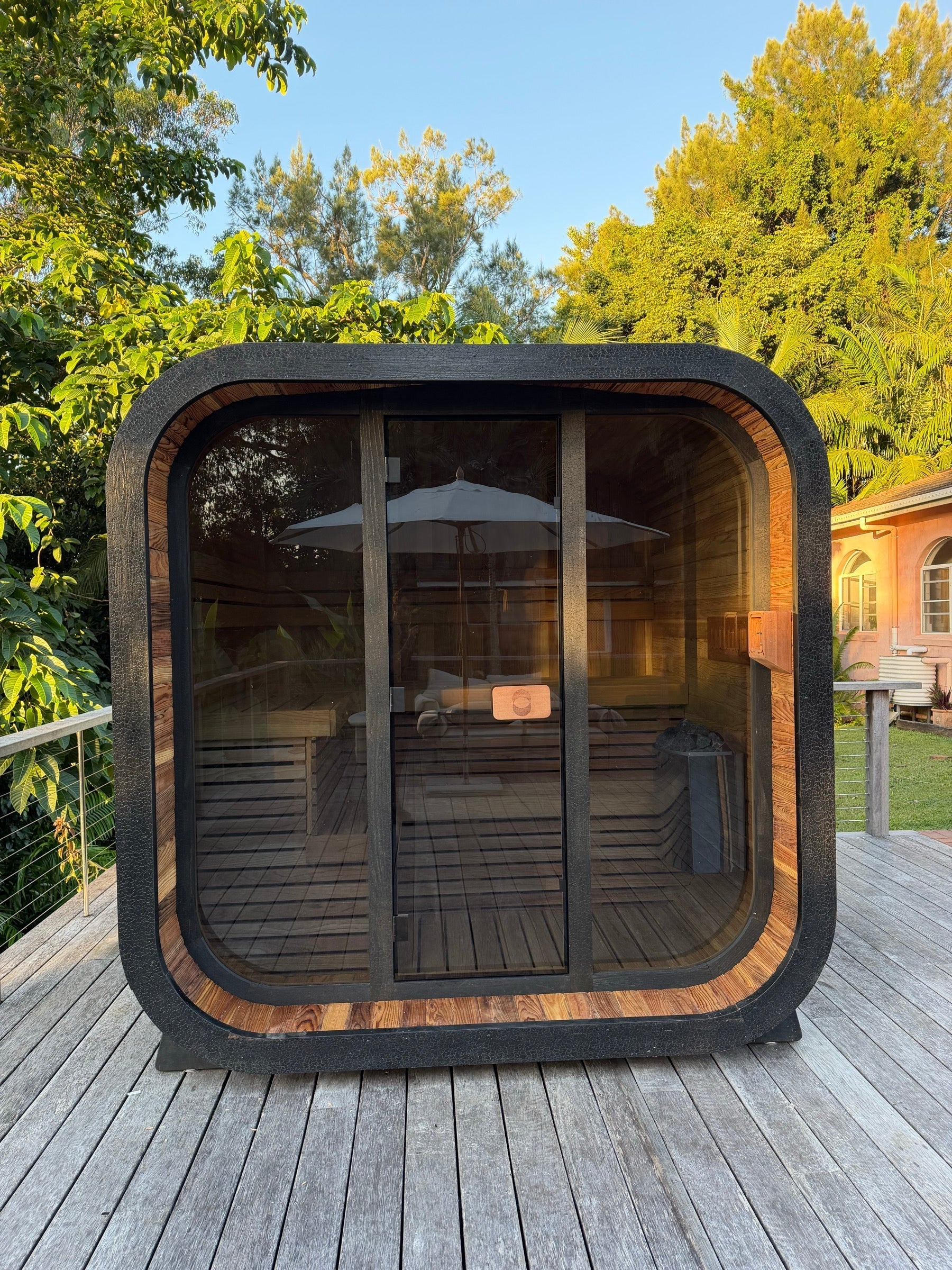
Japanese Cedar exterior. HUUM Drop 9kW heater with 60kg Olivine diabase stone capacity. Active mechanical ventilation. Zero-glue construction throughout.
SEE THE GENESIS →What Does Löyly Mean in Finnish Sauna?
Löyly is a Finnish word that refers to the steam created when water is thrown onto hot sauna stones, the enveloping heat that follows, and the overall feeling of warmth and presence in the sauna room. It has no single English equivalent. Finns use it to describe not just the steam itself, but the quality of the whole experience.
In Finnish sauna culture, löyly is the measure of a sauna worth sitting in. A room can read 90°C on the thermometer and still have terrible löyly — harsh, uneven, airless heat that drives you out after five minutes. That is not a sauna. That is a failure of engineering.
Good löyly is soft, breathable, and enveloping. You feel it on your back, your shoulders, your legs. You can throw water on the stones and deepen it. You stay longer — and staying longer is exactly where the benefits compound.
Why Good Löyly Determines Whether the Session Actually Works
Heat Distribution
Good löyly spreads heat evenly. You feel warmth across your back, your legs, your shoulders — not just on your face near the heater. Poor löyly creates hot spots at the front and cold zones in the corners, making the session uncomfortable within minutes.
Uneven heat forces you to move, adjust, cut the session short. That matters because the research on sauna cardiovascular health shows the benefits are dose-dependent — frequency and duration both drive the outcome.
Breathing Comfort
Properly generated löyly softens the air. The humidity from water hitting hot stones makes the heat feel gentler and opens your airways. You can breathe deeply at 90°C without strain.
Bad löyly burns your throat and forces you out early. That is not a minor inconvenience — it means every session falls short of the 20-minute threshold where the data says the benefits begin.
Session Duration and Health Outcomes
A 2015 study by Laukkanen et al., published in JAMA Internal Medicine, tracked 2,315 Finnish men over 20 years and found that sauna use 4–7 times per week at approximately 79°C for at least 20 minutes was associated with a 40% reduction in all-cause mortality compared to once-weekly use.
That outcome depends entirely on staying in long enough. A sauna with good löyly makes 20 minutes feel effortless. A sauna with harsh, uneven heat makes it feel like endurance. For a broader overview of what the research supports, see our evidence-based sauna benefits guide.
The Sauna That Does Not Compromise
Active mechanical ventilation. Blue-light-free amber lighting. 70–100°C operating range. IP67 rated for year-round Australian outdoor installation.
EXPLORE THE GENESIS →What Creates Real Löyly — The Four Engineering Requirements
1. Stone Mass — The Foundation of Everything
The stones are what hold and radiate heat. When water hits them, they generate steam. Too little stone mass and the löyly is weak — the stones cool immediately, the steam dissipates before it reaches you, and the humidity spike lasts seconds instead of minutes.
The Finnish standard is 6–8kg of rough-surfaced volcanic stone per cubic metre of sauna space. The stones should be Olivine diabase, peridotite, or similar — coarse-grained volcanic rock with high heat retention and maximum surface area for steam generation.
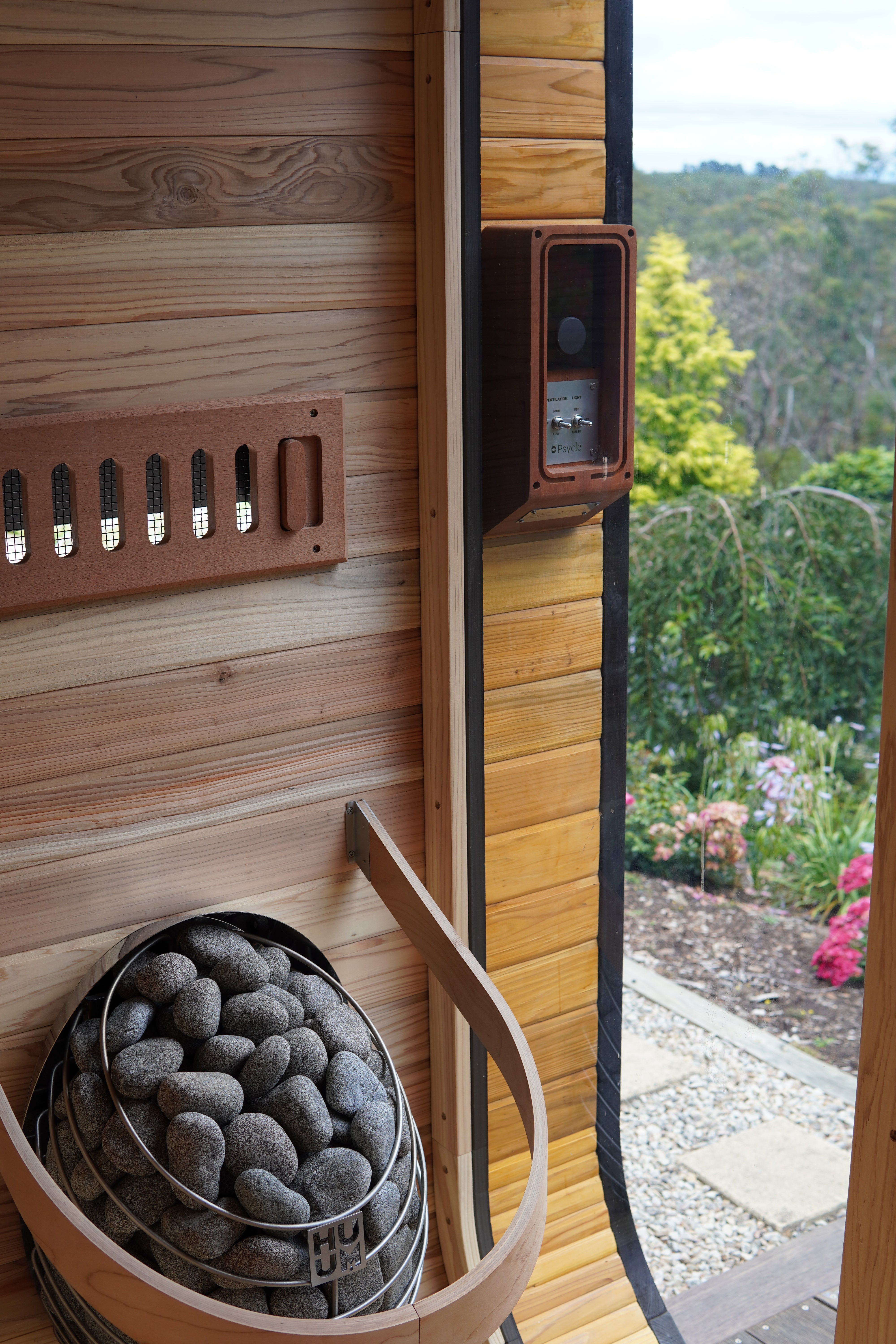
Most home electric heaters carry 20–30kg of stones total. That is insufficient for a 3–4 person sauna. The Genesis uses the HUUM Drop 9kW heater loaded with 60kg of Olivine diabase. That stone volume holds heat through repeated löyly pours without the temperature dropping.
2. Active Mechanical Ventilation — The Invisible Requirement
Most home saunas have passive ventilation or none at all. Without active airflow, CO₂ builds up within 15 minutes. You feel it as a suffocating heaviness — not the clean heat of a proper sauna, but stale, recycled air that drives you out before the session delivers anything.
Active mechanical ventilation replaces the air in the sauna 6–8 times per hour without creating cold drafts. Fresh air enters low, rises through the heat zone, and exhausts near the ceiling. The temperature stays consistent and the air stays clean.
The Genesis includes a built-in active ventilation system running at 88 m³/hr on low and 120 m³/hr on high. It is not an add-on — it is engineered into the cabin. Our full breakdown of why this matters is in our sauna ventilation guide for Australian buyers.
3. Temperature and Humidity Control
Real löyly requires a temperature range of 70–100°C and the ability to control humidity by pouring water on the stones. Too dry and the air feels harsh and abrasive. Too cool and the session lacks the intensity that drives cardiovascular response and deep sweat.
The HUUM Drop heater in the Genesis delivers precise temperature control across that full range. The WiFi-enabled UKU app lets you preheat remotely, monitor temperature, and adjust before you step in. Throw water on 60kg of Olivine diabase and the humidity response is immediate — soft, enveloping, breathable.
4. Spatial Design — Where Geometry Meets Heat
The height of the benches relative to the stones, the distance from the heater, and the ceiling height all determine how heat moves through the room. Get it wrong and the heat stratifies — your head cooks while your legs stay cool.
Benches should sit above the level of the heater stones so your body receives even heat from the floor up. The Genesis is designed with bench placement and heater positioning optimised for consistent heat distribution across the full body. That is geometry, not guesswork.
| Löyly Factor | Minimum Standard | Genesis Specification |
|---|---|---|
| Stone mass | 6–8kg per m³ of sauna volume | 60kg Olivine diabase (HUUM Drop 9kW) |
| Ventilation | 6–8 air changes per hour | Active mechanical: 88–120 m³/hr |
| Temperature range | 70–100°C with humidity control | 70–100°C, WiFi UKU app control |
| Construction | Zero off-gassing materials | 38mm Japanese Cedar, zero-glue joinery, non-VOC oil finish |
| Stone type | Rough volcanic rock | Olivine diabase — maximum surface area and heat retention |
What Kills Löyly — Why Most Home Saunas Fail
Most home saunas sold in Australia are built to a price, not a standard. The result is a product that looks like a sauna and heats like one, but cannot produce the löyly that makes the experience worth having.
Insufficient Stone Mass
A heater with 20–30kg of smooth stones cannot sustain löyly. Pour water and the stones cool immediately — the steam spike is brief, weak, and gone before it wraps around you. You are left with a humidity flash that fades in seconds.
This is not a minor shortcoming. It means you cannot manage the sauna environment — you cannot deepen or soften the heat. The session is whatever the heater gives you. That is not a Finnish sauna.
No Active Ventilation
Without forced airflow, CO₂ builds up fast in a sealed hot room. What you feel as discomfort at 15 minutes is not the heat — it is oxygen depletion. The session becomes something to endure rather than something to stay in.
Passive vents do not solve this. They rely on pressure differentials that barely exist in a sealed cabin. Active mechanical ventilation is the only real answer.
Toxic Materials That Off-Gas Under Heat
Saunas built with glued MDF panels and particle board off-gas formaldehyde when heated to 80–100°C. You are not just sweating in a hot room — you are breathing chemical vapour with every session.
That is not an edge case. It is standard construction for most home saunas sold in Australia at sub-premium price points. Zero-glue construction using solid timber is not a luxury specification. It is the minimum for a room you are going to heat to 90°C and breathe in.
The Genesis uses zero-glue mechanical joints throughout. Japanese Cedar, 38mm walls, non-VOC oil finish. No adhesives. No particle board. Nothing that reacts badly to heat. If you want to understand the full picture of what to look for and avoid, our complete home sauna buyer's guide covers every construction standard in detail.
How to Throw Löyly Correctly
Let the sauna fully preheat
Wait until the stones are at full temperature — typically 30–45 minutes after switching the heater on. Stones that are not fully saturated with heat will produce weak steam and cool quickly.
Use small amounts of water
50–100ml per pour is enough. Throwing large volumes of water floods the stones and drops the heater temperature. Small, controlled pours create a sustained steam release that builds gradually.
Pour from above the stones
Water poured directly from above disperses across the stone surface evenly. Pouring from the side concentrates the water on one area and produces uneven steam. The ladle and bucket included with the Genesis are sized for this technique.
Wait 3–5 minutes between pours
Give the stones time to recover heat before adding more water. Consecutive pours without recovery time lower stone temperature and weaken the löyly in each subsequent round.
Add eucalyptus or birch to the water
Traditional Finnish löyly uses birch whisks and birch oil in the water. In Australia, eucalyptus extract is a natural equivalent — a few drops in the ladle water before pouring opens the airways and deepens the sensory experience.
Löyly and Contrast Therapy — How They Work Together
In Finland, löyly is rarely the end of the ritual. The heat phase is followed by cold — a lake, a shower, or a plunge. That cycle of heat and cold is what drives the physiological adaptation that makes regular sauna use transformative rather than merely pleasant.
Heat elevates core temperature, drives cardiovascular response, and floods the body with heat shock proteins. Cold triggers vasoconstriction, activates the sympathetic nervous system, and spikes noradrenaline. Run both back to back and you are stacking two of the most potent non-pharmacological recovery tools in existence.
This is the logic behind the Psycle Contrast Kit — Genesis sauna and Origin cold plunge together. Heat recovers you. Cold hardens you. Together, they transform you. For a full breakdown of the science and protocols, see our contrast therapy guide for Australians. If you want to explore the cold side of the equation in depth, our complete guide to cold plunge benefits covers the research in full.
How the Genesis Is Engineered for Löyly
Psycle Wellness does not build saunas to a budget. The Genesis is engineered around the four requirements for proper Finnish löyly — and nothing in the specification is there by accident.
- HUUM Drop 9kW heater — 60kg Olivine diabase stone capacity, WiFi UKU app control, 70–100°C operating range
- Active mechanical ventilation — 88 m³/hr low, 120 m³/hr high, engineered into the cabin structure
- Zero-toxin construction — 38mm Japanese Cedar walls, zero-glue mechanical joinery, non-VOC oil finish, no particle board or MDF anywhere
- Blue-light-free lighting — Amber 585–590nm and Red 630–635nm, IP67 rated, withstands 200°C
- Optimised spatial design — bench height, heater placement, and airflow geometry engineered for even heat distribution
- IP67 outdoor rating — moisture-resistant throughout, built for Australian conditions, year-round outdoor placement
The Genesis comes with a full accessories kit: sand timer, thermometer, hygrometer, bucket and ladle, towel hooks, and three Australian wool sauna hats. Everything you need to run the protocol correctly from day one. Installation requirements, electrical specifications, and build timeline are covered in our home sauna installation guide.
If you are training hard and need to understand where sauna sits in a structured recovery protocol, our guide to sauna after workout recovery covers timing, duration, and what the research supports.
Ready to Build This Into Your Routine?
Free Australia-wide delivery. 3-year cabin warranty. 3-year heater warranty. $1,000 refundable deposit. 120-day build — order now for winter delivery.
SHOP THE GENESIS →Frequently Asked Questions
What does löyly mean in Finnish sauna?
Löyly is a Finnish word with no direct English translation. It refers to the steam generated when water is thrown onto hot sauna stones, the enveloping heat that follows, and the overall atmosphere of warmth and presence in the sauna room. In Finnish sauna culture, löyly is the measure of a sauna worth sitting in — it describes not just the steam itself, but the quality of the whole experience.
How much stone mass do you need for good löyly?
A proper Finnish sauna requires 6–8kg of rough volcanic stone per cubic metre of sauna space. The stones should be Olivine diabase, peridotite, or similar coarse-grained volcanic rock to maximise heat retention and steam generation. Most home electric heaters carry only 20–30kg of stones — insufficient for a 3–4 person sauna. The Genesis uses the HUUM Drop 9kW heater loaded with 60kg of Olivine diabase, which holds heat through repeated löyly pours without the temperature dropping.
Why does ventilation matter for löyly?
Without active ventilation, CO₂ builds up in the sauna within 15 minutes. What feels like heat discomfort is often oxygen depletion — stale, recycled air that forces you out before the session delivers its benefits. Active mechanical ventilation replaces sauna air 6–8 times per hour without creating cold drafts, keeping the air clean and breathable at full temperature. Passive vents do not achieve this. The Genesis runs active mechanical ventilation at 88–120 m³/hr, engineered into the cabin structure.
What temperature should a sauna be for löyly?
The optimal range for löyly is 70–100°C with humidity managed by pouring water on the stones. Below 70°C and the stones do not generate sufficient steam. Above 100°C and the air becomes too dry and harsh to be comfortable. The ability to throw water and control humidity is what makes the experience a Finnish sauna rather than a hot room. A 2015 study in JAMA Internal Medicine found the greatest cardiovascular benefit at sessions of approximately 79°C or above for 20 minutes or more.
Why do cheap home saunas have bad löyly?
Most budget home saunas fail at löyly for three reasons: insufficient stone mass (20–30kg instead of 60kg or more), no active ventilation (CO₂ builds fast in a sealed hot room), and materials that off-gas under heat. Glued MDF and particle board release formaldehyde when heated to 80–100°C. That is not a wellness product — it is the opposite. Real löyly requires solid timber, zero-glue construction, a properly sized stone heater, and mechanical ventilation. These are not premium features. They are the baseline.