
Home Sauna Australia: Buyer's Guide to Real Finnish Quality
Home Sauna Australia: The Complete Buyer's Guide (2026)

A home sauna Australia installation done correctly is one of the highest-return investments you can make in your health infrastructure. A traditional Finnish sauna operating at 80-100°C drives measurable cardiovascular adaptation, heat shock protein production, and sleep quality improvements that no supplement or gym membership can replicate. A 2015 study by Dr Jari Laukkanen, published in JAMA Internal Medicine and tracking 2,315 Finnish men over 20 years, found a 40% reduction in all-cause mortality among those using a traditional sauna 4-7 times per week compared to once-weekly users.
But the Australian home sauna market is polluted with flat-pack cabins built from glued MDF panels, undersized heaters that top out at 65°C, and zero ventilation systems. Most of them fail within three years. Some of them are actively harmful. This guide covers every decision you need to make - materials, heater spec, ventilation, electrical, council approval, cost, and which product is right for your space - so you walk away knowing exactly what to buy and what to refuse.
What Cheap Home Saunas in Australia Get Wrong
Before you can choose the right home sauna, you need to understand how the wrong ones fail. Most do. Not eventually - within the first three years, sometimes within 18 months.
The materials failure. The majority of budget saunas sold in Australia use MDF or particle board panels bonded with urea-formaldehyde adhesives. At room temperature, these materials look and feel fine. Heat them to 90°C - the operating temperature of a real Finnish sauna - and the glue breaks down. Formaldehyde off-gases directly into the air you're breathing. You came for recovery. You're getting chemical exposure instead.
This is not a theoretical concern. A 2019 study by researchers at the Finnish Institute of Occupational Health documented formaldehyde off-gassing rates 4-7 times higher in adhesive-bonded panel saunas compared to traditional solid-timber mechanical joinery construction. The concentration peaks during the first 15 minutes of a session - exactly when you're seated and breathing deeply.
The ventilation failure. Most flat-pack saunas have no active air exchange system. You're sealed inside a timber box with your metabolic rate elevated, CO2 rising with every breath, and no mechanical path for fresh air to enter. Within 15-20 minutes, CO2 concentration in a sealed 2m³ cabin can exceed 2,500ppm - well above the 1,000ppm threshold where cognitive performance degrades. The fatigue and lightheadedness you feel isn't the heat working. It's hypoxia.
The heater failure. The "plug and play" promise is the most common deception in the Australian sauna market. A real sauna heater for a 1.8m³ cabin requires 6kW minimum. At 240V, that's 25A draw. A 9kW heater draws 37.5A. You cannot run either through a standard 15A household circuit. Physics does not negotiate.
What suppliers do instead is drop in a 3kW or 4kW heater and claim it's "optimised for Australian conditions." Peak temperature tops out at 60-65°C. Heat recovery between sessions takes 90-120 minutes. The thermal mass is insufficient to generate löyly - the steam response from water on stones. It's a warm room, not a sauna. And by year two, that undersized heater is running at constant overdraw and failing early.
Every day you're using infrastructure like that is a day you're not actually recovering. Every session in a glued-panel cabin is a session breathing what you were trying to sweat out. That's not a small compromise. That's the opposite of what you're trying to achieve.
For a full physiological breakdown of why the sauna you use determines the outcomes you get, read our guide to sauna benefits and the research behind them.
What Real Sauna Construction Looks Like: The Genesis Standard
A real home sauna is engineered to operate at 70-100°C with active humidity control for 20+ years without structural failure, chemical off-gassing, or ventilation compromise. That requires specific decisions at every layer of construction.
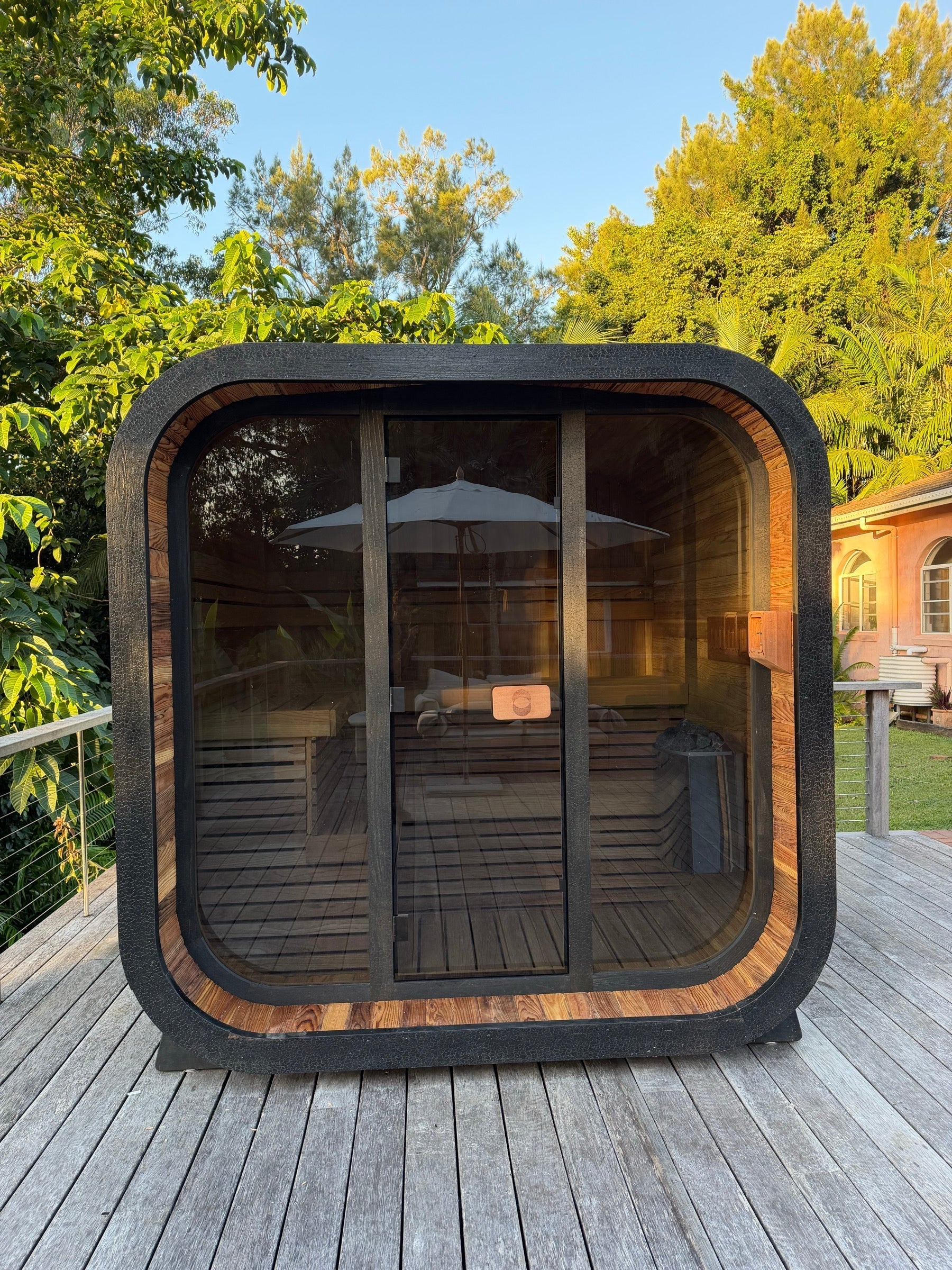
Timber species. The Genesis uses Japanese Cedar for the exterior - 38mm wall thickness, natural grain, no chemical treatment required. The interior benches are Nordic Spruce: pale, low-resin, dimensionally stable under thermal cycling. Low resin content matters because you're sitting on these benches at 90°C. High-resin timber like pine weeps sap at operating temperature. It burns skin. Nordic Spruce doesn't.
Construction method. Zero-glue mechanical joinery throughout. Tongue and groove interlocking panels. No adhesive, no bonded composites, no MDF. When you heat the cabin to 90°C, nothing breaks down and nothing off-gasses. The timber expands and contracts with the thermal cycle and returns to true. That's why Finnish saunas built in the 1960s are still standing.
Glass. 8mm safety laminated tempered glass - dual layer 4+4mm construction with grey tint. This is the same glass specification used in architectural facades. It handles the thermal differential between 90°C interior and ambient exterior without stress fracture. Budget saunas use 5mm or 6mm single-layer glass that develops micro-fractures within two to three years of thermal cycling.
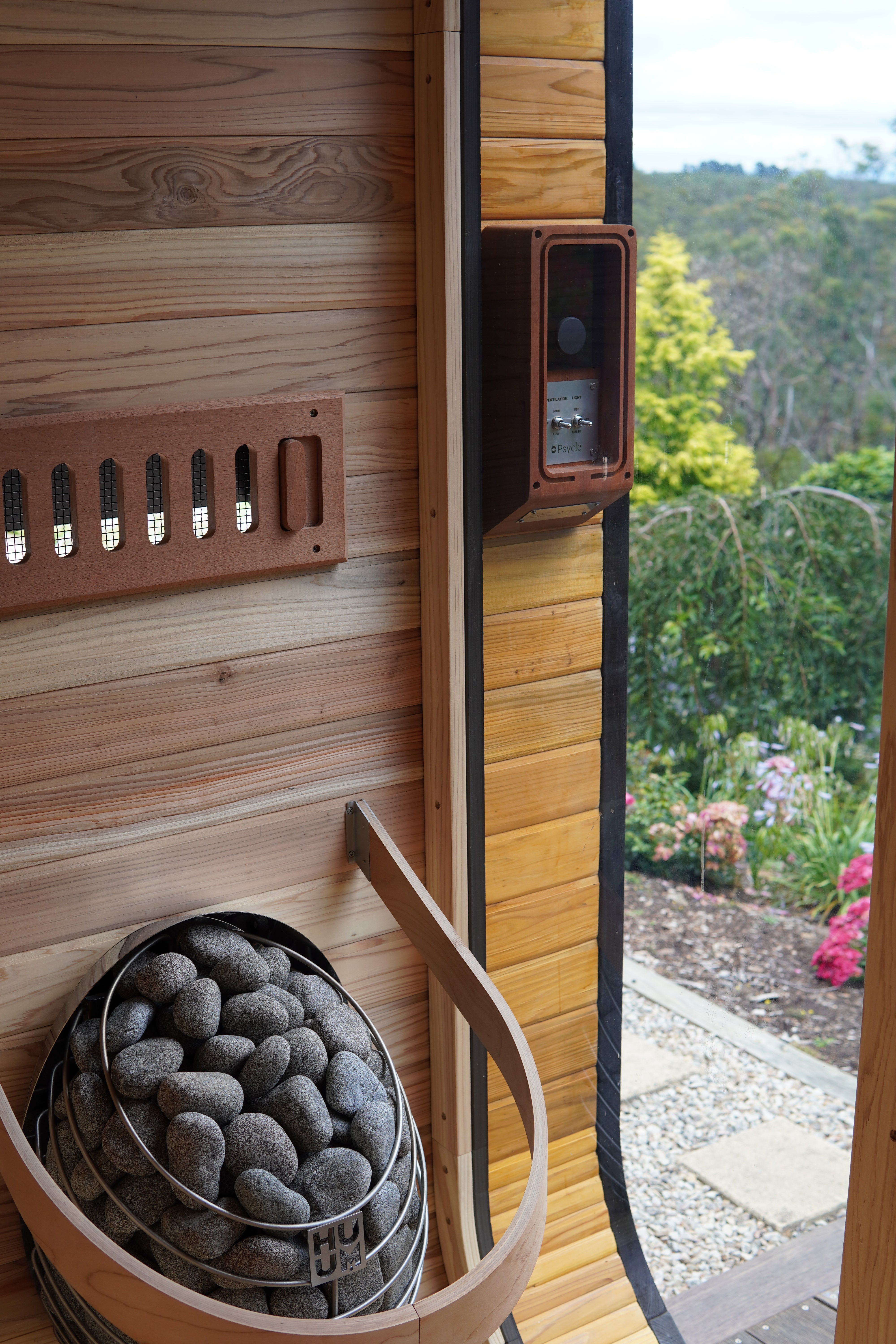
Heater. The Genesis ships with either the HUUM DROP 9kW or the Harvia Vega 9kW - both Finnish-engineered heaters at the top of the residential sauna market. The HUUM DROP carries 60kg of Olivine diabase stone and connects to the WiFi-enabled UKU app for remote pre-heat control. The Harvia Vega carries 20kg of Olivine diabase stones with precision mechanical controls. Both require a dedicated 50A circuit and heat the Genesis cabin to operating temperature in 45-60 minutes. Both have an expected service life of 15+ years under normal residential use.
Ventilation. Active mechanical system: intake fan at low position, exhaust vent at high position opposite wall, delivering 88 m³/hr on low speed and 120 m³/hr on high. That's 6-8 full air exchanges per hour during use - enough to maintain CO2 below 800ppm, keep oxygen saturation normal, and prevent mould accumulation between sessions. Not passive vents. Not gaps in the cladding. A real mechanical system designed for the cabin volume.
Lighting. Amber 585-590nm and Red 630-635nm LED, IP67 rated, certified to withstand 200°C. Blue-spectrum light suppresses melatonin production and disrupts your cortisol curve. If you're using the sauna in the evening for sleep preparation - which is one of the highest-value protocols - standard white LED lighting actively undermines the purpose. The Genesis ships with blue-light-free lighting as standard because the protocol matters.
Zero-Toxin Sauna Therapy, Built for Australians
Japanese Cedar. Zero-glue construction. HUUM Drop 9kW. 60kg Olivine diabase stone. Active ventilation at 120 m³/hr. In over 200 Australian homes.
SEE THE GENESIS ->How to Buy a Home Sauna in Australia: The Complete Buying Guide
This is the buying guide you need before you speak to any supplier. Use it to filter, to interrogate, and to know when to walk away.
The Material Checklist
Any supplier who can't answer these questions with specific materials and numbers is hiding something.
- Exterior timber species: Japanese Cedar, Canadian Western Red Cedar, or Nordic Spruce. If they say "premium hardwood" or "high-quality timber" without naming the species, ask again. If they can't name it, it's pine or treated softwood.
- Interior bench timber: Nordic Spruce, Aspen, or Abachi. Low resin content is non-negotiable. Ask specifically: "Does this timber contain resin that will weep at 90°C?" If they hedge, the answer is yes.
- Construction method: Mechanical joinery only - tongue and groove or interlocking lap joints. Zero adhesive. Zero glue. If they mention "bonded panels," "engineered timber," or "premium composites," you're looking at MDF or particle board.
- Ventilation type: Active mechanical - powered intake fan, dedicated exhaust vent, minimum 80 m³/hr capacity. "Passive vents" and "natural airflow" mean there's no real ventilation system.
- Heater brand and model: Demand the exact model number, wattage output, stone capacity in kg, and circuit amperage requirement. HUUM, Harvia, and Tylo are the Finnish benchmarks. Anything else deserves scrutiny.
- Circuit requirement: 50A dedicated circuit minimum for any cabin over 1.8m³. "Plug and play" is not a technical specification. It is a marketing phrase that conceals an underpowered heater.
- Lighting spec: Amber or red-spectrum LED, IP67 minimum, rated for 200°C. Standard white LED is a recovery compromise you should refuse.
- Warranty: 5-year cabin, 3-year heater. This is the minimum standard. Anything shorter means the manufacturer has priced in failure.
The Heater is the Engine - Treat it Like One
The single most important component in a home sauna is the heater. Not the timber. Not the glass. The heater.
A correctly specified heater reaches 80-100°C in 45-60 minutes, recovers between sessions in under an hour, and holds enough stone mass to generate genuine löyly - the steam burst from water thrown on stones that drives the temperature-humidity experience central to Finnish sauna ritual. The HUUM DROP 9kW with 60kg of Olivine diabase stone holds heat for the full session. The temperature doesn't collapse the moment you pour water. That stone mass is why.
An undersized heater - 3kW to 4kW, running off a standard circuit - peaks at 60-65°C, recovers in 2+ hours, and produces almost no steam response because there's insufficient thermal mass in the stones. You're not using a sauna. You're sitting in a warm room.
If you want to understand the full technical difference between heater types and what they mean for your session experience, read our breakdown of traditional sauna vs infrared in Australia.
Ventilation Is the Spec Nobody Checks - Until They Regret It
Ask every supplier this question: "What is the air exchange rate of your ventilation system in cubic metres per hour?" Most won't have an answer. That tells you everything.
A properly ventilated sauna maintains CO2 below 1,000ppm during a 30-minute session at full occupancy. It prevents mould accumulation between sessions. It keeps the air clean enough that your lungs are recovering alongside your muscles, not working against the environment. Read our detailed explanation of why sauna ventilation makes or breaks your experience to understand what the numbers mean in practice.
Genesis vs Genesis Mini: Which Home Sauna Is Right for You
Before you decide, consider the market context. Custom European sauna installations built by Finnish craftspeople and imported to Australia cost $40,000-$120,000 and up. Commercial-grade infrared units from premium US brands sit at $15,000-$30,000. That's the standard the Genesis was engineered to meet - and the price reflects that standard, not a compromise below it.
Within the Psycle range, the decision is between two models.
| Spec | Genesis | Genesis Mini | Generic Barrel / Flat-Pack |
|---|---|---|---|
| Capacity | 3-5 persons | 1-3 persons | 2-4 persons (claimed) |
| Timber | Japanese Cedar + Nordic Spruce benches | Japanese Cedar + Nordic Spruce benches | Pine, spruce, or unlisted "hardwood" |
| Wall thickness | 38mm solid timber | 38mm solid timber | 28mm or less, often composite |
| Construction | Zero-glue mechanical joinery | Zero-glue mechanical joinery | Adhesive-bonded panels |
| Heater | HUUM DROP 9kW or Harvia Vega 9kW | HUUM DROP 6kW or Harvia Vega 6kW | 3-4kW, no-name brand |
| Stone mass | 60kg Olivine diabase (HUUM) / 20kg (Harvia) | 60kg Olivine diabase (HUUM) / 20kg (Harvia) | 3-8kg typically |
| Ventilation | Active: 88/120 m³/hr | Active: 88/120 m³/hr | Passive vents or none |
| Glass | 8mm safety laminated (4+4mm, grey tint) | 8mm safety laminated (4+4mm, grey tint) | 5-6mm single layer |
| Lighting | Amber/Red 585-635nm, IP67, 200°C rated | Amber/Red 585-635nm, IP67, 200°C rated | Standard white LED |
| Circuit required | 50A dedicated | 32A dedicated | "15A plug and play" (underpowered) |
| Warranty | 5yr cabin / 3yr heater | 5yr cabin / 3yr heater | 1-2yr typically |
| Delivery | Free Australia-wide | Free Australia-wide | Variable, often extra |
Genesis Mini is the right choice for apartments, courtyard spaces, and households of 1-2 regular users. It runs on a 32A dedicated circuit - slightly easier to install than the Genesis's 50A requirement. The same zero-toxin construction standard, identical glass and lighting spec, just a smaller footprint: 2267H x 1571W x 1950D mm.
Genesis is the choice if you have the outdoor space. The 3-5 person capacity means it grows with the household - whether that's a partner who starts using it regularly, adult kids, or guests. A sauna of this quality holds its value as a lifestyle asset and typically increases property appeal. The 50A circuit is a real installation requirement, but it's a one-time cost on a 20+ year asset. Over a 10-year period, the Genesis costs less per day than a weekly visit to a commercial sauna - and it's available at 5am, after training, or whenever you actually need it.
The people who buy a Genesis have already decided they're done settling. The Mini makes sense for the constraints it's designed for. The Genesis makes sense for everyone else.
Sauna Installation in Australia: Electrical, Council, and Site Requirements
A home sauna Australia installation is infrastructure. Plan it before you order, not after.
Electrical Requirements
The Genesis requires a dedicated 50A circuit from your main switchboard - single phase or three phase. This is not a DIY task. It requires a licensed electrician working to AS/NZS 3000 wiring standards. Budget $1,500-$3,000 for the electrical installation depending on the distance from the switchboard and whether any trenching is required for underground conduit.
If the sauna site is more than 10 metres from the switchboard, the cable cross-section increases with run length. A 50A circuit over 20 metres requires 10mm² cable minimum. Your electrician will calculate the correct gauge. Don't skip this - undersized cable causes voltage drop, which reduces heater output and shortens heater lifespan.
The Genesis Mini requires a dedicated 32A circuit. The installation process is the same - licensed electrician, dedicated circuit, proper cable gauge - just at a lower amperage.
Site Preparation
The sauna must sit on a level, stable, permeable surface. Concrete pad is ideal. Compacted aggregate over landscape fabric works. Timber decking is acceptable if the frame is structurally reinforced and ventilated underneath to prevent moisture accumulation.
Minimum 300mm clearance on all sides for airflow and maintenance access. Ensure the site has drainage - either a natural slope away from the cabin or a French drain if the area is flat. Water from cleaning, condensation, and splash from the löyly ritual must drain away from the timber base.
If you're placing the Genesis in a fully exposed outdoor position with no roof cover - on a terrace or in an open garden - consider the optional Colorbond roof kit. It's engineered for the Genesis's external dimensions and rated for Australian weather conditions year-round.
Council Approval
Most Australian councils classify an outdoor sauna under 10m² as exempt development provided it is more than 900mm from any property boundary and under 3m in height. The Genesis has a maximum height of 2,289mm - well under the 3m threshold in most council guidelines.
However, some councils require a building permit for any structure with a permanent electrical connection above 15A. Check with your local council before ordering. The confirmation takes 2-3 days and prevents a costly rework later.
Delivery and Access
The Genesis ships as modular panels with a combined shipping weight of approximately 600kg. Delivery is free Australia-wide. The installation crew assembles on site. The external frame dimensions are 2289H x 2288W x 1945D mm - ensure your driveway, side access gate, and installation site all allow clearance for the delivery vehicle and installation team.
What Does a Home Sauna Cost in Australia? Real Numbers
Let's start where the market actually starts. Custom-built traditional saunas designed and installed by European craftspeople in Australian homes cost $40,000-$120,000. Premium commercial-grade infrared units from US brands sit at $15,000-$30,000. That's the genuine market ceiling for people who take this seriously.
Below that, the market fragments into quality tiers.
- $3,000-$6,000: Flat-pack infrared or glued-panel traditional saunas. Underpowered heaters, no active ventilation, typically using pine or treated softwood. Most fail within 2-3 years. The cheapest sauna is the one you replace twice.
- $6,000-$12,000: Mid-range traditional saunas. Better timber species, slightly better heaters, but often still using adhesive joinery and passive ventilation. Performance is inconsistent. Warrantees are short.
- $12,000-$20,000: Premium traditional saunas built to real Finnish engineering standards. This is where the Genesis sits. Solid timber, mechanical joinery, Finnish heaters, active ventilation, and long warranties.
- $40,000+: Custom installations. Bespoke design, permanent structure, architect-specified materials. The engineering standard is equivalent to the Genesis; the price reflects customisation and site labour.
Reframe the price. The Genesis, over a 10-year ownership period, costs less per day than a single weekly commercial sauna session. At $50-80 per session at a commercial facility - assuming it's even available at the time you want it, which it often isn't at 5am or post-training - a weekly habit costs $2,600-$4,160 per year. Over 10 years, that's $26,000-$41,600 in commercial sauna access alone. Compare that to one purchase, in your home, available on your schedule, with zero-toxin construction you control.
Add the cost of alternatives: sports massage at $120-150 per session. Gym recovery memberships at $80-150 per month. Cold plunge memberships. The cumulative ongoing spend on recovery infrastructure you don't own compounds every year. A one-time investment in genuine home sauna infrastructure eliminates that entirely.
The deposit to hold your Genesis build position is $1,000 AUD, fully refundable. The 120-day build lead time means production begins after you've had time to inspect the spec, confirm your site, and complete your electrical installation. You're not locked in until you're ready.
For a full cost breakdown including electrical, site preparation, and a comparison of ongoing vs upfront costs, read our detailed guide to what home saunas cost in Australia.
The Sauna That Doesn't Compromise
Over 200 Australian homes. 3-year cabin warranty - the longest in the market. $1,000 refundable deposit. Free Australia-wide delivery. 120-day build.
EXPLORE THE GENESIS ->What Australian Genesis Owners Actually Experience
Social proof means nothing without specifics. Here's what 90-day consistent use looks like in real terms from Australian customers.
One customer - a 42-year-old GP from Brisbane training for an Ironman - reported HRV up 12% and resting heart rate down 6bpm after 90 days of daily post-training sauna sessions. His protocol: 20 minutes at 85°C within 90 minutes of training. No supplements changed. No training volume changed. Just daily heat.
Another customer, a 38-year-old construction manager from Melbourne, bought the Genesis for sleep. Chronic sleep onset latency - taking 45-60 minutes to fall asleep most nights. After 60 days of evening sessions at 80°C finishing 90 minutes before bed, sleep onset was averaging 12 minutes. His words: "I just wanted something that actually worked. This works."
A third - a 35-year-old physiotherapist from Byron Bay - had tried two previous flat-pack saunas over five years, both of which failed and one of which started smelling of adhesive after 18 months of heating. "I wanted zero compromise. I wanted something I could put my name on when patients ask me about home recovery." She's been running the Genesis for two years with no maintenance issues and no off-gassing.
These aren't exceptions. Over 200 Australian households are running the Genesis right now. The pattern is consistent: people who train hard, who've tried the alternatives, who care about what they're breathing - they buy it once and they don't look back.
Home Sauna vs Commercial Sauna Membership in Australia
If you're using a commercial sauna regularly - a gym facility, a day spa, a wellness studio - you already know the friction. Session availability is dictated by opening hours, not your training schedule. Hygiene is shared. The heat quality varies. The air quality is often poor in high-traffic shared spaces. You drive there, you wait, you drive back.
What's the actual cost of that? At $50-80 per session for a quality commercial sauna in Sydney, Melbourne, or Brisbane, four sessions a month costs $200-$320. That's $2,400-$3,840 per year in sessions alone, before the time cost of travel. Over five years: $12,000-$19,200 in recovery infrastructure you don't own and can't access at 5:30am.
A home sauna eliminates the friction entirely. Your protocol happens when your body needs it - post-training at 8pm, early morning before work, whenever recovery matters. No travel. No shared space. No booking window. The constraint on your protocol is your discipline, not an external schedule.
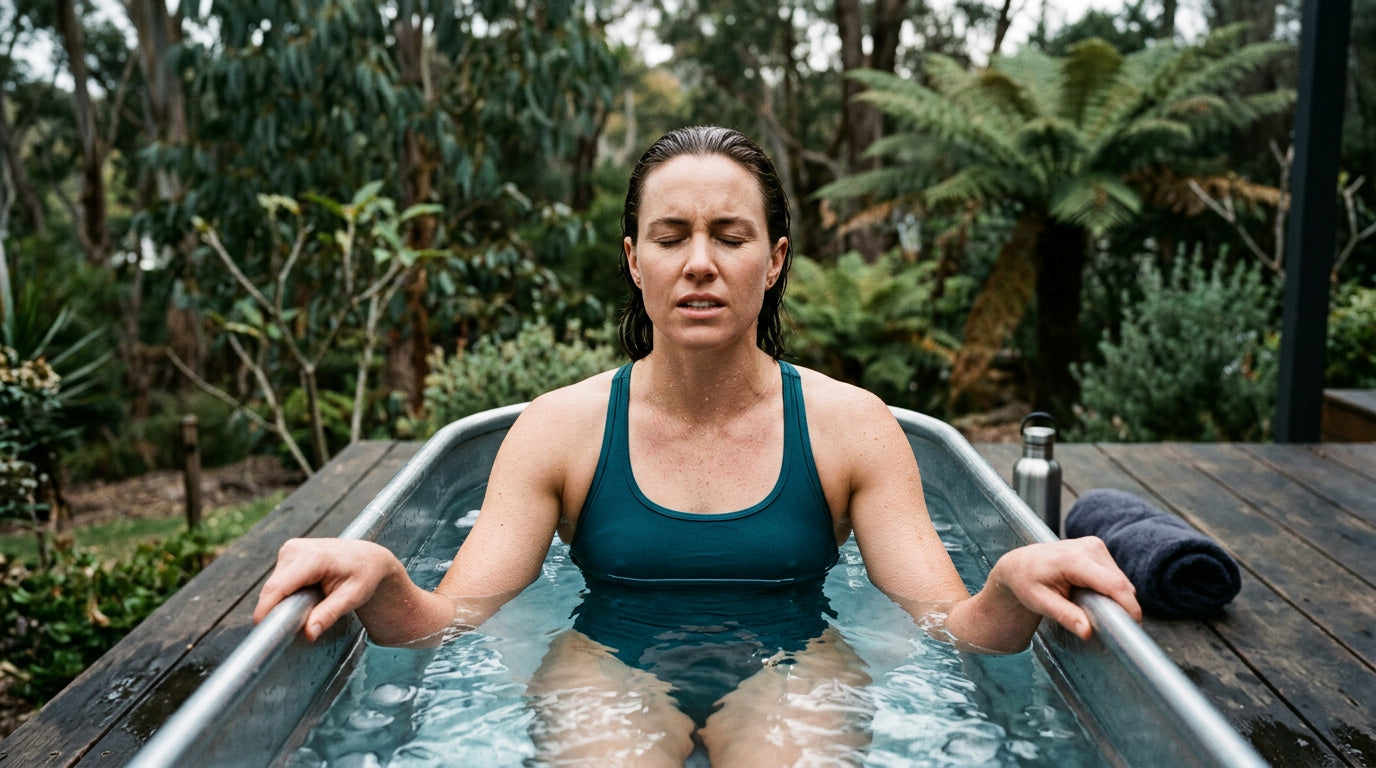
The Psycle contrast protocol - Genesis sauna at 85-95°C alternated with the Origin cold plunge at 8-12°C - is available in your backyard, any time, any day. That's not a luxury. That's a performance system.
Building Your Home Sauna Protocol
A sauna in your home is only as valuable as the protocol you run in it. Here are the three most common frameworks Psycle customers use.
Post-Training Recovery
15-20 minutes at 80-90°C within 2 hours of training. Heat accelerates metabolic waste clearance, reduces delayed-onset muscle soreness, and triggers heat shock protein production. Most common protocol among athletes and tradespeople. Pre-heat before your session ends - the HUUM UKU app handles this remotely.
Evening Wind-Down
20-30 minutes at 75-85°C, finishing 60-90 minutes before bed. The body temperature spike followed by rapid cool-down post-session aligns with the natural circadian temperature drop that precedes sleep. Run the amber 585nm lighting only during the session - no blue spectrum to protect melatonin production. Most effective protocol for sleep quality improvement.
Contrast Therapy
3-4 rounds alternating 10-15 minutes sauna at 85-95°C with 2-3 minutes cold plunge at 8-12°C. End on cold. Maximum cardiovascular load, maximum norepinephrine response, maximum mental fortitude demand. The Genesis and Origin together form the Contrast Kit - the protocol most associated with sustained HRV improvement in regular users.
Sauna-Only Stress Inoculation
30-45 minutes at 85-100°C with structured breathing. No protocol. No phone. Heat and deliberate discomfort tolerance. Used by high performers as a mental discipline tool as much as a physiological one. Not appropriate for beginners - acclimatise with shorter sessions before extending duration.
Session duration, temperature selection, and frequency targets vary significantly based on training load, heat adaptation, and individual health status. If you want the research-backed protocol guide, read our detailed breakdown of sauna session duration and protocols for Australians.
Frequently Asked Questions About Home Saunas in Australia
Do I need council approval for a home sauna in Australia?
Most Australian councils classify a sauna under 10m² as exempt development if it is more than 900mm from the property boundary and under 3m in height. The Genesis sits at 2289mm height - within most council thresholds. However, some councils require a building permit for any permanently wired structure with an electrical connection above 15A. Contact your local council before ordering to confirm. The check takes 2-3 days and eliminates compliance risk entirely.
What electrical circuit does a home sauna need in Australia?
A full-size home sauna running a 9kW heater requires a dedicated 50A circuit - single phase or three phase - installed by a licensed electrician to AS/NZS 3000 standards. The circuit must be on its own breaker and cannot be shared with any other appliance. Budget $1,500-$3,000 for the electrical installation depending on switchboard distance and site access. The Genesis Mini runs on a dedicated 32A circuit.
How long does a home sauna last in the Australian climate?
A traditional sauna built with solid-timber mechanical joinery, active ventilation, and proper drainage lasts 20-30 years in Australian conditions. UV exposure, coastal humidity, and thermal cycling are not a problem for Japanese Cedar or Nordic Spruce when properly specified and finished with non-VOC oil. Flat-pack saunas built with glued-panel construction typically degrade within 3-5 years due to adhesive breakdown, UV exposure, and moisture infiltration at panel joints.
What's the difference between a traditional sauna and an infrared sauna?
Traditional saunas heat the air to 70-100°C using a rock-filled heater. Infrared saunas heat the skin directly using radiant panels and operate at 50-65°C. The physiological difference is meaningful: traditional Finnish saunas at 80-100°C drive deeper cardiovascular adaptation, higher core temperature, and greater heat shock protein response than infrared at lower temperatures. Traditional saunas also allow löyly - water-on-stones humidity control - which is central to the Finnish ritual. Infrared units are simpler to build and draw less power, but they don't deliver equivalent physiological stimulus. Read the full comparison: traditional sauna vs infrared in Australia.
How much does it cost to run a home sauna in Australia?
A 9kW heater running a 45-minute heat-up followed by a 30-minute session draws approximately 6-7.5kWh per session. At the current average Australian residential electricity rate of $0.30-$0.40/kWh, each session costs $1.80-$3.00. Four sessions per week costs $7-$12 per week - $365-$625 per year. Against $50-80 per commercial sauna session, the economics are not close.
Can I install a home sauna indoors in Australia?
Yes, but the requirements are more complex. Indoor installation requires mechanical ventilation ducted to the outside, moisture-rated flooring (sealed concrete or tile - never timber subfloor without waterproof membrane), dedicated electrical circuit, and minimum ceiling height of 2.4m. Most Australian customers install outdoors for practicality and space. Indoor installation adds cost and lead time for the ventilation ducting work.
Can I move the Genesis if I sell my house?
The Genesis is modular and can be disassembled and relocated. Budget $3,000-$5,000 for professional disassembly, transport, and reinstallation depending on distance and site access. Most customers treat the Genesis as a permanent feature of the property - it increases buyer appeal and often becomes a selling point in the listing. We'd recommend discussing relocation with the buyer before disassembly; many prefer it stays.
The Decision You're Actually Making
You've seen the failure modes. You've seen the spec. You've seen the cost comparison. The question isn't whether a real home sauna is worth it - the research is unambiguous and the economics are straightforward. The question is whether you're ready to stop building your recovery on infrastructure you don't control.
Every week at a commercial facility is a week paying for access to a space you can't use at 5am, you can't trust is maintained properly, and you share with strangers. Every session in a flat-pack cabin is a session breathing formaldehyde off-gassing from adhesive-bonded panels heated to 90°C. Neither of those is a recovery tool. Both of them are compromises.
High performers don't buy saunas. They adopt recovery standards. The Genesis is what that standard looks like in practice: Japanese Cedar, zero-glue joinery, HUUM DROP 9kW with 60kg of Olivine diabase stone, active mechanical ventilation at 120 m³/hr, blue-light-free IP67 lighting, 8mm safety laminated glass, 38mm walls, and the only warranty in the Australian market that stands behind real Finnish construction - five years on the cabin, three on the heater.
The $1,000 deposit is refundable. The 120-day build time means you have time to complete your electrical installation, confirm your site, and inspect the spec in full before production locks in. We'd rather you take six months to decide than spend $15,000 on something you regret in twenty minutes.
If you want the real thing - built correctly, warranted properly, delivered free anywhere in Australia - it's here.
Done Settling for Less
Free Australia-wide delivery. $1,000 refundable deposit. 3-year cabin warranty. 3-year heater warranty. 120-day build - order now for delivery this winter.
SHOP THE GENESIS ->