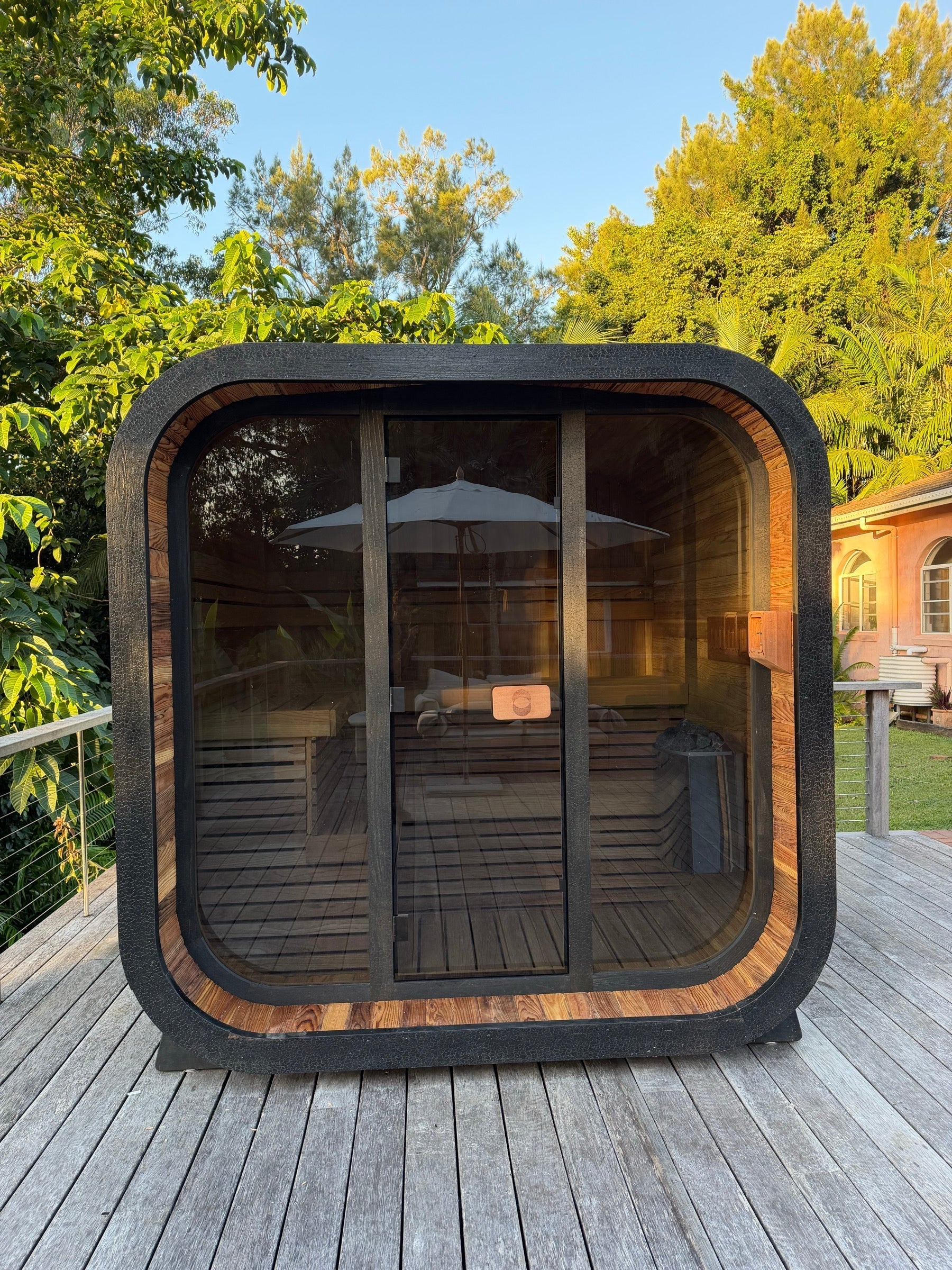


Are saunas good for your skin? Yes — when used correctly, regular sauna sessions improve circulation, clear pores, support collagen production, and accelerate the removal of dead skin cells. A 2015 study by Häkkinen et al. in the European Journal of Preventive Cardiology confirmed that habitual sauna bathing produces measurable cardiovascular and circulatory benefits — and the skin, as the body's largest organ, is directly upstream of those effects.
That said, not all saunas deliver equally. The temperature, construction materials, and air quality inside your sauna determine whether you're getting genuine skin benefits or sitting in a box that off-gasses formaldehyde at 90°C. The difference is not cosmetic. It's the difference between a wellness protocol and a health hazard.
Zero-Toxin Sauna Therapy, Built for Australians
Japanese Cedar exterior. Zero-glue construction. HUUM Drop heater. Engineered for the sessions that actually move the needle.
SEE THE GENESIS →How Sauna Heat Affects Your Skin
When you enter a traditional Finnish sauna at 80–100°C, your core temperature rises and your body responds immediately. Blood vessels dilate. Circulation increases to the skin's surface. Sweat glands activate. Within minutes, you're producing significant volumes of sweat — and everything that comes with it.
The skin benefits from this process through three distinct mechanisms: improved circulation delivering oxygen and nutrients to skin cells, sweat-driven clearance of pore-blocking debris, and the thermal stimulus to dermal repair processes including collagen synthesis. These are not theoretical benefits. They are the physiological consequence of sustained heat exposure done consistently over time.
Does Sweating in a Sauna Clean Your Skin?
Most home saunas are built with glued MDF panels and particle board. Heat that to 90°C and you are not just sweating — you are breathing in formaldehyde off-gassing from the adhesives with every single session. That is not a skin benefit. That is an active chemical exposure.
In a zero-toxin sauna built with zero-glue mechanical joints and real timber, the story is different. At temperature, your pores dilate and sweat volume increases sharply. This mechanical flushing action clears sebum, dead skin cells, and environmental debris that accumulate in follicles. Research by Vaskilampi (1988) in the European Journal of Applied Physiology confirmed that the temperature and humidity dynamics of traditional sauna environments produce measurable effects on the skin's surface. The result: clearer pores, improved texture, and skin that simply looks and feels better with consistent use.
The key word is consistent. One session produces temporary results. A weekly protocol — three to four sessions — produces structural change. For a full breakdown of frequency recommendations, see our guide to how often you should use a sauna.
Can Saunas Help with Acne?
Heat dilates blood vessels and drives circulation to the skin's surface. In the short term, this can reduce the appearance of inflammation and give the skin a clearer, more oxygenated look. For some people with acne-prone skin, the pore-clearing effect of heavy sweating also removes the debris that triggers breakouts.
The honest answer: saunas are not an acne treatment. They are a skin maintenance tool. The improvement you see after a session is real — but it requires repetition to hold. And critically, the post-session protocol matters. Rinse with cool water immediately after leaving the sauna to remove sweat and impurities before they re-enter the pores. Skipping this step can reverse the benefit entirely.
If stress is a contributor to your breakouts — and for high performers, it often is — sauna's well-documented cortisol-reducing effect is worth factoring in. Lower cortisol means less stress-driven sebum production. That is a real, if indirect, mechanism for better skin.
Do Saunas Reduce Wrinkles and Support Anti-Ageing?
This is where the science gets specific. Collagen is the structural protein responsible for skin firmness and elasticity. Production naturally declines from your mid-20s onward. Thermal therapy — specifically, the repeated heat stress delivered in a traditional sauna — has been shown to stimulate fibroblast activity, the cellular process responsible for producing new collagen.
Vollmer and West (2011) in the Texas Heart Institute Journal demonstrated that repeated thermal therapy produces cumulative, long-term improvement in endothelial function — the same vascular system that feeds nutrients and oxygen to your skin cells. Improved endothelial function means more efficient nutrient delivery. More efficient nutrient delivery means better skin maintenance over time.
This is not an overnight fix. It is a compounding return on a consistent protocol. Which is exactly why the infrastructure you use matters — a sauna you use four times a week for a decade delivers a fundamentally different return than one you use twice a month at a commercial facility.
The Sauna That Does Not Compromise
Active mechanical ventilation. Blue light blocking lighting. IPX4 rated. Zero-glue Japanese Cedar construction — engineered for daily use, for decades.
EXPLORE THE GENESIS →Are Saunas Safe for Eczema and Psoriasis?
Both conditions involve compromised skin barrier function and chronic inflammation. Sauna's effect here is conditional — it can help, but only with care.
The high humidity produced by pouring water over a properly loaded heater can temporarily hydrate and soothe irritated skin. For some people with eczema and psoriasis, consistent moderate heat exposure reduces inflammatory markers and provides relief between flare-ups. For others, high heat exacerbates symptoms.
The protocol adjustment for sensitive skin conditions: lower temperatures (70–80°C rather than 90°C), shorter sessions (10–12 minutes), and immediate moisturisation post-rinse. If you have an active flare, skip the session. If you are in remission and looking for a maintenance protocol, sauna can be a useful tool — but consult your dermatologist before establishing a routine.
The construction of your sauna also matters here. Chemically treated timber, synthetic linings, and adhesive-based construction release volatile compounds at high temperatures. For someone with reactive skin, that exposure is counterproductive. Zero-toxin construction is not a marketing label — it is a meaningful differentiator for anyone using sauna for genuine health outcomes.
The Sauna Protocol That Maximises Skin Benefit
Hydrate Before You Enter
Drink 500ml of water in the 30 minutes before your session. Sauna-induced sweat loss is significant — dehydration compromises every skin benefit you are trying to achieve.
Session Duration: 15–20 Minutes
At 80–100°C, 15–20 minutes is the evidence-supported window for circulatory and sweat-based skin benefits. Longer sessions without acclimatisation increase heat stress without proportional benefit.
Use Löyly Mid-Session
Pouring water over the stones raises humidity and intensifies the skin response. The steam opens pores and deepens the sweat response. For more on this technique, read our guide to löyly and why it matters.
Cool Rinse Immediately After
A cool shower closes the pores and removes sweat, dissolved sebum, and surface debris before they re-deposit. Skip this step and you partially undo the pore-clearing work of the session.
Moisturise While Skin Is Still Warm
Post-sauna skin is primed for absorption. Apply your moisturiser within five minutes of your cool rinse while your skin is still slightly warm — uptake is significantly higher in this window.
Repeat 3–4 Times Per Week
Skin benefit from sauna is cumulative, not acute. Three to four sessions per week over 8–12 weeks is where measurable improvements in texture, tone, and clarity become consistent.
Traditional Sauna vs Infrared for Skin Health
Infrared saunas operate at 50–70°C and heat the body directly via light waves rather than heating the air. Traditional Finnish saunas operate at 80–100°C and heat the air, with the option to add humidity through löyly.
| Factor | Traditional Sauna | Infrared Sauna |
|---|---|---|
| Operating temperature | 80–100°C | 50–70°C |
| Sweat volume | High — full-body thermal response | Moderate — lower ambient heat |
| Humidity control | Yes — löyly adjustable | No — dry heat only |
| Pore-clearing efficacy | High — heat + humidity combination | Moderate — heat only |
| Research depth | Decades of Finnish population data | Limited, shorter-term studies |
| Construction toxin risk | Variable — depends on materials | Variable — depends on materials |
For skin health specifically, the traditional sauna's higher temperature and humidity control through löyly make it the stronger tool. The ability to adjust steam intensity mid-session is a real advantage that infrared cannot replicate. For a full comparison of both modalities, see our breakdown of traditional sauna vs infrared.
Why the Sauna You Use Changes the Outcome
If you are taking sauna seriously enough to build a skin and recovery protocol around it, the quality of your infrastructure is not a secondary consideration. It is the primary variable.
A sauna built with chemically treated timber, synthetic adhesives, and inadequate ventilation produces a fundamentally different environment to one built with zero-glue mechanical joints, real Japanese Cedar, and active mechanical ventilation. At 90°C, those material choices determine what you are breathing. For your skin — and your lungs — that difference is not negligible.
The Psycle Genesis is built to a zero-toxin standard throughout. Japanese Cedar exterior. Nordic Spruce benches. HUUM Drop 9kW heater with 60kg of volcanic stone for stable, sustained heat. Zero-glue construction — every joint is mechanical. Active mechanical ventilation pulls clean air in and stale air out. IPX4 rated for Australian outdoor installation, year-round.
This is not a feature list for its own sake. These are the conditions that make the skin benefits described in this article actually achievable — session after session, for decades. If you are considering a home sauna and want to understand what real construction looks like, start with our complete home sauna buyer's guide for Australia.
And if you want to understand the full scope of what consistent sauna use delivers beyond skin health, the evidence base is substantial. Our guide to sauna benefits in Australia covers the cardiovascular, hormonal, and recovery research in full.
Frequently Asked Questions
Are saunas good for your skin?
Yes. Regular sauna use improves skin circulation, clears pores through sweat-driven flushing, and stimulates collagen-producing fibroblast activity. The effect is cumulative — consistent use over weeks and months produces visible improvements in texture, tone, and clarity. Single sessions provide temporary benefit; a weekly protocol of three to four sessions produces lasting change.
Can sauna cause skin damage?
Sauna can cause skin irritation or exacerbate certain conditions if misused. Prolonged sessions without adequate hydration dry out the skin rather than benefiting it. Very high temperatures can temporarily worsen eczema or psoriasis flares. The post-session protocol — cool rinse, moisturiser — is as important as the session itself. For people with reactive or condition-prone skin, starting with lower temperatures (70–80°C) and shorter sessions (10–12 minutes) reduces risk.
How often should you use a sauna for skin benefits?
Three to four sessions per week is the evidence-supported frequency for cumulative skin benefit. This aligns with the frequency documented in Finnish population studies showing measurable improvements in cardiovascular and skin health markers. For a full frequency guide across different health goals, see our article on how often you should use a sauna.
Does sauna help with acne?
Sauna can temporarily improve the appearance of acne-prone skin by dilating blood vessels, increasing surface circulation, and mechanically flushing pores through sweat. It is not a standalone acne treatment, but as part of a consistent skin care routine — with a proper post-session rinse — it can reduce the frequency and severity of breakouts for some people. Stress-related acne may also respond to sauna's cortisol-reducing effect over time.
Is sauna good for anti-ageing?
Regular sauna use supports two mechanisms relevant to skin ageing: improved circulatory delivery of oxygen and nutrients to skin cells, and thermal stimulation of fibroblast activity — the process responsible for collagen synthesis. Research by Vollmer and West (2011) in the Texas Heart Institute Journal confirmed cumulative endothelial improvements from repeated thermal therapy, directly relevant to skin health and appearance over time.
Does the sauna material affect skin benefit?
Yes — significantly. Saunas built with adhesive-bonded MDF or particle board off-gas formaldehyde and volatile organic compounds at high temperatures. Inhaling those compounds in a confined space at 90°C is a direct health exposure. Zero-toxin construction — zero-glue mechanical joints, real timber throughout — produces a clean thermal environment where the physiological benefits described in this article are actually achievable.
Ready to Build This Into Your Routine?
Free Australia-wide delivery. 3-year cabin warranty. 120-day build — order now to lock in your delivery window. $1,000 refundable deposit to start.
SHOP THE GENESIS →References
- Häkkinen, A., Rinne, M., Vasankari, T., Santtila, M., & Häkkinen, K. (2015). Associations of habitual sauna bathing with cardiovascular disease risk factors. European Journal of Preventive Cardiology, 22(5), 610–617.
- Vaskilampi, T. (1988). Humidity and temperature in sauna bath. European Journal of Applied Physiology and Occupational Physiology, 57(5), 563–566.
- Vollmer, D. L., & West, V. A. (2011). Repeated thermal therapy produces cumulative long-term improvement of endothelial function in patients with coronary risk factors. Texas Heart Institute Journal, 38(5), 261–265.
- Crinnion, W. J. (2007). Sauna as a valuable clinical tool for cardiovascular, autoimmune, toxicant-induced and other chronic health problems. Alternative Medicine Review, 12(1), 84–96.