
Sauna for Weight Loss Australia: Science-Backed Guide
Sauna for Weight Loss Australia: What the Science Actually Shows

Key Takeaways
- A single sauna session burns approximately 150–200 calories for a 75kg person at 90°C over 20 minutes — not meaningful fat loss on its own
- Two 20-minute sessions at 80°C produced a 16-fold increase in growth hormone, which directly supports fat mobilisation and muscle preservation (Leppäluoto et al., 1986)
- Traditional saunas at 80–100°C produce significantly stronger physiological responses than infrared units at 50–60°C — including greater core temperature rise and heat shock protein activation
- Heart rate in a traditional sauna reaches 100–150 BPM — a cardiovascular response comparable to moderate-intensity aerobic exercise (Laukkanen et al., 2018)
- Resting metabolic rate stays elevated for 30–60 minutes post-session — compounding effects require 3–4 sessions per week sustained over roughly 90 days
- Heat shock proteins activated by high ambient temperatures preserve lean muscle mass during a caloric deficit — the factor separating body composition improvement from simple scale weight loss
Sauna for weight loss in Australia is not a gimmick — but it is widely misunderstood. The immediate weight you lose after a session is water, not fat. That part is honest. What the research also shows, however, is that consistent, high-heat sauna use creates measurable metabolic, hormonal, and cardiovascular adaptations that support fat loss over time. Done correctly, it is a legitimate tool in a serious body composition strategy.
A 2019 review published in Evidence-Based Complementary and Alternative Medicine confirmed that repeated sauna bathing elevates resting metabolic rate, activates heat shock proteins (HSPs) that preserve lean muscle mass, and produces cardiovascular responses comparable to moderate aerobic exercise. This is not about the sweat. It is about what the heat does to your body's systems over time.
Zero-Toxin Sauna Therapy, Built for Australians
Japanese Cedar exterior. Zero-glue construction. HUUM Drop heater with 60kg volcanic stone. Built to last decades.
SEE THE GENESIS →The Problem with Most Sauna Weight Loss Advice
Most content on this topic sits at one of two useless extremes. Either it overclaims — "saunas melt fat" — or it dismisses the idea entirely with "it's just water weight." Both answers let you down.
The overclaim gets you into a cheap infrared cabinet at a day spa, sweating at 55°C through particleboard walls off-gassing volatile organic compounds, wondering why nothing changed after six weeks. The dismissal keeps you away from a genuinely powerful metabolic tool because someone reduced it to a single session of fluid loss.
The reality sits in the middle — but it requires specifics. The right heat (80–100°C, not 55°C), the right duration, the right frequency, and — if you want compounding results — the right pairing with deliberate cold exposure. That is the protocol this article builds. For a broader look at the full spectrum of physiological benefits, our evidence-based guide to sauna benefits in Australia covers the research in detail.
Does Sauna Help You Lose Weight? The Honest Answer
Yes — with precision. A single session does not produce meaningful fat reduction on its own. But regular sauna use, structured as part of a performance-oriented lifestyle, creates the biological conditions in which fat loss is more likely to occur and muscle is more likely to be preserved during a caloric deficit.
Here is what the evidence shows happens at the physiological level:
- Core temperature elevation drives caloric expenditure. When your core temperature rises above 38.5°C, your cardiovascular system accelerates to manage the thermal load. Heart rate increases to 100–150 BPM in a traditional 80–100°C sauna — a response the American Journal of Medicine (Laukkanen et al., 2018) compared to moderate-intensity aerobic exercise.
- Post-session metabolic rate stays elevated. The thermal stress of a sauna session keeps your resting metabolic rate above baseline for 30–60 minutes after you exit. Consistent sessions create a cumulative effect on daily caloric output.
- Growth hormone rises sharply. A study by Leppäluoto et al. (1986) in Acta Physiologica Scandinavica found that two 20-minute sauna sessions at 80°C produced a 16-fold increase in growth hormone. Growth hormone is central to fat mobilisation and muscle preservation — the two variables that define body composition.
- Heat shock proteins protect lean mass. HSPs are produced in response to thermal stress and play a direct role in maintaining skeletal muscle integrity during caloric restriction. Preserving muscle during a cut is what separates a quality physique result from simply losing weight on the scales.
None of this is conditional on owning a specific product. But the quality of heat matters enormously — which is why the type of sauna you use changes the result.
| Physiological Effect | Traditional Sauna (80–100°C) | Infrared Sauna (50–60°C) |
|---|---|---|
| Core temperature rise | Significant — 1–2°C above baseline | Moderate — approximately 0.5–1°C |
| Heart rate response | 100–150 BPM | 80–110 BPM |
| Growth hormone response | Up to 16× baseline (Leppäluoto, 1986) | Limited evidence |
| Heat shock protein activation | Strong — driven by high ambient air temperature | Weaker — lower ambient temperature |
| Löyly steam response | Yes — intensifies perceived heat and cardiovascular load | No |
| Off-gassing risk | Zero in quality zero-glue, non-VOC builds | Higher — many use MDF and adhesives |
How Many Calories Does a Sauna Burn? Australian Context
This is the most searched question on the topic — and the answer requires a range, not a single number. Caloric expenditure in a sauna session depends on your body mass, session duration, ambient temperature, and whether you introduce steam (löyly).
A 75kg person in a traditional Finnish sauna at 90°C for 20 minutes will burn approximately 150–200 calories. A 90kg person running the same session burns closer to 200–300 calories. Extend that to 30 minutes with a mid-session löyly pour and the upper end increases further. For a detailed breakdown by body weight, session length, and temperature, see our full guide to whether sauna burns calories.
The more important metric is not the caloric output of a single session. It is the compound effect of sessions run 3–4 times per week, over 90 days. That is where meaningful metabolic adaptation occurs.
Traditional vs Infrared Sauna for Weight Loss: Which Actually Works?
If your goal is body composition, the comparison is not close. Traditional Finnish saunas run at 80–100°C. Most infrared units top out at 50–60°C. That 20–40°C gap is not a minor variation — it determines whether the physiological adaptations you are training for actually occur.
Core temperature elevation above 38.5°C is the threshold at which heat shock protein activation, growth hormone release, and meaningful cardiovascular load converge. Infrared at 55°C rarely gets you there. A traditional sauna at 90°C gets you there within the first 10 minutes of a session.
There is a secondary problem with most infrared cabinets on the Australian market: construction. Many are built with MDF panels, adhesive-bonded joints, and synthetic liners. Heat those materials to their operating temperature and you are off-gassing formaldehyde and volatile organic compounds into an enclosed space — every session. For a full technical comparison of how these two sauna categories differ in design, heat delivery, and health outcomes, read our traditional vs infrared sauna breakdown.
The Genesis is built from 38mm Japanese Cedar with zero-glue mechanical joints and a non-VOC oil finish throughout. At 90°C, there is nothing to off-gas. That is not a marketing line — it is an engineering standard.
The Sauna Weight Loss Protocol That Actually Produces Results
A protocol that produces real metabolic adaptation has four non-negotiable variables: temperature, duration, frequency, and recovery pairing. Get all four right and the compounding effect over 90 days is significant. Miss one and you are doing a warm relaxation session, not a metabolic training protocol.
Temperature: 80–100°C
This is non-negotiable. Below 80°C you are not reaching the core temperature threshold required for heat shock protein activation or meaningful GH release. Set the HUUM Drop or Harvia Vega to operating temperature 20–30 minutes before your session begins.
Duration: 2 × 15–20 minutes with a rest interval
Two rounds of 15–20 minutes with a 5–10 minute cool-down between rounds. This is the protocol used in Leppäluoto et al. (1986) that produced the 16-fold GH response. A single continuous 30-minute session is second-best — two rounds are the target.
Frequency: 3–4 sessions per week minimum
The Kuopio Ischaemic Heart Disease Risk Factor Study (Laukkanen et al., 2018) found that health outcomes scaled with frequency — 4–7 sessions per week showed the strongest associations with reduced cardiovascular risk and mortality. For metabolic adaptation specifically, 3 sessions per week is the minimum threshold for compound effect.
Pair with cold exposure for amplified results
Contrast therapy — alternating heat and cold — drives a stronger norepinephrine response than heat alone. Norepinephrine is a direct trigger for fat mobilisation from adipose tissue. The cold plunge after a sauna session is not optional if your goal is body composition. It is the second half of the stimulus.
Sustain for 90 days minimum
Meaningful body composition results from heat therapy require consistent application over time. The metabolic adaptations — elevated resting metabolic rate, improved insulin sensitivity, preserved lean mass — accumulate across weeks and months, not individual sessions.
For guidance on how long each session should run based on your experience level and goal, our complete guide to sauna session duration breaks down the evidence by objective and physiology.
How Contrast Therapy Amplifies Sauna Weight Loss Results
Heat alone is a powerful metabolic stimulus. Heat followed by cold is a different category of intervention.
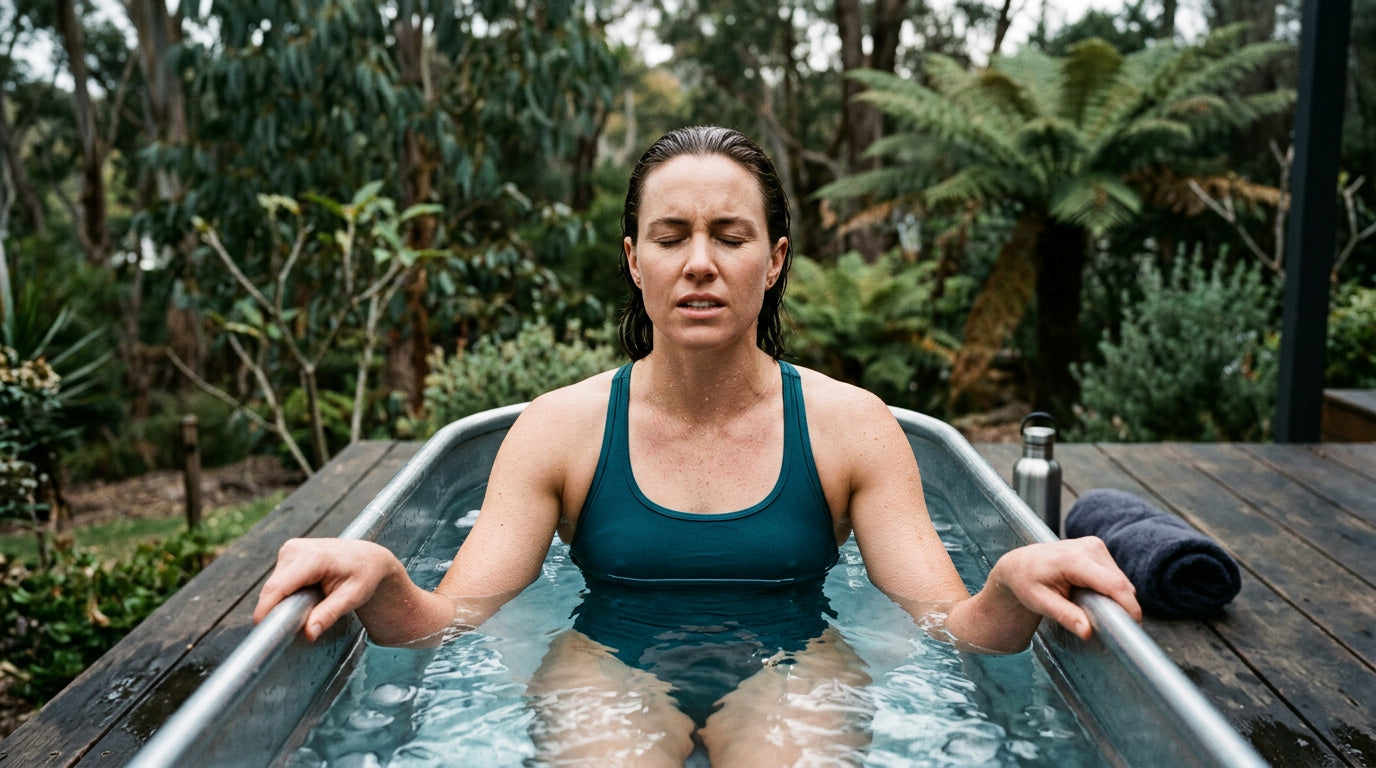
When you exit a 90°C sauna and enter cold water at 10–15°C, norepinephrine levels spike by 200–300% according to research by Rymaszewska et al. (2008) in Psychiatria Polska. Norepinephrine activates beta-adrenergic receptors on fat cells, triggering lipolysis — the breakdown of stored fat into free fatty acids for use as fuel. Heat primes the system. Cold pulls the trigger.
The sauna-to-cold-plunge sequence also drives a sharper post-session metabolic elevation than heat alone. The body works harder to restore thermal homeostasis after a contrast protocol than after a single-stimulus heat session — and that work costs calories.
If you are already running a sauna protocol and want to understand how to structure the contrast sequence for maximum metabolic effect, our complete guide to contrast therapy in Australia covers the full protocol, timing, and temperature targets. For specifics on cold exposure alone, our science guide to cold plunge recovery in Australia details the mechanisms in full.
The Sauna That Does Not Compromise
Active mechanical ventilation. Blue-light-free amber lighting. IP67 rated. HUUM Drop 9kW heater with 60kg Olivine diabase stone. Every detail engineered for serious use.
EXPLORE THE GENESIS →What Type of Sauna Is Best for Weight Loss in Australia?
Traditional Finnish sauna at 80–100°C is the evidence-backed standard. The research on growth hormone, heat shock proteins, cardiovascular load, and metabolic rate is built on traditional sauna data — not infrared.
Within the traditional sauna category, construction quality determines whether the protocol is safe to run daily. Most home saunas sold in Australia are built with glued MDF, synthetic panels, and adhesive-bonded joints. Heat those to 90°C and you are running your recovery protocol inside a chamber that is actively off-gassing formaldehyde. That is not a minor concern. It is the opposite of what you are trying to achieve.
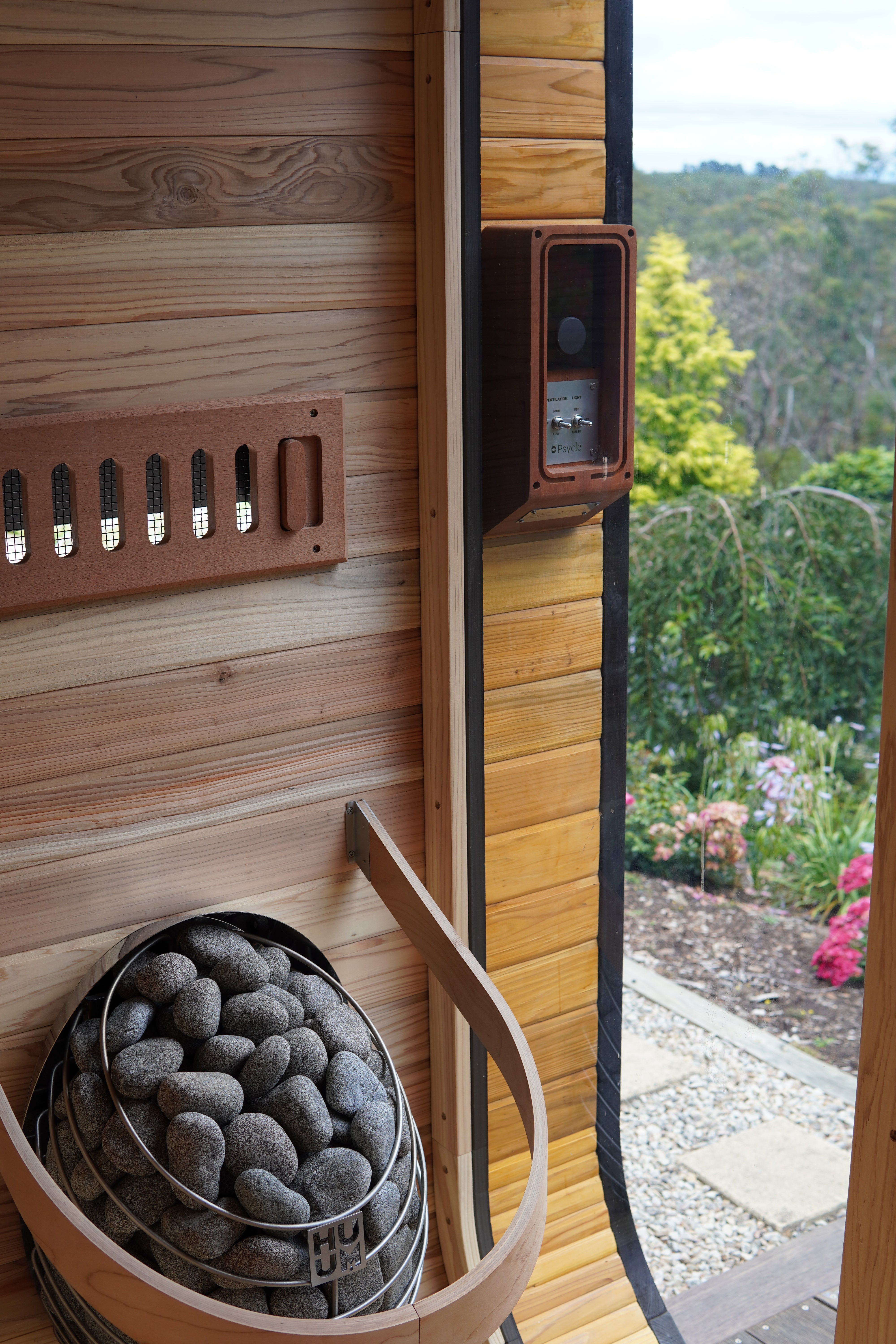
The Genesis is built to a different standard. 38mm Japanese Cedar walls. Zero-glue mechanical construction throughout. Non-VOC oil finish. HUUM Drop 9kW heater with 60kg of Olivine diabase stone — stone mass that holds temperature through a full session and through every löyly pour. You are not just buying heat. You are buying the conditions under which the research was conducted.
If you are comparing options before making a decision, our complete buyer's guide to the best home saunas in Australia covers what separates genuine Finnish-standard builds from the flat-pack alternatives at the same price point.
Does Sauna for Weight Loss Work for Women Differently Than Men?
The core physiological mechanisms — core temperature elevation, HSP activation, cardiovascular load, GH response — operate the same way regardless of sex. The research base, including Leppäluoto et al. (1986) and the Kuopio cohort studies, included both male and female subjects, and the findings held across both groups.
There are two nuances worth noting for women specifically. First, hormonal fluctuations across the menstrual cycle influence baseline heat tolerance and cardiovascular response — some women find heat sessions more comfortable in the follicular phase (days 1–14) than the luteal phase when core temperature is already slightly elevated. Second, pregnancy is a contraindication for high-heat sauna use. For the full evidence-based guidance on sauna use during pregnancy, see our guide to sauna and pregnancy in Australia.
Outside of those two considerations, the protocol is the same. Temperature, duration, frequency, cold pairing. The biology does not differentiate.
Sauna Before or After Workout for Weight Loss?
Both have merit. The optimal timing depends on your training goal for that session.
Post-workout sauna is the more commonly studied protocol and the recommendation for most people. Training depletes glycogen, elevates cortisol, and creates muscular micro-damage. A post-workout sauna session accelerates the repair cycle through increased GH release, improved peripheral blood flow, and HSP-mediated muscle protection. The caloric cost of the combined training and sauna session is also additive — you are extending the metabolic elevation period beyond the workout window.
Pre-workout sauna can be used as a primer for athletes seeking elevated core temperature and increased blood flow before training. The risk is dehydration — entering a training session already thermally stressed and slightly hypohydrated reduces performance and increases injury risk. If you use a pre-workout sauna, keep it to one round of 10–15 minutes at lower intensity, hydrate aggressively between the sauna and training, and do not attempt this in the Australian summer without acclimatisation.
For a detailed breakdown of the evidence on post-training sauna timing and duration, read our guide to sauna after workout for recovery.
How Often Should You Sauna for Weight Loss?
Three sessions per week is the minimum threshold for compound metabolic adaptation. Four to seven sessions per week is the range associated with the strongest outcomes in the Laukkanen cohort data.
For most Australians integrating sauna into a performance lifestyle, the realistic target is 4–5 sessions per week — enough to build consistent adaptation without overriding recovery capacity. The protocol should feel like training, not punishment. For guidance on structuring frequency by experience level and recovery capacity, our complete frequency guide covers the optimal sauna schedule in detail.
If you are fasting — intermittent or extended — there are specific considerations around timing and hydration that affect both the efficacy and safety of the protocol. Our guide to sauna while fasting covers the interaction between caloric restriction and heat therapy in full.
The Genesis: Engineered for This Protocol
If you are running a serious body composition protocol, the infrastructure matters. A 90°C session in a zero-toxin sauna is not the same session as 90°C in a cabinet built from glued particleboard. The air is different. The stone mass is different. The longevity is different.
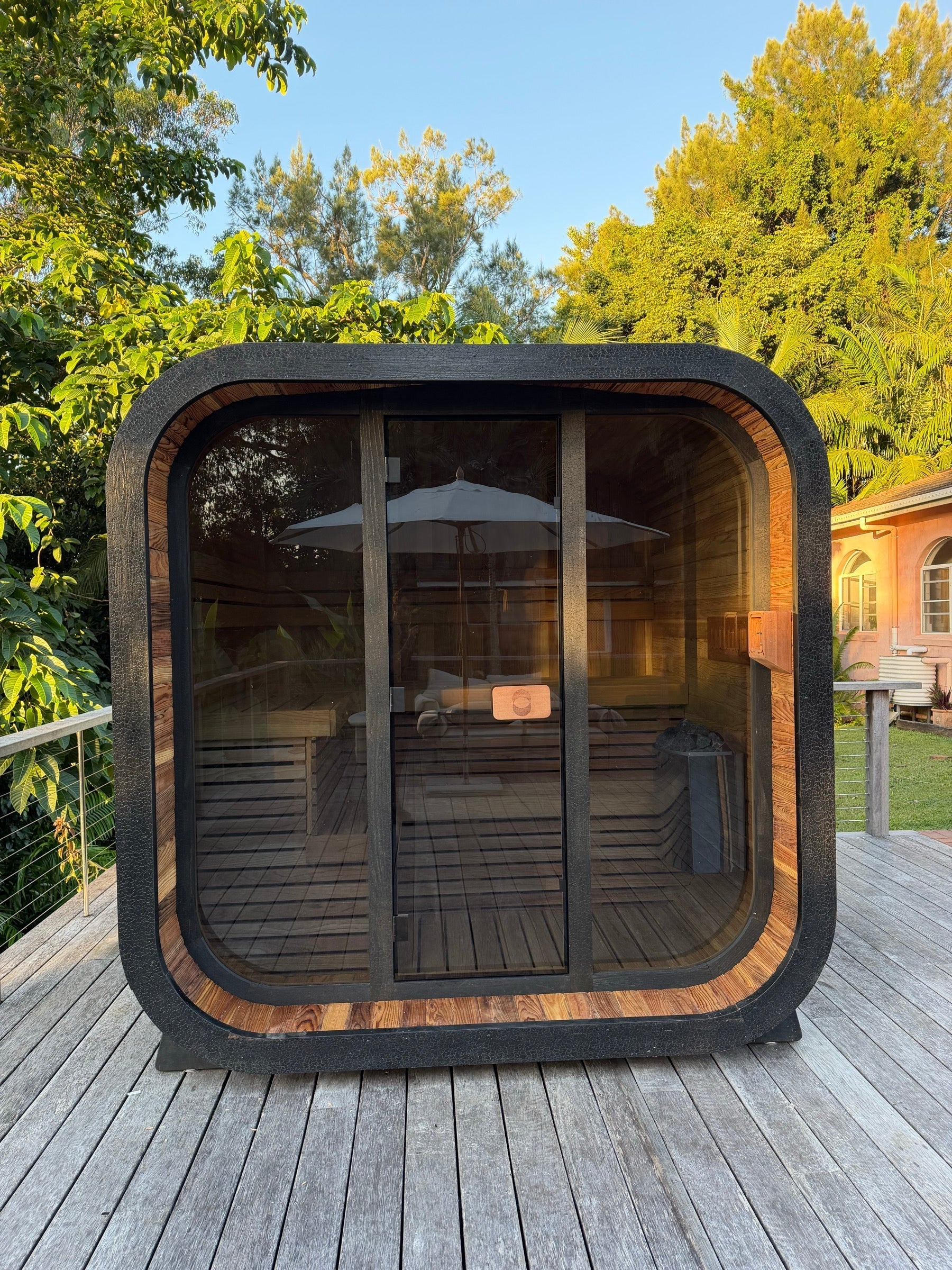
The Genesis is a 3–5 person traditional Finnish sauna built from 38mm Japanese Cedar with zero-glue mechanical joints throughout and a non-VOC oil finish on every surface. The HUUM Drop 9kW heater carries 60kg of Olivine diabase stone — enough mass to hold temperature through consecutive rounds and through heavy löyly use without the temperature dropping mid-session.
Active mechanical ventilation runs at 88–120 m³/hr, cycling fresh air through the cabin so the heat stays clean, not stale. Blue-light-free amber lighting at 585–590nm means your circadian rhythm is not disrupted by an evening session — which matters when sleep quality is a variable in your recovery and body composition outcomes.
The Genesis Mini carries the same zero-toxin specification in a more compact footprint — 38mm Japanese Cedar, zero-glue construction, non-VOC finish, 8mm safety laminated glass — with a HUUM Drop 6kW heater and 60kg stone volume. For apartments, courtyards, or households of 1–3 people, it delivers the identical protocol in a smaller envelope.
Both products ship Australia-wide. Build lead time is 120 days from deposit. The $1,000 deposit is fully refundable — because we would rather you take the time to decide correctly than rush a decision on infrastructure you will use daily for the next decade.
Social Proof: How Australians Are Running This Protocol
"I've run the contrast protocol — 2 × 20 in the Genesis, straight into the Origin — four times a week for the past 12 weeks. My body composition has shifted visibly. My recovery markers are better than they were in my mid-twenties. I've stopped paying for sports massage. The sauna does the work."
"I wanted something that actually gets hot and holds it. The HUUM Drop heater reaches operating temperature in under 40 minutes and the stone mass means the temperature does not drop when I pour. That is what I paid for."
The people who invest in a Genesis have already decided they are done settling for the flat-pack alternative. They treat recovery as training. The sauna is not a luxury — it is infrastructure.
Frequently Asked Questions: Sauna for Weight Loss Australia
Does sauna actually burn fat or just water weight?
Both — but on different timescales. A single session produces primarily water weight loss through sweat, which is rapidly restored with rehydration. The fat loss mechanism operates over weeks and months through elevated growth hormone, increased resting metabolic rate, heat shock protein activation, and — when paired with cold exposure — norepinephrine-driven lipolysis. Individual sessions do not melt fat. A sustained protocol creates the conditions in which fat mobilisation accelerates.
How many calories does a sauna burn in Australia?
A 75kg person in a traditional sauna at 90°C for 20 minutes burns approximately 150–200 calories. A 90kg person burns closer to 200–300 calories over the same session. A 30-minute session with löyly at the upper end of the temperature range can push beyond 300 calories for larger individuals. These figures are estimates derived from cardiovascular load data — the actual number varies with individual metabolic rate, fitness level, and hydration status.
Is infrared sauna or traditional sauna better for weight loss?
Traditional sauna at 80–100°C is significantly more effective for weight loss outcomes than infrared at 50–60°C. The research base on growth hormone response, heat shock protein activation, and cardiovascular load is built on traditional sauna data. Infrared produces lower core temperature elevation, a weaker GH response, and less metabolic stress. It is also more likely to involve construction materials — MDF, adhesives — that off-gas at operating temperatures, creating an additional health concern.
How long does it take to see weight loss results from sauna use?
Meaningful body composition changes require a minimum of 90 days at 3–4 sessions per week. Early adaptations — improved sleep quality, reduced water retention, faster muscle recovery — are typically noticeable within 2–3 weeks. Visible body composition change, when sauna is paired with appropriate nutrition and training, generally appears in the 6–12 week window. The compounding metabolic adaptations — elevated resting metabolic rate, improved insulin sensitivity, preserved lean mass — build progressively over months, not days.
Should I use sauna before or after a workout for fat loss?
Post-workout is the recommended protocol for most people. Training followed by a sauna session creates an additive metabolic stimulus — the workout depletes glycogen and elevates cortisol, and the sauna then drives GH release, accelerates muscular repair, and extends the metabolic elevation window. Pre-workout sauna is viable as a primer but carries a dehydration risk that can impair training performance if not carefully managed.
Is a home sauna worth it for weight loss in Australia?
Yes — if you are running the protocol at the required frequency. A commercial sauna session in Australia costs $30–$60 per visit. At 4 sessions per week over 12 months, that is $6,240–$12,480 per year for access you do not control. A Genesis delivers the protocol on your schedule, at the right temperature, in a zero-toxin environment, with a 3-year cabin warranty. The economics become clear quickly. The non-financial variable — daily accessibility — is what makes the difference between a protocol you run and one you abandon.
Ready to Build This Into Your Routine?
Free Australia-wide delivery. 3-year cabin warranty. $1,000 refundable deposit. 120-day build — order now for delivery this season.
SHOP THE GENESIS →